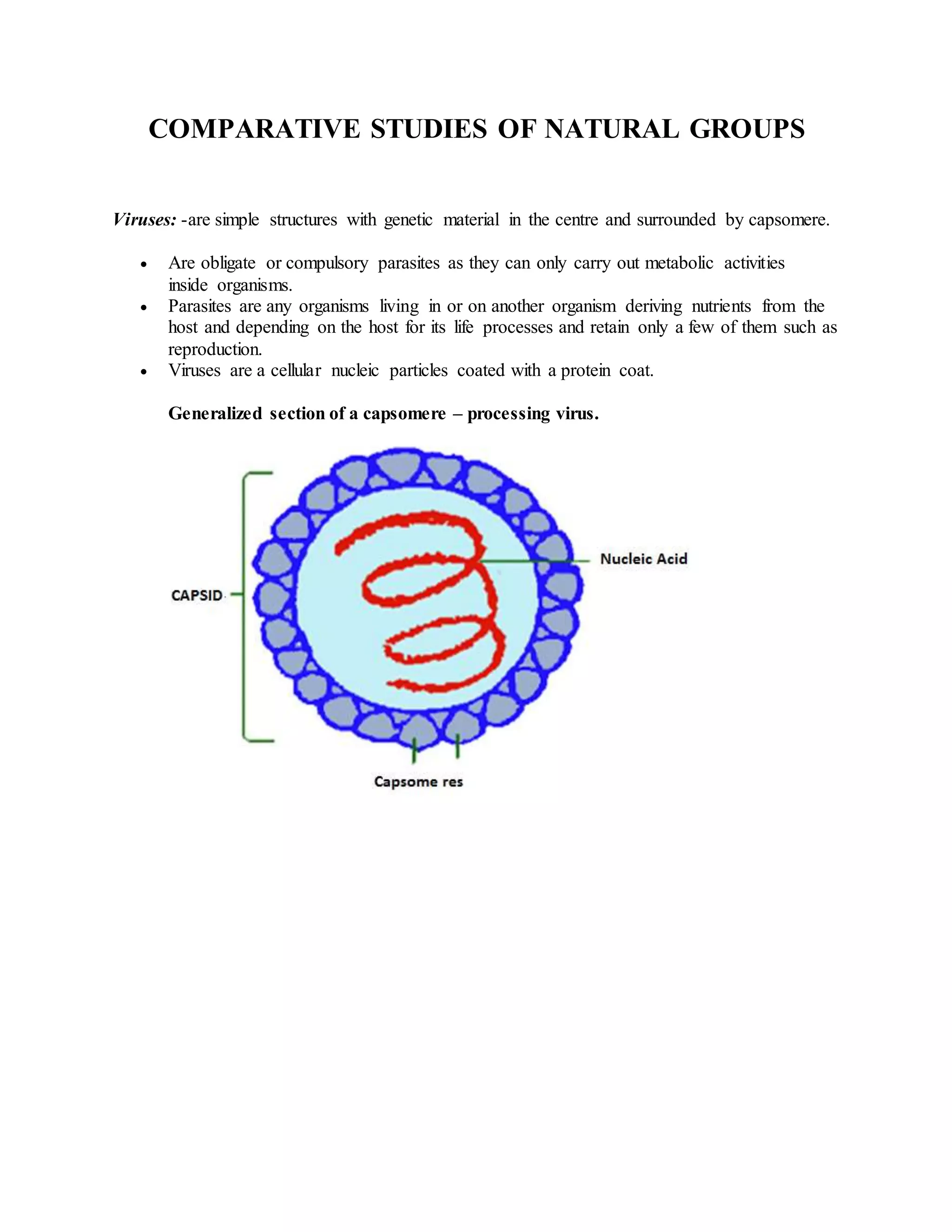
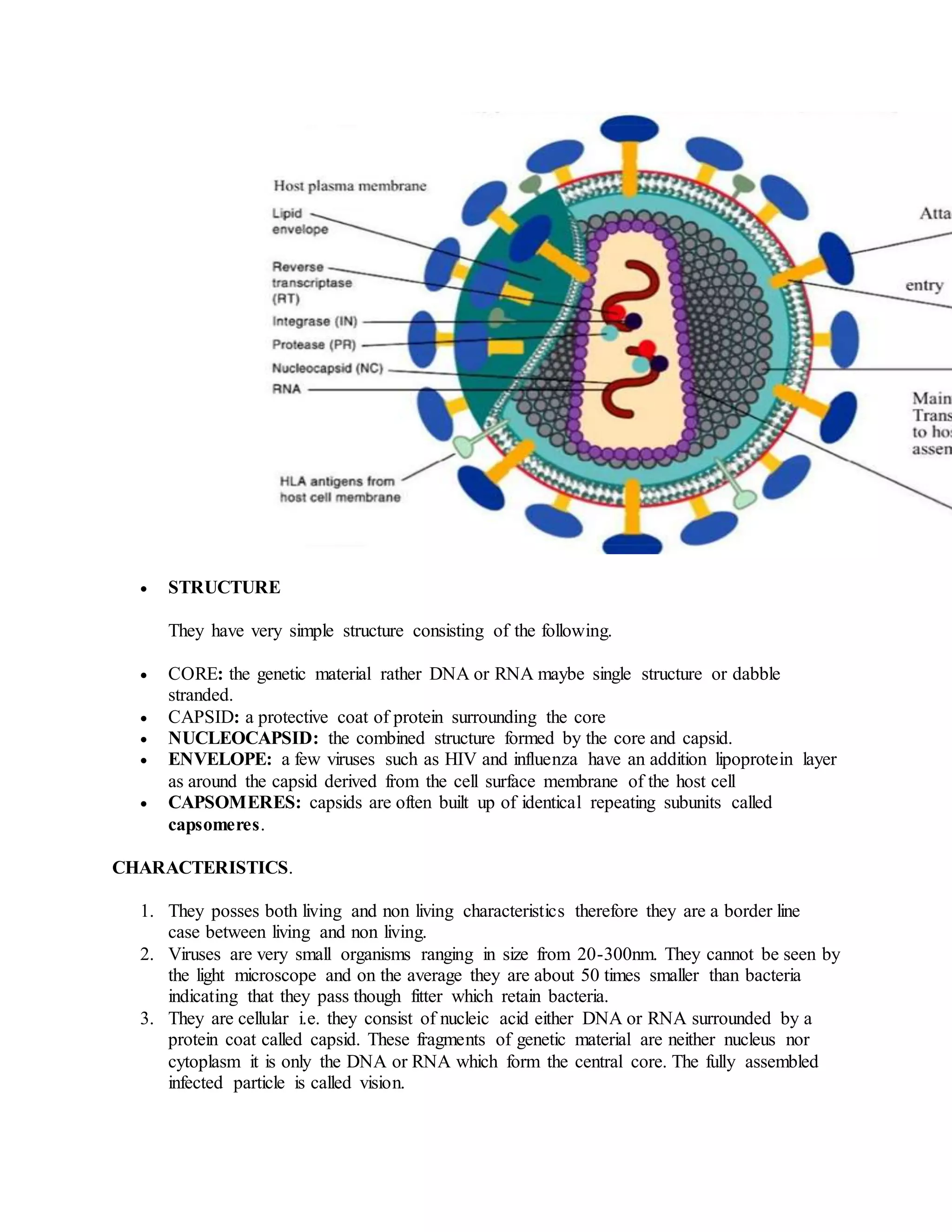
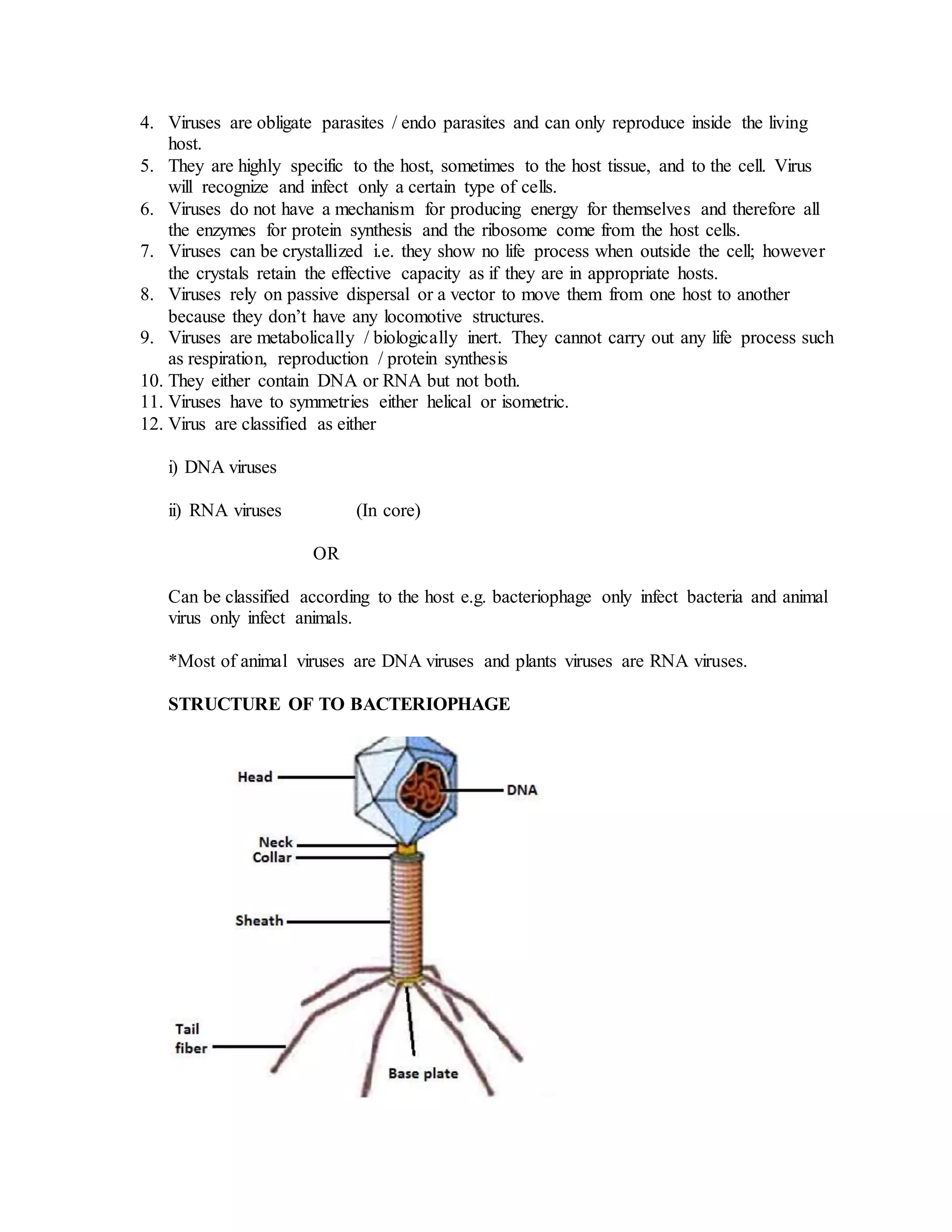
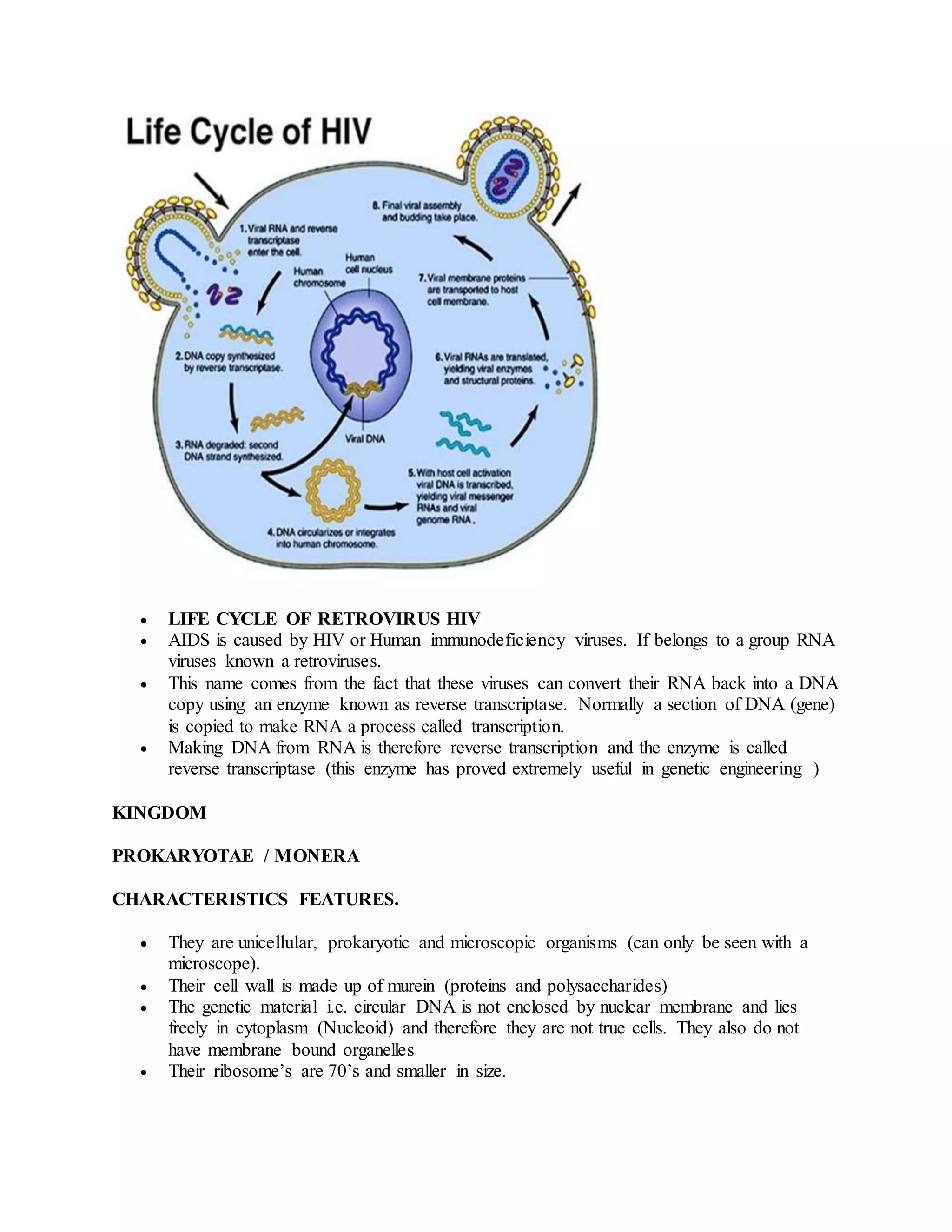
Viruses are simple structures composed of genetic material surrounded by a protein coat. They can only reproduce inside living host cells and rely on them for metabolic functions. Viruses come in many forms but generally have DNA or RNA at their core, surrounded by a protective protein capsid. They range greatly in size and infect a wide variety of organisms through passive dispersal. Viruses exhibit both living and non-living properties and are difficult to classify as they are minimal self-replicating particles that rely entirely on host cells. They can cause significant economic losses by spreading diseases in animals, plants, and humans.











![RHIZOPUS STOLONIFER
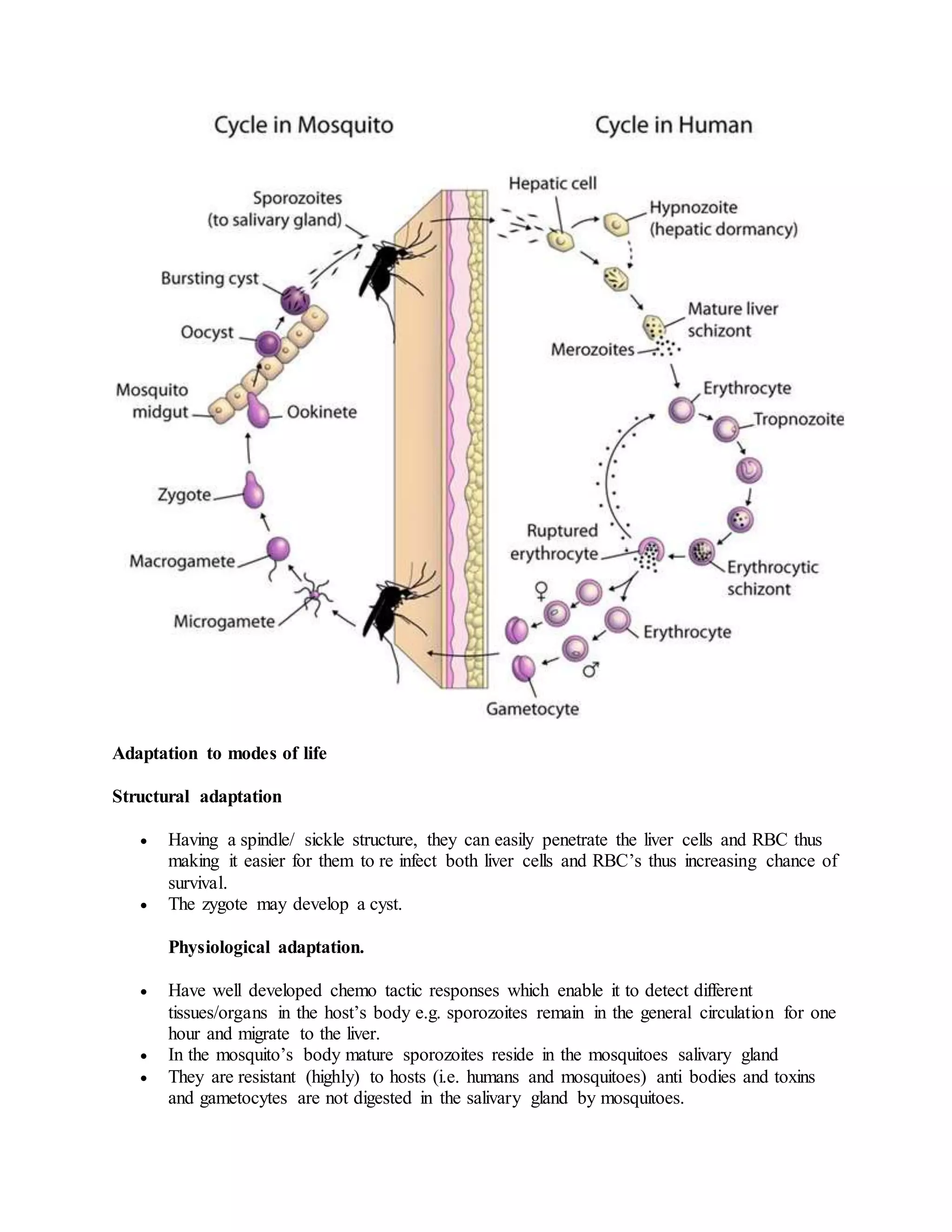
Adaptations to its mode of life.
Have branched rhizoids/ hyphae which secrets enzymes for extra-cellular digestion.
The walls of the rhizoids are permeable thus are used for absorption of the digested food
and they are also for attachment.
The hyphae are aseptate for easy passage of the absorbed food.
They have a high reproductive rate i.e. they produce large number of spores both sexually
and asexually thus increases chances of survival.
The sporangium are highly raised by the sporangiophore so that the spores can be easily
be blown by the air current when the sporangium ruptures.
The sporangium has collumela which changes its shape from Spherical to platform like
when sporangium ruptures for easy dispersion of spores.
The spores are light enough to be blown by wind and can remain dormant for a long
period and are yet viable.
PHYLUM BASIDIOMYCOTA
E.g. Agaricus campestris [mushroom]
Characteristics
The hyphae are septate and compacted /fused .This makes the basidiomycota to be more
advanced compared to other phylum
They reproduce sexually by basidiospores and asexual reproduction is not common.
They live on dead decaying organic matter /damp soils rich in organic matter
They are saprophytes i.e. digestion is extra cellular.](https://image.slidesharecdn.com/comparativestudiesofnaturalgroups-190508070159/75/Comparative-studies-of-natural-groups-32-2048.jpg)














![viii)They possess separate sexes female larges than male – no asexual reproduction.
HABITAT
-Free living in soil or water or parasite of man, demostic animals and plants.]Example of
parasitic
a)Ascaris lumbricoides –Intestinal roundworm in man.
b)Aricylostoma duodenale –Hookworm in mam intestine .
c)Wchereria bancrotti – cause elephantiasis
- live in blood a hymph.
d)Melodogyne –cause galls on the roots of tomato plants leading to wilting a poor growth.
Fig: Ascaris Lumbricoides.
They are white or yellow to pinking ,cylindrical worms, non segmented ,tepering at both ends.
At the anterior end there is a muscular sectorial pharynx which leads to a straight alimentary
canal .
There is a false body cavity (pseudocoeom) and a brain but no circulatory system and no definite
nerve cord.](https://image.slidesharecdn.com/comparativestudiesofnaturalgroups-190508070159/75/Comparative-studies-of-natural-groups-67-2048.jpg)














![1. introduction to_virology[1]](https://cdn.slidesharecdn.com/ss_thumbnails/1-210814125616-thumbnail.jpg?width=640&height=640&fit=bounds)


