FUNGI
By Mr. Vincent Ejakait
Content
 Definition
 Characteristics
 Structure
 Classification
 Pathogenesis
Mr. Ejakait
2
Definitions
Mr. Ejakait
3
Definitions
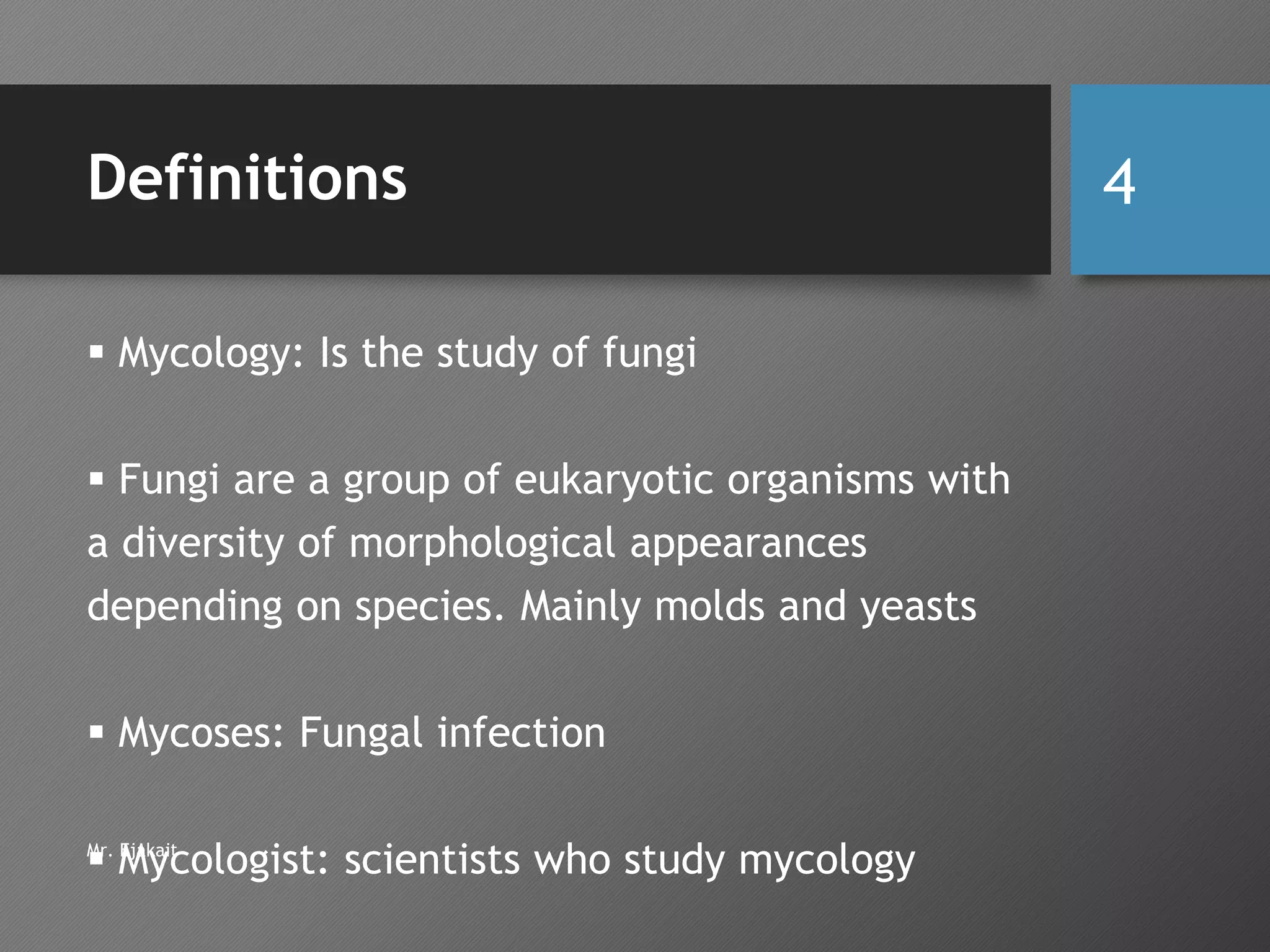
 Mycology: Is the study of fungi
 Fungi are a group of eukaryotic organisms with
a diversity of morphological appearances
depending on species. Mainly molds and yeasts
 Mycoses: Fungal infection
 Mycologist: scientists who study mycologyMr. Ejakait
4
Importance
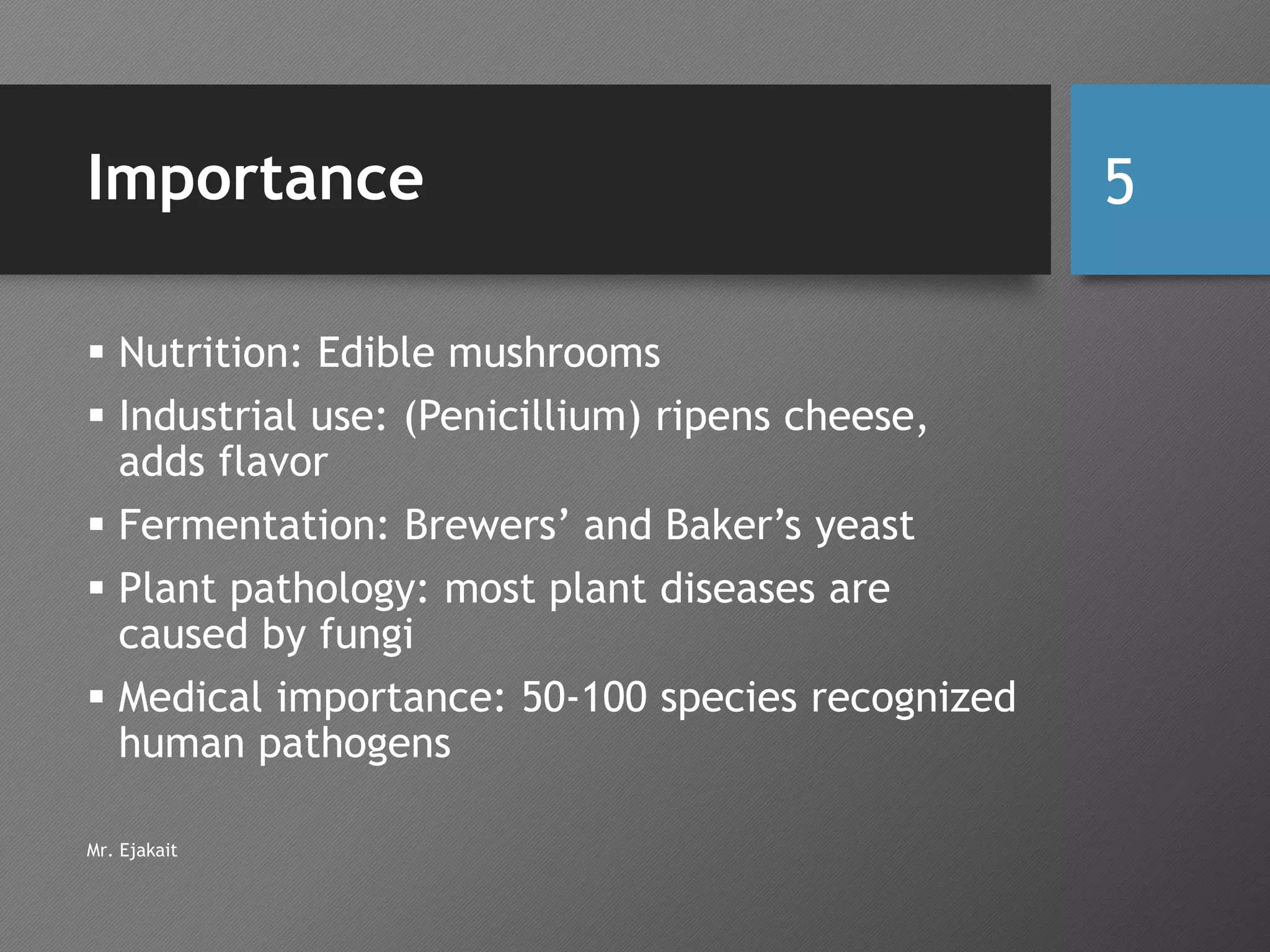
 Nutrition: Edible mushrooms
 Industrial use: (Penicillium) ripens cheese,
adds flavor
 Fermentation: Brewers’ and Baker’s yeast
 Plant pathology: most plant diseases are
caused by fungi
 Medical importance: 50-100 species recognized
human pathogens
Mr. Ejakait
5
Characteristics
Mr. Ejakait
6
General characteristics
 Eukaryotic in nature.
 Unicellular/Multicellular
 Mostly soil saprophytes
 Don’t possess chlorophyll
 Fungi are able to withstand certain extreme
environmental conditions better than most
other microorganisms.
 Fungi are heterotrophic, using a wide variety
of materials for nutrition.
Mr. Ejakait
7
Structure (Morphology)
Mr. Ejakait
8
Morphology
• Eukaryotic in nature: have a nucleus enclosed
within membranes
Mr. Ejakait
9
Morphology cont..
 Cell wall: made up of chitin, glucans, mannans
and complex polysaccharides.
 Cell wall consists of chitin not peptidoglycan like
bacteria. Thus fungi are insensitive to antibiotics
such as penicillins.
Mr. Ejakait
10
Fungal cell wall
Mr. Ejakait
11
Morphology cont..
 Consist of ergosterol rather
than cholesterol like
bacterial cell membrane.
 Ergosterol is the site of
action of antifungal drugs
e.g. amphotericin B & azole
group
Mr. Ejakait
12
Morphology cont..
 Cell division (reproduction) is:
 Sexual
 Asexual Sexual Asexual
Mr. Ejakait
13
Morphology cont..
 May be unicellular like Yeast or
 May be multicellular like Mould
Unicellular fungi Multicellular fungi
Mr. Ejakait
14
Morphology cont..
 Elongation of cell produces a tubular thread
like structure called hypha
 Tangled mass of hypha is called mycelium
 Fungi which forms mycelium is called moulds
or filamentous fungi
 Hypha may be septate or non-septateMr. Ejakait
15
Hypha
Mr. Ejakait
16
Septate vs Non-septate hypha
Mr. Ejakait
17
Classification
Mr. Ejakait
18
Classification of fungi
Morphological classification
Fungi are grouped into 4 morphologic classes:
1. Moulds
2. Yeasts
3. Dimorphic fungi
4. Yeast-like fungi
Mr. Ejakait
19
1. Moulds
 Also called filamentous fungi
 They are Multicellular
 Composed of branching filaments (hyphae)
 Has spores which are resistant resting or
dormant cells.
 Reproduction can be sexual or asexual
Mr. Ejakait
20
Moulds
Mr. Ejakait
21
2. Yeasts
 Predominate unicellular
 They are commonly oval, but some are elongated
and some spherical.
 Yeasts have no flagella or other locomotory
organelles seen in bacteria.
 Reproduce by budding.
 The only pathogenic yeast is Cryptocoocus
neoformans
Mr. Ejakait
22
Mr. Ejakait
23
3. Yeast – like fungus
 Grows partly as yeasts and
partly as elongated cells
resembling hyphae
 Such hyphae form
psuedomycelium
 Example include Candida
albicans
Mr. Ejakait
24
4. Dimorphic
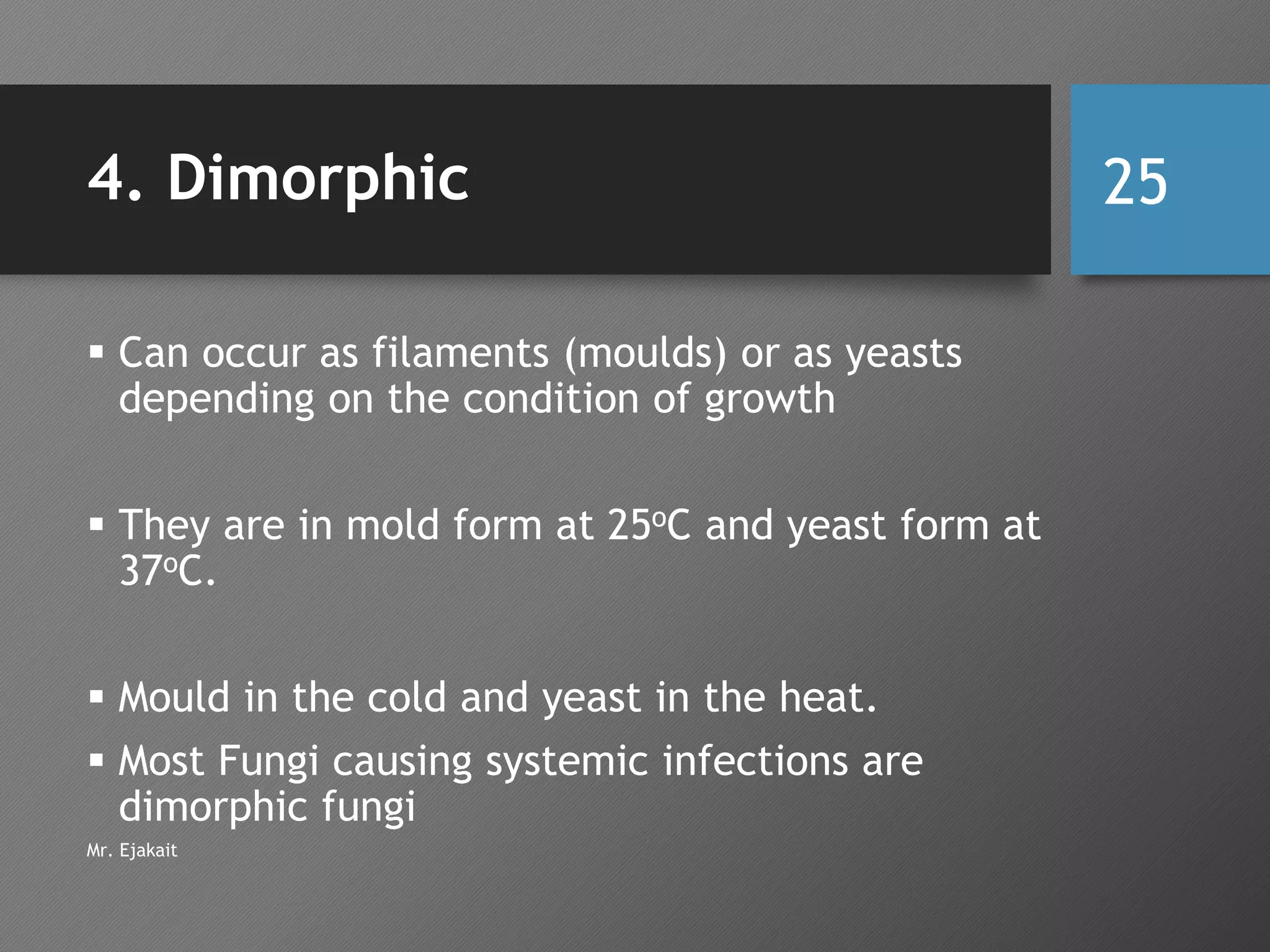
 Can occur as filaments (moulds) or as yeasts
depending on the condition of growth
 They are in mold form at 25oC and yeast form at
37oC.
 Mould in the cold and yeast in the heat.
 Most Fungi causing systemic infections are
dimorphic fungi
Mr. Ejakait
25
Mr. Ejakait
26
Pathogenesis
Mr. Ejakait
27
Mycoses
 Mycoses refers to the fungal infection.
 It can be divided into 4 broad categories:
1. Superficial mycoses
2. Cutaneous mycoses
3. Subcutaneous mycoses
4. Systemic mycoses
 Opportunistic mycosesMr. Ejakait
28
a. Superficial mycoses
 Surface infections limited to outermost layers
of skin and hair.
 Only in the dead layers of skin
 No inflammatory response
 Only cosmetic problems
 Examples: Pityriasis Versicolor, Tinea nigra,
Piedra
Mr. Ejakait
29
Pityriasis versicolor
Mr. Ejakait
30
Tinea nigra
Mr. Ejakait
31
Piedra
Mr. Ejakait
32
b. Cutaneous mycoses
 Fungal infections extending
deeper into the epidermis
and its integuments.
 Also called Dermatophytosis
Mr. Ejakait
33
Cutaneous mycoses cont..
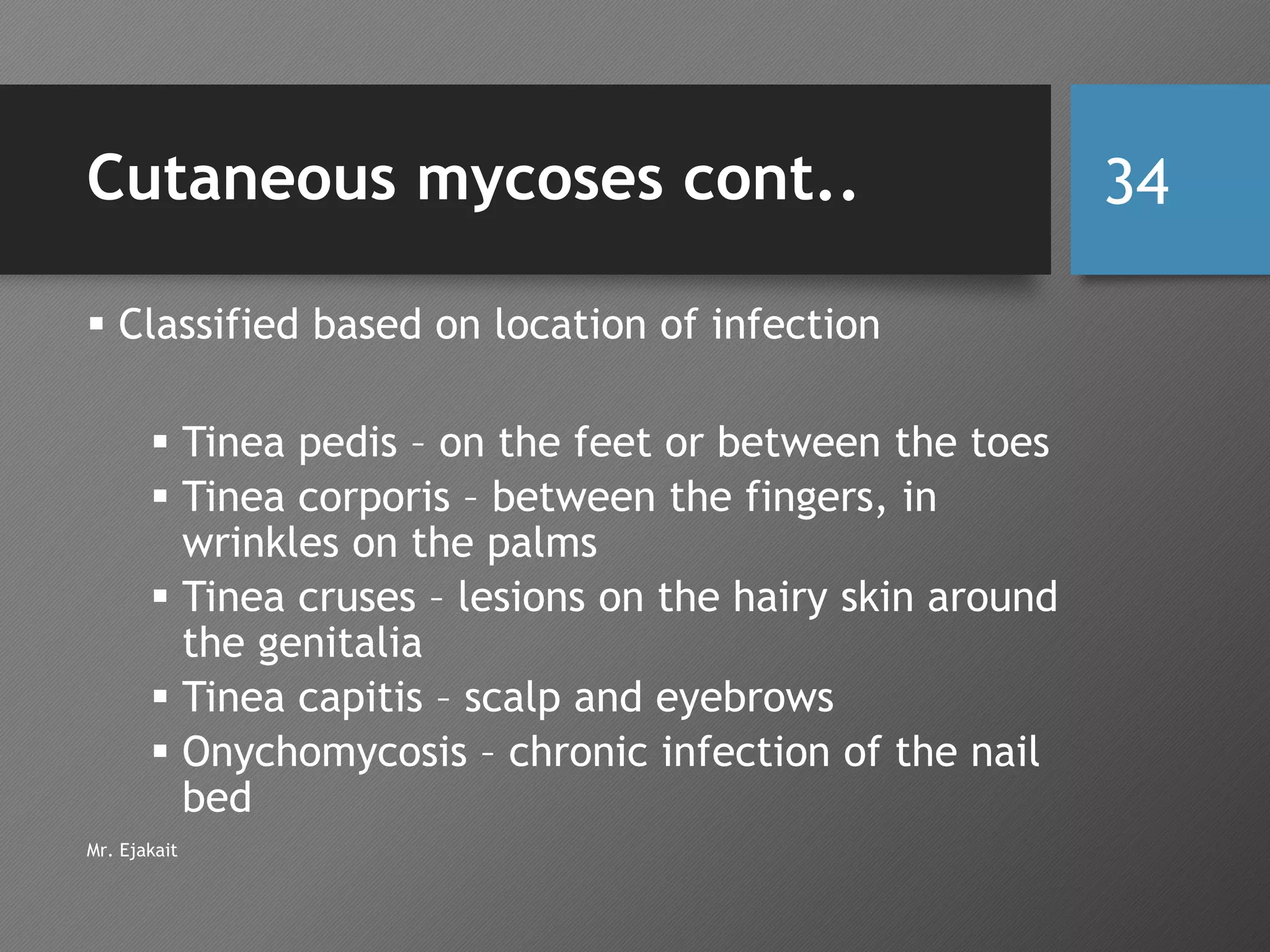
 Classified based on location of infection
 Tinea pedis – on the feet or between the toes
 Tinea corporis – between the fingers, in
wrinkles on the palms
 Tinea cruses – lesions on the hairy skin around
the genitalia
 Tinea capitis – scalp and eyebrows
 Onychomycosis – chronic infection of the nail
bed
Mr. Ejakait
34
Tenia
Mr. Ejakait
35
c. Subcutaneous mycoses
 Infections involving
dermis, subcutaneous
tissue, muscles and
fascia.
Mr. Ejakait
36
d. Systemic mycoses
 Infections originating primarily in the lungs
(acquired by inhalation) and spreading to
other organs.
Mr. Ejakait
37
Opportunistic mycoses
Besides the above four mentioned types, this
category includes infections in which fungi of no
significance or low virulence infect humans with
compromised immune system.
Mr. Ejakait
38

4. Fungi lecture

  • 1.
  • 2.
    Content  Definition  Characteristics Structure  Classification  Pathogenesis Mr. Ejakait 2
  • 3.
  • 4.
    Definitions  Mycology: Isthe study of fungi  Fungi are a group of eukaryotic organisms with a diversity of morphological appearances depending on species. Mainly molds and yeasts  Mycoses: Fungal infection  Mycologist: scientists who study mycologyMr. Ejakait 4
  • 5.
    Importance  Nutrition: Ediblemushrooms  Industrial use: (Penicillium) ripens cheese, adds flavor  Fermentation: Brewers’ and Baker’s yeast  Plant pathology: most plant diseases are caused by fungi  Medical importance: 50-100 species recognized human pathogens Mr. Ejakait 5
  • 6.
  • 7.
    General characteristics  Eukaryoticin nature.  Unicellular/Multicellular  Mostly soil saprophytes  Don’t possess chlorophyll  Fungi are able to withstand certain extreme environmental conditions better than most other microorganisms.  Fungi are heterotrophic, using a wide variety of materials for nutrition. Mr. Ejakait 7
  • 8.
  • 9.
    Morphology • Eukaryotic innature: have a nucleus enclosed within membranes Mr. Ejakait 9
  • 10.
    Morphology cont..  Cellwall: made up of chitin, glucans, mannans and complex polysaccharides.  Cell wall consists of chitin not peptidoglycan like bacteria. Thus fungi are insensitive to antibiotics such as penicillins. Mr. Ejakait 10
  • 11.
  • 12.
    Morphology cont..  Consistof ergosterol rather than cholesterol like bacterial cell membrane.  Ergosterol is the site of action of antifungal drugs e.g. amphotericin B & azole group Mr. Ejakait 12
  • 13.
    Morphology cont..  Celldivision (reproduction) is:  Sexual  Asexual Sexual Asexual Mr. Ejakait 13
  • 14.
    Morphology cont..  Maybe unicellular like Yeast or  May be multicellular like Mould Unicellular fungi Multicellular fungi Mr. Ejakait 14
  • 15.
    Morphology cont..  Elongationof cell produces a tubular thread like structure called hypha  Tangled mass of hypha is called mycelium  Fungi which forms mycelium is called moulds or filamentous fungi  Hypha may be septate or non-septateMr. Ejakait 15
  • 16.
  • 17.
    Septate vs Non-septatehypha Mr. Ejakait 17
  • 18.
  • 19.
    Classification of fungi Morphologicalclassification Fungi are grouped into 4 morphologic classes: 1. Moulds 2. Yeasts 3. Dimorphic fungi 4. Yeast-like fungi Mr. Ejakait 19
  • 20.
    1. Moulds  Alsocalled filamentous fungi  They are Multicellular  Composed of branching filaments (hyphae)  Has spores which are resistant resting or dormant cells.  Reproduction can be sexual or asexual Mr. Ejakait 20
  • 21.
  • 22.
    2. Yeasts  Predominateunicellular  They are commonly oval, but some are elongated and some spherical.  Yeasts have no flagella or other locomotory organelles seen in bacteria.  Reproduce by budding.  The only pathogenic yeast is Cryptocoocus neoformans Mr. Ejakait 22
  • 23.
  • 24.
    3. Yeast –like fungus  Grows partly as yeasts and partly as elongated cells resembling hyphae  Such hyphae form psuedomycelium  Example include Candida albicans Mr. Ejakait 24
  • 25.
    4. Dimorphic  Canoccur as filaments (moulds) or as yeasts depending on the condition of growth  They are in mold form at 25oC and yeast form at 37oC.  Mould in the cold and yeast in the heat.  Most Fungi causing systemic infections are dimorphic fungi Mr. Ejakait 25
  • 26.
  • 27.
  • 28.
    Mycoses  Mycoses refersto the fungal infection.  It can be divided into 4 broad categories: 1. Superficial mycoses 2. Cutaneous mycoses 3. Subcutaneous mycoses 4. Systemic mycoses  Opportunistic mycosesMr. Ejakait 28
  • 29.
    a. Superficial mycoses Surface infections limited to outermost layers of skin and hair.  Only in the dead layers of skin  No inflammatory response  Only cosmetic problems  Examples: Pityriasis Versicolor, Tinea nigra, Piedra Mr. Ejakait 29
  • 30.
  • 31.
  • 32.
  • 33.
    b. Cutaneous mycoses Fungal infections extending deeper into the epidermis and its integuments.  Also called Dermatophytosis Mr. Ejakait 33
  • 34.
    Cutaneous mycoses cont.. Classified based on location of infection  Tinea pedis – on the feet or between the toes  Tinea corporis – between the fingers, in wrinkles on the palms  Tinea cruses – lesions on the hairy skin around the genitalia  Tinea capitis – scalp and eyebrows  Onychomycosis – chronic infection of the nail bed Mr. Ejakait 34
  • 35.
  • 36.
    c. Subcutaneous mycoses Infections involving dermis, subcutaneous tissue, muscles and fascia. Mr. Ejakait 36
  • 37.
    d. Systemic mycoses Infections originating primarily in the lungs (acquired by inhalation) and spreading to other organs. Mr. Ejakait 37
  • 38.
    Opportunistic mycoses Besides theabove four mentioned types, this category includes infections in which fungi of no significance or low virulence infect humans with compromised immune system. Mr. Ejakait 38