Microbiology: the study of microscopic
organisms.
Bacteria: BacteriologyBacteria: Bacteriology
Viruses: Virology
Fungi: Mycology
Protozoa: Protozoology
What is Bacteria?
• Bacteria are unicellular (GK‡Kvlx)
• Prokaryotic (An organism without a nucleus is
called a prokaryote)
• Largest (in size) microorganisms.
Benefits of Bacteria
• Some species of bacteria present in the large intestine manufactures
(Zwi K‡i) vitamin K (an essential blood clotting factor)
• Some species give yogurt its tasty flavor and bread its sour taste.
• Some helps ruminant animals(RveiKvUv cÖvYx) to digest plant
cellulose.
• Some helps plants (soybean, peas, and alfalfa) to convert nitrogen to
a more usable form.
• They help in decaying dead animal and plant.
In the late 1600s,
Antoni van
Leeuwenhoek first
studied bacteria
under the
microscope.
Louis Pasteur Robert Koch
Confirmed
Bacteria as
Pathogens
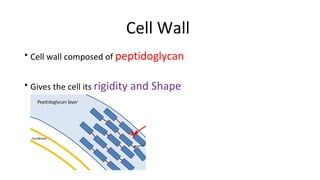
Cell Wall
• Cell wall composed of peptidoglycan
• Gives the cell its rigidity and Shape
Bacteria
• Bacteria are unicellular
• Bacteria have both DNA & RNA
• Ribosomes are present
• Bacterial DNA can copy itself in
order to make new genome
Virus
• Viruses are acellular
• Viruses have either DNA or RNA
• Ribosomes are absent
• Viruses cannot copy their genes
without the help of a host cell’s
nucleic acid.
According to requirement of
Oxygen
Aerobic Bacteria: Need Oxygen to grow
Anaerobic Bacteria: Need not oxygen to
grow
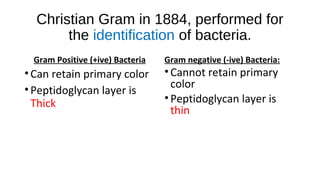
Christian Gram in 1884, performed for
the identification of bacteria.
Gram Positive (+ive) Bacteria
•Can retain primary color
•Peptidoglycan layer is
Thick
Gram negative (-ive) Bacteria:
•Cannot retain primary
color
•Peptidoglycan layer is
thin
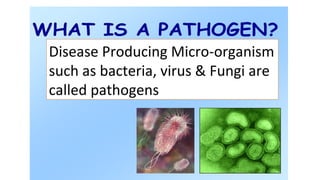
Disease Producing Micro-organism
such as bacteria, virus & Fungi are
called pathogens
Host Cell
A cell that harbors () foreign molecules, viruses, or microorganisms.
For example, a cell being host to a bacteria or virus.
Bacteria may attack any type of cell in the body. Then that cell is
called infected cell.
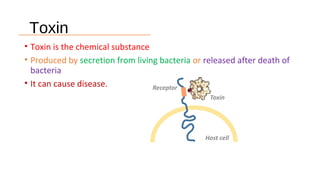
Toxin
• Toxin is the chemical substance
• Produced by secretion from living bacteria or released after death of
bacteria
• It can cause disease.
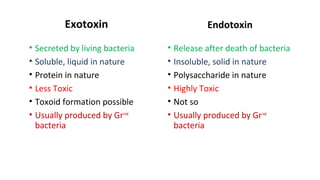
Exotoxin
• Secreted by living bacteria
• Soluble, liquid in nature
• Protein in nature
• Less Toxic
• Toxoid formation possible
• Usually produced by Gr+ive
bacteria
Endotoxin
• Release after death of bacteria
• Insoluble, solid in nature
• Polysaccharide in nature
• Highly Toxic
• Not so
• Usually produced by Gr-ive
bacteria
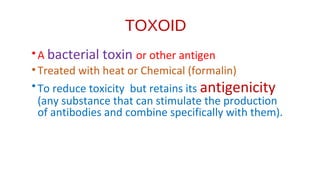
TOXOID
•A bacterial toxin or other antigen
•Treated with heat or Chemical (formalin)
•To reduce toxicity but retains its antigenicity
(any substance that can stimulate the production
of antibodies and combine specifically with them).
Route of Bacterial invasion
Pathogens may enter the body through several routes:
1)Respiratory : Through inhalation
2)Skin : Through cutting skins
3)Blood : Through contaminated needle, blood transfusion
4)Gastrointestinal : Through contaminated food
5)Urinary : Contamination through urethra
Bacterial reproduction
•Reproduce by binary fission
Topoisomerase iv cuts the two
interlinked DNA to separate, so
that they could be segregated
into two new bacterial cell.
DNA Gyrase (Topoisomerase ii)
removes and prevents the positive
super coiling of separated strand
DNA Helicase unwinds (†cuP Ly‡j †djv) and separates the double stranded DNA by breaking
hydrogen bonds (nvB‡Wªv‡Rb eÜb) between base pairs.
Gram positive bacteria Gram negative bacteria
1. Streptococcus pneumoniae ‡÷ªc‡UK°vm
wbD‡gvwb
2. Streptococcus mutans (‡÷ªc‡UK°vm
wgDU¨vbm& (Tooth decay)
3. Streptococcus pyogenes (Rheumatic fever)
4. Staphylococcus aureus (SSSI, boils,
carbuncles, furuncles, pneumonia)
5. Staphylococcus epidermidis (Endocarditis)
6. Mycobacterium tuberculosis (TB)
1. E. coli(gastroenteritis, UTI, and neonatal meningitis)
2. Salmonella typhi (Typhoid)
3. Salmonella paratyphi (Paratyphoid)
4. Shigella dysenteriae (Bacillary dysentery)
5. Proteus vulgaris (UTI and wound infections)
Neisseria gonorrhoeae (Gonorrhea)
6. Helicobacter pylori (Peptic ulcer, Stomach cancer)
Aerobic pathogen =need oxygen to grow
Gram positive bacteria Gram negative bacteria
1. Peptococcus(cystitis, septic arthritis surgical wound
infections)
2. Peptostreptococcus (brain, liver, breast, and lung
abscesses)
3. Clostridium sporogenes (gas gangrene)
4. Clostridium tetani (Tetanus)
5. Clostridium botulinum (Produce neurotoxins
causes muscular paralysis)
1. Bacteroides fragilis
2. Bacteroides pyogenes
3. Bacteroides vulgaris
4. Fusobacterium (meningitis, thrombosis of the
cerebral veins, infection of the urogenital and the GIT)
5. Mycoplasma pneumoniae (facultatively anaerobic
bacteria)
6. Vibrio cholerae (Cholera)
Anaerobic pathogen
Intra-cellular Bacteria Atypical Bacteria
Rickettsiae (typhus, rickettsialpox, Rocky Mountain spotted fever)
Chlamydia (cervicitis, urethritis, PID, epididymitis)
Mycoplasma pneumoniae (Pneumonia)
Legionella (GIT& Nervous system Infection, diarrhea, nausea,
pneumonia)
Mycobacterium leprae (Leprosy)
Brucella (arthritis, spondylitis, anaemia meningitis, optic neuritis and
endocarditis)
Listeria monocytogenes (food poisoning, meningitis and/or
encephalitis)
Rickettsiae (typhus, rickettsialpox, Rocky
Mountain spotted fever)
Chlamydia (cervicitis, urethritis, PID,
epididymitis)
Mycoplasma pneumoniae (Pneumonia)
Legionella (GIT& Nervous system Infection,
diarrhea, nausea, pneumonia)
Intracellular Bacteria: Capable of
growing and reproducing inside the
cells of a host
Atypical Bacteria
•Bacteria that have no structured cell wall
•Composed of cytoplasmic membrane and
peptidoglycan is known as atypical bacteria. Example:
Legionella,
Bacterial Resistance/ Antibiotic
Resistance:
The ability of a bacterial cell to resist the harmful effect
of an antibiotic
Causes:
a. Repeated use: Same class of antibiotic
b. Improper Dosage: 7 days instead of 10 days.
c. Sub dose: 400mg / 200 mg
d. Overuse: Rhinitis , Fever
e. Abuse : Viral Infections
Bacteria & Microbiology

Bacteria & Microbiology

  • 1.
    Microbiology: the studyof microscopic organisms. Bacteria: BacteriologyBacteria: Bacteriology Viruses: Virology Fungi: Mycology Protozoa: Protozoology
  • 2.
    What is Bacteria? •Bacteria are unicellular (GK‡Kvlx) • Prokaryotic (An organism without a nucleus is called a prokaryote) • Largest (in size) microorganisms.
  • 3.
    Benefits of Bacteria •Some species of bacteria present in the large intestine manufactures (Zwi K‡i) vitamin K (an essential blood clotting factor) • Some species give yogurt its tasty flavor and bread its sour taste. • Some helps ruminant animals(RveiKvUv cÖvYx) to digest plant cellulose. • Some helps plants (soybean, peas, and alfalfa) to convert nitrogen to a more usable form. • They help in decaying dead animal and plant.
  • 4.
    In the late1600s, Antoni van Leeuwenhoek first studied bacteria under the microscope.
  • 5.
    Louis Pasteur RobertKoch Confirmed Bacteria as Pathogens
  • 7.
    Cell Wall • Cellwall composed of peptidoglycan • Gives the cell its rigidity and Shape
  • 8.
    Bacteria • Bacteria areunicellular • Bacteria have both DNA & RNA • Ribosomes are present • Bacterial DNA can copy itself in order to make new genome Virus • Viruses are acellular • Viruses have either DNA or RNA • Ribosomes are absent • Viruses cannot copy their genes without the help of a host cell’s nucleic acid.
  • 9.
    According to requirementof Oxygen Aerobic Bacteria: Need Oxygen to grow Anaerobic Bacteria: Need not oxygen to grow
  • 13.
    Christian Gram in1884, performed for the identification of bacteria. Gram Positive (+ive) Bacteria •Can retain primary color •Peptidoglycan layer is Thick Gram negative (-ive) Bacteria: •Cannot retain primary color •Peptidoglycan layer is thin
  • 15.
    Disease Producing Micro-organism suchas bacteria, virus & Fungi are called pathogens
  • 18.
    Host Cell A cellthat harbors () foreign molecules, viruses, or microorganisms. For example, a cell being host to a bacteria or virus. Bacteria may attack any type of cell in the body. Then that cell is called infected cell.
  • 19.
    Toxin • Toxin isthe chemical substance • Produced by secretion from living bacteria or released after death of bacteria • It can cause disease.
  • 20.
    Exotoxin • Secreted byliving bacteria • Soluble, liquid in nature • Protein in nature • Less Toxic • Toxoid formation possible • Usually produced by Gr+ive bacteria Endotoxin • Release after death of bacteria • Insoluble, solid in nature • Polysaccharide in nature • Highly Toxic • Not so • Usually produced by Gr-ive bacteria
  • 22.
    TOXOID •A bacterial toxinor other antigen •Treated with heat or Chemical (formalin) •To reduce toxicity but retains its antigenicity (any substance that can stimulate the production of antibodies and combine specifically with them).
  • 24.
    Route of Bacterialinvasion Pathogens may enter the body through several routes: 1)Respiratory : Through inhalation 2)Skin : Through cutting skins 3)Blood : Through contaminated needle, blood transfusion 4)Gastrointestinal : Through contaminated food 5)Urinary : Contamination through urethra
  • 25.
  • 26.
    Topoisomerase iv cutsthe two interlinked DNA to separate, so that they could be segregated into two new bacterial cell. DNA Gyrase (Topoisomerase ii) removes and prevents the positive super coiling of separated strand DNA Helicase unwinds (†cuP Ly‡j †djv) and separates the double stranded DNA by breaking hydrogen bonds (nvB‡Wªv‡Rb eÜb) between base pairs.
  • 27.
    Gram positive bacteriaGram negative bacteria 1. Streptococcus pneumoniae ‡÷ªc‡UK°vm wbD‡gvwb 2. Streptococcus mutans (‡÷ªc‡UK°vm wgDU¨vbm& (Tooth decay) 3. Streptococcus pyogenes (Rheumatic fever) 4. Staphylococcus aureus (SSSI, boils, carbuncles, furuncles, pneumonia) 5. Staphylococcus epidermidis (Endocarditis) 6. Mycobacterium tuberculosis (TB) 1. E. coli(gastroenteritis, UTI, and neonatal meningitis) 2. Salmonella typhi (Typhoid) 3. Salmonella paratyphi (Paratyphoid) 4. Shigella dysenteriae (Bacillary dysentery) 5. Proteus vulgaris (UTI and wound infections) Neisseria gonorrhoeae (Gonorrhea) 6. Helicobacter pylori (Peptic ulcer, Stomach cancer) Aerobic pathogen =need oxygen to grow
  • 28.
    Gram positive bacteriaGram negative bacteria 1. Peptococcus(cystitis, septic arthritis surgical wound infections) 2. Peptostreptococcus (brain, liver, breast, and lung abscesses) 3. Clostridium sporogenes (gas gangrene) 4. Clostridium tetani (Tetanus) 5. Clostridium botulinum (Produce neurotoxins causes muscular paralysis) 1. Bacteroides fragilis 2. Bacteroides pyogenes 3. Bacteroides vulgaris 4. Fusobacterium (meningitis, thrombosis of the cerebral veins, infection of the urogenital and the GIT) 5. Mycoplasma pneumoniae (facultatively anaerobic bacteria) 6. Vibrio cholerae (Cholera) Anaerobic pathogen
  • 29.
    Intra-cellular Bacteria AtypicalBacteria Rickettsiae (typhus, rickettsialpox, Rocky Mountain spotted fever) Chlamydia (cervicitis, urethritis, PID, epididymitis) Mycoplasma pneumoniae (Pneumonia) Legionella (GIT& Nervous system Infection, diarrhea, nausea, pneumonia) Mycobacterium leprae (Leprosy) Brucella (arthritis, spondylitis, anaemia meningitis, optic neuritis and endocarditis) Listeria monocytogenes (food poisoning, meningitis and/or encephalitis) Rickettsiae (typhus, rickettsialpox, Rocky Mountain spotted fever) Chlamydia (cervicitis, urethritis, PID, epididymitis) Mycoplasma pneumoniae (Pneumonia) Legionella (GIT& Nervous system Infection, diarrhea, nausea, pneumonia)
  • 30.
    Intracellular Bacteria: Capableof growing and reproducing inside the cells of a host Atypical Bacteria •Bacteria that have no structured cell wall •Composed of cytoplasmic membrane and peptidoglycan is known as atypical bacteria. Example: Legionella,
  • 31.
    Bacterial Resistance/ Antibiotic Resistance: Theability of a bacterial cell to resist the harmful effect of an antibiotic Causes: a. Repeated use: Same class of antibiotic b. Improper Dosage: 7 days instead of 10 days. c. Sub dose: 400mg / 200 mg d. Overuse: Rhinitis , Fever e. Abuse : Viral Infections