NATIONAL
STANDARDS FOR
QUALITY ONLINE
  TEACHING
  iNACOL Professional Development

  Standards G & H
      Presented by: Janet Pope
TODAY'S PROFESSIONAL DEVELOPMENT
Objective:
 The learner will be able to
 carry out the mission of
 iNACOL by ensuring that
 all students have access
 to a world-class
 education and quality
 online learning
 opportunities that prepare
 them for a lifetime of
 success.
 (iNACOL, 2011a)
GOAL OF THIS PD---------THIS SESSION IS CONSIDERED TO BE A MAKE-AND-TAKE SESSION.

WHAT IS MAKE N TAKE?-----OPPORTUNITY FOR COLLABORATION WITH OTHER EDUCATORS   FOR
DEVELOPMENT OF LESSONS, UNITS AND MATERIALS FOR ONLINE INSTRUCTION


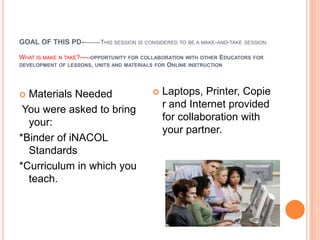
 Materials Needed                            Laptops, Printer, Copie
                                               r and Internet provided
 You were asked to bring
                                               for collaboration with
  your:
                                               your partner.
*Binder of iNACOL
  Standards
*Curriculum in which you
  teach.
STANDARD G (PAGE 11)
The online teacher demonstrates competencies in
creating and implementing assessment in online
learning environments in ways that ensure validity and
reliability of the instruments and procedures.
PRINCIPAL 1: WHAT IS ADEQUATE AND APPROPRIATE ASSESSMENT
INSTRUMENTS THAT CAN MEASURE ONLINE LEARNING THAT REFLECTS
SUFFICIENT CONTENT VALIDITY?


The following youtube video will discuss alternative ways
  you can evaluate the effectiveness of technology
  integration.

http://www.youtube.com/watch?v=x71hjtTgQ0E

Pair-share with someone next to you ways in which you
  have used alternative ways in evaluating the
  effectiveness of technology integration. Surf the Internet
  on ways that you can evaluate the effectiveness of
  technology integration within your own curriculum that
  reflects sufficient content validity. Print any needed
  resources for yourself and others and add to your binder
  for future reference.
PRINCIPLE 2: HOW DO TEACHERS IMPLEMENT ONLINE ASSESSMENT
MEASURES AND MATERIALS IN WAYS THAT ENSURE INSTRUMENT VALIDITY AND
RELIABILITY?

  EAGLE------Example of Online Assessment
   The EAGLE system can be used by teachers and
   students to target strengths and weaknesses relative to
   Louisiana’s Grade-Level Expectations.
https://www.louisianaeagle.org/pma/orca2/diag.htm

Activity:

   Collaborate with your partner on other assessments that
    may be used to ensure validity and reliability within your
    own curriculum. Print and file resources in your binder.
   OR you may design quality assessments using your
    curriculum and the EAGLE system website.
   Evaluate how you would managing the integrity of data
    collected.
PRINCIPAL 3: HOW DO TEACHERS USE MULTIPLE STRATEGIES FOR
ENSURING THE SECURITY OF ONLINE STUDENT
ASSESSMENTS, ACADEMIC INTEGRITY, AND ASSESSMENT DATA.

Encouraging Academic Integrity Online
  What can you do as an instructor to encourage your students to behave with integrity when they are
   engaged in activities and assessments online? The online environment poses special challenges to
   instructional designers and instructors, but some of these challenges can be overcome through
   thoughtful instructional design. The following suggestions are the result of a brainstorming session
   attended by instructional designers and web developers from the Centre for Teaching Excellence and
   Distance and Continuing Education at the University of Waterloo in the fall of 2008.


Activity: Design your own expectations teaching Academic Integrity For Your Own Online Course

   Explain why adhering to the principles of academic integrity are important in your field/discipline.
   Introduce students to (or remind them of) the skills they need to cite appropriately from various sources.
   Make expectations clear to students on all assessments, assignments and projects and provide
    guidelines on how tests should be taken and assignments completed.
   Be explicit where an individual rather than a collaborative approach should be taken to activities.
   Create academic integrity contracts or an honor system.
   Keep the lines of communication open and make it easy for students to approach you if they have
    problems with deadlines rather than resorting to cheating.


http://cte.uwaterloo.ca/teaching_resources/tips/encouraging_academic_inte
   grity_online.html
STANDARD K (PAGE 12)

The online teacher develops and delivers
assessment, projects, and assignments that meet
standards-based learning goals and assesses learning
progress by measuring student achievement of the
learning goals.
PRINCIPAL 1: HOW DO ONLINE TEACHERS IMPLEMENT AUTHENTIC
ASSESSMENTS?


The following youtube video uses 21st Century Skills
  in using authentic assessments. Shows how
  assessments can be used during a project as a way
  to provide a constant loop of feedback to students.

Activity: Collaborate with your partner using the
 laptop provided and design an assessment that will
 provide a constant loop of feedback to students.
 You may use one of the project activities in your
 curriculum.

http://www.youtube.com/watch?v=HiyaQ2WbBVU&fe
  ature=related
PRINCIPAL 2 WHAT ARE SOME OF THE PROCESSES OF CONTINUOUS
EVALUATION OF STUDENTS THAT WOULD REFLECT STUDENT
LEARNING PROGRESS THROUGHOUT THE COURSE?


Activity: By considering the previous YouTube Video
 about assessments that will provide a constant loop
 of feedback to students. Write a plan of how you
 can recreate a constant loop of feedback online
 with your students. Examples may include:

 Rubrics http://www.teach-nology.com/web_tools/rubrics/
 Blogging http://classblogmeister.com/

 Self-evaluations http://www.ndt-ed.org/TeachingResources/ClassroomTips/Self-evaluation.htm

 Student feedback (polls and surveys)
    http://www.surveymonkey.com/
PRINCIPLE 3: HOW DOES AN ONLINE TEACHER UNDERSTAND THE
RELATIONSHIP BETWEEN THE ASSIGNMENTS, ASSESSMENTS, AND
STANDARD-BASED LEARNING GOALS?


Why Backward Design?
   Backward design is a process that focuses on assessment first
    and instructional activities last. It shifts teacher perspectives.
    Traditional curriculum design often begins with really interesting
    books or activities we want to teach or are required to cover. We
    then design a curriculum, often on the go and then decide on
    some type of assessment at the end.
   Backward design forces teachers to look at the big picture with
    the end goals in mind. In backward planning teachers set the
    vision or the essential understanding of their curriculum or unit,
    decide how students will provide evidence of their learning, and
    finally design instructional activities to help kids learn what is
    needed to be successful.
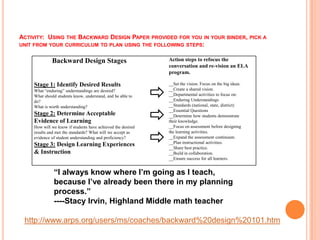
ACTIVITY: USING THE BACKWARD DESIGN PAPER                    PROVIDED FOR YOU IN YOUR BINDER, PICK A
UNIT FROM YOUR CURRICULUM TO PLAN USING THE FOLLOWING STEPS:


             Backward Design Stages                               Action steps to refocus the
                                                                  conversation and re-vision an ELA
                                                                  program.

    Stage 1: Identify Desired Results                             __Set the vision. Focus on the big ideas.
    What “enduring” understandings are desired?
    What should students know, understand, and be able to
    do?
                                                                 __Create a shared vision.
                                                                  __Departmental activities to focus on:
                                                                  __Enduring Understandings
                                                                  __Standards (national, state, district)


                                                             
    What is worth understanding?
                                                                  __Essential Questions
    Stage 2: Determine Acceptable                                 __Determine how students demonstrate
    Evidence of Learning                                          their knowledge.
    How will we know if students have achieved the desired        __Focus on assessment before designing


                                                             
    results and met the standards? What will we accept as         the learning activities.
    evidence of student understanding and proficiency?            __Expand the assessment continuum.
                                                                  __Plan instructional activities.
    Stage 3: Design Learning Experiences                          __Share best practice.
    & Instruction                                                 __Build in collaboration.
                                                                  __Ensure success for all learners.


              “I always know where I’m going as I teach,
              because I’ve already been there in my planning
              process.”
              ----Stacy Irvin, Highland Middle math teacher

 http://www.arps.org/users/ms/coaches/backward%20design%20101.htm
CONGRATULATIONS
You have demonstrated the
knowledge, understanding, and abilities of Standard G
and Standard H. We hope you enjoyed the “Make-N-
Take” method of this online professional development.
References
Backward design 101: Curriculum planning guide. (n.d.). Retrieved June 29,2012 from
   http://www.arps.org/users/ms/coaches/backward design 101.htm
iNACOL. (2011a). National standards for quality online courses. Retrieved June 24, 2012 from
   http://www.inacol.org/research/nationalstandards/iNACOL_CourseStandards_2011.pdf
iNACOL. (2011b). National standards for quality online teaching. Retrieved June 24, 2012 from
    http://www.inacol.org/research/nationalstandards/iNACOL_TeachingStandardsv2.pdf
Landmark's classblogmeister. (2007). Retrieved June 27, 2012 from
    http://classblogmeister.com/
Louisiana Department of Education: EAGLE assessment. (2012). Retrieved June 26, 2012 from
    https://www.louisianaeagle.org/pma/orca2/diag.htm
Survey monkey: Free online software and questionnaire. (1999). Retrieved from
     http://www.surveymonkey
 Technology: Rubric design. (1999). Retrieved June 27, 2012from http://www.teach-
     nology.com/web_tools/rubrics
 University of Warterloo: Teaching academic integrity. (2012). Retrieved June 26, 2012 from
     http://cte.uwaterloo.ca/teaching_resources/tips/encouraging_academic_integrity_online.html
 YouTube. (2011). Retrieved fromhttp://www.youtube.com/watch?v=HiyaQ2WbBVU&feature=related
 YouTube. (2012). Retrieved from http://www.youtube.com/watch?v=x71hjtTgQ0E

National standards for quality online teaching

  • 1.
    NATIONAL STANDARDS FOR QUALITY ONLINE TEACHING iNACOL Professional Development Standards G & H Presented by: Janet Pope
  • 2.
    TODAY'S PROFESSIONAL DEVELOPMENT Objective: The learner will be able to carry out the mission of iNACOL by ensuring that all students have access to a world-class education and quality online learning opportunities that prepare them for a lifetime of success. (iNACOL, 2011a)
  • 3.
    GOAL OF THISPD---------THIS SESSION IS CONSIDERED TO BE A MAKE-AND-TAKE SESSION. WHAT IS MAKE N TAKE?-----OPPORTUNITY FOR COLLABORATION WITH OTHER EDUCATORS FOR DEVELOPMENT OF LESSONS, UNITS AND MATERIALS FOR ONLINE INSTRUCTION  Materials Needed  Laptops, Printer, Copie r and Internet provided You were asked to bring for collaboration with your: your partner. *Binder of iNACOL Standards *Curriculum in which you teach.
  • 4.
    STANDARD G (PAGE11) The online teacher demonstrates competencies in creating and implementing assessment in online learning environments in ways that ensure validity and reliability of the instruments and procedures.
  • 5.
    PRINCIPAL 1: WHATIS ADEQUATE AND APPROPRIATE ASSESSMENT INSTRUMENTS THAT CAN MEASURE ONLINE LEARNING THAT REFLECTS SUFFICIENT CONTENT VALIDITY? The following youtube video will discuss alternative ways you can evaluate the effectiveness of technology integration. http://www.youtube.com/watch?v=x71hjtTgQ0E Pair-share with someone next to you ways in which you have used alternative ways in evaluating the effectiveness of technology integration. Surf the Internet on ways that you can evaluate the effectiveness of technology integration within your own curriculum that reflects sufficient content validity. Print any needed resources for yourself and others and add to your binder for future reference.
  • 6.
    PRINCIPLE 2: HOWDO TEACHERS IMPLEMENT ONLINE ASSESSMENT MEASURES AND MATERIALS IN WAYS THAT ENSURE INSTRUMENT VALIDITY AND RELIABILITY?  EAGLE------Example of Online Assessment The EAGLE system can be used by teachers and students to target strengths and weaknesses relative to Louisiana’s Grade-Level Expectations. https://www.louisianaeagle.org/pma/orca2/diag.htm Activity:  Collaborate with your partner on other assessments that may be used to ensure validity and reliability within your own curriculum. Print and file resources in your binder.  OR you may design quality assessments using your curriculum and the EAGLE system website.  Evaluate how you would managing the integrity of data collected.
  • 7.
    PRINCIPAL 3: HOWDO TEACHERS USE MULTIPLE STRATEGIES FOR ENSURING THE SECURITY OF ONLINE STUDENT ASSESSMENTS, ACADEMIC INTEGRITY, AND ASSESSMENT DATA. Encouraging Academic Integrity Online  What can you do as an instructor to encourage your students to behave with integrity when they are engaged in activities and assessments online? The online environment poses special challenges to instructional designers and instructors, but some of these challenges can be overcome through thoughtful instructional design. The following suggestions are the result of a brainstorming session attended by instructional designers and web developers from the Centre for Teaching Excellence and Distance and Continuing Education at the University of Waterloo in the fall of 2008. Activity: Design your own expectations teaching Academic Integrity For Your Own Online Course  Explain why adhering to the principles of academic integrity are important in your field/discipline.  Introduce students to (or remind them of) the skills they need to cite appropriately from various sources.  Make expectations clear to students on all assessments, assignments and projects and provide guidelines on how tests should be taken and assignments completed.  Be explicit where an individual rather than a collaborative approach should be taken to activities.  Create academic integrity contracts or an honor system.  Keep the lines of communication open and make it easy for students to approach you if they have problems with deadlines rather than resorting to cheating. http://cte.uwaterloo.ca/teaching_resources/tips/encouraging_academic_inte grity_online.html
  • 8.
    STANDARD K (PAGE12) The online teacher develops and delivers assessment, projects, and assignments that meet standards-based learning goals and assesses learning progress by measuring student achievement of the learning goals.
  • 9.
    PRINCIPAL 1: HOWDO ONLINE TEACHERS IMPLEMENT AUTHENTIC ASSESSMENTS? The following youtube video uses 21st Century Skills in using authentic assessments. Shows how assessments can be used during a project as a way to provide a constant loop of feedback to students. Activity: Collaborate with your partner using the laptop provided and design an assessment that will provide a constant loop of feedback to students. You may use one of the project activities in your curriculum. http://www.youtube.com/watch?v=HiyaQ2WbBVU&fe ature=related
  • 10.
    PRINCIPAL 2 WHATARE SOME OF THE PROCESSES OF CONTINUOUS EVALUATION OF STUDENTS THAT WOULD REFLECT STUDENT LEARNING PROGRESS THROUGHOUT THE COURSE? Activity: By considering the previous YouTube Video about assessments that will provide a constant loop of feedback to students. Write a plan of how you can recreate a constant loop of feedback online with your students. Examples may include:  Rubrics http://www.teach-nology.com/web_tools/rubrics/  Blogging http://classblogmeister.com/  Self-evaluations http://www.ndt-ed.org/TeachingResources/ClassroomTips/Self-evaluation.htm  Student feedback (polls and surveys) http://www.surveymonkey.com/
  • 11.
    PRINCIPLE 3: HOWDOES AN ONLINE TEACHER UNDERSTAND THE RELATIONSHIP BETWEEN THE ASSIGNMENTS, ASSESSMENTS, AND STANDARD-BASED LEARNING GOALS? Why Backward Design?  Backward design is a process that focuses on assessment first and instructional activities last. It shifts teacher perspectives. Traditional curriculum design often begins with really interesting books or activities we want to teach or are required to cover. We then design a curriculum, often on the go and then decide on some type of assessment at the end.  Backward design forces teachers to look at the big picture with the end goals in mind. In backward planning teachers set the vision or the essential understanding of their curriculum or unit, decide how students will provide evidence of their learning, and finally design instructional activities to help kids learn what is needed to be successful.
  • 12.
    ACTIVITY: USING THEBACKWARD DESIGN PAPER PROVIDED FOR YOU IN YOUR BINDER, PICK A UNIT FROM YOUR CURRICULUM TO PLAN USING THE FOLLOWING STEPS: Backward Design Stages Action steps to refocus the conversation and re-vision an ELA program. Stage 1: Identify Desired Results __Set the vision. Focus on the big ideas. What “enduring” understandings are desired? What should students know, understand, and be able to do?  __Create a shared vision. __Departmental activities to focus on: __Enduring Understandings __Standards (national, state, district)  What is worth understanding? __Essential Questions Stage 2: Determine Acceptable __Determine how students demonstrate Evidence of Learning their knowledge. How will we know if students have achieved the desired __Focus on assessment before designing  results and met the standards? What will we accept as the learning activities. evidence of student understanding and proficiency? __Expand the assessment continuum. __Plan instructional activities. Stage 3: Design Learning Experiences __Share best practice. & Instruction __Build in collaboration. __Ensure success for all learners. “I always know where I’m going as I teach, because I’ve already been there in my planning process.” ----Stacy Irvin, Highland Middle math teacher http://www.arps.org/users/ms/coaches/backward%20design%20101.htm
  • 13.
    CONGRATULATIONS You have demonstratedthe knowledge, understanding, and abilities of Standard G and Standard H. We hope you enjoyed the “Make-N- Take” method of this online professional development.
  • 14.
    References Backward design 101:Curriculum planning guide. (n.d.). Retrieved June 29,2012 from http://www.arps.org/users/ms/coaches/backward design 101.htm iNACOL. (2011a). National standards for quality online courses. Retrieved June 24, 2012 from http://www.inacol.org/research/nationalstandards/iNACOL_CourseStandards_2011.pdf iNACOL. (2011b). National standards for quality online teaching. Retrieved June 24, 2012 from http://www.inacol.org/research/nationalstandards/iNACOL_TeachingStandardsv2.pdf Landmark's classblogmeister. (2007). Retrieved June 27, 2012 from http://classblogmeister.com/ Louisiana Department of Education: EAGLE assessment. (2012). Retrieved June 26, 2012 from https://www.louisianaeagle.org/pma/orca2/diag.htm Survey monkey: Free online software and questionnaire. (1999). Retrieved from http://www.surveymonkey Technology: Rubric design. (1999). Retrieved June 27, 2012from http://www.teach- nology.com/web_tools/rubrics University of Warterloo: Teaching academic integrity. (2012). Retrieved June 26, 2012 from http://cte.uwaterloo.ca/teaching_resources/tips/encouraging_academic_integrity_online.html YouTube. (2011). Retrieved fromhttp://www.youtube.com/watch?v=HiyaQ2WbBVU&feature=related YouTube. (2012). Retrieved from http://www.youtube.com/watch?v=x71hjtTgQ0E