Categorizing E-commerce
Business Models
 No one correct way
 We categorize business models according to:
 E-commerce sector (B2C, B2B, C2C)
 Type of e-commerce technology; i.e., m-commerce
 Similar business models appear in more than
one sector
 Some companies use multiple business
models; e.g., eBay
Slide 2-1
B2C Business Models: Portal
 Search plus an integrated package of content
and services
 Revenue models:
 Advertising, subscription fees, transaction fees
 Variations:
 Horizontal/General
 Vertical/Specialized (Vortal)
 Pure Search
Slide 2-2
B2C Models: E-tailer
 Online version of traditional retailer
 Revenue model: Sales
 Variations:
 Virtual merchant
 Bricks-and-clicks
 Catalog merchant
 Manufacturer-direct
 Low barriers to entry
Slide 2-3
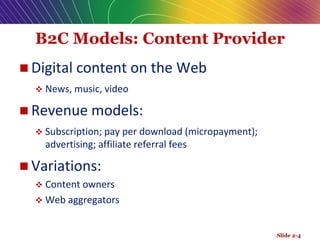
B2C Models: Content Provider
 Digital content on the Web
 News, music, video
 Revenue models:
 Subscription; pay per download (micropayment);
advertising; affiliate referral fees
 Variations:
 Content owners
 Web aggregators
Slide 2-4
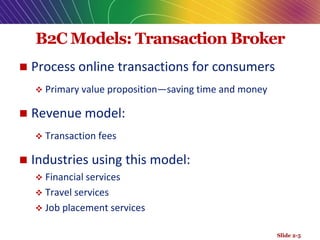
B2C Models: Transaction Broker
 Process online transactions for consumers
 Primary value proposition—saving time and money
 Revenue model:
 Transaction fees
 Industries using this model:
 Financial services
 Travel services
 Job placement services
Slide 2-5
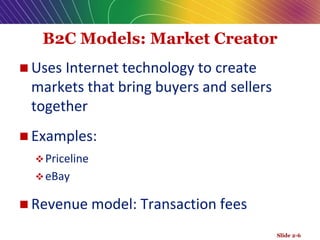
B2C Models: Market Creator
 Uses Internet technology to create
markets that bring buyers and sellers
together
 Examples:
Priceline
eBay
 Revenue model: Transaction fees
Slide 2-6
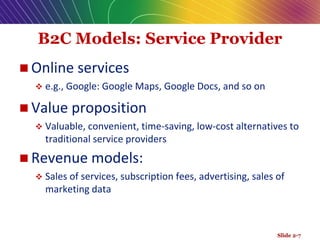
B2C Models: Service Provider
 Online services
 e.g., Google: Google Maps, Google Docs, and so on
 Value proposition
 Valuable, convenient, time-saving, low-cost alternatives to
traditional service providers
 Revenue models:
 Sales of services, subscription fees, advertising, sales of
marketing data
Slide 2-7
B2C Models: Community Provider
 Provides online environment (social
network) where people with similar
interests can transact, share content, and
communicate
E.g., Facebook, MySpace, LinkedIn
 Revenue models:
Advertising fees, subscription fees, sales
revenues, transaction fees, affiliate fees
Slide 2-8

B2C Models

  • 1.
    Categorizing E-commerce Business Models No one correct way  We categorize business models according to:  E-commerce sector (B2C, B2B, C2C)  Type of e-commerce technology; i.e., m-commerce  Similar business models appear in more than one sector  Some companies use multiple business models; e.g., eBay Slide 2-1
  • 2.
    B2C Business Models:Portal  Search plus an integrated package of content and services  Revenue models:  Advertising, subscription fees, transaction fees  Variations:  Horizontal/General  Vertical/Specialized (Vortal)  Pure Search Slide 2-2
  • 3.
    B2C Models: E-tailer Online version of traditional retailer  Revenue model: Sales  Variations:  Virtual merchant  Bricks-and-clicks  Catalog merchant  Manufacturer-direct  Low barriers to entry Slide 2-3
  • 4.
    B2C Models: ContentProvider  Digital content on the Web  News, music, video  Revenue models:  Subscription; pay per download (micropayment); advertising; affiliate referral fees  Variations:  Content owners  Web aggregators Slide 2-4
  • 5.
    B2C Models: TransactionBroker  Process online transactions for consumers  Primary value proposition—saving time and money  Revenue model:  Transaction fees  Industries using this model:  Financial services  Travel services  Job placement services Slide 2-5
  • 6.
    B2C Models: MarketCreator  Uses Internet technology to create markets that bring buyers and sellers together  Examples: Priceline eBay  Revenue model: Transaction fees Slide 2-6
  • 7.
    B2C Models: ServiceProvider  Online services  e.g., Google: Google Maps, Google Docs, and so on  Value proposition  Valuable, convenient, time-saving, low-cost alternatives to traditional service providers  Revenue models:  Sales of services, subscription fees, advertising, sales of marketing data Slide 2-7
  • 8.
    B2C Models: CommunityProvider  Provides online environment (social network) where people with similar interests can transact, share content, and communicate E.g., Facebook, MySpace, LinkedIn  Revenue models: Advertising fees, subscription fees, sales revenues, transaction fees, affiliate fees Slide 2-8