International Journal of Engineering Research and Development
e-ISSN: 2278-067X, p-ISSN: 2278-800X, www.ijerd.com
Volume 11, Issue 04 (April 2015), PP.07-13
7
A Novel VLSI Architecture for FFT Utilizing Proposed 4:2 & 7:2
Compressor
Mamta Raj, Prof. Sanket Choudhary, Dr. Soni Changlani
M.Tech Scholar, Electronics and Communication Department, LNCTS Bhopal, India
Assistant Professor, Electronics and Communication Department, LNCTS Bhopal, India
HOD, Electronics and Communication Department,LNCTS Bhopal, India
Abstract:- With the appearance of new innovation in the fields of VLSI and correspondence, there is likewise a
perpetually developing interest for fast transforming and low range outline. It is likewise a remarkable certainty
that the multiplier unit structures a fundamental piece of processor configuration. Because of this respect, rapid
multiplier architectures turn into the need of the day. In this paper, we acquaint a novel structural engineering
with perform high velocity duplication utilizing old Vedic math's strategies. Another fast approach using 4:2
compressors and novel 7:2 compressors for expansion has additionally been joined in the same and has been
investigated. Upon examination, the compressor based multiplier present in this paper, is just about two times
quicker than the mainstream routines for augmentation. Likewise we outline a FFT utilizing compressor based
multiplier. This all configuration and examinations were done on a Xilinx Spartan 3e arrangement of FPGA and
the timing and zone of the outline, on the same have been ascertained.
Keywords:- Fast Fourier Transform (FFT), 4:2 Compressor, Modified 4:2 Compressor, 7:2 Compressor.
I. INTRODUCTION
Advanced sign transforming (DSP) is the scientific control of a data sign to change or enhance it
somehow. It is described by the representation of discrete time, discrete recurrence, or other discrete area
motions by a succession of numbers or images and the transforming of these signs [1].
The objective of DSP is for the most part to gauge, channel and/or pack nonstop certifiable simple
signs. The principal step is ordinarily to change over the sign from a simple to an advanced structure, by
inspecting and after that digitizing it utilizing a simple to-computerized converter (ADC), which transforms the
simple sign into a surge of numbers. Be that as it may, regularly, the obliged yield sign is an alternate simple
yield signal, which obliges a computerized to-simple converter (DAC). Regardless of the possibility that this
methodology is more unpredictable than simple handling and has a discrete worth range, the utilization of
computational energy to advanced sign preparing takes into account numerous points of interest over simple
transforming in numerous applications, for example, slip recognition and amendment in transmission and also
information pressure. DSP calculations have long been run on standard PCs, and in addition on specific
processors called advanced sign processor and deliberately manufactured equipment, for example, application-
particular incorporated circuit (ASICs). Today there are extra advancements utilized for computerized sign
handling including all the more capable broadly useful chip, field-programmable door clusters (FPGAs),
advanced sign controllers (basically for modern applications, for example, engine control), and stream
processors, among others [2-3]. The FFT is a standout amongst the most generally utilized computerized sign
handling calculation. As of late, FFT processor has been broadly utilized as a part of computerized sign handling
field sought OFDM, MIMO-OFDM correspondence frameworks. FFT/IFFT processors are key parts for an
orthogonal recurrence division multiplexing (OFDM) based remote IEEE 802.16 broadband correspondence
framework; it is a standout amongst the most complex and escalated processing module of different remote
guidelines physical layer (ofdm-802.11a, MIMO-OFDM 802.11, 802.16,802.16e) [4].
II. COMPRESSOR BASED MULTIPLIER
Vedic science is an antiquated quick figuring math system which is taken from recorded old book of
intelligence. Vedic science is an antiquated Vedic math which gives the exceptional procedure of mental
estimation with the assistance of straightforward tenets and standards. Swami Bharati Krishna Tirtha (1884-
1960), previous Jagadguru Sankaracharya of Puri selected arrangement of 16 Sutras (axioms) and 13 Sub -
Sutras (culminations) from the Atharva Veda. He created strategies and methods for opening up the standards
A Novel VLSI Architecture for FFT Utilizing Proposed 4:2 & 7:2 Compressor
8
contained in the equations and their sub-recipes, and called it Vedic Mathematics. As indicated by him, there
has been extensive writing on Mathematics in the Veda-sakhas.
Vedic science is a piece of four Vedas (books of shrewdness). It is a piece of Sthapatya- Veda (book on
structural building and construction modeling), which is an upa-veda (supplement) of Atharva Veda. It covers
clarification of a few present day numerical terms including number-crunching, geometry (plane, co-ordinate),
trigonometry, quadratic comparisons, factorization and even analytics.
a. 4:2 Compressor
To add binary numbers with minimal carry propagation we use compressor adder instead of other
adder. Compressor is a digital modern circuit which is used for high speed with minimum gates requires
designing technique. This compressor becomes the essential tool for fast multiplication adding technique by
keeping an eye on fast processor and lesser area.
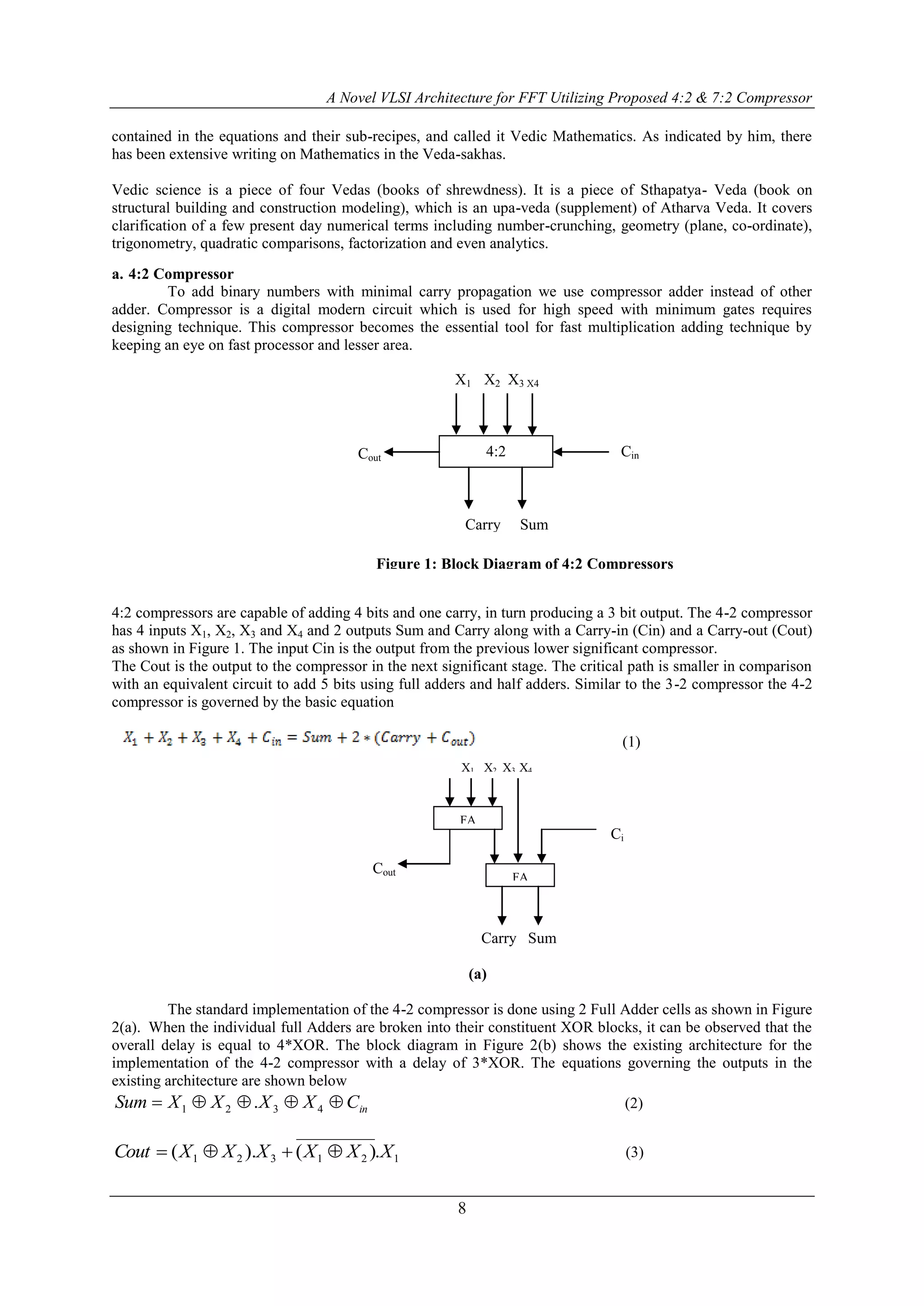
4:2 compressors are capable of adding 4 bits and one carry, in turn producing a 3 bit output. The 4-2 compressor
has 4 inputs X1, X2, X3 and X4 and 2 outputs Sum and Carry along with a Carry-in (Cin) and a Carry-out (Cout)
as shown in Figure 1. The input Cin is the output from the previous lower significant compressor.
The Cout is the output to the compressor in the next significant stage. The critical path is smaller in comparison
with an equivalent circuit to add 5 bits using full adders and half adders. Similar to the 3-2 compressor the 4-2
compressor is governed by the basic equation
(1)
(a)
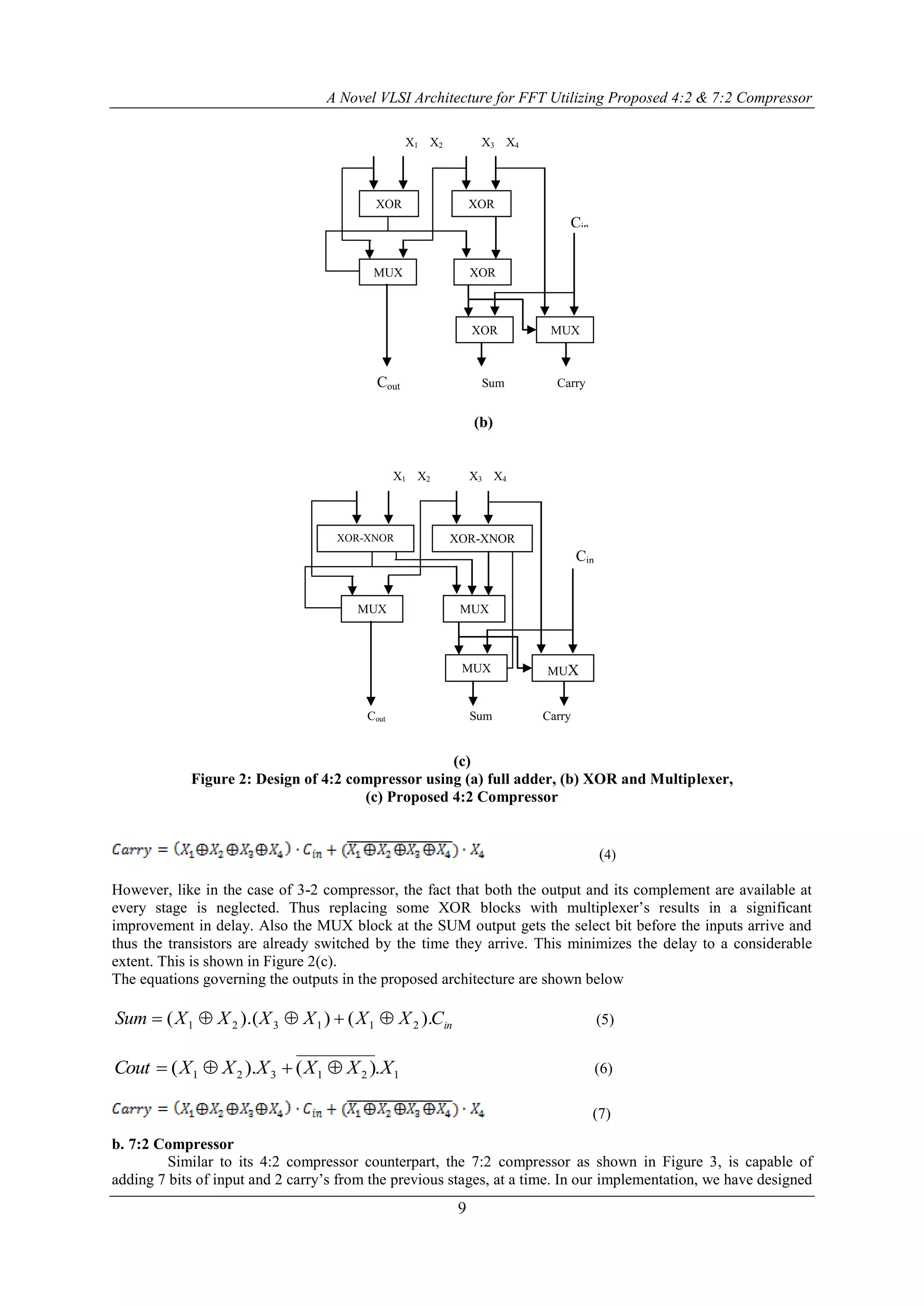
The standard implementation of the 4-2 compressor is done using 2 Full Adder cells as shown in Figure
2(a). When the individual full Adders are broken into their constituent XOR blocks, it can be observed that the
overall delay is equal to 4*XOR. The block diagram in Figure 2(b) shows the existing architecture for the
implementation of the 4-2 compressor with a delay of 3*XOR. The equations governing the outputs in the
existing architecture are shown below
inCXXXXSum  4321 . (2)
121321 .)().( XXXXXXCout  (3)
Cout
Carry Sum
Cin4:2
X1 X2 X3 X4
Figure 1: Block Diagram of 4:2 Compressors
Carry Sum
Ci
n
Cout
FA
FA
X1 X2 X3 X4
A Novel VLSI Architecture for FFT Utilizing Proposed 4:2 & 7:2 Compressor
9
(b)
(c)
Figure 2: Design of 4:2 compressor using (a) full adder, (b) XOR and Multiplexer,
(c) Proposed 4:2 Compressor
(4)
However, like in the case of 3-2 compressor, the fact that both the output and its complement are available at
every stage is neglected. Thus replacing some XOR blocks with multiplexer’s results in a significant
improvement in delay. Also the MUX block at the SUM output gets the select bit before the inputs arrive and
thus the transistors are already switched by the time they arrive. This minimizes the delay to a considerable
extent. This is shown in Figure 2(c).
The equations governing the outputs in the proposed architecture are shown below
inCXXXXXXSum ).()).(( 211321  (5)
121321 .)().( XXXXXXCout  (6)
(7)
b. 7:2 Compressor
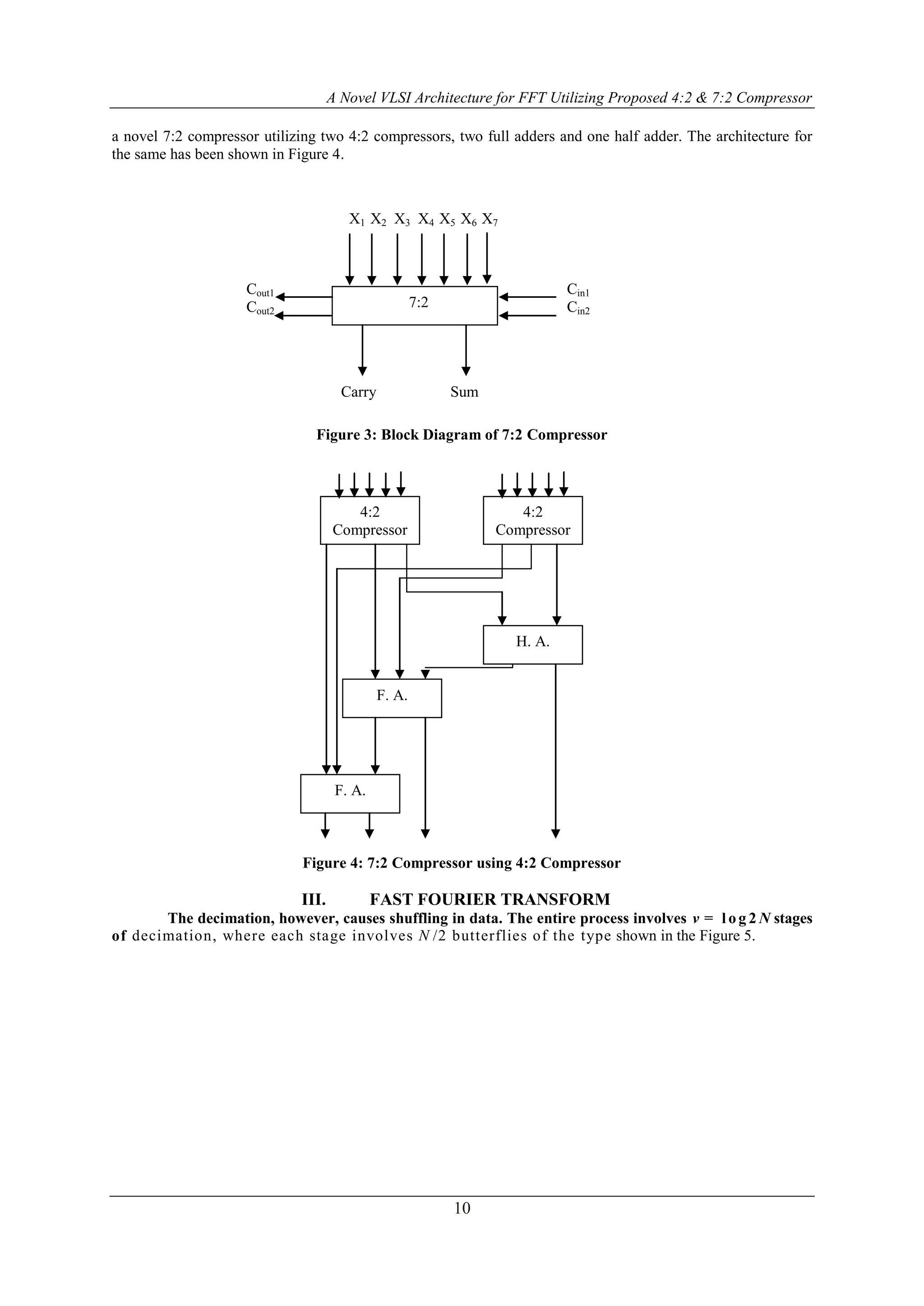
Similar to its 4:2 compressor counterpart, the 7:2 compressor as shown in Figure 3, is capable of
adding 7 bits of input and 2 carry’s from the previous stages, at a time. In our implementation, we have designed
Cin
X1 X2 X3 X4
XORMUX
XOR XOR
XOR MUX
Cout Sum Carry
Cout Sum Carry
Cin
MUX
XOR-XNOR XOR-XNOR
MUX
MUX MUX
X1 X2 X3 X4
A Novel VLSI Architecture for FFT Utilizing Proposed 4:2 & 7:2 Compressor
10
a novel 7:2 compressor utilizing two 4:2 compressors, two full adders and one half adder. The architecture for
the same has been shown in Figure 4.
Figure 3: Block Diagram of 7:2 Compressor
Figure 4: 7:2 Compressor using 4:2 Compressor
III. FAST FOURIER TRANSFORM
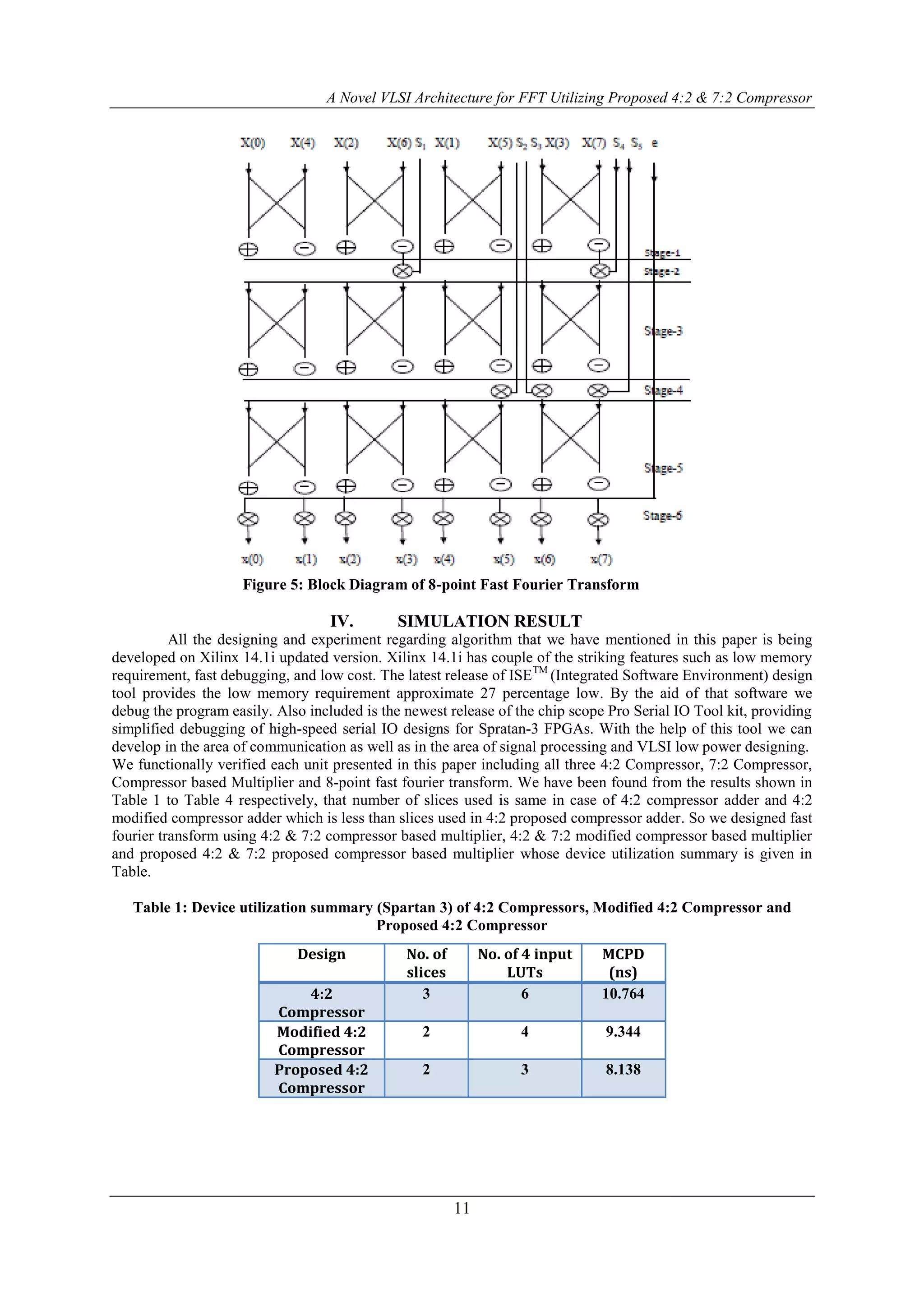
The decimation, however, causes shuffling in data. The entire process involves v = l og 2 N stages
of decimation, where each stage involves N /2 butterflies of the type shown in the Figure 5.
Cout1
Cout2
Cin1
Cin2
X1 X2 X3 X4 X5 X6 X7
Carry Sum
7:2
F. A.
4:2
Compressor
s
4:2
Compressor
s
H. A.
F. A.
A Novel VLSI Architecture for FFT Utilizing Proposed 4:2 & 7:2 Compressor
11
Figure 5: Block Diagram of 8-point Fast Fourier Transform
IV. SIMULATION RESULT
All the designing and experiment regarding algorithm that we have mentioned in this paper is being
developed on Xilinx 14.1i updated version. Xilinx 14.1i has couple of the striking features such as low memory
requirement, fast debugging, and low cost. The latest release of ISETM
(Integrated Software Environment) design
tool provides the low memory requirement approximate 27 percentage low. By the aid of that software we
debug the program easily. Also included is the newest release of the chip scope Pro Serial IO Tool kit, providing
simplified debugging of high-speed serial IO designs for Spratan-3 FPGAs. With the help of this tool we can
develop in the area of communication as well as in the area of signal processing and VLSI low power designing.
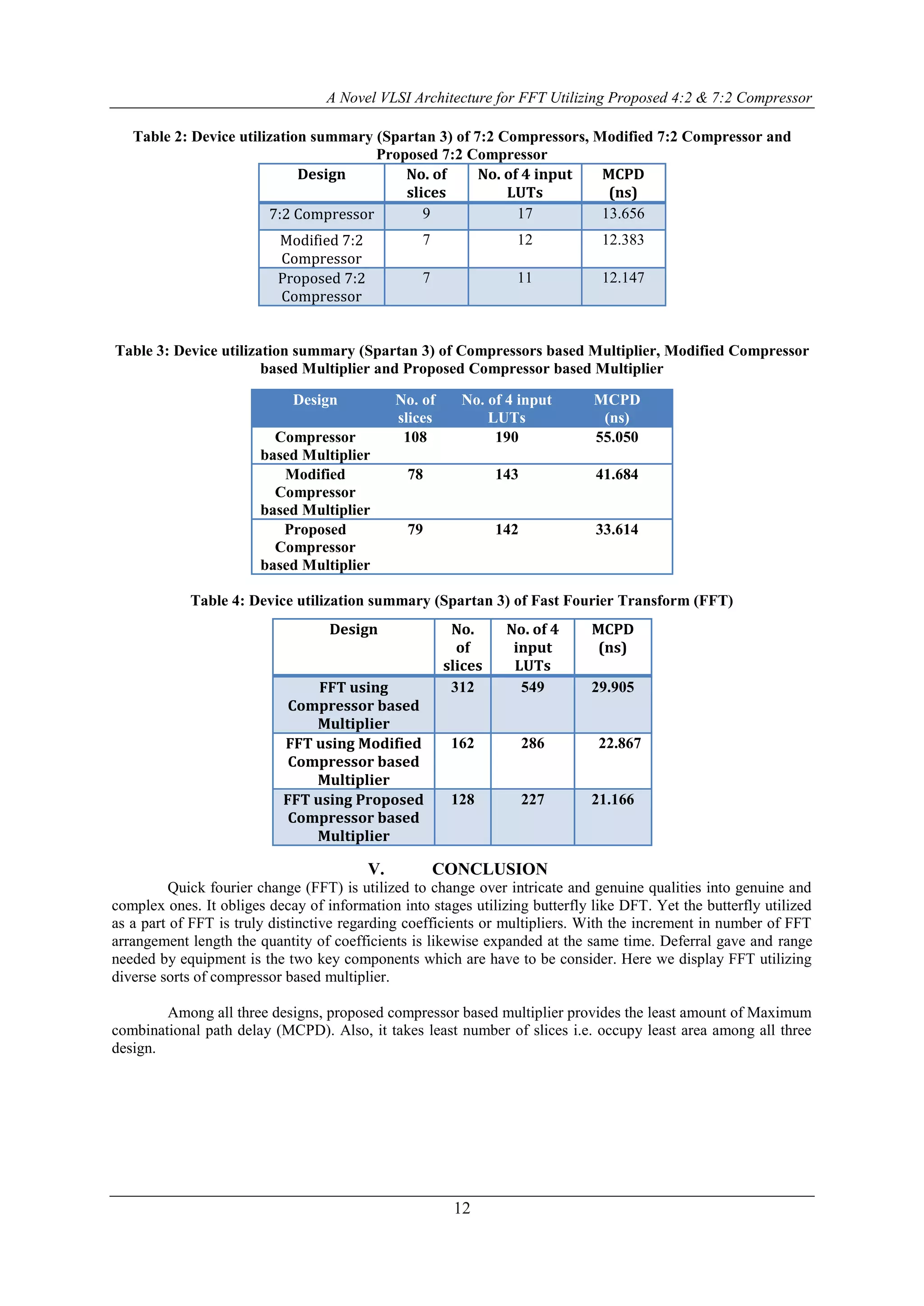
We functionally verified each unit presented in this paper including all three 4:2 Compressor, 7:2 Compressor,
Compressor based Multiplier and 8-point fast fourier transform. We have been found from the results shown in
Table 1 to Table 4 respectively, that number of slices used is same in case of 4:2 compressor adder and 4:2
modified compressor adder which is less than slices used in 4:2 proposed compressor adder. So we designed fast
fourier transform using 4:2 & 7:2 compressor based multiplier, 4:2 & 7:2 modified compressor based multiplier
and proposed 4:2 & 7:2 proposed compressor based multiplier whose device utilization summary is given in
Table.
Table 1: Device utilization summary (Spartan 3) of 4:2 Compressors, Modified 4:2 Compressor and
Proposed 4:2 Compressor
Design No. of
slices
No. of 4 input
LUTs
MCPD
(ns)
4:2
Compressor
3 6 10.764
Modified 4:2
Compressor
2 4 9.344
Proposed 4:2
Compressor
2 3 8.138
A Novel VLSI Architecture for FFT Utilizing Proposed 4:2 & 7:2 Compressor
12
Table 2: Device utilization summary (Spartan 3) of 7:2 Compressors, Modified 7:2 Compressor and
Proposed 7:2 Compressor
Table 3: Device utilization summary (Spartan 3) of Compressors based Multiplier, Modified Compressor
based Multiplier and Proposed Compressor based Multiplier
Table 4: Device utilization summary (Spartan 3) of Fast Fourier Transform (FFT)
V. CONCLUSION
Quick fourier change (FFT) is utilized to change over intricate and genuine qualities into genuine and
complex ones. It obliges decay of information into stages utilizing butterfly like DFT. Yet the butterfly utilized
as a part of FFT is truly distinctive regarding coefficients or multipliers. With the increment in number of FFT
arrangement length the quantity of coefficients is likewise expanded at the same time. Deferral gave and range
needed by equipment is the two key components which are have to be consider. Here we display FFT utilizing
diverse sorts of compressor based multiplier.
Among all three designs, proposed compressor based multiplier provides the least amount of Maximum
combinational path delay (MCPD). Also, it takes least number of slices i.e. occupy least area among all three
design.
Design No. of
slices
No. of 4 input
LUTs
MCPD
(ns)
7:2 Compressor 9 17 13.656
Modified 7:2
Compressor
7 12 12.383
Proposed 7:2
Compressor
7 11 12.147
Design No. of
slices
No. of 4 input
LUTs
MCPD
(ns)
Compressor
based Multiplier
108 190 55.050
Modified
Compressor
based Multiplier
78 143 41.684
Proposed
Compressor
based Multiplier
79 142 33.614
Design No.
of
slices
No. of 4
input
LUTs
MCPD
(ns)
FFT using
Compressor based
Multiplier
312 549 29.905
FFT using Modified
Compressor based
Multiplier
162 286 22.867
FFT using Proposed
Compressor based
Multiplier
128 227 21.166
A Novel VLSI Architecture for FFT Utilizing Proposed 4:2 & 7:2 Compressor
13
REFERENCES
[1]. Sushma R. Huddar and Sudhir Rao, Kalpana M., “Novel High Speed Vedic Mathematics Multiplier
using Compressors ”, 978-1-4673-5090-7/13/$31.00 ©2013 IEEE.
[2]. S. S. Kerur, Prakash Narchi, Jayashree C N, Harish M Kittur and Girish V A, “Implementation of
Vedic multiplier for Digital Signal Processing”, International Conference on VLSI, Communication &
Instrumentation (ICVCI) 2011, Proceedings published by International Joural of Computer
Applications® (IJCA), pp.1-6.
[3]. Himanshu Thapaliyal and M.B Srinivas, “VLSI Implementation of RSA Encryption System Using
Ancient Indian Vedic Mathematics”, Center for VLSI and Embedded System Technologies,
International Institute of Information Technology Hyderabad, India.
[4]. Jagadguru Swami Sri Bharati Krishna Tirthaji Maharaja, “Vedic Mathematics: Sixteen simple
Mathematical Formulae from the Veda”, Delhi(2011).
[5]. Sumit Vaidya and Depak Dandekar. “Delay-power perfor-mance comparison of multipliers in VLSI
circuit design”. International Journal of Computer Networks & Communications (IJCNC), Vol.2, No.4,
July 2010.
[6]. P. D. Chidgupkar and M. T. Karad, “The Implementation of Vedic Algorithms in Digital Signal
Procesing”, Global J. of Eng. Edu, Vol.8, No.2, 204, UICEE Published in Australia.
[7]. Asmita Haveliya, “Design and Simulation of 32-Point FFT Using Radix-2 Algorithm for FPGA
Implementation”, Second International Conference on Advanced Computing & Communication
Technologies IEEE 2012.
[8]. S. Correa, L. C. Freitas, A. Klautau and J. C. W. A. Costa, “VHDL Implementation of a Flexible and
Synthesizable FFT Processor”, IEEE LATIN AMERICA TRANSACTIONS, VOL. 10, NO. 1, JAN.
2012.
[9]. Kamaru Adzha Bin Kadiran. “Design and Implementation of OFDM Transmitter and Receiver on
FPGA Hardware”, November 2005.

A Novel VLSI Architecture for FFT Utilizing Proposed 4:2 & 7:2 Compressor

  • 1.
    International Journal ofEngineering Research and Development e-ISSN: 2278-067X, p-ISSN: 2278-800X, www.ijerd.com Volume 11, Issue 04 (April 2015), PP.07-13 7 A Novel VLSI Architecture for FFT Utilizing Proposed 4:2 & 7:2 Compressor Mamta Raj, Prof. Sanket Choudhary, Dr. Soni Changlani M.Tech Scholar, Electronics and Communication Department, LNCTS Bhopal, India Assistant Professor, Electronics and Communication Department, LNCTS Bhopal, India HOD, Electronics and Communication Department,LNCTS Bhopal, India Abstract:- With the appearance of new innovation in the fields of VLSI and correspondence, there is likewise a perpetually developing interest for fast transforming and low range outline. It is likewise a remarkable certainty that the multiplier unit structures a fundamental piece of processor configuration. Because of this respect, rapid multiplier architectures turn into the need of the day. In this paper, we acquaint a novel structural engineering with perform high velocity duplication utilizing old Vedic math's strategies. Another fast approach using 4:2 compressors and novel 7:2 compressors for expansion has additionally been joined in the same and has been investigated. Upon examination, the compressor based multiplier present in this paper, is just about two times quicker than the mainstream routines for augmentation. Likewise we outline a FFT utilizing compressor based multiplier. This all configuration and examinations were done on a Xilinx Spartan 3e arrangement of FPGA and the timing and zone of the outline, on the same have been ascertained. Keywords:- Fast Fourier Transform (FFT), 4:2 Compressor, Modified 4:2 Compressor, 7:2 Compressor. I. INTRODUCTION Advanced sign transforming (DSP) is the scientific control of a data sign to change or enhance it somehow. It is described by the representation of discrete time, discrete recurrence, or other discrete area motions by a succession of numbers or images and the transforming of these signs [1]. The objective of DSP is for the most part to gauge, channel and/or pack nonstop certifiable simple signs. The principal step is ordinarily to change over the sign from a simple to an advanced structure, by inspecting and after that digitizing it utilizing a simple to-computerized converter (ADC), which transforms the simple sign into a surge of numbers. Be that as it may, regularly, the obliged yield sign is an alternate simple yield signal, which obliges a computerized to-simple converter (DAC). Regardless of the possibility that this methodology is more unpredictable than simple handling and has a discrete worth range, the utilization of computational energy to advanced sign preparing takes into account numerous points of interest over simple transforming in numerous applications, for example, slip recognition and amendment in transmission and also information pressure. DSP calculations have long been run on standard PCs, and in addition on specific processors called advanced sign processor and deliberately manufactured equipment, for example, application- particular incorporated circuit (ASICs). Today there are extra advancements utilized for computerized sign handling including all the more capable broadly useful chip, field-programmable door clusters (FPGAs), advanced sign controllers (basically for modern applications, for example, engine control), and stream processors, among others [2-3]. The FFT is a standout amongst the most generally utilized computerized sign handling calculation. As of late, FFT processor has been broadly utilized as a part of computerized sign handling field sought OFDM, MIMO-OFDM correspondence frameworks. FFT/IFFT processors are key parts for an orthogonal recurrence division multiplexing (OFDM) based remote IEEE 802.16 broadband correspondence framework; it is a standout amongst the most complex and escalated processing module of different remote guidelines physical layer (ofdm-802.11a, MIMO-OFDM 802.11, 802.16,802.16e) [4]. II. COMPRESSOR BASED MULTIPLIER Vedic science is an antiquated quick figuring math system which is taken from recorded old book of intelligence. Vedic science is an antiquated Vedic math which gives the exceptional procedure of mental estimation with the assistance of straightforward tenets and standards. Swami Bharati Krishna Tirtha (1884- 1960), previous Jagadguru Sankaracharya of Puri selected arrangement of 16 Sutras (axioms) and 13 Sub - Sutras (culminations) from the Atharva Veda. He created strategies and methods for opening up the standards
  • 2.
    A Novel VLSIArchitecture for FFT Utilizing Proposed 4:2 & 7:2 Compressor 8 contained in the equations and their sub-recipes, and called it Vedic Mathematics. As indicated by him, there has been extensive writing on Mathematics in the Veda-sakhas. Vedic science is a piece of four Vedas (books of shrewdness). It is a piece of Sthapatya- Veda (book on structural building and construction modeling), which is an upa-veda (supplement) of Atharva Veda. It covers clarification of a few present day numerical terms including number-crunching, geometry (plane, co-ordinate), trigonometry, quadratic comparisons, factorization and even analytics. a. 4:2 Compressor To add binary numbers with minimal carry propagation we use compressor adder instead of other adder. Compressor is a digital modern circuit which is used for high speed with minimum gates requires designing technique. This compressor becomes the essential tool for fast multiplication adding technique by keeping an eye on fast processor and lesser area. 4:2 compressors are capable of adding 4 bits and one carry, in turn producing a 3 bit output. The 4-2 compressor has 4 inputs X1, X2, X3 and X4 and 2 outputs Sum and Carry along with a Carry-in (Cin) and a Carry-out (Cout) as shown in Figure 1. The input Cin is the output from the previous lower significant compressor. The Cout is the output to the compressor in the next significant stage. The critical path is smaller in comparison with an equivalent circuit to add 5 bits using full adders and half adders. Similar to the 3-2 compressor the 4-2 compressor is governed by the basic equation (1) (a) The standard implementation of the 4-2 compressor is done using 2 Full Adder cells as shown in Figure 2(a). When the individual full Adders are broken into their constituent XOR blocks, it can be observed that the overall delay is equal to 4*XOR. The block diagram in Figure 2(b) shows the existing architecture for the implementation of the 4-2 compressor with a delay of 3*XOR. The equations governing the outputs in the existing architecture are shown below inCXXXXSum  4321 . (2) 121321 .)().( XXXXXXCout  (3) Cout Carry Sum Cin4:2 X1 X2 X3 X4 Figure 1: Block Diagram of 4:2 Compressors Carry Sum Ci n Cout FA FA X1 X2 X3 X4
  • 3.
    A Novel VLSIArchitecture for FFT Utilizing Proposed 4:2 & 7:2 Compressor 9 (b) (c) Figure 2: Design of 4:2 compressor using (a) full adder, (b) XOR and Multiplexer, (c) Proposed 4:2 Compressor (4) However, like in the case of 3-2 compressor, the fact that both the output and its complement are available at every stage is neglected. Thus replacing some XOR blocks with multiplexer’s results in a significant improvement in delay. Also the MUX block at the SUM output gets the select bit before the inputs arrive and thus the transistors are already switched by the time they arrive. This minimizes the delay to a considerable extent. This is shown in Figure 2(c). The equations governing the outputs in the proposed architecture are shown below inCXXXXXXSum ).()).(( 211321  (5) 121321 .)().( XXXXXXCout  (6) (7) b. 7:2 Compressor Similar to its 4:2 compressor counterpart, the 7:2 compressor as shown in Figure 3, is capable of adding 7 bits of input and 2 carry’s from the previous stages, at a time. In our implementation, we have designed Cin X1 X2 X3 X4 XORMUX XOR XOR XOR MUX Cout Sum Carry Cout Sum Carry Cin MUX XOR-XNOR XOR-XNOR MUX MUX MUX X1 X2 X3 X4
  • 4.
    A Novel VLSIArchitecture for FFT Utilizing Proposed 4:2 & 7:2 Compressor 10 a novel 7:2 compressor utilizing two 4:2 compressors, two full adders and one half adder. The architecture for the same has been shown in Figure 4. Figure 3: Block Diagram of 7:2 Compressor Figure 4: 7:2 Compressor using 4:2 Compressor III. FAST FOURIER TRANSFORM The decimation, however, causes shuffling in data. The entire process involves v = l og 2 N stages of decimation, where each stage involves N /2 butterflies of the type shown in the Figure 5. Cout1 Cout2 Cin1 Cin2 X1 X2 X3 X4 X5 X6 X7 Carry Sum 7:2 F. A. 4:2 Compressor s 4:2 Compressor s H. A. F. A.
  • 5.
    A Novel VLSIArchitecture for FFT Utilizing Proposed 4:2 & 7:2 Compressor 11 Figure 5: Block Diagram of 8-point Fast Fourier Transform IV. SIMULATION RESULT All the designing and experiment regarding algorithm that we have mentioned in this paper is being developed on Xilinx 14.1i updated version. Xilinx 14.1i has couple of the striking features such as low memory requirement, fast debugging, and low cost. The latest release of ISETM (Integrated Software Environment) design tool provides the low memory requirement approximate 27 percentage low. By the aid of that software we debug the program easily. Also included is the newest release of the chip scope Pro Serial IO Tool kit, providing simplified debugging of high-speed serial IO designs for Spratan-3 FPGAs. With the help of this tool we can develop in the area of communication as well as in the area of signal processing and VLSI low power designing. We functionally verified each unit presented in this paper including all three 4:2 Compressor, 7:2 Compressor, Compressor based Multiplier and 8-point fast fourier transform. We have been found from the results shown in Table 1 to Table 4 respectively, that number of slices used is same in case of 4:2 compressor adder and 4:2 modified compressor adder which is less than slices used in 4:2 proposed compressor adder. So we designed fast fourier transform using 4:2 & 7:2 compressor based multiplier, 4:2 & 7:2 modified compressor based multiplier and proposed 4:2 & 7:2 proposed compressor based multiplier whose device utilization summary is given in Table. Table 1: Device utilization summary (Spartan 3) of 4:2 Compressors, Modified 4:2 Compressor and Proposed 4:2 Compressor Design No. of slices No. of 4 input LUTs MCPD (ns) 4:2 Compressor 3 6 10.764 Modified 4:2 Compressor 2 4 9.344 Proposed 4:2 Compressor 2 3 8.138
  • 6.
    A Novel VLSIArchitecture for FFT Utilizing Proposed 4:2 & 7:2 Compressor 12 Table 2: Device utilization summary (Spartan 3) of 7:2 Compressors, Modified 7:2 Compressor and Proposed 7:2 Compressor Table 3: Device utilization summary (Spartan 3) of Compressors based Multiplier, Modified Compressor based Multiplier and Proposed Compressor based Multiplier Table 4: Device utilization summary (Spartan 3) of Fast Fourier Transform (FFT) V. CONCLUSION Quick fourier change (FFT) is utilized to change over intricate and genuine qualities into genuine and complex ones. It obliges decay of information into stages utilizing butterfly like DFT. Yet the butterfly utilized as a part of FFT is truly distinctive regarding coefficients or multipliers. With the increment in number of FFT arrangement length the quantity of coefficients is likewise expanded at the same time. Deferral gave and range needed by equipment is the two key components which are have to be consider. Here we display FFT utilizing diverse sorts of compressor based multiplier. Among all three designs, proposed compressor based multiplier provides the least amount of Maximum combinational path delay (MCPD). Also, it takes least number of slices i.e. occupy least area among all three design. Design No. of slices No. of 4 input LUTs MCPD (ns) 7:2 Compressor 9 17 13.656 Modified 7:2 Compressor 7 12 12.383 Proposed 7:2 Compressor 7 11 12.147 Design No. of slices No. of 4 input LUTs MCPD (ns) Compressor based Multiplier 108 190 55.050 Modified Compressor based Multiplier 78 143 41.684 Proposed Compressor based Multiplier 79 142 33.614 Design No. of slices No. of 4 input LUTs MCPD (ns) FFT using Compressor based Multiplier 312 549 29.905 FFT using Modified Compressor based Multiplier 162 286 22.867 FFT using Proposed Compressor based Multiplier 128 227 21.166
  • 7.
    A Novel VLSIArchitecture for FFT Utilizing Proposed 4:2 & 7:2 Compressor 13 REFERENCES [1]. Sushma R. Huddar and Sudhir Rao, Kalpana M., “Novel High Speed Vedic Mathematics Multiplier using Compressors ”, 978-1-4673-5090-7/13/$31.00 ©2013 IEEE. [2]. S. S. Kerur, Prakash Narchi, Jayashree C N, Harish M Kittur and Girish V A, “Implementation of Vedic multiplier for Digital Signal Processing”, International Conference on VLSI, Communication & Instrumentation (ICVCI) 2011, Proceedings published by International Joural of Computer Applications® (IJCA), pp.1-6. [3]. Himanshu Thapaliyal and M.B Srinivas, “VLSI Implementation of RSA Encryption System Using Ancient Indian Vedic Mathematics”, Center for VLSI and Embedded System Technologies, International Institute of Information Technology Hyderabad, India. [4]. Jagadguru Swami Sri Bharati Krishna Tirthaji Maharaja, “Vedic Mathematics: Sixteen simple Mathematical Formulae from the Veda”, Delhi(2011). [5]. Sumit Vaidya and Depak Dandekar. “Delay-power perfor-mance comparison of multipliers in VLSI circuit design”. International Journal of Computer Networks & Communications (IJCNC), Vol.2, No.4, July 2010. [6]. P. D. Chidgupkar and M. T. Karad, “The Implementation of Vedic Algorithms in Digital Signal Procesing”, Global J. of Eng. Edu, Vol.8, No.2, 204, UICEE Published in Australia. [7]. Asmita Haveliya, “Design and Simulation of 32-Point FFT Using Radix-2 Algorithm for FPGA Implementation”, Second International Conference on Advanced Computing & Communication Technologies IEEE 2012. [8]. S. Correa, L. C. Freitas, A. Klautau and J. C. W. A. Costa, “VHDL Implementation of a Flexible and Synthesizable FFT Processor”, IEEE LATIN AMERICA TRANSACTIONS, VOL. 10, NO. 1, JAN. 2012. [9]. Kamaru Adzha Bin Kadiran. “Design and Implementation of OFDM Transmitter and Receiver on FPGA Hardware”, November 2005.