Human
Reproductive
System
Male
Reproductive
Organs
Male External Reproductive Organs
1.

Penis
The organ used to transfer urine, sperm and
semen. Also contains the Urethra.

2.

Scrotum
The sac around the testicles. A muscular
tissue that holds the testes to suspend them
away from the body.
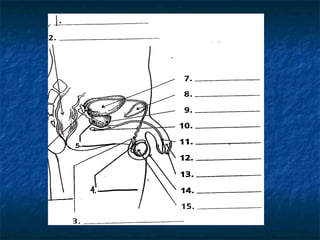
Male Internal
Reproductive Organs

1.

Testicles

Two sex glands that produce the male
reproductive
cells called sperm and the male
hormone
testosterone. Composed of hundreds of tiny tubes.
Called “seminiferous tubules”

2. Epididymis
The place where sperm are stored until they
ripen
and mature. Connects seminiferous tubules in the testes
to the vas deferens.
Male Internal
Reproductive Organs
3. Vas deferens
The passageway carrying the sperm from the
epididymis to the seminal vesicles.

4. Seminal Vesicles
Produces a sticky, sugary fluid to nourish the
sperm.
5. Prostate Gland
A donut shaped gland that surrounds the urethra and
produces liquid that adds to the
semen and
hormones. (protects and enriches sperm)
Male Internal
Reproductive Organs
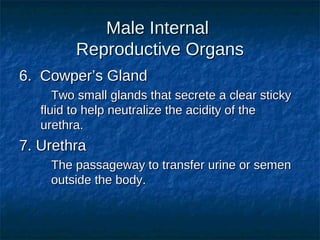
6. Cowper’s Gland
Two small glands that secrete a clear sticky
fluid to help neutralize the acidity of the
urethra.

7. Urethra
The passageway to transfer urine or semen
outside the body.
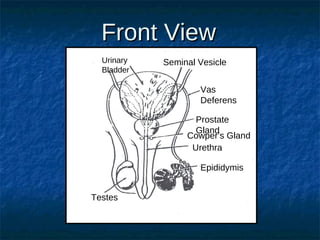
Front View
Urinary
Bladder

Seminal Vesicle
Vas
Deferens
Prostate
Gland
Cowper’s Gland
Urethra
Epididymis

Testes
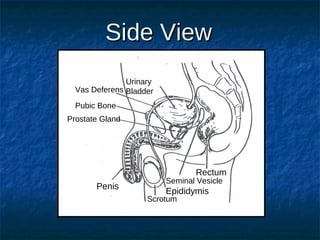
Side View
Urinary
Vas Deferens Bladder
Pubic Bone
Prostate Gland

Rectum

Penis

Seminal Vesicle

Epididymis

Scrotum
Female
Reproductive
Organs
Female External
Reproductive Organs
1.

Labia
Outer and inner lips protecting against
germ entry through the vagina.

2. Vulva
All sexual parts located outside the
body.
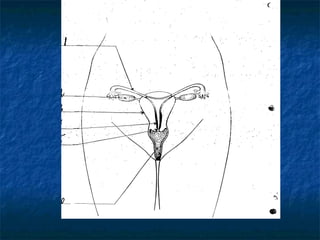
Female Internal
Reproductive Organs
1.

Vagina
Passageway from outside the body to
the
cervix for sperm, menstrual fluid,
and birth canal.

2.

Cervix
The lower end of the uterus, a neck like
part attached to the vagina.
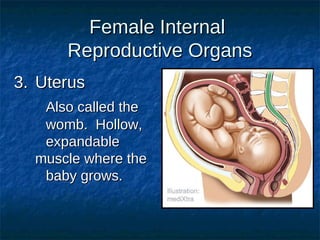
Female Internal
Reproductive Organs
3. Uterus
Also called the
womb. Hollow,
expandable
muscle where the
baby grows.
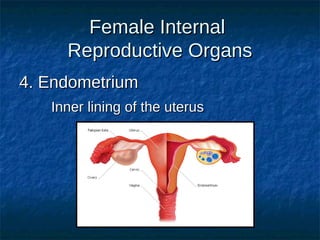
Female Internal
Reproductive Organs
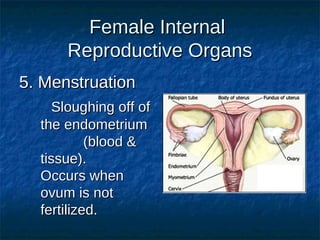
4. Endometrium
Inner lining of the uterus
Female Internal
Reproductive Organs
5. Menstruation
Sloughing off of
the endometrium
(blood &
tissue).
Occurs when
ovum is not
fertilized.
Female Internal
Reproductive Organs
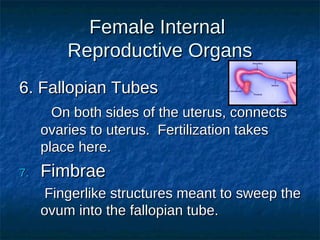
6. Fallopian Tubes
On both sides of the uterus, connects
ovaries to uterus. Fertilization takes
place here.
7.

Fimbrae
Fingerlike structures meant to sweep the
ovum into the fallopian tube.
Female Internal
Reproductive Organs
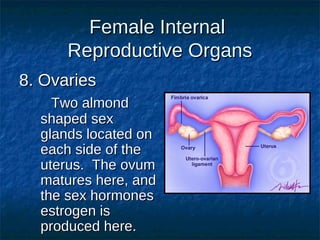
8. Ovaries
Two almond
shaped sex
glands located on
each side of the
uterus. The ovum
matures here, and
the sex hormones
estrogen is
produced here.
Non Reproductive Parts
In Pelvic Area
1.

Perineum
Area between the rectum and the
vagina.
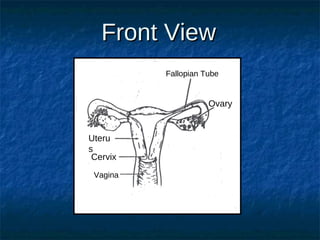
Front View
Fallopian Tube

Ovary

Uteru
s
Cervix
Vagina
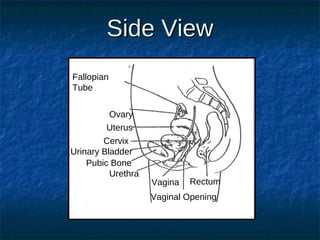
Side View
Fallopian
Tube
Ovary
Uterus
Cervix
Urinary Bladder
Pubic Bone
Urethra

Vagina

Rectum

Vaginal Opening
Male Reproductive System


http://kidshealth.org/teen/interactive/mrs_it.htm
Female Reproductive System


http://kidshealth.org/teen/interactive/female_it.
Caring for the Male System









Practice good Hygiene
 Bathe regularly and thoroughly clean the
penis and scrotum. (Under the foreskin)
Wear protective equipment
 Cup or other support
Practice Abstinence to avoid STD’s
Regular Self Exams
 Check
Get Regular Check ups every 12-18 months
Testicular Self Exam






1. Stand in front of a mirror and look for
swelling. Roll the testicle between thumb
and forefingers.
2. Cancerous lumps are usually found on
the side but can be found on the front.
Find the epididymis so you don’t mistake it
for a lump (a soft tube like structure
behind the testicle.)
3. Most lumps are not cancerous, but if
you do find one see a health care
professional.
Caring for the Female System


Bathe Regularly



Change tampons and pads every few hours



Get regular medical Exams



Practice Abstinence to avoid STD’s



Perform Self Exams
Breast Self Exam
1.

2.
3.
4.

Lie down with a pillow under your right
shoulder. Put your right shoulder under your
head. Place the three middle fingers of your left
hand on your right breast. Rub in a circular
motion with light, medium, and then firm
pressure. Go in a zig zag motion up and down.
Repeat on the other side.
Look in a mirror for changes, rashes, dimpling,
scaliness or discharge from the nipple.
Raise your arms, palms together and look for
changes.
Examine your underarms.
4 Stages of The Menstrual
Cycle
Days 1-5
Menstruation
Lining of uterus is shed
Days 6-9
Lining of the uterus is very thin
4 Stages of The Menstrual
Cycle
Days 10-14
Lining of uterus thickens
Days 15-28
Lining of the uterus is ready to
receive a fertilized egg.
Conception
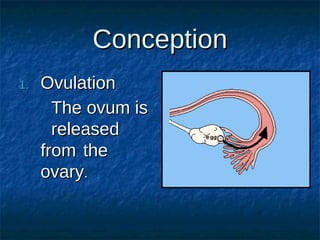
1.

Ovulation
The ovum is
released
from the
ovary.
Conception
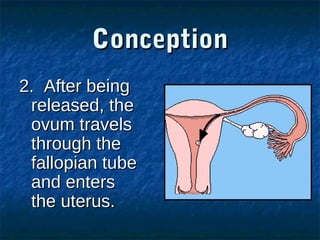
2. After being
released, the
ovum travels
through the
fallopian tube
and enters
the uterus.
Conception
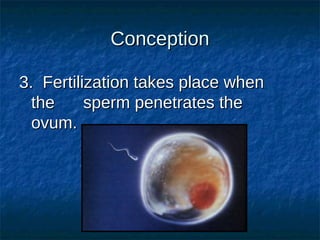
3. Fertilization takes place when
the
sperm penetrates the
ovum.
Conception
4.

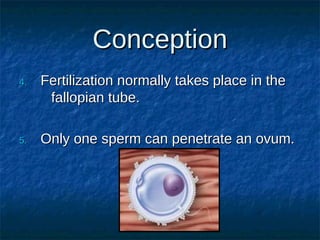
Fertilization normally takes place in the
fallopian tube.

5.

Only one sperm can penetrate an ovum.
Conception
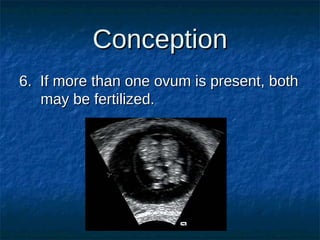
6. If more than one ovum is present, both
may be fertilized.
Conception
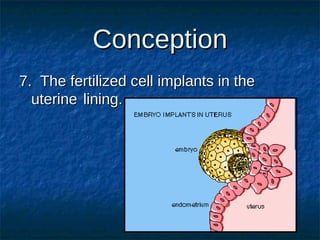
7. The fertilized cell implants in the
uterine lining.
Conception Video


http://www.babycenter.com/2_inside-pregnanc

Human reproduction powerpoint