Topic
B+ TREES
Presented by:
Mujahid Hussain Jalbanee
(Student of Software Engineering)
Tree:
 Tree is collection of nodes.
 Nodes have data and pointers.
 Pointers can be dynamic and can be thousands.
 Files are just like leaves.
 1st node called Root.
 Sibling nodes have same parent node.
 Path means to go towards particular node.
B+ Trees:
 Every node has pointers to other nodes and key values.
 If there are N pointers then there can be N-1 number of key
values.
 Key values are repeated from root node to leaf node because
data pointers are located at leaf nodes.
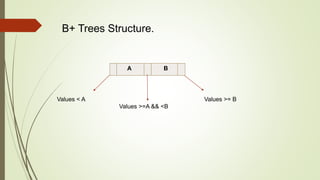
B+ Trees Structure.
A B
Values < A
Values >=A && <B
Values >= B
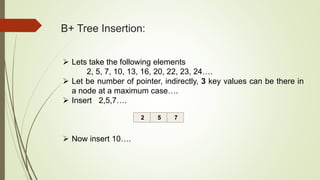
B+ Tree Insertion:
 Lets take the following elements
2, 5, 7, 10, 13, 16, 20, 22, 23, 24….
 Let be number of pointer, indirectly, 3 key values can be there in
a node at a maximum case….
 Insert 2,5,7….
 Now insert 10….
2 5 7
Continue……..
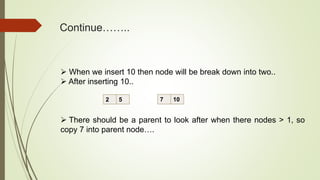
 When we insert 10 then node will be break down into two..
 After inserting 10..
 There should be a parent to look after when there nodes > 1, so
copy 7 into parent node….
2 5 7 10
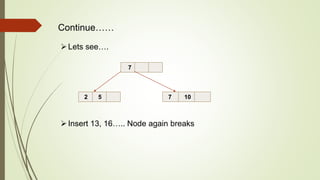
Lets see….
Insert 13, 16….. Node again breaks
7
2 5 7 10
Continue……
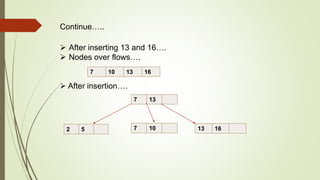
 After inserting 13 and 16….
 Nodes over flows….
 After insertion….
7 10 13 16
2 5 13 16
7 13
7 10
Continue…..
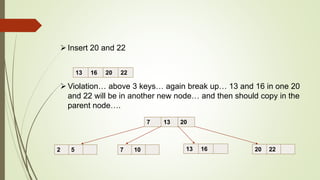
Insert 20 and 22
Violation… above 3 keys… again break up… 13 and 16 in one 20
and 22 will be in another new node… and then should copy in the
parent node….
13 16 20 22
2 5 7 10 13 16 20 22
7 13 20
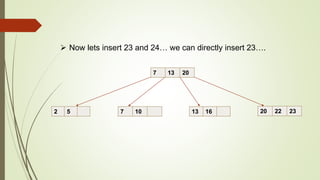
 Now lets insert 23 and 24… we can directly insert 23….
7 13 20
2 5 7 10 13 16 20 22 23
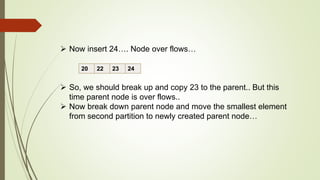
 Now insert 24…. Node over flows…
 So, we should break up and copy 23 to the parent.. But this
time parent node is over flows..
 Now break down parent node and move the smallest element
from second partition to newly created parent node…
20 22 23 24
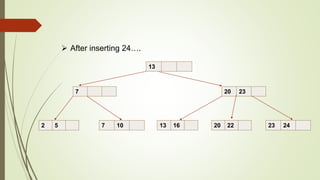
 After inserting 24….
13
7 20 23
2 5 23 2420 2213 167 10
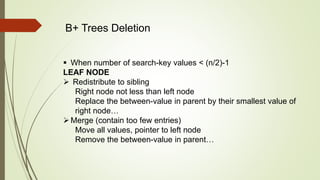
 When number of search-key values < (n/2)-1
LEAF NODE
 Redistribute to sibling
Right node not less than left node
Replace the between-value in parent by their smallest value of
right node…
Merge (contain too few entries)
Move all values, pointer to left node
Remove the between-value in parent…
B+ Trees Deletion
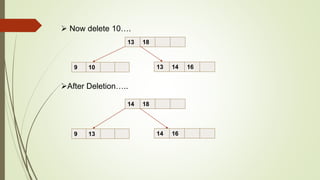
13 18
9 13
13 14 169 10
14 16
14 18
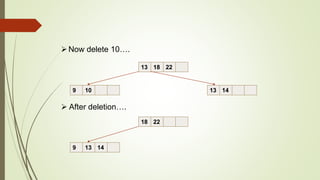
 Now delete 10….
After Deletion…..
Now delete 10….
 After deletion….
9 10 13 14
18 22
13 18 22
9 13 14
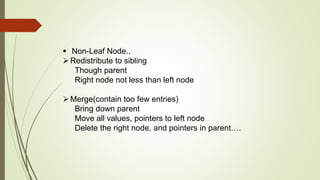
 Non-Leaf Node..
Redistribute to sibling
Though parent
Right node not less than left node
Merge(contain too few entries)
Bring down parent
Move all values, pointers to left node
Delete the right node, and pointers in parent….
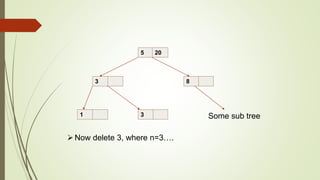
5 20
83
31 Some sub tree
Now delete 3, where n=3….
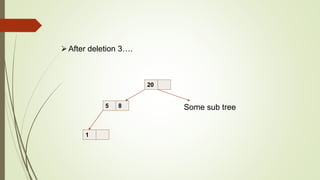
After deletion 3….
20
5 8
1
Some sub tree
Advantages:
Automatically adjust the nodes to fit the new records.
It re-organizes the nodes in the case of delete.
Good space utilization nodes contain only to the pointers to
the records and leaf nodes contain records.
It is suitable for partial and range search too.
Disadvantages:
There is no rearrangement of nodes while insertion or
deletion, then it would be an overhead.
It takes little effort, time and space.
But this disadvantage can be ignored compared to the speed
of traversal.
B+ Tree
B+ Tree

B+ Tree

  • 1.
    Topic B+ TREES Presented by: MujahidHussain Jalbanee (Student of Software Engineering)
  • 2.
    Tree:  Tree iscollection of nodes.  Nodes have data and pointers.  Pointers can be dynamic and can be thousands.  Files are just like leaves.  1st node called Root.  Sibling nodes have same parent node.  Path means to go towards particular node.
  • 3.
    B+ Trees:  Everynode has pointers to other nodes and key values.  If there are N pointers then there can be N-1 number of key values.  Key values are repeated from root node to leaf node because data pointers are located at leaf nodes.
  • 4.
    B+ Trees Structure. AB Values < A Values >=A && <B Values >= B
  • 5.
    B+ Tree Insertion: Lets take the following elements 2, 5, 7, 10, 13, 16, 20, 22, 23, 24….  Let be number of pointer, indirectly, 3 key values can be there in a node at a maximum case….  Insert 2,5,7….  Now insert 10…. 2 5 7
  • 6.
    Continue……..  When weinsert 10 then node will be break down into two..  After inserting 10..  There should be a parent to look after when there nodes > 1, so copy 7 into parent node…. 2 5 7 10
  • 7.
    Lets see…. Insert 13,16….. Node again breaks 7 2 5 7 10 Continue……
  • 8.
     After inserting13 and 16….  Nodes over flows….  After insertion…. 7 10 13 16 2 5 13 16 7 13 7 10 Continue…..
  • 9.
    Insert 20 and22 Violation… above 3 keys… again break up… 13 and 16 in one 20 and 22 will be in another new node… and then should copy in the parent node…. 13 16 20 22 2 5 7 10 13 16 20 22 7 13 20
  • 10.
     Now letsinsert 23 and 24… we can directly insert 23…. 7 13 20 2 5 7 10 13 16 20 22 23
  • 11.
     Now insert24…. Node over flows…  So, we should break up and copy 23 to the parent.. But this time parent node is over flows..  Now break down parent node and move the smallest element from second partition to newly created parent node… 20 22 23 24
  • 12.
     After inserting24…. 13 7 20 23 2 5 23 2420 2213 167 10
  • 13.
     When numberof search-key values < (n/2)-1 LEAF NODE  Redistribute to sibling Right node not less than left node Replace the between-value in parent by their smallest value of right node… Merge (contain too few entries) Move all values, pointer to left node Remove the between-value in parent… B+ Trees Deletion
  • 14.
    13 18 9 13 1314 169 10 14 16 14 18  Now delete 10…. After Deletion…..
  • 15.
    Now delete 10…. After deletion…. 9 10 13 14 18 22 13 18 22 9 13 14
  • 16.
     Non-Leaf Node.. Redistributeto sibling Though parent Right node not less than left node Merge(contain too few entries) Bring down parent Move all values, pointers to left node Delete the right node, and pointers in parent….
  • 17.
    5 20 83 31 Somesub tree Now delete 3, where n=3….
  • 18.
  • 19.
    Advantages: Automatically adjust thenodes to fit the new records. It re-organizes the nodes in the case of delete. Good space utilization nodes contain only to the pointers to the records and leaf nodes contain records. It is suitable for partial and range search too.
  • 20.
    Disadvantages: There is norearrangement of nodes while insertion or deletion, then it would be an overhead. It takes little effort, time and space. But this disadvantage can be ignored compared to the speed of traversal.