Avidin-Biotin interaction
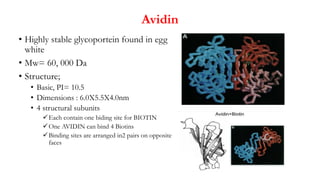
Avidin
• Highly stable glycoportein found in egg
white
• Mw= 60, 000 Da
• Structure;
• Basic, PI= 10.5
• Dimensions : 6.0X5.5X4.0nm
• 4 structural subunits
Each contain one biding site for BIOTIN
One AVIDIN can bind 4 Biotins
Binding sites are arranged in2 pairs on opposite
faces
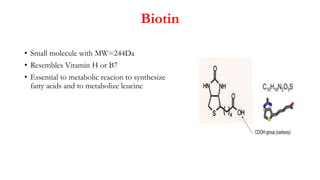
Biotin
• Small molecule with MW=244Da
• Resembles Vitamin H or B7
• Essential to metabolic reacion to synthesize
fatty acids and to metabolize leucine
Avidin-Biotin: Nature’s superglue
• Exhibit highest known affinity in nature between a ligand and a protein-
Ka=1015M-1
• Arises from hydrophobic interactions between biotin and aromatic
amino acids arranged inside the avidin biding pockets
• Avidin-biotin bonds are very difficult to break- pH 2-13, 9M Urea
• Strongest non-covalent bond in nature
• The avidin-biotin is highly specific and strong binding, the avidin-biotin
system is widely used in a variety of biochemical applications
Affinity chromatography
Binding assays
Immobilizing a protein onto a biosensor using
avidin-biotin bridges
Uses of avidin-biotin system
• Applied to every type of biosensor and nanoparticle surface
Optical
Acoustic
Electrochemical
Nanoparticles
• Detection of BIOTIN in an analyte solution using a sensor immobilized with
AVIDIN is a standard test to simulate detection of PROTEIN-DRUG interactions
High MW immobilized ligands
Low MW analyte
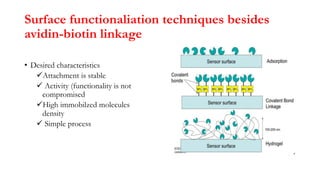
Surface functionaliation techniques besides
avidin-biotin linkage
• Desired characteristics
Attachment is stable
 Activity (functionality is not
compromised
High immobilzed molecules
density
 Simple process
Adsorption
• Very simple method
Expose sensor to solution that contains the protein to be immobilized
Wash off loosely (or unbound ) material
• Few experimental variables
pH of protein solution
 incubation time
ionic strabngth (salt content) of protein solution
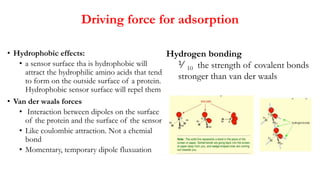
Driving force for adsorption
• Hydrophobic effects:
• a sensor surface tha is hydrophobic will
attract the hydrophilic amino acids that tend
to form on the outside surface of a protein.
Hydrophobic sensor surface will repel them
• Van der waals forces
• Interaction between dipoles on the surface
of the protein and the surface of the sensor
• Like coulombic attraction. Not a chemial
bond
• Momentary, temporary dipole fluxuation
Hydrogen bonding
⅟10 the strength of covalent bonds
stronger than van der waals
The problems with adsorption as an immobiliztion
method
• Highly dependent on the individual molecule and the state of the sensor
surface
• Different protein will adsorb with very different densities and activities
• Sensor cleaning/ pretreatment/ storage condition make a large impact
on immobilization density
• Functional activity is usually low
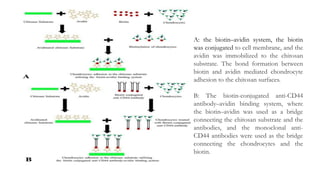
A: the biotin–avidin system, the biotin
was conjugated to cell membrane, and the
avidin was immobilized to the chitosan
substrate. The bond formation between
biotin and avidin mediated chondrocyte
adhesion to the chitosan surfaces.
B: The biotin-conjugated anti-CD44
antibody–avidin binding system, where
the biotin–avidin was used as a bridge
connecting the chitosan substrate and the
antibodies, and the monoclonal anti-
CD44 antibodies were used as the bridge
connecting the chondrocytes and the
biotin.
Covalent linkage
• Strongest attachment strength
• Need to make a chemical bond linkage between
the sensor and the protein
• LYSINE amino acids are the usual target
• Lysine is one of the hydrophilic
aminoacids
• Commonly exposed to the outside
surface of the folded protein
• Rarely involved in the active site of a
protein
• Highly reactive
• NH2 group
Bifunctional linker (BFL)
Covalent bond to sensor at one end, Covalent bond
to NH2 group on the protein at the other end
Quizzes
• Differentiate between Avidin, streptavidin, CaptAvidin and neutravidin.
• State the applications of avidine-biotin applications
CaptAvidin Agarose CaptAvidin agarose (C-21386) is another versatile form of a biotin-
binding protein in that its affinity for biotinylated molecules can be completely reversed
by raising the pH to 10, permitting the facile separation and isolation of biotin-labeled
molecules from complex mixtures.
This form of agarose-immobilized biotin-binding protein has been used to purify
immunoglobulin from whole rabbit serum and to isolate antitransferrin antibodies
directly from rabbit antiserum
CaptAvidin
Streptavidin
• Another biotin-binding protein is streptavidin, which is isolated from Streptomyces avidinii
and has a mass of 60,000 daltons.
• In contrast to avidin, streptavidin has no carbohydrate and has a mildly acidic pI of 5.5.
Commercially products use a recombinant form of streptavidin having a mass of 53,000
daltons and a near-neutral pI. Streptavidin is much less soluble in water than avidin.
• There are considerable differences in the composition of avidin and streptavidin, but they are
remarkably similar in other respects. Streptavidin is also a tetrameric protein, with each
subunit binding one molecule of biotin with affinity similar to that of avidin.
• Guanidinium chloride at pH 1.5 will dissociate avidin and streptavidin into subunits, but
streptavidin is more resistant to dissociation.
• Biotin-Binding Proteins Streptavidin

Avidin biotin interaction

  • 1.
  • 2.
    Avidin • Highly stableglycoportein found in egg white • Mw= 60, 000 Da • Structure; • Basic, PI= 10.5 • Dimensions : 6.0X5.5X4.0nm • 4 structural subunits Each contain one biding site for BIOTIN One AVIDIN can bind 4 Biotins Binding sites are arranged in2 pairs on opposite faces
  • 3.
    Biotin • Small moleculewith MW=244Da • Resembles Vitamin H or B7 • Essential to metabolic reacion to synthesize fatty acids and to metabolize leucine
  • 4.
    Avidin-Biotin: Nature’s superglue •Exhibit highest known affinity in nature between a ligand and a protein- Ka=1015M-1 • Arises from hydrophobic interactions between biotin and aromatic amino acids arranged inside the avidin biding pockets • Avidin-biotin bonds are very difficult to break- pH 2-13, 9M Urea • Strongest non-covalent bond in nature • The avidin-biotin is highly specific and strong binding, the avidin-biotin system is widely used in a variety of biochemical applications Affinity chromatography Binding assays
  • 5.
    Immobilizing a proteinonto a biosensor using avidin-biotin bridges
  • 6.
    Uses of avidin-biotinsystem • Applied to every type of biosensor and nanoparticle surface Optical Acoustic Electrochemical Nanoparticles • Detection of BIOTIN in an analyte solution using a sensor immobilized with AVIDIN is a standard test to simulate detection of PROTEIN-DRUG interactions High MW immobilized ligands Low MW analyte
  • 7.
    Surface functionaliation techniquesbesides avidin-biotin linkage • Desired characteristics Attachment is stable  Activity (functionality is not compromised High immobilzed molecules density  Simple process
  • 8.
    Adsorption • Very simplemethod Expose sensor to solution that contains the protein to be immobilized Wash off loosely (or unbound ) material • Few experimental variables pH of protein solution  incubation time ionic strabngth (salt content) of protein solution
  • 9.
    Driving force foradsorption • Hydrophobic effects: • a sensor surface tha is hydrophobic will attract the hydrophilic amino acids that tend to form on the outside surface of a protein. Hydrophobic sensor surface will repel them • Van der waals forces • Interaction between dipoles on the surface of the protein and the surface of the sensor • Like coulombic attraction. Not a chemial bond • Momentary, temporary dipole fluxuation Hydrogen bonding ⅟10 the strength of covalent bonds stronger than van der waals
  • 10.
    The problems withadsorption as an immobiliztion method • Highly dependent on the individual molecule and the state of the sensor surface • Different protein will adsorb with very different densities and activities • Sensor cleaning/ pretreatment/ storage condition make a large impact on immobilization density • Functional activity is usually low
  • 12.
    A: the biotin–avidinsystem, the biotin was conjugated to cell membrane, and the avidin was immobilized to the chitosan substrate. The bond formation between biotin and avidin mediated chondrocyte adhesion to the chitosan surfaces. B: The biotin-conjugated anti-CD44 antibody–avidin binding system, where the biotin–avidin was used as a bridge connecting the chitosan substrate and the antibodies, and the monoclonal anti- CD44 antibodies were used as the bridge connecting the chondrocytes and the biotin.
  • 13.
    Covalent linkage • Strongestattachment strength • Need to make a chemical bond linkage between the sensor and the protein • LYSINE amino acids are the usual target • Lysine is one of the hydrophilic aminoacids • Commonly exposed to the outside surface of the folded protein • Rarely involved in the active site of a protein • Highly reactive • NH2 group Bifunctional linker (BFL) Covalent bond to sensor at one end, Covalent bond to NH2 group on the protein at the other end
  • 14.
    Quizzes • Differentiate betweenAvidin, streptavidin, CaptAvidin and neutravidin. • State the applications of avidine-biotin applications CaptAvidin Agarose CaptAvidin agarose (C-21386) is another versatile form of a biotin- binding protein in that its affinity for biotinylated molecules can be completely reversed by raising the pH to 10, permitting the facile separation and isolation of biotin-labeled molecules from complex mixtures. This form of agarose-immobilized biotin-binding protein has been used to purify immunoglobulin from whole rabbit serum and to isolate antitransferrin antibodies directly from rabbit antiserum CaptAvidin
  • 15.
    Streptavidin • Another biotin-bindingprotein is streptavidin, which is isolated from Streptomyces avidinii and has a mass of 60,000 daltons. • In contrast to avidin, streptavidin has no carbohydrate and has a mildly acidic pI of 5.5. Commercially products use a recombinant form of streptavidin having a mass of 53,000 daltons and a near-neutral pI. Streptavidin is much less soluble in water than avidin. • There are considerable differences in the composition of avidin and streptavidin, but they are remarkably similar in other respects. Streptavidin is also a tetrameric protein, with each subunit binding one molecule of biotin with affinity similar to that of avidin. • Guanidinium chloride at pH 1.5 will dissociate avidin and streptavidin into subunits, but streptavidin is more resistant to dissociation. • Biotin-Binding Proteins Streptavidin