Directorate of Poultry Research
(ISO 9001:2008 Certified Institution)
Rajendranagar, Hyderabad-500 030
Prevalence of Mycoplasma gallisepticum
Infection in Indian Poultry Farms
M R Reddy
Principal Scientist
2nd International Conference on
Animal & Dairy Sciences
Background
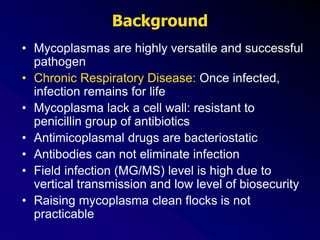
• Mycoplasmas are highly versatile and successful
pathogen
• Chronic Respiratory Disease: Once infected,
infection remains for life
• Mycoplasma lack a cell wall: resistant to
penicillin group of antibiotics
• Antimicoplasmal drugs are bacteriostatic
• Antibodies can not eliminate infection
• Field infection (MG/MS) level is high due to
vertical transmission and low level of biosecurity
• Raising mycoplasma clean flocks is not
practicable
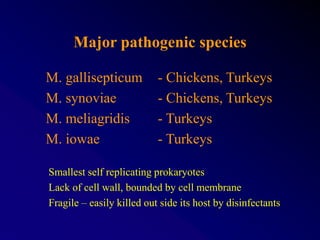
Major pathogenic species
M. gallisepticum - Chickens, Turkeys
M. synoviae - Chickens, Turkeys
M. meliagridis - Turkeys
M. iowae - Turkeys
Smallest self replicating prokaryotes
Lack of cell wall, bounded by cell membrane
Fragile – easily killed out side its host by disinfectants
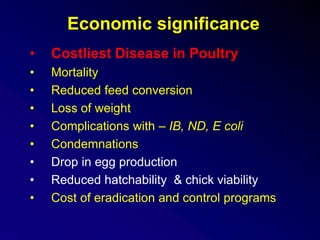
• Costliest Disease in Poultry
• Mortality
• Reduced feed conversion
• Loss of weight
• Complications with – IB, ND, E coli
• Condemnations
• Drop in egg production
• Reduced hatchability & chick viability
• Cost of eradication and control programs
Economic significance
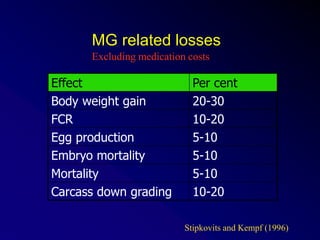
MG related losses
Effect Per cent
Body weight gain 20-30
FCR 10-20
Egg production 5-10
Embryo mortality 5-10
Mortality 5-10
Carcass down grading 10-20
Excluding medication costs
Stipkovits and Kempf (1996)
Transmission
• Horizontal
– Within a flock - contact or aerosols
– Between flocks - windborne
• Vertical
– Parent to the chick through egg
• Venereal
Target organs:
– Respiratory system
– Synovial membranes
– Reproductive system
Incubation period:
– Chronic slow spreading
– Varies from 6-21 days
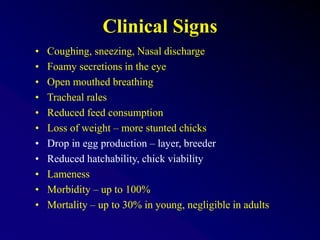
Clinical Signs
• Coughing, sneezing, Nasal discharge
• Foamy secretions in the eye
• Open mouthed breathing
• Tracheal rales
• Reduced feed consumption
• Loss of weight – more stunted chicks
• Drop in egg production – layer, breeder
• Reduced hatchability, chick viability
• Lameness
• Morbidity – up to 100%
• Mortality – up to 30% in young, negligible in adults
Gross Lesions
• Sinusitis and conjunctivitis
• Tracheitis with excessive mucus
• Airsacculitis
• Pneumonia
• Synovitis
• Osteomyelitis
• Salpingitis
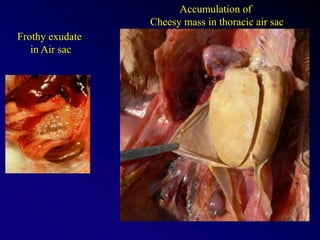
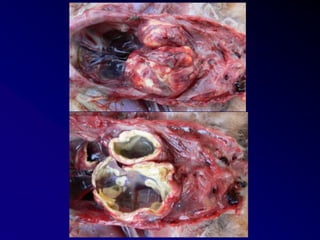
Frothy exudate
in Air sac
Accumulation of
Cheesy mass in thoracic air sac
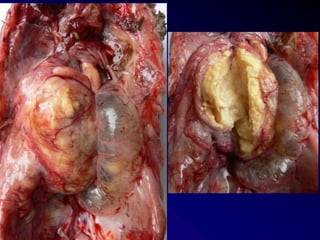
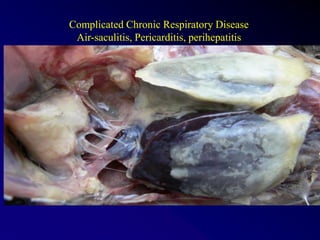
Complicated Chronic Respiratory Disease
Air-saculitis, Pericarditis, perihepatitis
To determine the prevalence of
M. gallisepticum from different
regions in Indian poultry industry
STUDY OBJECTIVE
Methodology
• Sampling
• Antibody detection by ELISA
• Isolation and Identification of MG
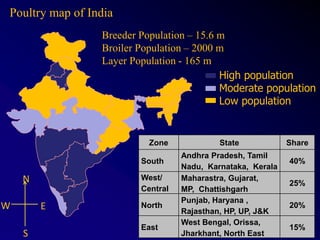
Breeder Population – 15.6 m
Broiler Population – 2000 m
Layer Population - 165 m
High population
Moderate population
Low population
Poultry map of India
N
E
S
W
Zone State Share
South
Andhra Pradesh, Tamil
Nadu, Karnataka, Kerala
40%
West/
Central
Maharastra, Gujarat,
MP, Chattishgarh
25%
North
Punjab, Haryana ,
Rajasthan, HP, UP, J&K
20%
East
West Bengal, Orissa,
Jharkhant, North East
15%
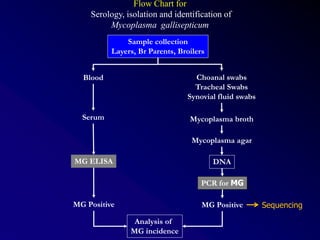
Flow Chart for
Serology, isolation and identification of
Mycoplasma gallisepticum
Sample collection
Layers, Br Parents, Broilers
Blood
Serum
MG ELISA
MG Positive
Choanal swabs
Tracheal Swabs
Synovial fluid swabs
Mycoplasma broth
Mycoplasma agar
DNA
PCR for MG
MG Positive
Analysis of
MG incidence
Sequencing
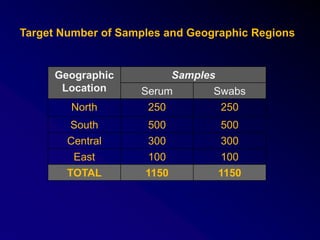
Geographic
Location
Samples
Serum Swabs
North 250 250
South 500 500
Central 300 300
East 100 100
TOTAL 1150 1150
Target Number of Samples and Geographic Regions
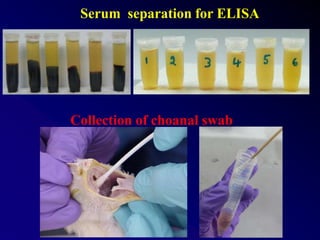
Serum separation for ELISA
Collection of choanal swab
Filling Sample Submission Form
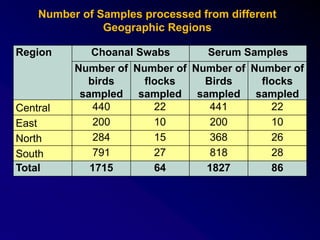
Number of Samples processed from different
Geographic Regions
Region Choanal Swabs Serum Samples
Number of
birds
sampled
Number of
flocks
sampled
Number of
Birds
sampled
Number of
flocks
sampled
Central 440 22 441 22
East 200 10 200 10
North 284 15 368 26
South 791 27 818 28
Total 1715 64 1827 86
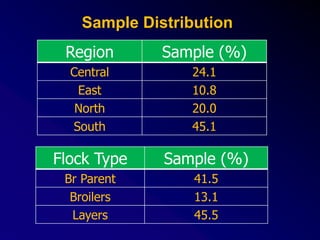
Sample Distribution
Region Sample (%)
Central 24.1
East 10.8
North 20.0
South 45.1
Flock Type Sample (%)
Br Parent 41.5
Broilers 13.1
Layers 45.5
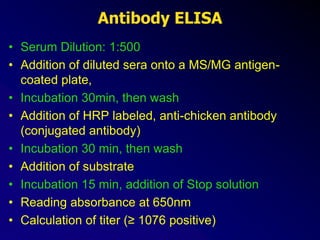
Antibody ELISA
• Serum Dilution: 1:500
• Addition of diluted sera onto a MS/MG antigen-
coated plate,
• Incubation 30min, then wash
• Addition of HRP labeled, anti-chicken antibody
(conjugated antibody)
• Incubation 30 min, then wash
• Addition of substrate
• Incubation 15 min, addition of Stop solution
• Reading absorbance at 650nm
• Calculation of titer (≥ 1076 positive)
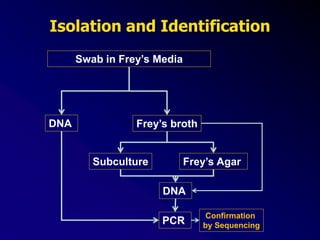
Isolation and Identification
Swab in Frey’s Media
DNA
Frey’s Agar
Frey’s broth
Subculture
DNA
PCR
Confirmation
by Sequencing
MG PCR Primers
Primer name Sequence Product size (bp)
MGC2 2F 5’-CGCAATTTGGTCCTAATCCCCAACA-3’
300
MGC2 2R 5’-TAA ACCCACCTCCAGCTTTATTTCC-3’
MG14F 5’-GAGCTAATCTGTAAAGTTGGTC-3’
185
MG13R 5’-GCTTCCTTGCGGTTAGCAAC-3’
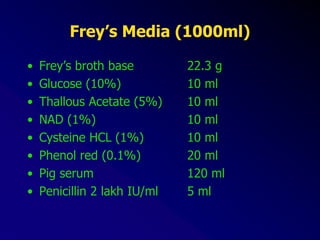
Frey’s Media (1000ml)
• Frey’s broth base 22.3 g
• Glucose (10%) 10 ml
• Thallous Acetate (5%) 10 ml
• NAD (1%) 10 ml
• Cysteine HCL (1%) 10 ml
• Phenol red (0.1%) 20 ml
• Pig serum 120 ml
• Penicillin 2 lakh IU/ml 5 ml
RESULTS
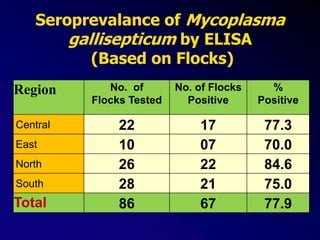
Seroprevalance of Mycoplasma
gallisepticum by ELISA
(Based on Flocks)
Region No. of
Flocks Tested
No. of Flocks
Positive
%
Positive
Central 22 17 77.3
East 10 07 70.0
North 26 22 84.6
South 28 21 75.0
Total 86 67 77.9
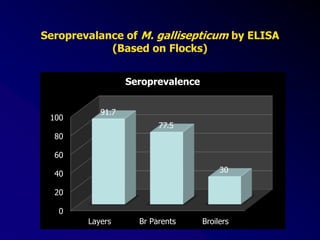
Seroprevalance of M. gallisepticum by ELISA
(Based on Flocks)
0
20
40
60
80
100
Layers Br Parents Broilers
91.7
77.5
30
Seroprevalence
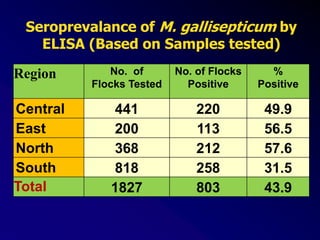
Seroprevalance of M. gallisepticum by
ELISA (Based on Samples tested)
Region No. of
Flocks Tested
No. of Flocks
Positive
%
Positive
Central 441 220 49.9
East 200 113 56.5
North 368 212 57.6
South 818 258 31.5
Total 1827 803 43.9
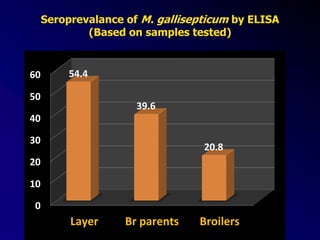
0
10
20
30
40
50
60
Layer Br parents Broilers
54.4
39.6
20.8
Seroprevalance of M. gallisepticum by ELISA
(Based on samples tested)
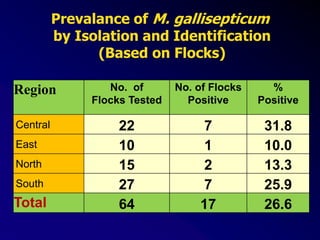
Prevalance of M. gallisepticum
by Isolation and Identification
(Based on Flocks)
Region No. of
Flocks Tested
No. of Flocks
Positive
%
Positive
Central 22 7 31.8
East 10 1 10.0
North 15 2 13.3
South 27 7 25.9
Total 64 17 26.6
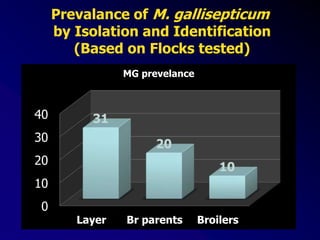
Prevalance of M. gallisepticum
by Isolation and Identification
(Based on Flocks tested)
0
10
20
30
40
Layer Br parents Broilers
31
20
10
MG prevelance
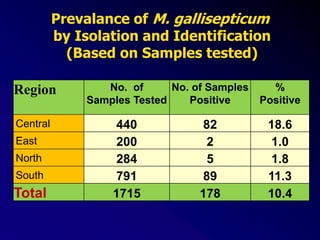
Prevalance of M. gallisepticum
by Isolation and Identification
(Based on Samples tested)
Region No. of
Samples Tested
No. of Samples
Positive
%
Positive
Central 440 82 18.6
East 200 2 1.0
North 284 5 1.8
South 791 89 11.3
Total 1715 178 10.4
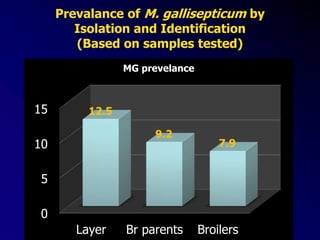
Prevalance of M. gallisepticum by
Isolation and Identification
(Based on samples tested)
0
5
10
15
Layer Br parents Broilers
12.5
9.2
7.9
MG prevelance
Thank you
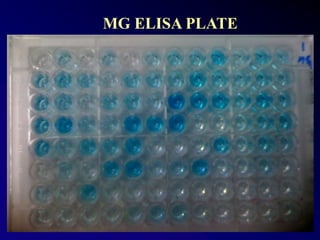
MG ELISA PLATE
Conclusions
• This study demonstrated the high prevalence of M.
gallisepticum infection in Commercial Layers, Broiler
Parents and Commercial Broilers in all major poultry
growing areas of the country.
• Because of high value of individual parent breeder
hen and their ability to infect progeny by vertical
transmission, economic losses are potentially more
severe when MG infection occurs in breeder flocks.
• The high prevalence and wide distribution of MG
infection warrants development and adaptation of
strategies to prevent or minimize economic impact
of MG infection.
Thank you

m-r-reddy-directorate-of-poultry-research-india.ppt

  • 1.
    Directorate of PoultryResearch (ISO 9001:2008 Certified Institution) Rajendranagar, Hyderabad-500 030 Prevalence of Mycoplasma gallisepticum Infection in Indian Poultry Farms M R Reddy Principal Scientist 2nd International Conference on Animal & Dairy Sciences
  • 2.
    Background • Mycoplasmas arehighly versatile and successful pathogen • Chronic Respiratory Disease: Once infected, infection remains for life • Mycoplasma lack a cell wall: resistant to penicillin group of antibiotics • Antimicoplasmal drugs are bacteriostatic • Antibodies can not eliminate infection • Field infection (MG/MS) level is high due to vertical transmission and low level of biosecurity • Raising mycoplasma clean flocks is not practicable
  • 3.
    Major pathogenic species M.gallisepticum - Chickens, Turkeys M. synoviae - Chickens, Turkeys M. meliagridis - Turkeys M. iowae - Turkeys Smallest self replicating prokaryotes Lack of cell wall, bounded by cell membrane Fragile – easily killed out side its host by disinfectants
  • 4.
    • Costliest Diseasein Poultry • Mortality • Reduced feed conversion • Loss of weight • Complications with – IB, ND, E coli • Condemnations • Drop in egg production • Reduced hatchability & chick viability • Cost of eradication and control programs Economic significance
  • 5.
    MG related losses EffectPer cent Body weight gain 20-30 FCR 10-20 Egg production 5-10 Embryo mortality 5-10 Mortality 5-10 Carcass down grading 10-20 Excluding medication costs Stipkovits and Kempf (1996)
  • 6.
    Transmission • Horizontal – Withina flock - contact or aerosols – Between flocks - windborne • Vertical – Parent to the chick through egg • Venereal
  • 7.
    Target organs: – Respiratorysystem – Synovial membranes – Reproductive system Incubation period: – Chronic slow spreading – Varies from 6-21 days
  • 8.
    Clinical Signs • Coughing,sneezing, Nasal discharge • Foamy secretions in the eye • Open mouthed breathing • Tracheal rales • Reduced feed consumption • Loss of weight – more stunted chicks • Drop in egg production – layer, breeder • Reduced hatchability, chick viability • Lameness • Morbidity – up to 100% • Mortality – up to 30% in young, negligible in adults
  • 9.
    Gross Lesions • Sinusitisand conjunctivitis • Tracheitis with excessive mucus • Airsacculitis • Pneumonia • Synovitis • Osteomyelitis • Salpingitis
  • 10.
    Frothy exudate in Airsac Accumulation of Cheesy mass in thoracic air sac
  • 13.
    Complicated Chronic RespiratoryDisease Air-saculitis, Pericarditis, perihepatitis
  • 14.
    To determine theprevalence of M. gallisepticum from different regions in Indian poultry industry STUDY OBJECTIVE
  • 15.
    Methodology • Sampling • Antibodydetection by ELISA • Isolation and Identification of MG
  • 16.
    Breeder Population –15.6 m Broiler Population – 2000 m Layer Population - 165 m High population Moderate population Low population Poultry map of India N E S W Zone State Share South Andhra Pradesh, Tamil Nadu, Karnataka, Kerala 40% West/ Central Maharastra, Gujarat, MP, Chattishgarh 25% North Punjab, Haryana , Rajasthan, HP, UP, J&K 20% East West Bengal, Orissa, Jharkhant, North East 15%
  • 17.
    Flow Chart for Serology,isolation and identification of Mycoplasma gallisepticum Sample collection Layers, Br Parents, Broilers Blood Serum MG ELISA MG Positive Choanal swabs Tracheal Swabs Synovial fluid swabs Mycoplasma broth Mycoplasma agar DNA PCR for MG MG Positive Analysis of MG incidence Sequencing
  • 18.
    Geographic Location Samples Serum Swabs North 250250 South 500 500 Central 300 300 East 100 100 TOTAL 1150 1150 Target Number of Samples and Geographic Regions
  • 19.
    Serum separation forELISA Collection of choanal swab
  • 20.
  • 21.
    Number of Samplesprocessed from different Geographic Regions Region Choanal Swabs Serum Samples Number of birds sampled Number of flocks sampled Number of Birds sampled Number of flocks sampled Central 440 22 441 22 East 200 10 200 10 North 284 15 368 26 South 791 27 818 28 Total 1715 64 1827 86
  • 22.
    Sample Distribution Region Sample(%) Central 24.1 East 10.8 North 20.0 South 45.1 Flock Type Sample (%) Br Parent 41.5 Broilers 13.1 Layers 45.5
  • 23.
    Antibody ELISA • SerumDilution: 1:500 • Addition of diluted sera onto a MS/MG antigen- coated plate, • Incubation 30min, then wash • Addition of HRP labeled, anti-chicken antibody (conjugated antibody) • Incubation 30 min, then wash • Addition of substrate • Incubation 15 min, addition of Stop solution • Reading absorbance at 650nm • Calculation of titer (≥ 1076 positive)
  • 24.
    Isolation and Identification Swabin Frey’s Media DNA Frey’s Agar Frey’s broth Subculture DNA PCR Confirmation by Sequencing
  • 25.
    MG PCR Primers Primername Sequence Product size (bp) MGC2 2F 5’-CGCAATTTGGTCCTAATCCCCAACA-3’ 300 MGC2 2R 5’-TAA ACCCACCTCCAGCTTTATTTCC-3’ MG14F 5’-GAGCTAATCTGTAAAGTTGGTC-3’ 185 MG13R 5’-GCTTCCTTGCGGTTAGCAAC-3’
  • 26.
    Frey’s Media (1000ml) •Frey’s broth base 22.3 g • Glucose (10%) 10 ml • Thallous Acetate (5%) 10 ml • NAD (1%) 10 ml • Cysteine HCL (1%) 10 ml • Phenol red (0.1%) 20 ml • Pig serum 120 ml • Penicillin 2 lakh IU/ml 5 ml
  • 27.
  • 28.
    Seroprevalance of Mycoplasma gallisepticumby ELISA (Based on Flocks) Region No. of Flocks Tested No. of Flocks Positive % Positive Central 22 17 77.3 East 10 07 70.0 North 26 22 84.6 South 28 21 75.0 Total 86 67 77.9
  • 29.
    Seroprevalance of M.gallisepticum by ELISA (Based on Flocks) 0 20 40 60 80 100 Layers Br Parents Broilers 91.7 77.5 30 Seroprevalence
  • 30.
    Seroprevalance of M.gallisepticum by ELISA (Based on Samples tested) Region No. of Flocks Tested No. of Flocks Positive % Positive Central 441 220 49.9 East 200 113 56.5 North 368 212 57.6 South 818 258 31.5 Total 1827 803 43.9
  • 31.
    0 10 20 30 40 50 60 Layer Br parentsBroilers 54.4 39.6 20.8 Seroprevalance of M. gallisepticum by ELISA (Based on samples tested)
  • 32.
    Prevalance of M.gallisepticum by Isolation and Identification (Based on Flocks) Region No. of Flocks Tested No. of Flocks Positive % Positive Central 22 7 31.8 East 10 1 10.0 North 15 2 13.3 South 27 7 25.9 Total 64 17 26.6
  • 33.
    Prevalance of M.gallisepticum by Isolation and Identification (Based on Flocks tested) 0 10 20 30 40 Layer Br parents Broilers 31 20 10 MG prevelance
  • 34.
    Prevalance of M.gallisepticum by Isolation and Identification (Based on Samples tested) Region No. of Samples Tested No. of Samples Positive % Positive Central 440 82 18.6 East 200 2 1.0 North 284 5 1.8 South 791 89 11.3 Total 1715 178 10.4
  • 35.
    Prevalance of M.gallisepticum by Isolation and Identification (Based on samples tested) 0 5 10 15 Layer Br parents Broilers 12.5 9.2 7.9 MG prevelance
  • 36.
  • 37.
    Conclusions • This studydemonstrated the high prevalence of M. gallisepticum infection in Commercial Layers, Broiler Parents and Commercial Broilers in all major poultry growing areas of the country. • Because of high value of individual parent breeder hen and their ability to infect progeny by vertical transmission, economic losses are potentially more severe when MG infection occurs in breeder flocks. • The high prevalence and wide distribution of MG infection warrants development and adaptation of strategies to prevent or minimize economic impact of MG infection.

  • 38.