Aero plane
lift
 Brief discussion of the 4 forces acting on a
plane
 Brief definition of the 4 forces
 Weight
 Drag
 Thrust
 Lift
 How lift is developed
 Two Perspectives on how lift is created
 Demonstrations
 Factors that affect lift
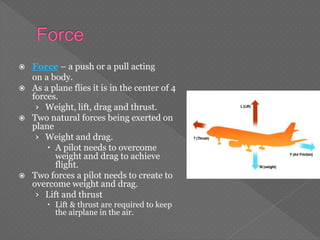
 Force – a push or a pull acting
on a body.
 As a plane flies it is in the center of 4
forces.
› Weight, lift, drag and thrust.
 Two natural forces being exerted on
plane
› Weight and drag.
 A pilot needs to overcome
weight and drag to achieve
flight.
 Two forces a pilot needs to create to
overcome weight and drag.
› Lift and thrust
 Lift & thrust are required to keep
the airplane in the air.
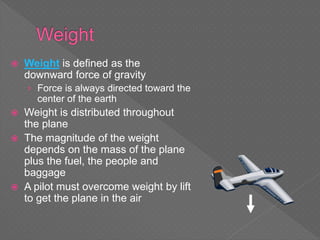
 Weight is defined as the
downward force of gravity
› Force is always directed toward the
center of the earth
 Weight is distributed throughout
the plane
 The magnitude of the weight
depends on the mass of the plane
plus the fuel, the people and
baggage
 A pilot must overcome weight by lift
to get the plane in the air
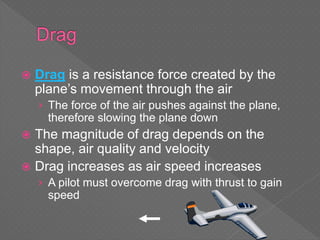
 Drag is a resistance force created by the
plane’s movement through the air
› The force of the air pushes against the plane,
therefore slowing the plane down
 The magnitude of drag depends on the
shape, air quality and velocity
 Drag increases as air speed increases
› A pilot must overcome drag with thrust to gain
speed
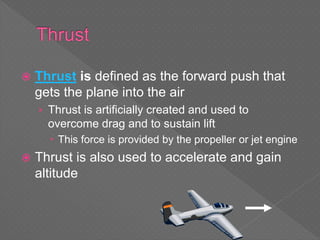
 Thrust is defined as the forward push that
gets the plane into the air
› Thrust is artificially created and used to
overcome drag and to sustain lift
 This force is provided by the propeller or jet engine
 Thrust is also used to accelerate and gain
altitude
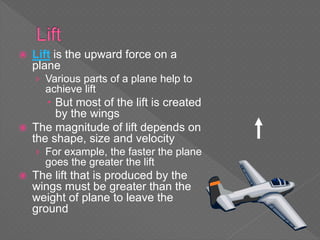
 Lift is the upward force on a
plane
› Various parts of a plane help to
achieve lift
 But most of the lift is created
by the wings
 The magnitude of lift depends on
the shape, size and velocity
› For example, the faster the plane
goes the greater the lift
 The lift that is produced by the
wings must be greater than the
weight of plane to leave the
ground
 Two explanations to help understand how lift is
created
 Both contribute to creating lift
 Bernoulli’s Principle
› Largely depends on the shape of the wing
› Concentrates on speeds and pressures in the
airstream
› Involves pressure imbalances
 Newtonian Explanation
› Largely depends on the tilt of the wing
› Concentrates on the acceleration of the passing
airstream
› Involves the deflection of the air stream
 Principal concept in aerodynamics is the idea
that air is a fluid
› Air has mass, therefore it has weight
 Because it has weight, it exerts pressure
› Air flows and behaves in a similar manner to
other liquids
› Air has molecules which are constantly
moving
 Lift can exist only in the presence of a moving
fluid
› Faster moving fluids exert less force on
surfaces they are flowing along
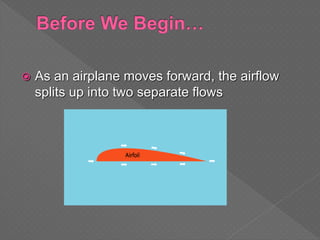
 As an airplane moves forward, the airflow
splits up into two separate flows
 Bernoulli’s Principle states that when the
speed of a moving fluid increases, the
pressure decreases and when the speed of
a moving fluid decreases, the pressure
increases.
 Air flowing around the wing experiences a change
in speed and each change in speed is accompanied
by a change in pressure
› Airflow going under the wing encounters a sloping surface
 Slows airflow down and slow moving air maintains a higher
pressure on the bottom surface
› Airflow going over the wing encounters the up/down
sloping
 Slows the airflow down, then it speeds it up; with the faster
moving air a lower pressure develops on the top surface
› Air going over must travel farther, so its average speed is
greater
than the speed of the air below
 Result: A reduction in sidewise pressure which occurs at the
top, exerting a lifting force on the entire wing
 Pressure imbalance produces an overall upward
force
Bernoulli principle derived from the Law of Conservation
of Energy
 A fluid under pressure has potential energy.
› Energy can be stored in pressurized air
› The higher the pressure the greater the potential energy
 Moving fluids have both potential energy and kinetic energy.
› Total energy must remain constant, so its potential energy
decreases, and which means its pressure decreases as well
› When the air’s speed and motional energy increase, the pressure
and pressure energy must decrease to compensate
 Speed increases over the wing because the airflow converts
some of its pressure energy into kinetic energ
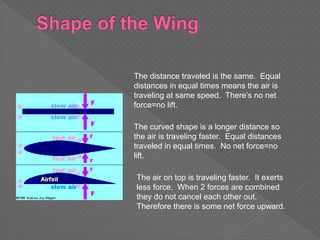
The distance traveled is the same. Equal
distances in equal times means the air is
traveling at same speed. There’s no net
force=no lift.
The curved shape is a longer distance so
the air is traveling faster. Equal distances
traveled in equal times. No net force=no
lift.
The air on top is traveling faster. It exerts
less force. When 2 forces are combined
they do not cancel each other out.
Therefore there is some net force upward.
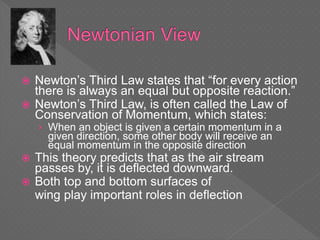
 Newton’s Third Law states that “for every action
there is always an equal but opposite reaction.”
 Newton’s Third Law, is often called the Law of
Conservation of Momentum, which states:
› When an object is given a certain momentum in a
given direction, some other body will receive an
equal momentum in the opposite direction
 This theory predicts that as the air stream
passes by, it is deflected downward.
 Both top and bottom surfaces of
wing play important roles in deflection
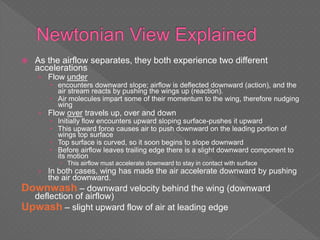
 As the airflow separates, they both experience two different
accelerations
› Flow under
 encounters downward slope; airflow is deflected downward (action), and the
air stream reacts by pushing the wings up (reaction).
 Air molecules impart some of their momentum to the wing, therefore nudging
wing
› Flow over travels up, over and down
 Initially flow encounters upward sloping surface-pushes it upward
 This upward force causes air to push downward on the leading portion of
wings top surface
 Top surface is curved, so it soon begins to slope downward
 Before airflow leaves trailing edge there is a slight downward component to
its motion
 This airflow must accelerate downward to stay in contact with surface
› In both cases, wing has made the air accelerate downward by pushing
the air downward.
Downwash – downward velocity behind the wing (downward
deflection of airflow)
Upwash – slight upward flow of air at leading edge
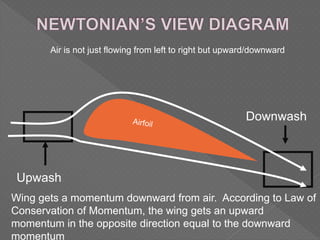
Air is not just flowing from left to right but upward/downward
Downwash
Upwash
Wing gets a momentum downward from air. According to Law of
Conservation of Momentum, the wing gets an upward
momentum in the opposite direction equal to the downward
momentum
 Speed
› The faster the wing moves through the air the more air is
forced over and under
 So a plane must maintain ample velocity to keep the upward
lifting force
 If it slows down too much—lift decreases—plane descend
 Density of air
› The denser the air the more lift (colder air is more dense; air
density changes with altitude)
 Planes climb better in winter.
 Shape of wing
› Asymmetrical
 Angle of attack (its tilt relative to the wind)
› Downside: increases drag
Done
By
Lithin Lal
How does flight fly

How does flight fly

  • 1.
  • 2.
     Brief discussionof the 4 forces acting on a plane  Brief definition of the 4 forces  Weight  Drag  Thrust  Lift  How lift is developed  Two Perspectives on how lift is created  Demonstrations  Factors that affect lift
  • 3.
     Force –a push or a pull acting on a body.  As a plane flies it is in the center of 4 forces. › Weight, lift, drag and thrust.  Two natural forces being exerted on plane › Weight and drag.  A pilot needs to overcome weight and drag to achieve flight.  Two forces a pilot needs to create to overcome weight and drag. › Lift and thrust  Lift & thrust are required to keep the airplane in the air.
  • 4.
     Weight isdefined as the downward force of gravity › Force is always directed toward the center of the earth  Weight is distributed throughout the plane  The magnitude of the weight depends on the mass of the plane plus the fuel, the people and baggage  A pilot must overcome weight by lift to get the plane in the air
  • 5.
     Drag isa resistance force created by the plane’s movement through the air › The force of the air pushes against the plane, therefore slowing the plane down  The magnitude of drag depends on the shape, air quality and velocity  Drag increases as air speed increases › A pilot must overcome drag with thrust to gain speed
  • 6.
     Thrust isdefined as the forward push that gets the plane into the air › Thrust is artificially created and used to overcome drag and to sustain lift  This force is provided by the propeller or jet engine  Thrust is also used to accelerate and gain altitude
  • 7.
     Lift isthe upward force on a plane › Various parts of a plane help to achieve lift  But most of the lift is created by the wings  The magnitude of lift depends on the shape, size and velocity › For example, the faster the plane goes the greater the lift  The lift that is produced by the wings must be greater than the weight of plane to leave the ground
  • 8.
     Two explanationsto help understand how lift is created  Both contribute to creating lift  Bernoulli’s Principle › Largely depends on the shape of the wing › Concentrates on speeds and pressures in the airstream › Involves pressure imbalances  Newtonian Explanation › Largely depends on the tilt of the wing › Concentrates on the acceleration of the passing airstream › Involves the deflection of the air stream
  • 9.
     Principal conceptin aerodynamics is the idea that air is a fluid › Air has mass, therefore it has weight  Because it has weight, it exerts pressure › Air flows and behaves in a similar manner to other liquids › Air has molecules which are constantly moving  Lift can exist only in the presence of a moving fluid › Faster moving fluids exert less force on surfaces they are flowing along
  • 10.
     As anairplane moves forward, the airflow splits up into two separate flows
  • 11.
     Bernoulli’s Principlestates that when the speed of a moving fluid increases, the pressure decreases and when the speed of a moving fluid decreases, the pressure increases.
  • 12.
     Air flowingaround the wing experiences a change in speed and each change in speed is accompanied by a change in pressure › Airflow going under the wing encounters a sloping surface  Slows airflow down and slow moving air maintains a higher pressure on the bottom surface › Airflow going over the wing encounters the up/down sloping  Slows the airflow down, then it speeds it up; with the faster moving air a lower pressure develops on the top surface › Air going over must travel farther, so its average speed is greater than the speed of the air below  Result: A reduction in sidewise pressure which occurs at the top, exerting a lifting force on the entire wing  Pressure imbalance produces an overall upward force
  • 13.
    Bernoulli principle derivedfrom the Law of Conservation of Energy  A fluid under pressure has potential energy. › Energy can be stored in pressurized air › The higher the pressure the greater the potential energy  Moving fluids have both potential energy and kinetic energy. › Total energy must remain constant, so its potential energy decreases, and which means its pressure decreases as well › When the air’s speed and motional energy increase, the pressure and pressure energy must decrease to compensate  Speed increases over the wing because the airflow converts some of its pressure energy into kinetic energ
  • 14.
    The distance traveledis the same. Equal distances in equal times means the air is traveling at same speed. There’s no net force=no lift. The curved shape is a longer distance so the air is traveling faster. Equal distances traveled in equal times. No net force=no lift. The air on top is traveling faster. It exerts less force. When 2 forces are combined they do not cancel each other out. Therefore there is some net force upward.
  • 15.
     Newton’s ThirdLaw states that “for every action there is always an equal but opposite reaction.”  Newton’s Third Law, is often called the Law of Conservation of Momentum, which states: › When an object is given a certain momentum in a given direction, some other body will receive an equal momentum in the opposite direction  This theory predicts that as the air stream passes by, it is deflected downward.  Both top and bottom surfaces of wing play important roles in deflection
  • 16.
     As theairflow separates, they both experience two different accelerations › Flow under  encounters downward slope; airflow is deflected downward (action), and the air stream reacts by pushing the wings up (reaction).  Air molecules impart some of their momentum to the wing, therefore nudging wing › Flow over travels up, over and down  Initially flow encounters upward sloping surface-pushes it upward  This upward force causes air to push downward on the leading portion of wings top surface  Top surface is curved, so it soon begins to slope downward  Before airflow leaves trailing edge there is a slight downward component to its motion  This airflow must accelerate downward to stay in contact with surface › In both cases, wing has made the air accelerate downward by pushing the air downward. Downwash – downward velocity behind the wing (downward deflection of airflow) Upwash – slight upward flow of air at leading edge
  • 17.
    Air is notjust flowing from left to right but upward/downward Downwash Upwash Wing gets a momentum downward from air. According to Law of Conservation of Momentum, the wing gets an upward momentum in the opposite direction equal to the downward momentum
  • 18.
     Speed › Thefaster the wing moves through the air the more air is forced over and under  So a plane must maintain ample velocity to keep the upward lifting force  If it slows down too much—lift decreases—plane descend  Density of air › The denser the air the more lift (colder air is more dense; air density changes with altitude)  Planes climb better in winter.  Shape of wing › Asymmetrical  Angle of attack (its tilt relative to the wind) › Downside: increases drag
  • 19.