AVAILABILITY OF WATER RESOURCES
M.CHAITHANYA KUMAR
ECE- ‘B’-13121A04A6
“ WATER = LIFE
CONSERVATION = FUTURE ”
A GLIMPSE OF CONTENTS
• Introduction
• Water resources
• Hydrological cycle
• Water resources in india
• Availability of water in india
• Conservation of water
• Impacts with out water
• Proverbs
INTRODUCTION
• Water is essential for human civilisation, living organisms, and natural
habitat. It has supernumeary applications in both domestic and industrial
purposes .
• Due to its multiple benefits and the problems created by its excesses,
shortages and quality deterioration, water as a resource requires special
attention.
• On a global scale, total quantity of water available is about 1600 million
cubic km. The hydrologic cycle moves enormous quantity of water around
the globe.
• However, much of the world’s water has little potential for human use
because 97.5% of all water on earth is saline water.
• Out of the remaining 2.5% freshwater, most of Which lies deep and frozen
in Antarctica and Greenland, only about 0.26% fish in rivers, lakes and in
the soils and shallow aquifiers which are readily usable for mankind.
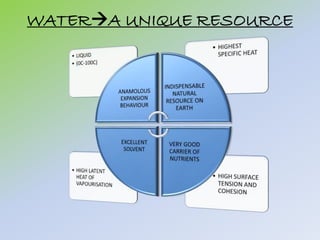
WATERA UNIQUE RESOURCE
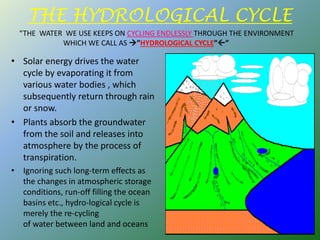
THE HYDROLOGICAL CYCLE
• Solar energy drives the water
cycle by evaporating it from
various water bodies , which
subsequently return through rain
or snow.
• Plants absorb the groundwater
from the soil and releases into
atmosphere by the process of
transpiration.
• Ignoring such long-term effects as
the changes in atmospheric storage
conditions, run-off filling the ocean
basins etc., hydro-logical cycle is
merely the re-cycling
of water between land and oceans
“THE WATER WE USE KEEPS ON CYCLING ENDLESSLY THROUGH THE ENVIRONMENT
WHICH WE CALL AS ”HYDROLOGICAL CYCLE””
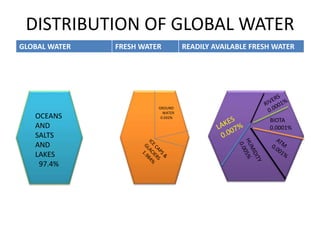
DISTRIBUTION OF GLOBAL WATER
GLOBAL WATER FRESH WATER READILY AVAILABLE FRESH WATER
OCEANS
AND
SALTS
AND
LAKES
97.4%
GROUND
WATER
0.592%
BIOTA
0.0001%
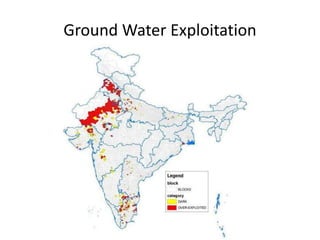
Ground Water Exploitation
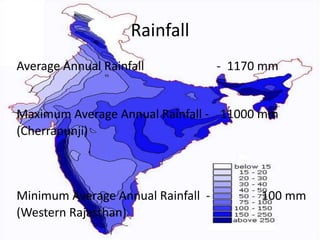
Rainfall
Average Annual Rainfall - 1170 mm
Maximum Average Annual Rainfall - 11000 mm
(Cherrapunji)
Minimum Average Annual Rainfall - 100 mm
(Western Rajasthan)
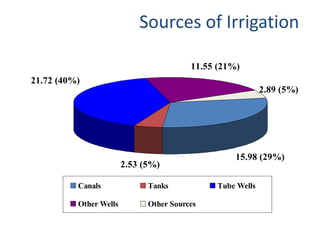
Sources of Irrigation
2.89 (5%)
2.53 (5%)
11.55 (21%)
15.98 (29%)
21.72 (40%)
Canals Tanks Tube Wells
Other Wells Other Sources
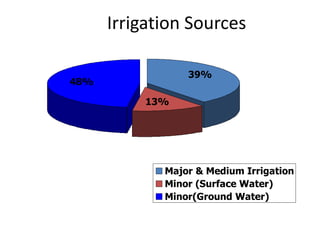
Irrigation Sources
39%
13%
48%
Major & Medium Irrigation
Minor (Surface Water)
Minor(Ground Water)
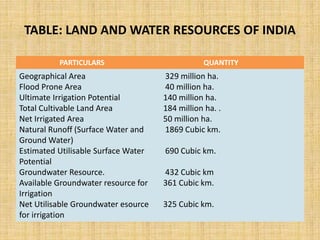
TABLE: LAND AND WATER RESOURCES OF INDIA
PARTICULARS QUANTITY
Geographical Area
Flood Prone Area
Ultimate Irrigation Potential
Total Cultivable Land Area
Net Irrigated Area
Natural Runoff (Surface Water and
Ground Water)
Estimated Utilisable Surface Water
Potential
Groundwater Resource.
Available Groundwater resource for
Irrigation
Net Utilisable Groundwater esource
for irrigation
329 million ha.
40 million ha.
140 million ha.
184 million ha. .
50 million ha.
1869 Cubic km.
690 Cubic km.
432 Cubic km
361 Cubic km.
325 Cubic km.
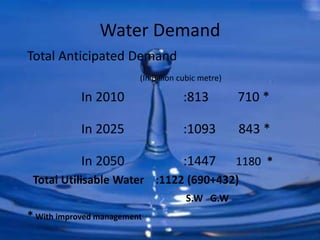
Water Demand
Total Anticipated Demand
(In Billion cubic metre)
In 2010 :813 710 *
In 2025 :1093 843 *
In 2050 :1447 1180 *
Total Utilisable Water :1122 (690+432)
S.W G.W
* With improved management
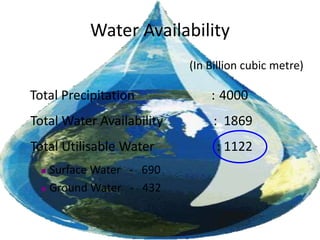
Water Availability
(In Billion cubic metre)
Total Precipitation : 4000
Total Water Availability : 1869
Total Utilisable Water : 1122
 Surface Water - 690
 Ground Water - 432
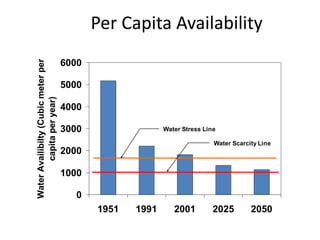
Per Capita Availability
0
1000
2000
3000
4000
5000
6000
1951 1991 2001 2025 2050
WaterAvailibilty(Cubicmeterper
capitaperyear)
Water Stress Line
Water Scarcity Line
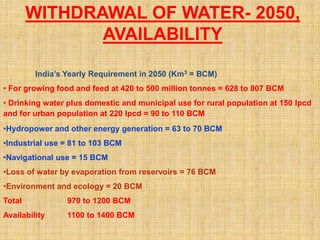
WITHDRAWAL OF WATER- 2050,
AVAILABILITY
India’s Yearly Requirement in 2050 (Km3 = BCM)
• For growing food and feed at 420 to 500 million tonnes = 628 to 807 BCM
• Drinking water plus domestic and municipal use for rural population at 150 lpcd
and for urban population at 220 lpcd = 90 to 110 BCM
•Hydropower and other energy generation = 63 to 70 BCM
•Industrial use = 81 to 103 BCM
•Navigational use = 15 BCM
•Loss of water by evaporation from reservoirs = 76 BCM
•Environment and ecology = 20 BCM
Total 970 to 1200 BCM
Availability 1100 to 1400 BCM
CONSERVATION OF WATER
• Efficiency of utilisation in all the diverse uses of water should
be optimised and an awareness of water as a scarce resource
should be fostered.
• Conservation consciousness should be promoted through
education, regulation, incentives and disincentives.
• The resources should be conserved and the availability
augmented by maximising retention, eliminating pollution
and minimising losses. For this, measures like lining in the
conveyance system, modernization and rehabilitation of
existing systems , recycling and re-use of treated effluents
and techniques like drip and sprinkler may be promoted.
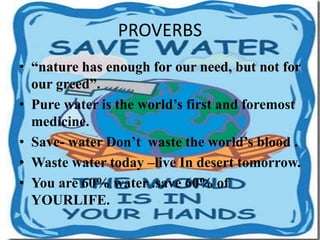
PROVERBS
• “nature has enough for our need, but not for
our greed”.
• Pure water is the world’s first and foremost
medicine.
• Save- water Don’t waste the world’s blood .
• Waste water today –live In desert tomorrow.
• You are 60% water .save 60% of
YOURLIFE.
Availability of water resources

Availability of water resources

  • 1.
    AVAILABILITY OF WATERRESOURCES M.CHAITHANYA KUMAR ECE- ‘B’-13121A04A6 “ WATER = LIFE CONSERVATION = FUTURE ”
  • 2.
    A GLIMPSE OFCONTENTS • Introduction • Water resources • Hydrological cycle • Water resources in india • Availability of water in india • Conservation of water • Impacts with out water • Proverbs
  • 3.
    INTRODUCTION • Water isessential for human civilisation, living organisms, and natural habitat. It has supernumeary applications in both domestic and industrial purposes . • Due to its multiple benefits and the problems created by its excesses, shortages and quality deterioration, water as a resource requires special attention. • On a global scale, total quantity of water available is about 1600 million cubic km. The hydrologic cycle moves enormous quantity of water around the globe. • However, much of the world’s water has little potential for human use because 97.5% of all water on earth is saline water. • Out of the remaining 2.5% freshwater, most of Which lies deep and frozen in Antarctica and Greenland, only about 0.26% fish in rivers, lakes and in the soils and shallow aquifiers which are readily usable for mankind.
  • 4.
  • 5.
    THE HYDROLOGICAL CYCLE •Solar energy drives the water cycle by evaporating it from various water bodies , which subsequently return through rain or snow. • Plants absorb the groundwater from the soil and releases into atmosphere by the process of transpiration. • Ignoring such long-term effects as the changes in atmospheric storage conditions, run-off filling the ocean basins etc., hydro-logical cycle is merely the re-cycling of water between land and oceans “THE WATER WE USE KEEPS ON CYCLING ENDLESSLY THROUGH THE ENVIRONMENT WHICH WE CALL AS ”HYDROLOGICAL CYCLE””
  • 6.
    DISTRIBUTION OF GLOBALWATER GLOBAL WATER FRESH WATER READILY AVAILABLE FRESH WATER OCEANS AND SALTS AND LAKES 97.4% GROUND WATER 0.592% BIOTA 0.0001%
  • 7.
  • 8.
    Rainfall Average Annual Rainfall- 1170 mm Maximum Average Annual Rainfall - 11000 mm (Cherrapunji) Minimum Average Annual Rainfall - 100 mm (Western Rajasthan)
  • 9.
    Sources of Irrigation 2.89(5%) 2.53 (5%) 11.55 (21%) 15.98 (29%) 21.72 (40%) Canals Tanks Tube Wells Other Wells Other Sources
  • 10.
    Irrigation Sources 39% 13% 48% Major &Medium Irrigation Minor (Surface Water) Minor(Ground Water)
  • 11.
    TABLE: LAND ANDWATER RESOURCES OF INDIA PARTICULARS QUANTITY Geographical Area Flood Prone Area Ultimate Irrigation Potential Total Cultivable Land Area Net Irrigated Area Natural Runoff (Surface Water and Ground Water) Estimated Utilisable Surface Water Potential Groundwater Resource. Available Groundwater resource for Irrigation Net Utilisable Groundwater esource for irrigation 329 million ha. 40 million ha. 140 million ha. 184 million ha. . 50 million ha. 1869 Cubic km. 690 Cubic km. 432 Cubic km 361 Cubic km. 325 Cubic km.
  • 12.
    Water Demand Total AnticipatedDemand (In Billion cubic metre) In 2010 :813 710 * In 2025 :1093 843 * In 2050 :1447 1180 * Total Utilisable Water :1122 (690+432) S.W G.W * With improved management
  • 13.
    Water Availability (In Billioncubic metre) Total Precipitation : 4000 Total Water Availability : 1869 Total Utilisable Water : 1122  Surface Water - 690  Ground Water - 432
  • 14.
    Per Capita Availability 0 1000 2000 3000 4000 5000 6000 19511991 2001 2025 2050 WaterAvailibilty(Cubicmeterper capitaperyear) Water Stress Line Water Scarcity Line
  • 15.
    WITHDRAWAL OF WATER-2050, AVAILABILITY India’s Yearly Requirement in 2050 (Km3 = BCM) • For growing food and feed at 420 to 500 million tonnes = 628 to 807 BCM • Drinking water plus domestic and municipal use for rural population at 150 lpcd and for urban population at 220 lpcd = 90 to 110 BCM •Hydropower and other energy generation = 63 to 70 BCM •Industrial use = 81 to 103 BCM •Navigational use = 15 BCM •Loss of water by evaporation from reservoirs = 76 BCM •Environment and ecology = 20 BCM Total 970 to 1200 BCM Availability 1100 to 1400 BCM
  • 16.
    CONSERVATION OF WATER •Efficiency of utilisation in all the diverse uses of water should be optimised and an awareness of water as a scarce resource should be fostered. • Conservation consciousness should be promoted through education, regulation, incentives and disincentives. • The resources should be conserved and the availability augmented by maximising retention, eliminating pollution and minimising losses. For this, measures like lining in the conveyance system, modernization and rehabilitation of existing systems , recycling and re-use of treated effluents and techniques like drip and sprinkler may be promoted.
  • 18.
    PROVERBS • “nature hasenough for our need, but not for our greed”. • Pure water is the world’s first and foremost medicine. • Save- water Don’t waste the world’s blood . • Waste water today –live In desert tomorrow. • You are 60% water .save 60% of YOURLIFE.