Water Conservation
The Facts and What We Can do About it.
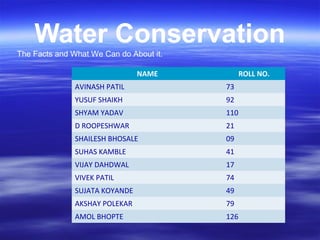
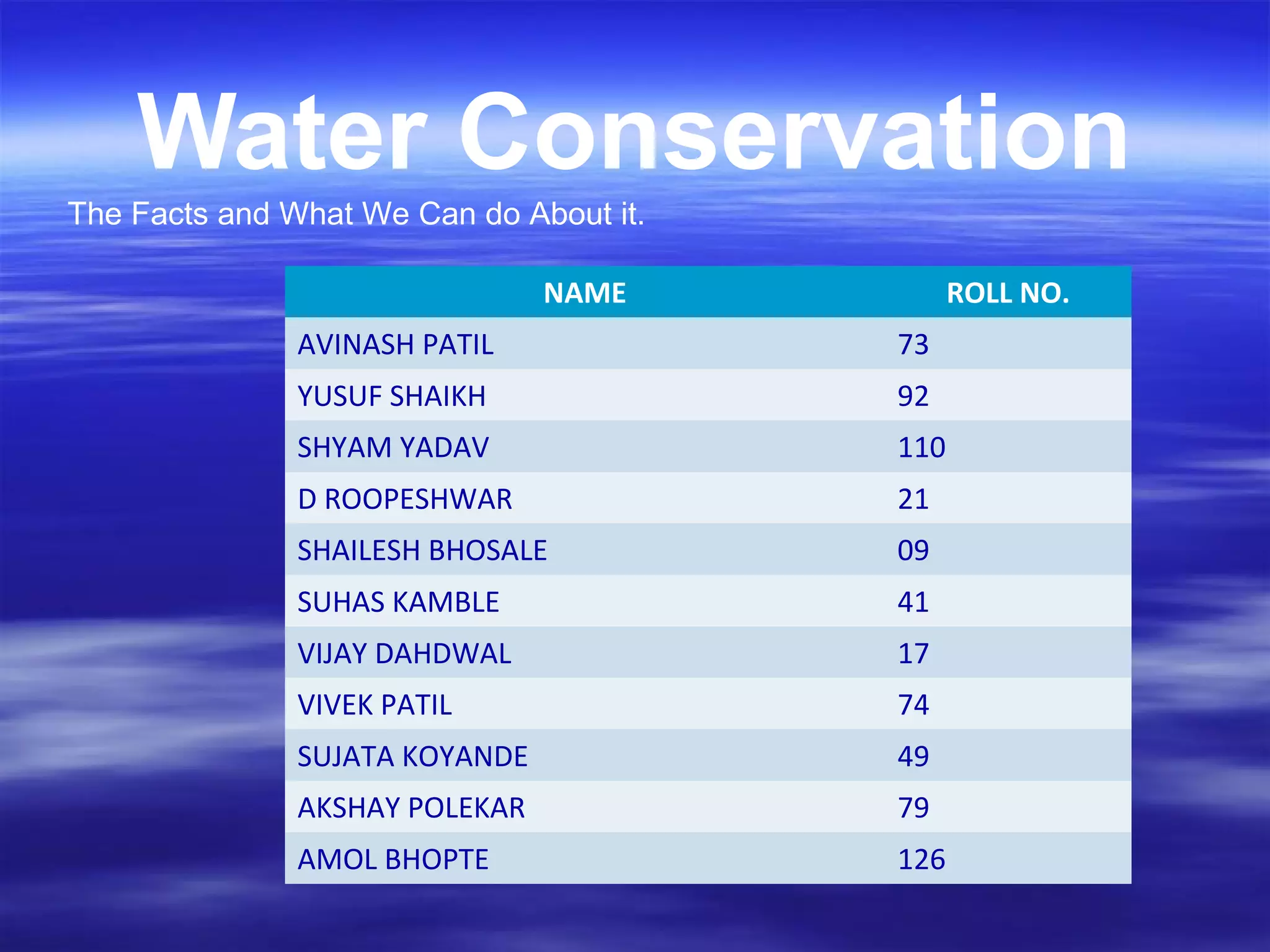
NAME ROLL NO.
AVINASH PATIL 73
YUSUF SHAIKH 92
SHYAM YADAV 110
D ROOPESHWAR 21
SHAILESH BHOSALE 09
SUHAS KAMBLE 41
VIJAY DAHDWAL 17
VIVEK PATIL 74
SUJATA KOYANDE 49
AKSHAY POLEKAR 79
AMOL BHOPTE 126
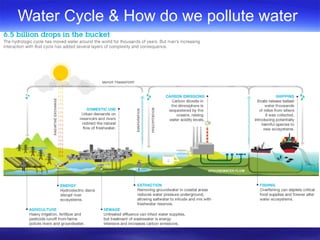
Water Cycle & How do we pollute water
What Is Water Conservation?
 Water conservation refers to reducing the
usage of water and recycling of waste water
for different purposes such as residential,
cleaning, manufacturing, and agricultural
irrigation.
 Any beneficial reduction in water loss, use
or waste.Improved water management
practices that reduce or enhance the
beneficial use of water.
Water Availibilty
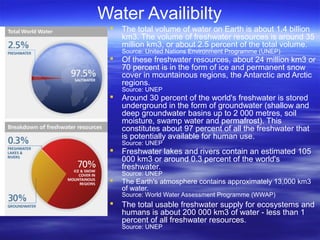
 The total volume of water on Earth is about 1.4 billion
km3. The volume of freshwater resources is around 35
million km3, or about 2.5 percent of the total volume.
Source: United Nations Environment Programme (UNEP)
 Of these freshwater resources, about 24 million km3 or
70 percent is in the form of ice and permanent snow
cover in mountainous regions, the Antarctic and Arctic
regions.
Source: UNEP
 Around 30 percent of the world's freshwater is stored
underground in the form of groundwater (shallow and
deep groundwater basins up to 2 000 metres, soil
moisture, swamp water and permafrost). This
constitutes about 97 percent of all the freshwater that
is potentially available for human use.
Source: UNEP
 Freshwater lakes and rivers contain an estimated 105
000 km3 or around 0.3 percent of the world's
freshwater.
Source: UNEP
 The Earth's atmosphere contains approximately 13,000 km3
of water.
Source: World Water Assessment Programme (WWAP)
 The total usable freshwater supply for ecosystems and
humans is about 200 000 km3 of water - less than 1
percent of all freshwater resources.
Source: UNEP
Water Uses
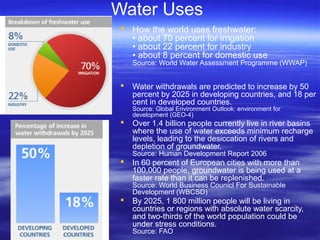
 How the world uses freshwater:
• about 70 percent for irrigation
• about 22 percent for industry
• about 8 percent for domestic use
Source: World Water Assessment Programme (WWAP)
 Water withdrawals are predicted to increase by 50
percent by 2025 in developing countries, and 18 per
cent in developed countries.
Source: Global Environment Outlook: environment for
development (GEO-4)
 Over 1.4 billion people currently live in river basins
where the use of water exceeds minimum recharge
levels, leading to the desiccation of rivers and
depletion of groundwater.
Source: Human Development Report 2006
 In 60 percent of European cities with more than
100,000 people, groundwater is being used at a
faster rate than it can be replenished.
Source: World Business Counicl For Sustainable
Development (WBCSD)
 By 2025, 1 800 million people will be living in
countries or regions with absolute water scarcity,
and two-thirds of the world population could be
under stress conditions.
Source: FAO
Water Uses
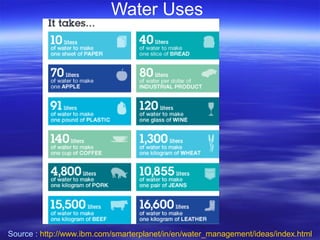
Source : http://www.ibm.com/smarterplanet/in/en/water_management/ideas/index.html
Water Demand
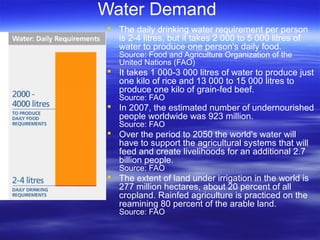
 The daily drinking water requirement per person
is 2-4 litres, but it takes 2 000 to 5 000 litres of
water to produce one person's daily food.
Source: Food and Agriculture Organization of the
United Nations (FAO)
 It takes 1 000-3 000 litres of water to produce just
one kilo of rice and 13 000 to 15 000 litres to
produce one kilo of grain-fed beef.
Source: FAO
 In 2007, the estimated number of undernourished
people worldwide was 923 million.
Source: FAO
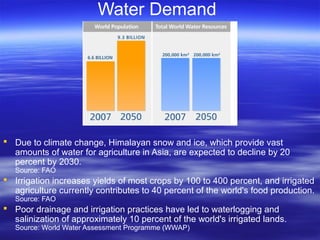
 Over the period to 2050 the world's water will
have to support the agricultural systems that will
feed and create livelihoods for an additional 2.7
billion people.
Source: FAO
 The extent of land under irrigation in the world is
277 million hectares, about 20 percent of all
cropland. Rainfed agriculture is practiced on the
reamining 80 percent of the arable land.
Source: FAO
Water Demand
 Due to climate change, Himalayan snow and ice, which provide vast
amounts of water for agriculture in Asia, are expected to decline by 20
percent by 2030.
Source: FAO
 Irrigation increases yields of most crops by 100 to 400 percent, and irrigated
agriculture currently contributes to 40 percent of the world's food production.
Source: FAO
 Poor drainage and irrigation practices have led to waterlogging and
salinization of approximately 10 percent of the world's irrigated lands.
Source: World Water Assessment Programme (WWAP)
8 Ps
 Product(Objective) - Public outreach campaign
 Price – Cost of Advertising material,Salaries of Govt.
employees, Valuable time of N.S.S. & N.G.O. members
 Place – Mumbai ( Being metro city ), School, College,
Community Social Programs, Govt. Bldg, Industrial Summit
 Promotion – Media Campaign in School, Seminar in
Colleges, Speech on Conservation of Water by Community
Leaders in Social & Community programs, Documentaries
& Panel Discussion in Channels
 Public –
Internal – Ministry of Water Resources, Local Govt.
Bodies, NGO, NSS
External – General Public & Industries
8 Ps
 Partnership – Local NGO, Chamber of Commerce,
Local & National Media
 Policy – To make aware about water crisis & make them
conserve water by avoiding wastage of it.
 Purse string – Funds provided by
Local Bodies, Ministry of Water Resources, Foundation,
CSR funds, Donations
 THANK YOU

Water conservation social mktg

  • 1.
    Water Conservation The Factsand What We Can do About it. NAME ROLL NO. AVINASH PATIL 73 YUSUF SHAIKH 92 SHYAM YADAV 110 D ROOPESHWAR 21 SHAILESH BHOSALE 09 SUHAS KAMBLE 41 VIJAY DAHDWAL 17 VIVEK PATIL 74 SUJATA KOYANDE 49 AKSHAY POLEKAR 79 AMOL BHOPTE 126
  • 2.
    Water Cycle &How do we pollute water
  • 3.
    What Is WaterConservation?  Water conservation refers to reducing the usage of water and recycling of waste water for different purposes such as residential, cleaning, manufacturing, and agricultural irrigation.  Any beneficial reduction in water loss, use or waste.Improved water management practices that reduce or enhance the beneficial use of water.
  • 4.
    Water Availibilty  Thetotal volume of water on Earth is about 1.4 billion km3. The volume of freshwater resources is around 35 million km3, or about 2.5 percent of the total volume. Source: United Nations Environment Programme (UNEP)  Of these freshwater resources, about 24 million km3 or 70 percent is in the form of ice and permanent snow cover in mountainous regions, the Antarctic and Arctic regions. Source: UNEP  Around 30 percent of the world's freshwater is stored underground in the form of groundwater (shallow and deep groundwater basins up to 2 000 metres, soil moisture, swamp water and permafrost). This constitutes about 97 percent of all the freshwater that is potentially available for human use. Source: UNEP  Freshwater lakes and rivers contain an estimated 105 000 km3 or around 0.3 percent of the world's freshwater. Source: UNEP  The Earth's atmosphere contains approximately 13,000 km3 of water. Source: World Water Assessment Programme (WWAP)  The total usable freshwater supply for ecosystems and humans is about 200 000 km3 of water - less than 1 percent of all freshwater resources. Source: UNEP
  • 5.
    Water Uses  Howthe world uses freshwater: • about 70 percent for irrigation • about 22 percent for industry • about 8 percent for domestic use Source: World Water Assessment Programme (WWAP)  Water withdrawals are predicted to increase by 50 percent by 2025 in developing countries, and 18 per cent in developed countries. Source: Global Environment Outlook: environment for development (GEO-4)  Over 1.4 billion people currently live in river basins where the use of water exceeds minimum recharge levels, leading to the desiccation of rivers and depletion of groundwater. Source: Human Development Report 2006  In 60 percent of European cities with more than 100,000 people, groundwater is being used at a faster rate than it can be replenished. Source: World Business Counicl For Sustainable Development (WBCSD)  By 2025, 1 800 million people will be living in countries or regions with absolute water scarcity, and two-thirds of the world population could be under stress conditions. Source: FAO
  • 6.
    Water Uses Source :http://www.ibm.com/smarterplanet/in/en/water_management/ideas/index.html
  • 7.
    Water Demand  Thedaily drinking water requirement per person is 2-4 litres, but it takes 2 000 to 5 000 litres of water to produce one person's daily food. Source: Food and Agriculture Organization of the United Nations (FAO)  It takes 1 000-3 000 litres of water to produce just one kilo of rice and 13 000 to 15 000 litres to produce one kilo of grain-fed beef. Source: FAO  In 2007, the estimated number of undernourished people worldwide was 923 million. Source: FAO  Over the period to 2050 the world's water will have to support the agricultural systems that will feed and create livelihoods for an additional 2.7 billion people. Source: FAO  The extent of land under irrigation in the world is 277 million hectares, about 20 percent of all cropland. Rainfed agriculture is practiced on the reamining 80 percent of the arable land. Source: FAO
  • 8.
    Water Demand  Dueto climate change, Himalayan snow and ice, which provide vast amounts of water for agriculture in Asia, are expected to decline by 20 percent by 2030. Source: FAO  Irrigation increases yields of most crops by 100 to 400 percent, and irrigated agriculture currently contributes to 40 percent of the world's food production. Source: FAO  Poor drainage and irrigation practices have led to waterlogging and salinization of approximately 10 percent of the world's irrigated lands. Source: World Water Assessment Programme (WWAP)
  • 9.
    8 Ps  Product(Objective)- Public outreach campaign  Price – Cost of Advertising material,Salaries of Govt. employees, Valuable time of N.S.S. & N.G.O. members  Place – Mumbai ( Being metro city ), School, College, Community Social Programs, Govt. Bldg, Industrial Summit  Promotion – Media Campaign in School, Seminar in Colleges, Speech on Conservation of Water by Community Leaders in Social & Community programs, Documentaries & Panel Discussion in Channels  Public – Internal – Ministry of Water Resources, Local Govt. Bodies, NGO, NSS External – General Public & Industries
  • 10.
    8 Ps  Partnership– Local NGO, Chamber of Commerce, Local & National Media  Policy – To make aware about water crisis & make them conserve water by avoiding wastage of it.  Purse string – Funds provided by Local Bodies, Ministry of Water Resources, Foundation, CSR funds, Donations
  • 11.