Presented by :
Rahmatullah
Example 1: Google’s Self Driving Car/ Waymo
Google’s self-driving prototypes rely on their
sensors and software to drive themselves.
Commercial self driving car in callifornia (US)
Example 2: DARPA Urban Challenge
 Introduction
 What do you mean by Autonomous Car?
 What is the need of this type of car?
 History
 Limitations
 Components
 Advantages
 Disadvantages
 Present Scenario
 Conclusion
CONTENTS
INTRODUCTION
What do you mean by Autonomous Car?
 word autonomous is derived from a Greek roots.
Autonomous = autos + nomos
(SELF) (GOVERN)
 An Autonomous car or a self driving car is a vehicle that is
capable of sensing its environment and navigating without
human inputs.
 What is the need of this type of car?
Driver error is the most common cause of traffic
accidents.
India contributes 6 % of the world's road accident deaths.
Cell phones in-car ,entertainment systems, more traffic
and more complicated road systems making it more
frequent.
Experiments have been conducted on automating cars since the
1920s.
The first self-sufficient and truly autonomous cars appeared in the
1980s
Since then numerous major companies have developed working
prototype of autonomous car
HISTORY
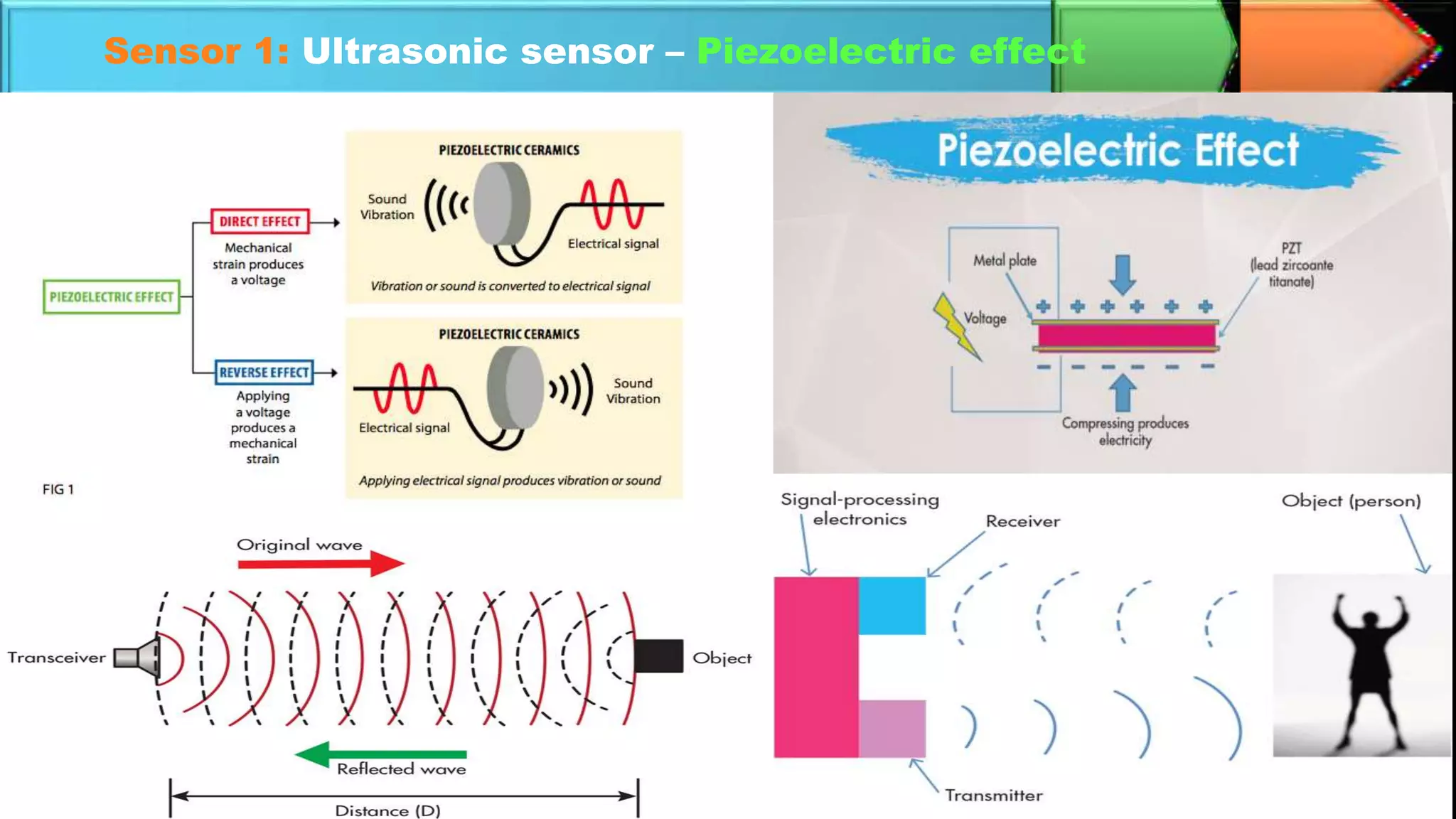
Sensor 1: Ultrasonic sensor – Piezoelectric effect
Sensor 1: Ultrasonic sensor
These are used for Blind Spot detection as well as to
detect nearby objects or measure the position of other
vehicles during parking.
 These sensors are mounted on the left rear wheel of a
vehicle.
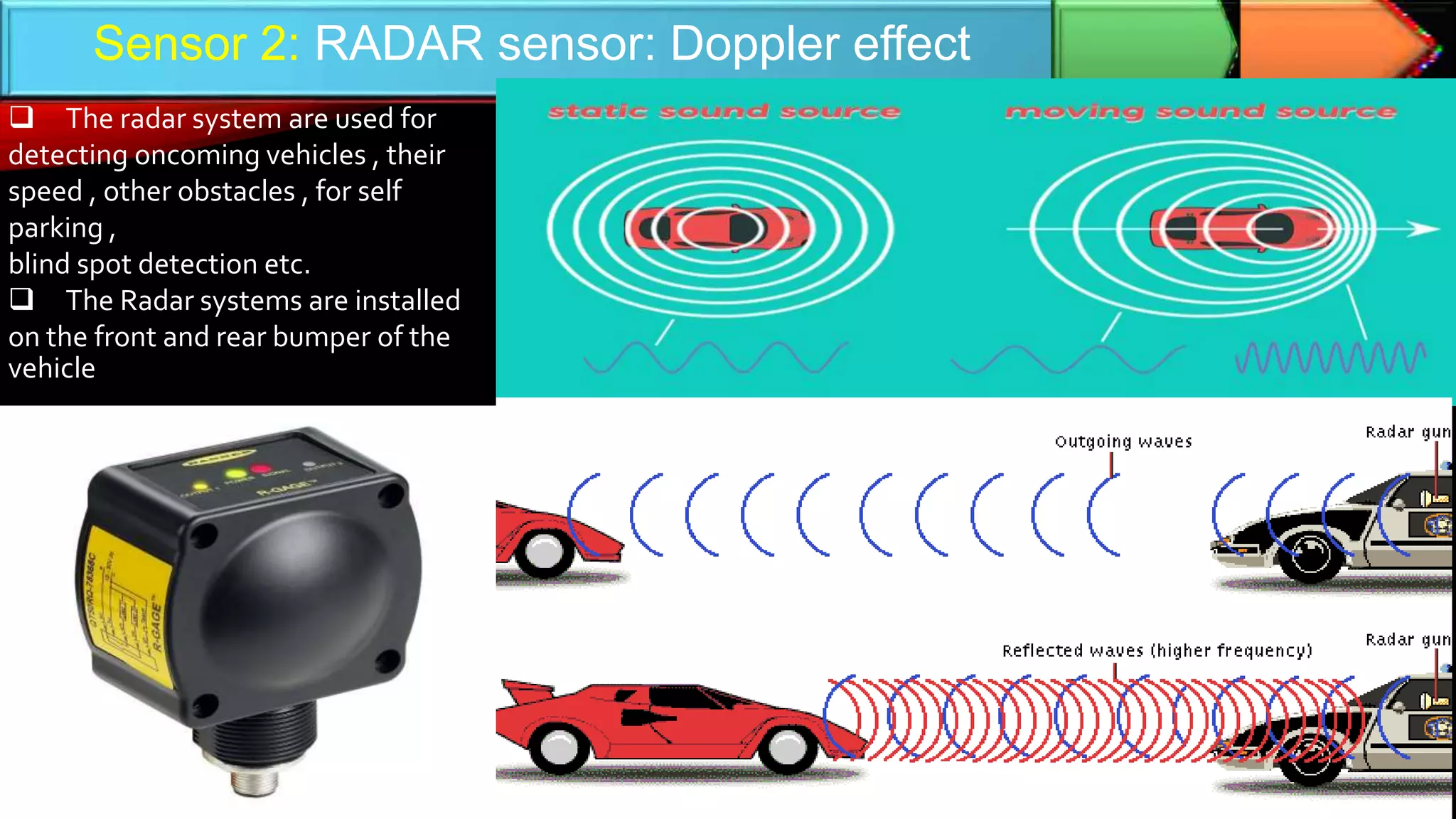
Sensor 2: RADAR sensor: Doppler effect
 The radar system are used for
detecting oncoming vehicles , their
speed , other obstacles , for self
parking ,
blind spot detection etc.
 The Radar systems are installed
on the front and rear bumper of the
vehicle
Sensor 3: LIDAR sensor
LIDAR system
It uses laser, ultra violet, visible light or infrared
light to image objects.
 A rotating, roof-mounted LIDAR (Light Detection
and Ranging) sensor monitors a 60-meter range
around the car and creates a dynamic 3-D map of
the car’s current environment.
Sensor 4: Image Sensor – Computer Vision
An image sensor is the soul of a camera. It is used to
determine image size , resolution , low-light performance,
depth of field, dynamic range, lenses and even
the camera’s physical size.
 VIDEO CAMERAS:
 Video cameras are installed at the top of the front glass,
near the rear view mirror.
 These are used to detect the traffic lights, traffic signs,
pedestrians etc.They also detect different road signs like
“ STOP” signs, zebra crossings, sign Boards etc.
5. GPS Sensor – Working principle
GPS uses satellites to gather information about the current position of the vehicle.
INERTIAL MEASUREMENT UNIT(IMU)
 Data from GPS alone is less accurate . So , this data is
combined with outputs from the IMU.
 IMU uses a combination of accelerometers, gyroscopes
and magnetometers.
“
”
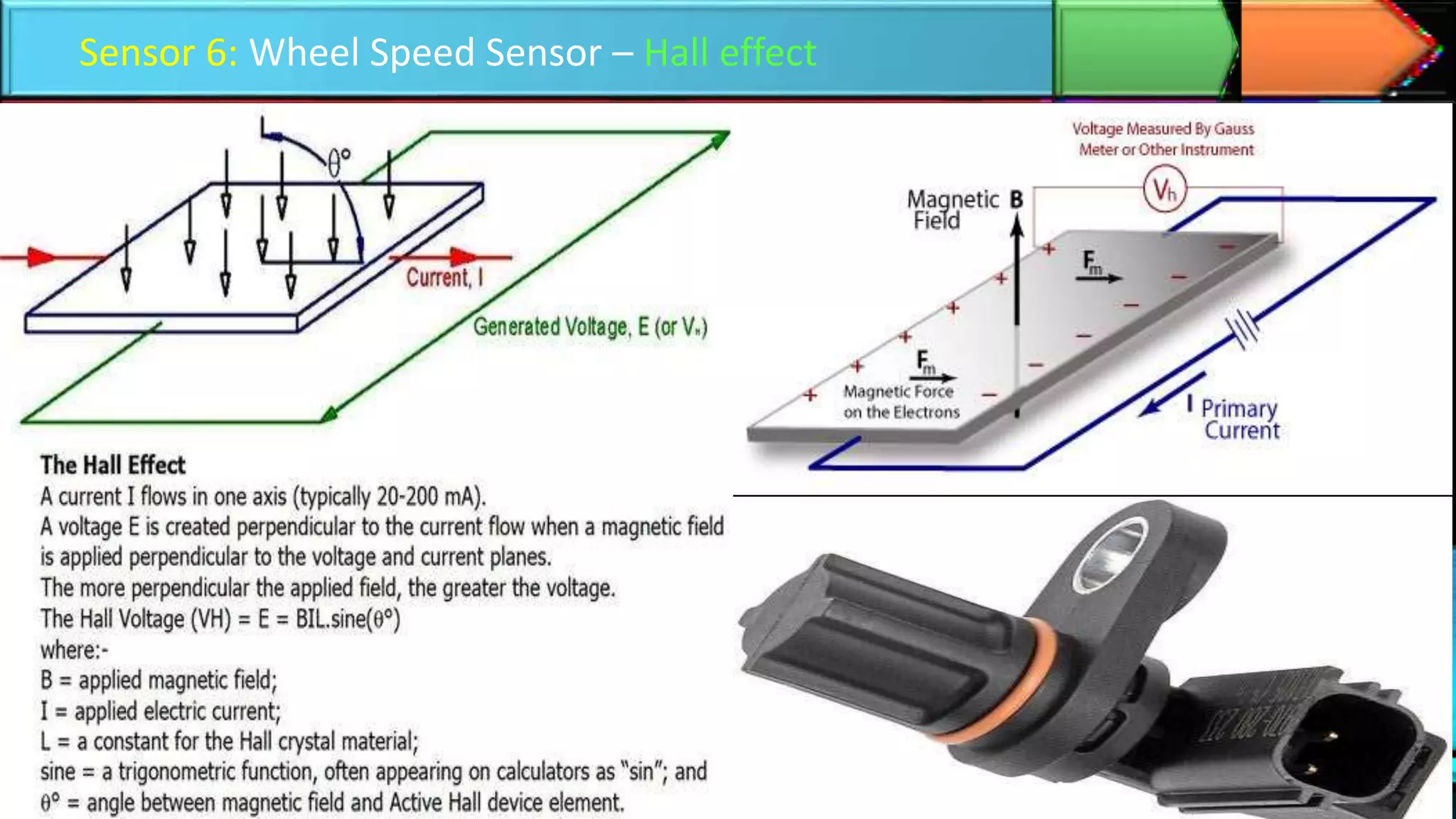
Sensor 6: Wheel Speed Sensor – Hall effect
V2X Communication
Cars will talk to other cars, exchanging data and alerting drivers to
potential collisions. They’ll talk to sensors on signs on stoplights,
bus stops, to get traffic updates and rerouting alerts.
The main motivations for V2X are road safety, traffic
efficiency, and energy savings. There are two types of
V2X communication technology
1.WLAN-based, and
2.cellular-based.
Location of sensors
Advantages
 Safety drive
 Time save
 Current location can be find through GPS
 Choose the shortest path for their destination
 Fuel save
 Maximum utilization of parking space
 Follow the traffic rules
 Perfect breaking
 Chances of hacking
 Failure of sensor leads to accident
 Loss of privacy
 Can be used for terrorism
Disadvantages
LIMITATIONS
• If the vehicle is using internet which is having less
security then hackers can be switched off on the
road(in rare cases)
• Hackers can change the route which is plotted in the
system(in rare cases)
• In case of failure of main sensor and backup sensors
the vehicle can create a chance of accident
 Heavy rainfall affect the functionality of roof
mounted sensors( ie. LIDAR)
 Mercedes-Benz
 Bosch
 Nissan
 Toyota
 Audi
 Volvo
 Google etc
 Companies have developed working prototype
Present Scenario
In phoenix capital of Arizona ( in state of US ), the commercial self driving car
waymo 1 launched in 5 December 2018 .public of phoenix call through mobile
APP for transportation service.
Conclusion
In conclusion, upon addressing the mechanics of the driverless car as
well as its benefits and potential issues, it is quite interesting to see
how the world will actually become by the year 2040. Sensors that are
an integral part of an autonomous vehicle will become more
sophisticated and will potentially have more functionality addition in
the near future.
It is fascinating to see the effects this creation will have on the states
in which it is legalized as well as on the people that have chosen to
experiment with it.
THANKS FOR
OVERWHELMED ATTENSION

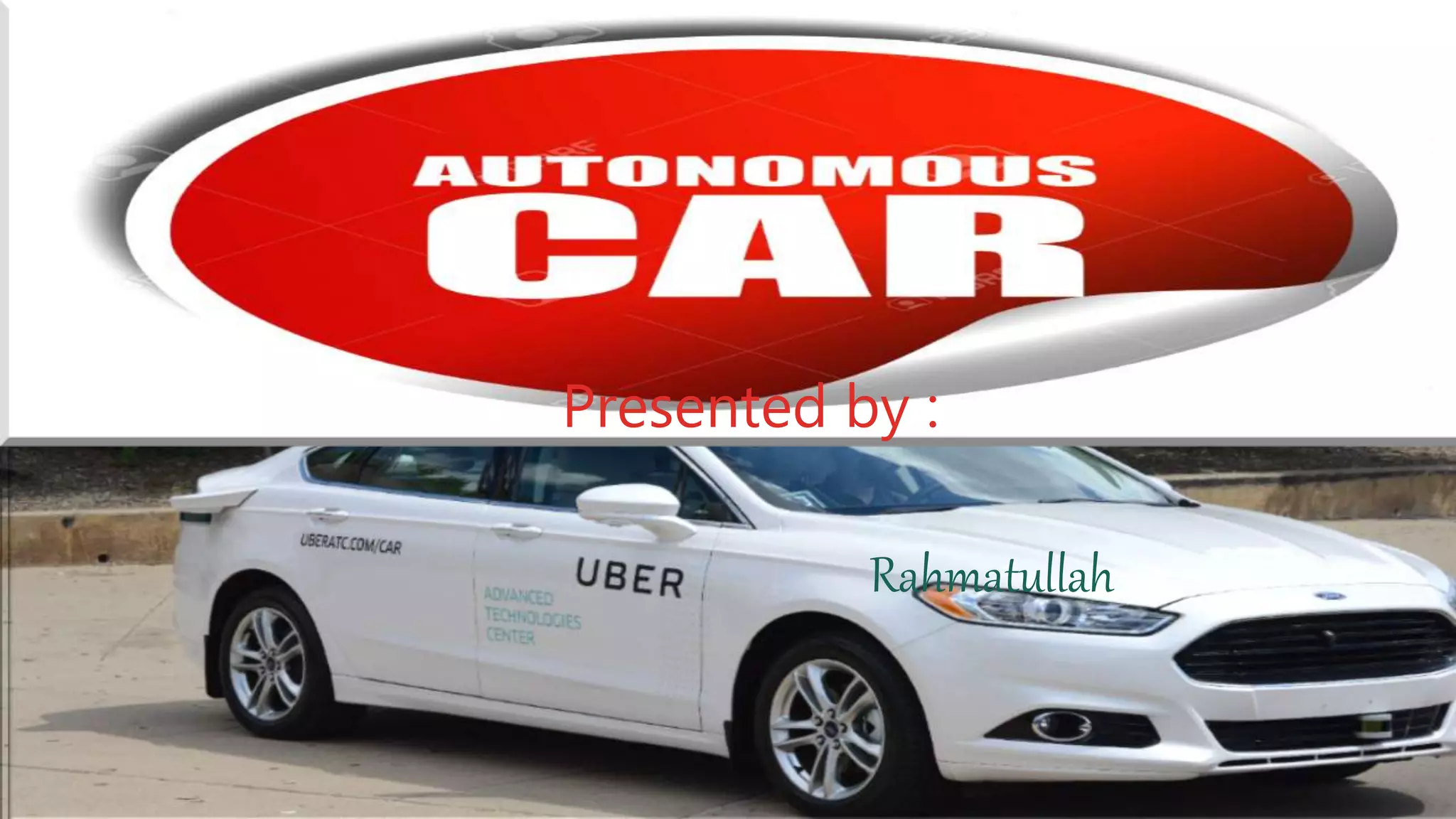
Autonomous car presentation

  • 1.
  • 2.
    Example 1: Google’sSelf Driving Car/ Waymo Google’s self-driving prototypes rely on their sensors and software to drive themselves. Commercial self driving car in callifornia (US)
  • 3.
    Example 2: DARPAUrban Challenge
  • 4.
     Introduction  Whatdo you mean by Autonomous Car?  What is the need of this type of car?  History  Limitations  Components  Advantages  Disadvantages  Present Scenario  Conclusion CONTENTS
  • 5.
    INTRODUCTION What do youmean by Autonomous Car?  word autonomous is derived from a Greek roots. Autonomous = autos + nomos (SELF) (GOVERN)  An Autonomous car or a self driving car is a vehicle that is capable of sensing its environment and navigating without human inputs.  What is the need of this type of car? Driver error is the most common cause of traffic accidents. India contributes 6 % of the world's road accident deaths. Cell phones in-car ,entertainment systems, more traffic and more complicated road systems making it more frequent.
  • 6.
    Experiments have beenconducted on automating cars since the 1920s. The first self-sufficient and truly autonomous cars appeared in the 1980s Since then numerous major companies have developed working prototype of autonomous car HISTORY
  • 8.
    Sensor 1: Ultrasonicsensor – Piezoelectric effect
  • 9.
    Sensor 1: Ultrasonicsensor These are used for Blind Spot detection as well as to detect nearby objects or measure the position of other vehicles during parking.  These sensors are mounted on the left rear wheel of a vehicle.
  • 10.
    Sensor 2: RADARsensor: Doppler effect  The radar system are used for detecting oncoming vehicles , their speed , other obstacles , for self parking , blind spot detection etc.  The Radar systems are installed on the front and rear bumper of the vehicle
  • 11.
    Sensor 3: LIDARsensor LIDAR system It uses laser, ultra violet, visible light or infrared light to image objects.  A rotating, roof-mounted LIDAR (Light Detection and Ranging) sensor monitors a 60-meter range around the car and creates a dynamic 3-D map of the car’s current environment.
  • 12.
    Sensor 4: ImageSensor – Computer Vision An image sensor is the soul of a camera. It is used to determine image size , resolution , low-light performance, depth of field, dynamic range, lenses and even the camera’s physical size.  VIDEO CAMERAS:  Video cameras are installed at the top of the front glass, near the rear view mirror.  These are used to detect the traffic lights, traffic signs, pedestrians etc.They also detect different road signs like “ STOP” signs, zebra crossings, sign Boards etc.
  • 13.
    5. GPS Sensor– Working principle GPS uses satellites to gather information about the current position of the vehicle. INERTIAL MEASUREMENT UNIT(IMU)  Data from GPS alone is less accurate . So , this data is combined with outputs from the IMU.  IMU uses a combination of accelerometers, gyroscopes and magnetometers.
  • 14.
    “ ” Sensor 6: WheelSpeed Sensor – Hall effect
  • 15.
    V2X Communication Cars willtalk to other cars, exchanging data and alerting drivers to potential collisions. They’ll talk to sensors on signs on stoplights, bus stops, to get traffic updates and rerouting alerts. The main motivations for V2X are road safety, traffic efficiency, and energy savings. There are two types of V2X communication technology 1.WLAN-based, and 2.cellular-based.
  • 16.
  • 18.
    Advantages  Safety drive Time save  Current location can be find through GPS  Choose the shortest path for their destination  Fuel save  Maximum utilization of parking space  Follow the traffic rules  Perfect breaking  Chances of hacking  Failure of sensor leads to accident  Loss of privacy  Can be used for terrorism Disadvantages LIMITATIONS • If the vehicle is using internet which is having less security then hackers can be switched off on the road(in rare cases) • Hackers can change the route which is plotted in the system(in rare cases) • In case of failure of main sensor and backup sensors the vehicle can create a chance of accident  Heavy rainfall affect the functionality of roof mounted sensors( ie. LIDAR)
  • 19.
     Mercedes-Benz  Bosch Nissan  Toyota  Audi  Volvo  Google etc  Companies have developed working prototype Present Scenario In phoenix capital of Arizona ( in state of US ), the commercial self driving car waymo 1 launched in 5 December 2018 .public of phoenix call through mobile APP for transportation service.
  • 20.
    Conclusion In conclusion, uponaddressing the mechanics of the driverless car as well as its benefits and potential issues, it is quite interesting to see how the world will actually become by the year 2040. Sensors that are an integral part of an autonomous vehicle will become more sophisticated and will potentially have more functionality addition in the near future. It is fascinating to see the effects this creation will have on the states in which it is legalized as well as on the people that have chosen to experiment with it.
  • 22.