Autonomous Vehicles
INTRODUCTION
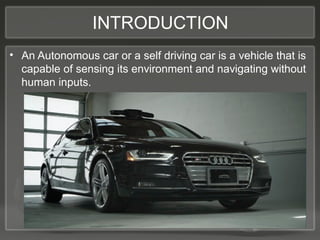
• An Autonomous car or a self driving car is a vehicle that is
capable of sensing its environment and navigating without
human inputs.
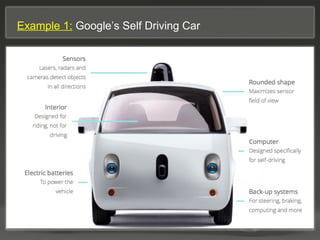
Example 1: Google’s Self Driving Car
Google’s self-driving prototypes rely on their sensors and
software to drive themselves.
Example 1: Google’s Self Driving Car
Google’s self-driving prototypes rely on their sensors and
software to drive themselves.
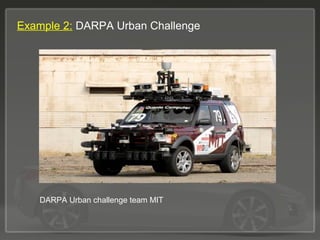
Example 2: DARPA Urban Challenge
DARPA Urban challenge team MIT
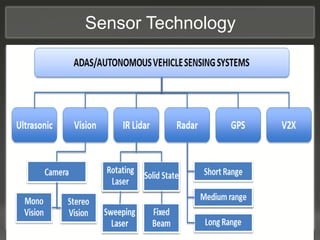
Sensor Technology
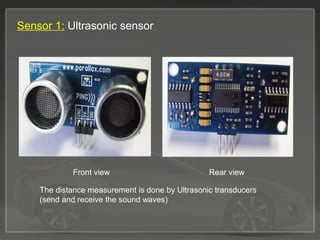
Sensor 1: Ultrasonic sensor
The distance measurement is done by Ultrasonic transducers
(send and receive the sound waves)
Front view Rear view
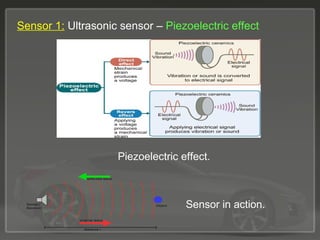
Sensor 1: Ultrasonic sensor – Piezoelectric effect
Sensor in action.
Piezoelectric effect.
Sensor 1: Ultrasonic sensor - Applications
Medical Imaging
Autonomous Vehicles
Ultrasonic cleaning
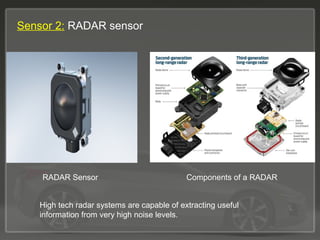
Sensor 2: RADAR sensor
High tech radar systems are capable of extracting useful
information from very high noise levels.
RADAR Sensor Components of a RADAR
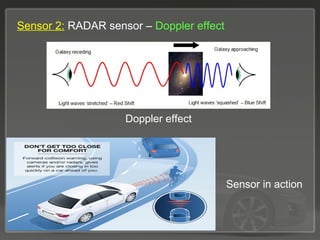
Sensor 2: RADAR sensor – Doppler effect
Sensor in action
Doppler effect
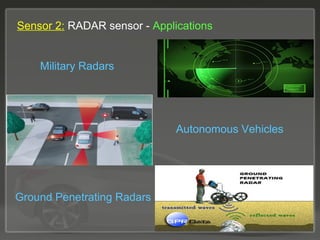
Sensor 2: RADAR sensor - Applications
Military Radars
Autonomous Vehicles
Ground Penetrating Radars
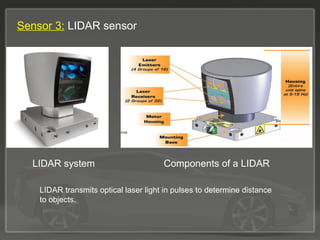
Sensor 3: LIDAR sensor
LIDAR transmits optical laser light in pulses to determine distance
to objects.
LIDAR system Components of a LIDAR
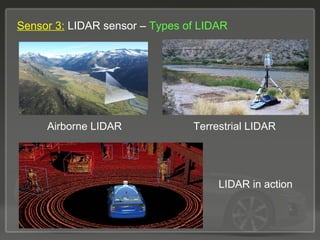
Sensor 3: LIDAR sensor – Types of LIDAR
LIDAR in action
Airborne LIDAR Terrestrial LIDAR
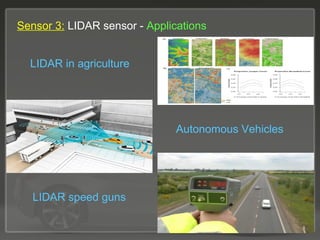
Sensor 3: LIDAR sensor - Applications
LIDAR in agriculture
Autonomous Vehicles
LIDAR speed guns
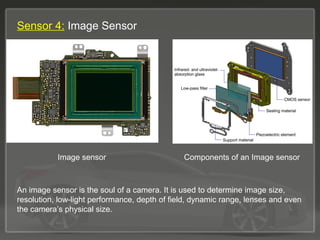
Sensor 4: Image Sensor
Image sensor Components of an Image sensor
An image sensor is the soul of a camera. It is used to determine image size,
resolution, low-light performance, depth of field, dynamic range, lenses and even
the camera’s physical size.
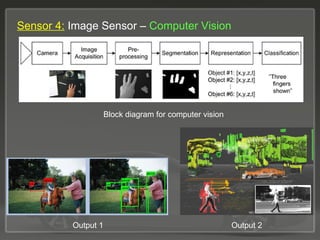
Sensor 4: Image Sensor – Computer Vision
Block diagram for computer vision
Output 1 Output 2
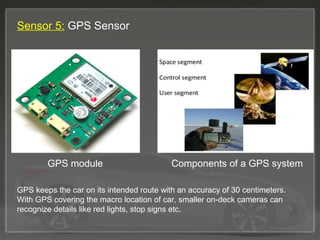
Sensor 5: GPS Sensor
GPS keeps the car on its intended route with an accuracy of 30 centimeters.
With GPS covering the macro location of car, smaller on-deck cameras can
recognize details like red lights, stop signs etc.
GPS module Components of a GPS system
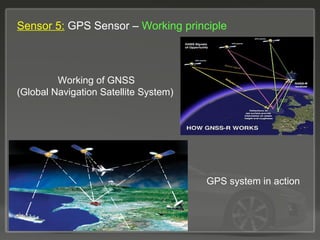
Sensor 5: GPS Sensor – Working principle
Working of GNSS
(Global Navigation Satellite System)
GPS system in action
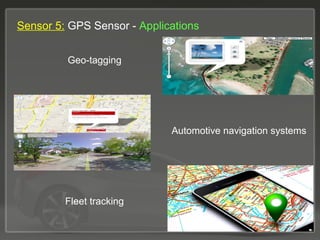
Sensor 5: GPS Sensor - Applications
Automotive navigation systems
Geo-tagging
Fleet tracking
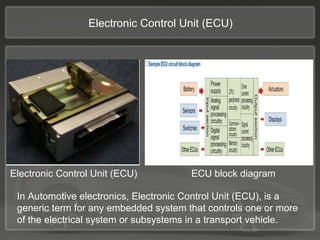
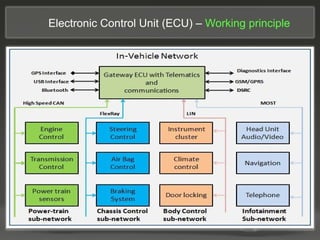
In Automotive electronics, Electronic Control Unit (ECU), is a
generic term for any embedded system that controls one or more
of the electrical system or subsystems in a transport vehicle.
Electronic Control Unit (ECU) ECU block diagram
Electronic Control Unit (ECU)
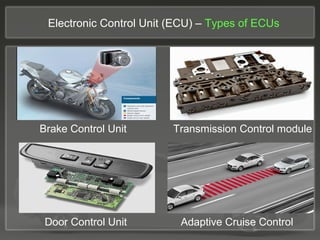
Door Control Unit
Brake Control Unit Transmission Control module
Adaptive Cruise Control
Electronic Control Unit (ECU) – Types of ECUs
Electronic Control Unit (ECU) – Working principle
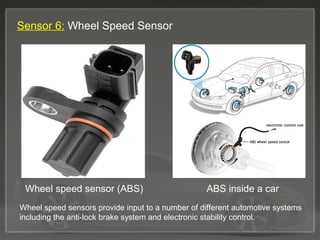
Sensor 6: Wheel Speed Sensor
Wheel speed sensors provide input to a number of different automotive systems
including the anti-lock brake system and electronic stability control.
Wheel speed sensor (ABS) ABS inside a car
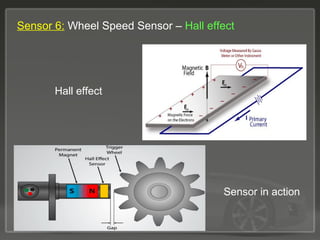
Sensor 6: Wheel Speed Sensor – Hall effect
Sensor in action
Hall effect
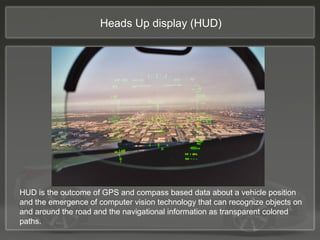
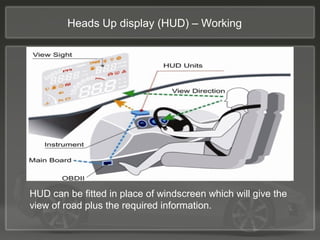
HUD is the outcome of GPS and compass based data about a vehicle position
and the emergence of computer vision technology that can recognize objects on
and around the road and the navigational information as transparent colored
paths.
Heads Up display (HUD)
Heads Up display (HUD) – Working
HUD can be fitted in place of windscreen which will give the
view of road plus the required information.
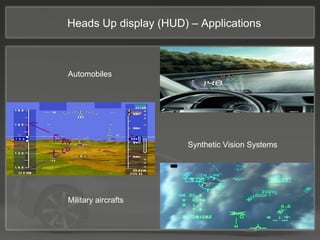
Heads Up display (HUD) – Applications
Synthetic Vision Systems
Automobiles
Military aircrafts
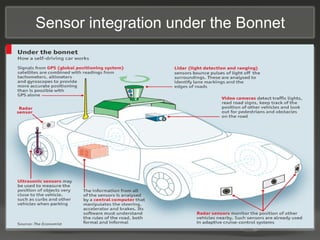
Sensor integration under the Bonnet
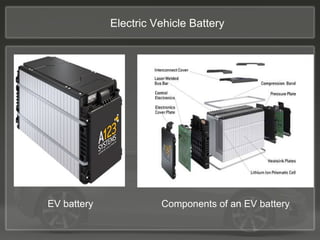
Electric Vehicle Battery
EV battery Components of an EV battery
V2X Communication
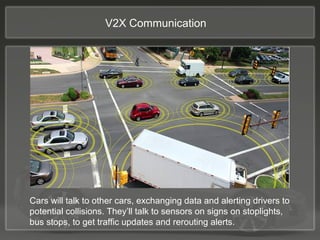
Cars will talk to other cars, exchanging data and alerting drivers to
potential collisions. They’ll talk to sensors on signs on stoplights,
bus stops, to get traffic updates and rerouting alerts.
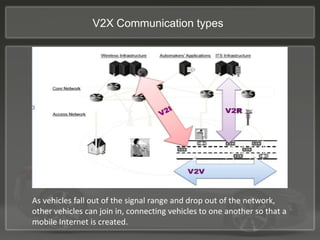
V2X Communication types
As vehicles fall out of the signal range and drop out of the network,
other vehicles can join in, connecting vehicles to one another so that a
mobile Internet is created.
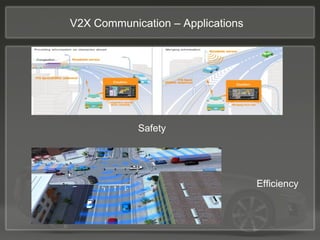
V2X Communication – Applications
Safety
Efficiency
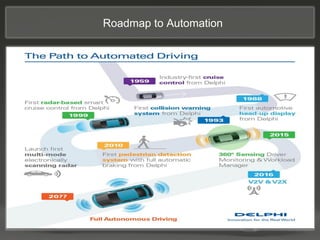
Roadmap to Automation
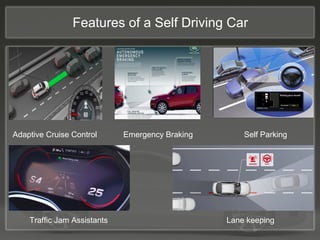
Features of a Self Driving Car
Adaptive Cruise Control Emergency Braking Self Parking
Traffic Jam Assistants Lane keeping
Challenges
• Unpredictable humans: Autonomous vehicles will have to
deal with drivers who speed, pass even when there’s a double
yellow line and drive the wrong way on a one-way street.
• Bad weather: Snow, rain, fog and other types of weather make
driving difficult for humans, and it’s no different for driverless cars,
which stay in their lanes by using cameras that track lines on the
pavement. But they can’t do that if the road has a coating of snow.
• Digital Mapping: Very few roads have been mapped to this
degree. Moreover, maps can become out of date as road
conditions change. There may be construction or detours. An
intersection with a four-way stop might get a traffic light or become
a roundabout.
Conclusion
In conclusion, upon addressing the mechanics of the driverless car
as well as its benefits and potential issues, it is quite interesting to
see how the world will actually become by the year 2040.
Sensors that are an integral part of an autonomous vehicle will
become more sophisticated and will potentially have more
functionality addition in the near future.
It is fascinating to see the effects this creation will have on the states
in which it is legalized as well as on the people that have chosen to
experiment with it.

Autonomousvehicles 161212101224

  • 1.
  • 2.
    INTRODUCTION • An Autonomouscar or a self driving car is a vehicle that is capable of sensing its environment and navigating without human inputs.
  • 3.
    Example 1: Google’sSelf Driving Car Google’s self-driving prototypes rely on their sensors and software to drive themselves.
  • 4.
    Example 1: Google’sSelf Driving Car Google’s self-driving prototypes rely on their sensors and software to drive themselves.
  • 5.
    Example 2: DARPAUrban Challenge DARPA Urban challenge team MIT
  • 6.
  • 7.
    Sensor 1: Ultrasonicsensor The distance measurement is done by Ultrasonic transducers (send and receive the sound waves) Front view Rear view
  • 8.
    Sensor 1: Ultrasonicsensor – Piezoelectric effect Sensor in action. Piezoelectric effect.
  • 9.
    Sensor 1: Ultrasonicsensor - Applications Medical Imaging Autonomous Vehicles Ultrasonic cleaning
  • 10.
    Sensor 2: RADARsensor High tech radar systems are capable of extracting useful information from very high noise levels. RADAR Sensor Components of a RADAR
  • 11.
    Sensor 2: RADARsensor – Doppler effect Sensor in action Doppler effect
  • 12.
    Sensor 2: RADARsensor - Applications Military Radars Autonomous Vehicles Ground Penetrating Radars
  • 13.
    Sensor 3: LIDARsensor LIDAR transmits optical laser light in pulses to determine distance to objects. LIDAR system Components of a LIDAR
  • 14.
    Sensor 3: LIDARsensor – Types of LIDAR LIDAR in action Airborne LIDAR Terrestrial LIDAR
  • 15.
    Sensor 3: LIDARsensor - Applications LIDAR in agriculture Autonomous Vehicles LIDAR speed guns
  • 16.
    Sensor 4: ImageSensor Image sensor Components of an Image sensor An image sensor is the soul of a camera. It is used to determine image size, resolution, low-light performance, depth of field, dynamic range, lenses and even the camera’s physical size.
  • 17.
    Sensor 4: ImageSensor – Computer Vision Block diagram for computer vision Output 1 Output 2
  • 18.
    Sensor 5: GPSSensor GPS keeps the car on its intended route with an accuracy of 30 centimeters. With GPS covering the macro location of car, smaller on-deck cameras can recognize details like red lights, stop signs etc. GPS module Components of a GPS system
  • 19.
    Sensor 5: GPSSensor – Working principle Working of GNSS (Global Navigation Satellite System) GPS system in action
  • 20.
    Sensor 5: GPSSensor - Applications Automotive navigation systems Geo-tagging Fleet tracking
  • 21.
    In Automotive electronics,Electronic Control Unit (ECU), is a generic term for any embedded system that controls one or more of the electrical system or subsystems in a transport vehicle. Electronic Control Unit (ECU) ECU block diagram Electronic Control Unit (ECU)
  • 22.
    Door Control Unit BrakeControl Unit Transmission Control module Adaptive Cruise Control Electronic Control Unit (ECU) – Types of ECUs
  • 23.
    Electronic Control Unit(ECU) – Working principle
  • 24.
    Sensor 6: WheelSpeed Sensor Wheel speed sensors provide input to a number of different automotive systems including the anti-lock brake system and electronic stability control. Wheel speed sensor (ABS) ABS inside a car
  • 25.
    Sensor 6: WheelSpeed Sensor – Hall effect Sensor in action Hall effect
  • 26.
    HUD is theoutcome of GPS and compass based data about a vehicle position and the emergence of computer vision technology that can recognize objects on and around the road and the navigational information as transparent colored paths. Heads Up display (HUD)
  • 27.
    Heads Up display(HUD) – Working HUD can be fitted in place of windscreen which will give the view of road plus the required information.
  • 28.
    Heads Up display(HUD) – Applications Synthetic Vision Systems Automobiles Military aircrafts
  • 29.
  • 30.
    Electric Vehicle Battery EVbattery Components of an EV battery
  • 31.
    V2X Communication Cars willtalk to other cars, exchanging data and alerting drivers to potential collisions. They’ll talk to sensors on signs on stoplights, bus stops, to get traffic updates and rerouting alerts.
  • 32.
    V2X Communication types Asvehicles fall out of the signal range and drop out of the network, other vehicles can join in, connecting vehicles to one another so that a mobile Internet is created.
  • 33.
    V2X Communication –Applications Safety Efficiency
  • 34.
  • 35.
    Features of aSelf Driving Car Adaptive Cruise Control Emergency Braking Self Parking Traffic Jam Assistants Lane keeping
  • 36.
    Challenges • Unpredictable humans:Autonomous vehicles will have to deal with drivers who speed, pass even when there’s a double yellow line and drive the wrong way on a one-way street. • Bad weather: Snow, rain, fog and other types of weather make driving difficult for humans, and it’s no different for driverless cars, which stay in their lanes by using cameras that track lines on the pavement. But they can’t do that if the road has a coating of snow. • Digital Mapping: Very few roads have been mapped to this degree. Moreover, maps can become out of date as road conditions change. There may be construction or detours. An intersection with a four-way stop might get a traffic light or become a roundabout.
  • 37.
    Conclusion In conclusion, uponaddressing the mechanics of the driverless car as well as its benefits and potential issues, it is quite interesting to see how the world will actually become by the year 2040. Sensors that are an integral part of an autonomous vehicle will become more sophisticated and will potentially have more functionality addition in the near future. It is fascinating to see the effects this creation will have on the states in which it is legalized as well as on the people that have chosen to experiment with it.