 Fahad Alam Joy
2016-1-55-005
 Abdul Kader Jilani
2016-1-55-006
 Tonmoy Saha
2016-1-55-007
History
 Experiments have been conducted on automated
driving systems (ADS) since at least the 1920s; trials
began in the 1950s.
 The first semi-automated car was developed in 1977,
by Japan's Tsukuba Mechanical Engineering
Laboratory
 The first truly autonomous cars appeared in the 1980s,
with Carnegie Mellon University's Navlab
 In December 2018, Waymo the company that emerged
from Google’s self-driving-car project, officially
started its commercial self-driving-car service in the
suburbs of Phoenix.
Autonomous Car
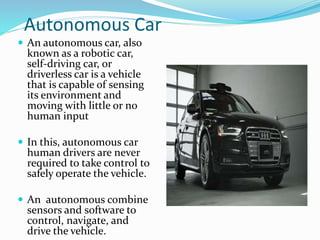
 An autonomous car, also
known as a robotic car,
self-driving car, or
driverless car is a vehicle
that is capable of sensing
its environment and
moving with little or no
human input
 In this, autonomous car
human drivers are never
required to take control to
safely operate the vehicle.
 An autonomous combine
sensors and software to
control, navigate, and
drive the vehicle.
5G
 • Autonomous car is a super computer with
deterministic network on wheels
 • 5G will play significant role in autonomous
vehicle
 It will be transformative, fueling innovation
across every industry and every aspect of our
lives.
 Over time, 5G technology will revolutionize
the way we live, work, and play.
 5G will support up to 10x faster
Vehicle Hardware
 • RADAR
 • Optics
 • LIDAR
 • GPS
 • Processors
 • Wheel Speed Sensors
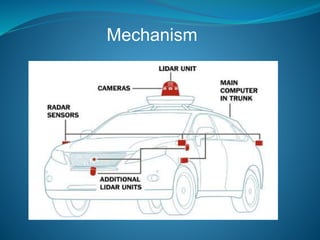
Mechanism
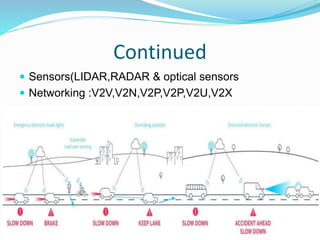
Continued
 Sensors(LIDAR,RADAR & optical sensors
 Networking :V2V,V2N,V2P,V2P,V2U,V2X
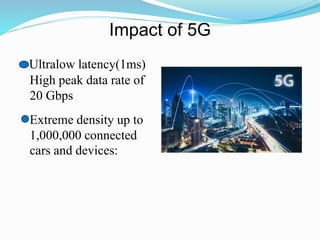
Impact of 5G
Ultralow latency(1ms)
• High peak data rate of
20 Gbps
• Extreme density up to
1,000,000 connected
cars and devices:
•There will be no accidents.
•Security will also increase.
•Bring ease to the disabled people.
•There would be many jobs created.
•Fewer carbon emissions.
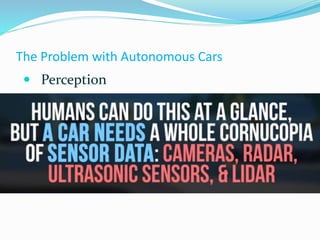
The Problem with Autonomous Cars
 Perception
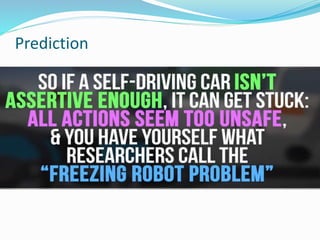
Prediction
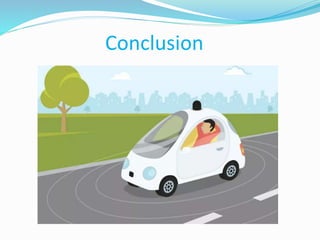
Conclusion

Autonomous Car in 5G

  • 1.
     Fahad AlamJoy 2016-1-55-005  Abdul Kader Jilani 2016-1-55-006  Tonmoy Saha 2016-1-55-007
  • 3.
    History  Experiments havebeen conducted on automated driving systems (ADS) since at least the 1920s; trials began in the 1950s.  The first semi-automated car was developed in 1977, by Japan's Tsukuba Mechanical Engineering Laboratory  The first truly autonomous cars appeared in the 1980s, with Carnegie Mellon University's Navlab  In December 2018, Waymo the company that emerged from Google’s self-driving-car project, officially started its commercial self-driving-car service in the suburbs of Phoenix.
  • 4.
    Autonomous Car  Anautonomous car, also known as a robotic car, self-driving car, or driverless car is a vehicle that is capable of sensing its environment and moving with little or no human input  In this, autonomous car human drivers are never required to take control to safely operate the vehicle.  An autonomous combine sensors and software to control, navigate, and drive the vehicle.
  • 5.
    5G  • Autonomouscar is a super computer with deterministic network on wheels  • 5G will play significant role in autonomous vehicle  It will be transformative, fueling innovation across every industry and every aspect of our lives.  Over time, 5G technology will revolutionize the way we live, work, and play.  5G will support up to 10x faster
  • 6.
    Vehicle Hardware  •RADAR  • Optics  • LIDAR  • GPS  • Processors  • Wheel Speed Sensors
  • 8.
  • 9.
    Continued  Sensors(LIDAR,RADAR &optical sensors  Networking :V2V,V2N,V2P,V2P,V2U,V2X
  • 10.
    Impact of 5G Ultralowlatency(1ms) • High peak data rate of 20 Gbps • Extreme density up to 1,000,000 connected cars and devices:
  • 11.
    •There will beno accidents. •Security will also increase. •Bring ease to the disabled people. •There would be many jobs created. •Fewer carbon emissions.
  • 12.
    The Problem withAutonomous Cars  Perception
  • 13.
  • 14.