AUTONOMOUS VEHICLES
PRESENTED BY:
YAMINI( 17001504026)
M.Tech. (M.E.)
AUTONOMOUS VEHICLES : A SEMINAR 1
A SEMINAR ON
DEENBANDHU CHHOTURAM UNIVERSITY OF SCIENCE
AND TECHNOLOGY, MURTHAL, SONIPAT (Hr.)
1 INTRODUCTION AND HISTORY
2 TECHNOLOGY
3 DEVELOPMENT AND CURRENT SCENARIO
4 ADVANTAGES
5 DISADVANTAGES AND CHALLENGES
CONTENTS
AUTONOMOUS VEHICLES : A SEMINAR 2
INTRODUCTION
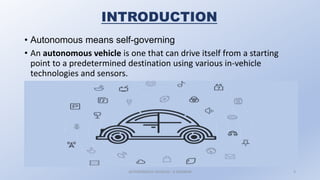
• Autonomous means self-governing
• An autonomous vehicle is one that can drive itself from a starting
point to a predetermined destination using various in-vehicle
technologies and sensors.
AUTONOMOUS VEHICLES : A SEMINAR 3
AUTONOMOUS VEHICLES : A SEMINAR
0
100000
200000
300000
400000
500000
600000
2005 2006 2007 2008 2009 2010 2011 2012 2013 2014 2015 2016
Accidents in India
total raod accidents Total people killed
0
5
10
15
20
25
30
35
2005 2006 2007 2008 2009 2010 2011 2012 2013 2014 2015 2016
Accident severity
4
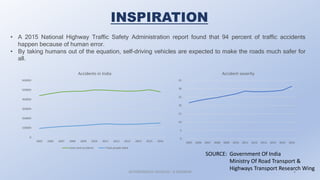
• A 2015 National Highway Traffic Safety Administration report found that 94 percent of traffic accidents
happen because of human error.
• By taking humans out of the equation, self-driving vehicles are expected to make the roads much safer for
all.
INSPIRATION
SOURCE: Government Of India
Ministry Of Road Transport &
Highways Transport Research Wing
AUTONOMOUS VEHICLES : A SEMINAR
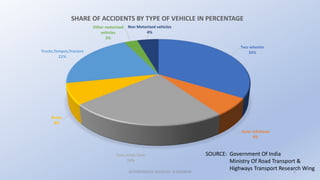
Two wheeler
34%
Auto rickshaws
6%
Cars,Jeeps,Taxis
24%
Buses
8%
Trucks,Tempos,Tractors
21%
Other motorised
vehicles
3%
Non Motorised vehicles
4%
SHARE OF ACCIDENTS BY TYPE OF VEHICLE IN PERCENTAGE
5
SOURCE: Government Of India
Ministry Of Road Transport &
Highways Transport Research Wing
AUTONOMOUS VEHICLES : A SEMINAR 6
HISTORY
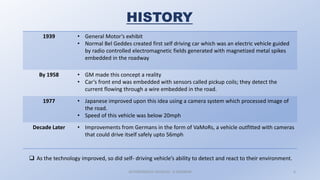
1939 • General Motor’s exhibit
• Normal Bel Geddes created first self driving car which was an electric vehicle guided
by radio controlled electromagnetic fields generated with magnetized metal spikes
embedded in the roadway
By 1958 • GM made this concept a reality
• Car’s front end was embedded with sensors called pickup coils; they detect the
current flowing through a wire embedded in the road.
1977 • Japanese improved upon this idea using a camera system which processed image of
the road.
• Speed of this vehicle was below 20mph
Decade Later • Improvements from Germans in the form of VaMoRs, a vehicle outfitted with cameras
that could drive itself safely upto 56mph
 As the technology improved, so did self- driving vehicle’s ability to detect and react to their environment.
The DARPA Grand Challenge
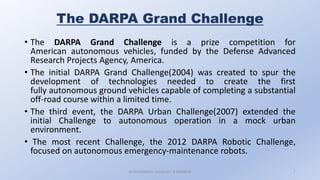
• The DARPA Grand Challenge is a prize competition for
American autonomous vehicles, funded by the Defense Advanced
Research Projects Agency, America.
• The initial DARPA Grand Challenge(2004) was created to spur the
development of technologies needed to create the first
fully autonomous ground vehicles capable of completing a substantial
off-road course within a limited time.
• The third event, the DARPA Urban Challenge(2007) extended the
initial Challenge to autonomous operation in a mock urban
environment.
• The most recent Challenge, the 2012 DARPA Robotic Challenge,
focused on autonomous emergency-maintenance robots.
AUTONOMOUS VEHICLES : A SEMINAR 7
1
2 3
4 5
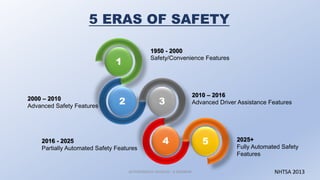
1950 - 2000
Safety/Convenience Features
2000 – 2010
Advanced Safety Features
2010 – 2016
Advanced Driver Assistance Features
2016 - 2025
Partially Automated Safety Features
2025+
Fully Automated Safety
Features
5 ERAS OF SAFETY
AUTONOMOUS VEHICLES : A SEMINAR 8NHTSA 2013
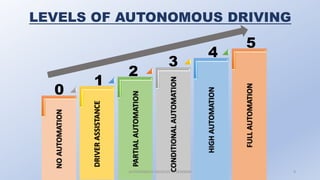
NOAUTOMATION
DRIVERASSISTANCE
PARTIALAUTOMATION
CONDITIONALAUTOMATION
HIGHAUTOMATION
FULLAUTOMATION
0
1
2
3
4
5
LEVELS OF AUTONOMOUS DRIVING
AUTONOMOUS VEHICLES : A SEMINAR 9
AUTONOMOUS VEHICLES : A SEMINAR 10
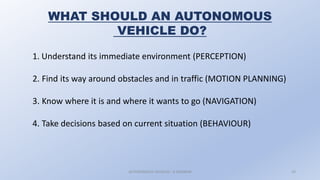
WHAT SHOULD AN AUTONOMOUS
VEHICLE DO?
1. Understand its immediate environment (PERCEPTION)
2. Find its way around obstacles and in traffic (MOTION PLANNING)
3. Know where it is and where it wants to go (NAVIGATION)
4. Take decisions based on current situation (BEHAVIOUR)
AUTONOMOUS VEHICLES : A SEMINAR 11
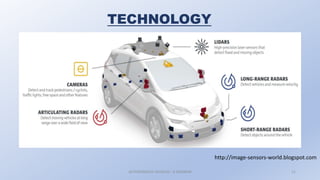
TECHNOLOGY
http://image-sensors-world.blogspot.com
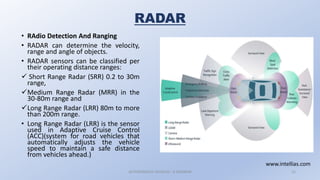
RADAR
• RAdio Detection And Ranging
• RADAR can determine the velocity,
range and angle of objects.
• RADAR sensors can be classified per
their operating distance ranges:
 Short Range Radar (SRR) 0.2 to 30m
range,
Medium Range Radar (MRR) in the
30-80m range and
Long Range Radar (LRR) 80m to more
than 200m range.
• Long Range Radar (LRR) is the sensor
used in Adaptive Cruise Control
(ACC)(system for road vehicles that
automatically adjusts the vehicle
speed to maintain a safe distance
from vehicles ahead.)
AUTONOMOUS VEHICLES : A SEMINAR 12
www.intellias.com
LIDAR
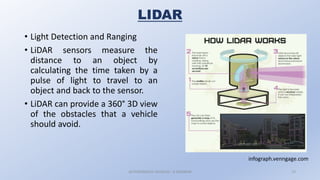
• Light Detection and Ranging
• LiDAR sensors measure the
distance to an object by
calculating the time taken by a
pulse of light to travel to an
object and back to the sensor.
• LiDAR can provide a 360° 3D view
of the obstacles that a vehicle
should avoid.
AUTONOMOUS VEHICLES : A SEMINAR 13
infograph.venngage.com
WHEEL SPEED SENSORS
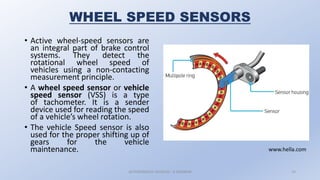
• Active wheel-speed sensors are
an integral part of brake control
systems. They detect the
rotational wheel speed of
vehicles using a non-contacting
measurement principle.
• A wheel speed sensor or vehicle
speed sensor (VSS) is a type
of tachometer. It is a sender
device used for reading the speed
of a vehicle’s wheel rotation.
• The vehicle Speed sensor is also
used for the proper shifting up of
gears for the vehicle
maintenance.
AUTONOMOUS VEHICLES : A SEMINAR 14
www.hella.com
GPS
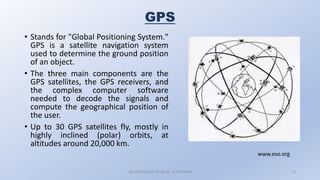
• Stands for "Global Positioning System."
GPS is a satellite navigation system
used to determine the ground position
of an object.
• The three main components are the
GPS satellites, the GPS receivers, and
the complex computer software
needed to decode the signals and
compute the geographical position of
the user.
• Up to 30 GPS satellites fly, mostly in
highly inclined (polar) orbits, at
altitudes around 20,000 km.
AUTONOMOUS VEHICLES : A SEMINAR 15
www.eso.org
ULTRASONIC SENSORS
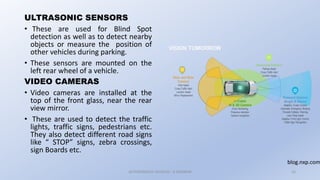
• These are used for Blind Spot
detection as well as to detect nearby
objects or measure the position of
other vehicles during parking.
• These sensors are mounted on the
left rear wheel of a vehicle.
VIDEO CAMERAS
• Video cameras are installed at the
top of the front glass, near the rear
view mirror.
• These are used to detect the traffic
lights, traffic signs, pedestrians etc.
They also detect different road signs
like “ STOP” signs, zebra crossings,
sign Boards etc.
AUTONOMOUS VEHICLES : A SEMINAR 16
blog.nxp.com
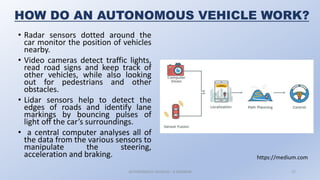
HOW DO AN AUTONOMOUS VEHICLE WORK?
• Radar sensors dotted around the
car monitor the position of vehicles
nearby.
• Video cameras detect traffic lights,
read road signs and keep track of
other vehicles, while also looking
out for pedestrians and other
obstacles.
• Lidar sensors help to detect the
edges of roads and identify lane
markings by bouncing pulses of
light off the car’s surroundings.
• a central computer analyses all of
the data from the various sensors to
manipulate the steering,
acceleration and braking.
AUTONOMOUS VEHICLES : A SEMINAR 17
https://medium.com
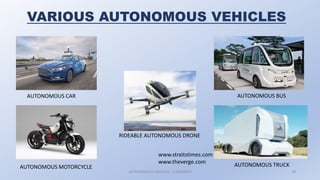
VARIOUS AUTONOMOUS VEHICLES
AUTONOMOUS VEHICLES : A SEMINAR 18
AUTONOMOUS CAR
www.straitstimes.com
www.theverge.com
AUTONOMOUS MOTORCYCLE
RIDEABLE AUTONOMOUS DRONE
AUTONOMOUS BUS
AUTONOMOUS TRUCK
AUTONOMOUS VEHICLES : A SEMINAR 19
WHAT DO AUTHORS SAY?
• Johanna Zmud, Texas A&M University: Autonomous cars need to learn
how to drive just like people do: with real-world practice on public roads.
• Simone Pettigrew, Curtin University: A survey found very few are aware of
the social health benefits from the wide scale use of autonomous vehicles.
• Neil McBride, De Mantfort University: Far from setting us free,
autonomous vehicles are set to enable new forms of surveillance and
oppression.
• Giselle Rampersad, Flinders University: Do people really trust driverless
cars to carry them safely to their destinations? New research sows that we
are ready to use driverless cars in certain situations but not others,yet.
AUTONOMOUS VEHICLES : A SEMINAR 20
16
5 2
4 3
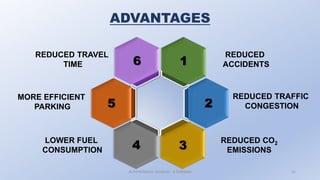
REDUCED
ACCIDENTS
REDUCED TRAFFIC
CONGESTION
REDUCED TRAVEL
TIME
MORE EFFICIENT
PARKING
LOWER FUEL
CONSUMPTION
REDUCED CO2
EMISSIONS
ADVANTAGES
AUTONOMOUS VEHICLES : A SEMINAR 21
16
5 2
4 3
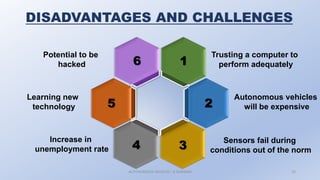
Trusting a computer to
perform adequately
Autonomous vehicles
will be expensive
Potential to be
hacked
Learning new
technology
Increase in
unemployment rate
Sensors fail during
conditions out of the norm
DISADVANTAGES AND CHALLENGES
AUTONOMOUS VEHICLES : A SEMINAR 22
• Trepagnier et al., NAVIGATION AND CONTROL SYSTEM FOR AUTONOMOUS
VEHICLES, United States Patent, 2011
• I Barabás, A Todoruț, N Cordoș, A Molea, CURRENT CHALLENGES IN AUTONOMOUS
DRIVING , IOP Conf. Series: Materials Science and Engineering 252 (2017) 012096
• James M. Anderson, Nidhi Kalra, Karlyn D. Stanley, Paul Sorensen, Constantine
Samaras, Oluwatobi A. Oluwatola, AUTONOMOUS VEHICLE TECHNOLOGY- A GUIDE
FOR POLICYMAKERS
• Todd Litman ,Victoria Transport Policy Institute, AUTONOMOUS VEHICLE
IMPLEMENTATION PREDICTIONS IMPLICATIONS FOR TRANSPORT PLANNING ,2017
• ITS Digest, The World’s Forum For Intelligent Transportation System
• Autonomous Driving in Urban Environments: Boss and the Urban Challenge
AUTONOMOUS VEHICLES : A SEMINAR 23
REFERENCES

Autonomous Vehicles

  • 1.
    AUTONOMOUS VEHICLES PRESENTED BY: YAMINI(17001504026) M.Tech. (M.E.) AUTONOMOUS VEHICLES : A SEMINAR 1 A SEMINAR ON DEENBANDHU CHHOTURAM UNIVERSITY OF SCIENCE AND TECHNOLOGY, MURTHAL, SONIPAT (Hr.)
  • 2.
    1 INTRODUCTION ANDHISTORY 2 TECHNOLOGY 3 DEVELOPMENT AND CURRENT SCENARIO 4 ADVANTAGES 5 DISADVANTAGES AND CHALLENGES CONTENTS AUTONOMOUS VEHICLES : A SEMINAR 2
  • 3.
    INTRODUCTION • Autonomous meansself-governing • An autonomous vehicle is one that can drive itself from a starting point to a predetermined destination using various in-vehicle technologies and sensors. AUTONOMOUS VEHICLES : A SEMINAR 3
  • 4.
    AUTONOMOUS VEHICLES :A SEMINAR 0 100000 200000 300000 400000 500000 600000 2005 2006 2007 2008 2009 2010 2011 2012 2013 2014 2015 2016 Accidents in India total raod accidents Total people killed 0 5 10 15 20 25 30 35 2005 2006 2007 2008 2009 2010 2011 2012 2013 2014 2015 2016 Accident severity 4 • A 2015 National Highway Traffic Safety Administration report found that 94 percent of traffic accidents happen because of human error. • By taking humans out of the equation, self-driving vehicles are expected to make the roads much safer for all. INSPIRATION SOURCE: Government Of India Ministry Of Road Transport & Highways Transport Research Wing
  • 5.
    AUTONOMOUS VEHICLES :A SEMINAR Two wheeler 34% Auto rickshaws 6% Cars,Jeeps,Taxis 24% Buses 8% Trucks,Tempos,Tractors 21% Other motorised vehicles 3% Non Motorised vehicles 4% SHARE OF ACCIDENTS BY TYPE OF VEHICLE IN PERCENTAGE 5 SOURCE: Government Of India Ministry Of Road Transport & Highways Transport Research Wing
  • 6.
    AUTONOMOUS VEHICLES :A SEMINAR 6 HISTORY 1939 • General Motor’s exhibit • Normal Bel Geddes created first self driving car which was an electric vehicle guided by radio controlled electromagnetic fields generated with magnetized metal spikes embedded in the roadway By 1958 • GM made this concept a reality • Car’s front end was embedded with sensors called pickup coils; they detect the current flowing through a wire embedded in the road. 1977 • Japanese improved upon this idea using a camera system which processed image of the road. • Speed of this vehicle was below 20mph Decade Later • Improvements from Germans in the form of VaMoRs, a vehicle outfitted with cameras that could drive itself safely upto 56mph  As the technology improved, so did self- driving vehicle’s ability to detect and react to their environment.
  • 7.
    The DARPA GrandChallenge • The DARPA Grand Challenge is a prize competition for American autonomous vehicles, funded by the Defense Advanced Research Projects Agency, America. • The initial DARPA Grand Challenge(2004) was created to spur the development of technologies needed to create the first fully autonomous ground vehicles capable of completing a substantial off-road course within a limited time. • The third event, the DARPA Urban Challenge(2007) extended the initial Challenge to autonomous operation in a mock urban environment. • The most recent Challenge, the 2012 DARPA Robotic Challenge, focused on autonomous emergency-maintenance robots. AUTONOMOUS VEHICLES : A SEMINAR 7
  • 8.
    1 2 3 4 5 1950- 2000 Safety/Convenience Features 2000 – 2010 Advanced Safety Features 2010 – 2016 Advanced Driver Assistance Features 2016 - 2025 Partially Automated Safety Features 2025+ Fully Automated Safety Features 5 ERAS OF SAFETY AUTONOMOUS VEHICLES : A SEMINAR 8NHTSA 2013
  • 9.
  • 10.
    AUTONOMOUS VEHICLES :A SEMINAR 10 WHAT SHOULD AN AUTONOMOUS VEHICLE DO? 1. Understand its immediate environment (PERCEPTION) 2. Find its way around obstacles and in traffic (MOTION PLANNING) 3. Know where it is and where it wants to go (NAVIGATION) 4. Take decisions based on current situation (BEHAVIOUR)
  • 11.
    AUTONOMOUS VEHICLES :A SEMINAR 11 TECHNOLOGY http://image-sensors-world.blogspot.com
  • 12.
    RADAR • RAdio DetectionAnd Ranging • RADAR can determine the velocity, range and angle of objects. • RADAR sensors can be classified per their operating distance ranges:  Short Range Radar (SRR) 0.2 to 30m range, Medium Range Radar (MRR) in the 30-80m range and Long Range Radar (LRR) 80m to more than 200m range. • Long Range Radar (LRR) is the sensor used in Adaptive Cruise Control (ACC)(system for road vehicles that automatically adjusts the vehicle speed to maintain a safe distance from vehicles ahead.) AUTONOMOUS VEHICLES : A SEMINAR 12 www.intellias.com
  • 13.
    LIDAR • Light Detectionand Ranging • LiDAR sensors measure the distance to an object by calculating the time taken by a pulse of light to travel to an object and back to the sensor. • LiDAR can provide a 360° 3D view of the obstacles that a vehicle should avoid. AUTONOMOUS VEHICLES : A SEMINAR 13 infograph.venngage.com
  • 14.
    WHEEL SPEED SENSORS •Active wheel-speed sensors are an integral part of brake control systems. They detect the rotational wheel speed of vehicles using a non-contacting measurement principle. • A wheel speed sensor or vehicle speed sensor (VSS) is a type of tachometer. It is a sender device used for reading the speed of a vehicle’s wheel rotation. • The vehicle Speed sensor is also used for the proper shifting up of gears for the vehicle maintenance. AUTONOMOUS VEHICLES : A SEMINAR 14 www.hella.com
  • 15.
    GPS • Stands for"Global Positioning System." GPS is a satellite navigation system used to determine the ground position of an object. • The three main components are the GPS satellites, the GPS receivers, and the complex computer software needed to decode the signals and compute the geographical position of the user. • Up to 30 GPS satellites fly, mostly in highly inclined (polar) orbits, at altitudes around 20,000 km. AUTONOMOUS VEHICLES : A SEMINAR 15 www.eso.org
  • 16.
    ULTRASONIC SENSORS • Theseare used for Blind Spot detection as well as to detect nearby objects or measure the position of other vehicles during parking. • These sensors are mounted on the left rear wheel of a vehicle. VIDEO CAMERAS • Video cameras are installed at the top of the front glass, near the rear view mirror. • These are used to detect the traffic lights, traffic signs, pedestrians etc. They also detect different road signs like “ STOP” signs, zebra crossings, sign Boards etc. AUTONOMOUS VEHICLES : A SEMINAR 16 blog.nxp.com
  • 17.
    HOW DO ANAUTONOMOUS VEHICLE WORK? • Radar sensors dotted around the car monitor the position of vehicles nearby. • Video cameras detect traffic lights, read road signs and keep track of other vehicles, while also looking out for pedestrians and other obstacles. • Lidar sensors help to detect the edges of roads and identify lane markings by bouncing pulses of light off the car’s surroundings. • a central computer analyses all of the data from the various sensors to manipulate the steering, acceleration and braking. AUTONOMOUS VEHICLES : A SEMINAR 17 https://medium.com
  • 18.
    VARIOUS AUTONOMOUS VEHICLES AUTONOMOUSVEHICLES : A SEMINAR 18 AUTONOMOUS CAR www.straitstimes.com www.theverge.com AUTONOMOUS MOTORCYCLE RIDEABLE AUTONOMOUS DRONE AUTONOMOUS BUS AUTONOMOUS TRUCK
  • 19.
  • 20.
    WHAT DO AUTHORSSAY? • Johanna Zmud, Texas A&M University: Autonomous cars need to learn how to drive just like people do: with real-world practice on public roads. • Simone Pettigrew, Curtin University: A survey found very few are aware of the social health benefits from the wide scale use of autonomous vehicles. • Neil McBride, De Mantfort University: Far from setting us free, autonomous vehicles are set to enable new forms of surveillance and oppression. • Giselle Rampersad, Flinders University: Do people really trust driverless cars to carry them safely to their destinations? New research sows that we are ready to use driverless cars in certain situations but not others,yet. AUTONOMOUS VEHICLES : A SEMINAR 20
  • 21.
    16 5 2 4 3 REDUCED ACCIDENTS REDUCEDTRAFFIC CONGESTION REDUCED TRAVEL TIME MORE EFFICIENT PARKING LOWER FUEL CONSUMPTION REDUCED CO2 EMISSIONS ADVANTAGES AUTONOMOUS VEHICLES : A SEMINAR 21
  • 22.
    16 5 2 4 3 Trustinga computer to perform adequately Autonomous vehicles will be expensive Potential to be hacked Learning new technology Increase in unemployment rate Sensors fail during conditions out of the norm DISADVANTAGES AND CHALLENGES AUTONOMOUS VEHICLES : A SEMINAR 22
  • 23.
    • Trepagnier etal., NAVIGATION AND CONTROL SYSTEM FOR AUTONOMOUS VEHICLES, United States Patent, 2011 • I Barabás, A Todoruț, N Cordoș, A Molea, CURRENT CHALLENGES IN AUTONOMOUS DRIVING , IOP Conf. Series: Materials Science and Engineering 252 (2017) 012096 • James M. Anderson, Nidhi Kalra, Karlyn D. Stanley, Paul Sorensen, Constantine Samaras, Oluwatobi A. Oluwatola, AUTONOMOUS VEHICLE TECHNOLOGY- A GUIDE FOR POLICYMAKERS • Todd Litman ,Victoria Transport Policy Institute, AUTONOMOUS VEHICLE IMPLEMENTATION PREDICTIONS IMPLICATIONS FOR TRANSPORT PLANNING ,2017 • ITS Digest, The World’s Forum For Intelligent Transportation System • Autonomous Driving in Urban Environments: Boss and the Urban Challenge AUTONOMOUS VEHICLES : A SEMINAR 23 REFERENCES