SMART
RETAIL.
PRESENTED TO:
Dr. Soumitra Nayak
ECE4006: SENSORS AND IOT
PRESENTED BY:
Kunal Rana (18BEE10024)
Objective of Design and its features.
1. The system is designed to make retail
shopping easy and smart.
2. Benefits customers :
a. People Counter -> Fixed number of people
allowed at a time (Freedom)
b. Independent Billing -> No billing queues
(Time)
c. Smart Cart -> Displays current bill amount
(Budget)
3. Benefits retailer :
a. Automation -> Lesser staff (Money)
b. Innovation -> Attracts Customers
(Profitability)
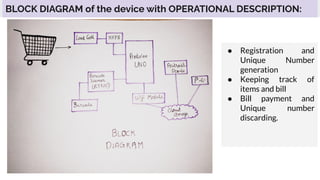
BLOCK DIAGRAM of the device with OPERATIONAL DESCRIPTION:
● Registration and
Unique Number
generation
● Keeping track of
items and bill
● Bill payment and
Unique number
discarding.
Hardware components:
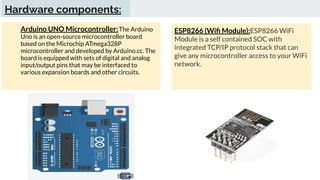
Arduino UNO Microcontroller:The Arduino
Uno is an open-source microcontroller board
based on the Microchip ATmega328P
microcontroller and developed by Arduino.cc. The
board is equipped with sets of digital and analog
input/output pins that may be interfaced to
various expansion boards and other circuits.
ESP8266 (Wifi Module):ESP8266 WiFi
Module is a self contained SOC with
integrated TCP/IP protocol stack that can
give any microcontroller access to your WiFi
network.
Hardware Component:
HX711 (Weighing module):It is
a precision 24-bit analog to digital
converter (ADC) designed for weigh
scales and industrial control
applications to interface directly
with a bridge sensor.
Load Cell: It is a force
transducer. It converts a force
such as tension, compression,
pressure, or torque into an
electrical signal that can be
measured and standardized.
Barcode scanner: It is
an optical scanner that can
read printed barcodes,
decode the data contained
in the barcode and send the
data to a computer.
Hardware Connections:
LOAD CELL AND HX711 to ARDUINO UNO.
BARCODE SCANNER TO ARDUINO UNO:
ARDUINO UNO to ESP8266
Software components:
Arduino IDE: The Arduino Software
(IDE) allows you to write programs and
upload them to your board.
MOBILE APPLICATION/ WEBSITE:
● The mobile application/website will
provide an interface to customer and
retailer.
● The mobile app/website will help
customer to keep a track of his bill
and products purchased with some
basic details regarding product.
● The mobile app/website will help
retailer to keep a track of the stock
available.
● The mobile app/website will allow
retailer to know the detailed
purchase history of the customer and
his billing summary.
Working of Hardware and Software components:
Software component:
● Cloud--->Real time data--->
calculations--->Mobile
app/website
● It will have the detailed
information of the goods available
at the store.
(Quantity, expiry etc.)
Hardware Components:
● Barcode scanner-
Barcode of item---> barcode
scanner--->Arduino uno--->Wifi
module--->Cloud--->Mobile
app/website
● Weight measuring-
Load cell--->HX711--->Arduino
uno--->Wifi
module--->Cloud--->Mobile
app/website
Advantages of this model:
● Keeps record of number of carts (people) in
shop, intimates if exceeds capacity. Also
monitors suspicious activities (Abnormally
active for long duration)
● Customer bypasses the biller and queue.
Faster shopping experience.
● Interactive cart helps customer find the
specified product in shop by letting him
know the row and rack number.
● Reads premade shopping list through a NFC
sensor from his smartphone.
● Minimal multi touching of surfaces, which is
crucial these times.
● Also helps customer get to know additional
details about product such as expiry,
nutritional facts, trends, local demand, etc.
Limitation of this model:
● At present technology(Barcoding), there
are chances the product goes without being
scanned into the cart, accidentally or
intentionally.
● Costly compared to current practices, but
reaps the benefit in long run. (Remember,
Time is Money!)
● Carts will need recharging of batteries and
hence will have a definite down time. Hence
extra carts should be ready for peak hours.
● Verification of purchased products on exit
is a problem to be solved.
THANK YOU.

Smart retail using IOT

  • 1.
    SMART RETAIL. PRESENTED TO: Dr. SoumitraNayak ECE4006: SENSORS AND IOT PRESENTED BY: Kunal Rana (18BEE10024)
  • 2.
    Objective of Designand its features. 1. The system is designed to make retail shopping easy and smart. 2. Benefits customers : a. People Counter -> Fixed number of people allowed at a time (Freedom) b. Independent Billing -> No billing queues (Time) c. Smart Cart -> Displays current bill amount (Budget) 3. Benefits retailer : a. Automation -> Lesser staff (Money) b. Innovation -> Attracts Customers (Profitability)
  • 3.
    BLOCK DIAGRAM ofthe device with OPERATIONAL DESCRIPTION: ● Registration and Unique Number generation ● Keeping track of items and bill ● Bill payment and Unique number discarding.
  • 4.
    Hardware components: Arduino UNOMicrocontroller:The Arduino Uno is an open-source microcontroller board based on the Microchip ATmega328P microcontroller and developed by Arduino.cc. The board is equipped with sets of digital and analog input/output pins that may be interfaced to various expansion boards and other circuits. ESP8266 (Wifi Module):ESP8266 WiFi Module is a self contained SOC with integrated TCP/IP protocol stack that can give any microcontroller access to your WiFi network.
  • 5.
    Hardware Component: HX711 (Weighingmodule):It is a precision 24-bit analog to digital converter (ADC) designed for weigh scales and industrial control applications to interface directly with a bridge sensor. Load Cell: It is a force transducer. It converts a force such as tension, compression, pressure, or torque into an electrical signal that can be measured and standardized. Barcode scanner: It is an optical scanner that can read printed barcodes, decode the data contained in the barcode and send the data to a computer.
  • 6.
    Hardware Connections: LOAD CELLAND HX711 to ARDUINO UNO. BARCODE SCANNER TO ARDUINO UNO: ARDUINO UNO to ESP8266
  • 7.
    Software components: Arduino IDE:The Arduino Software (IDE) allows you to write programs and upload them to your board. MOBILE APPLICATION/ WEBSITE: ● The mobile application/website will provide an interface to customer and retailer. ● The mobile app/website will help customer to keep a track of his bill and products purchased with some basic details regarding product. ● The mobile app/website will help retailer to keep a track of the stock available. ● The mobile app/website will allow retailer to know the detailed purchase history of the customer and his billing summary.
  • 8.
    Working of Hardwareand Software components: Software component: ● Cloud--->Real time data---> calculations--->Mobile app/website ● It will have the detailed information of the goods available at the store. (Quantity, expiry etc.) Hardware Components: ● Barcode scanner- Barcode of item---> barcode scanner--->Arduino uno--->Wifi module--->Cloud--->Mobile app/website ● Weight measuring- Load cell--->HX711--->Arduino uno--->Wifi module--->Cloud--->Mobile app/website
  • 9.
    Advantages of thismodel: ● Keeps record of number of carts (people) in shop, intimates if exceeds capacity. Also monitors suspicious activities (Abnormally active for long duration) ● Customer bypasses the biller and queue. Faster shopping experience. ● Interactive cart helps customer find the specified product in shop by letting him know the row and rack number. ● Reads premade shopping list through a NFC sensor from his smartphone. ● Minimal multi touching of surfaces, which is crucial these times. ● Also helps customer get to know additional details about product such as expiry, nutritional facts, trends, local demand, etc.
  • 10.
    Limitation of thismodel: ● At present technology(Barcoding), there are chances the product goes without being scanned into the cart, accidentally or intentionally. ● Costly compared to current practices, but reaps the benefit in long run. (Remember, Time is Money!) ● Carts will need recharging of batteries and hence will have a definite down time. Hence extra carts should be ready for peak hours. ● Verification of purchased products on exit is a problem to be solved.
  • 11.