AUTOMATIZED RAILWAY GATE
CONTROLLER

Project Guide :
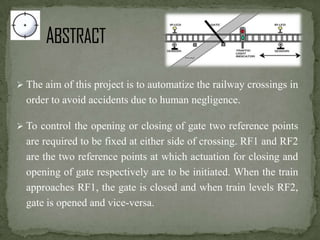
 The aim of this project is to automatize the railway crossings in

order to avoid accidents due to human negligence.
 To control the opening or closing of gate two reference points

are required to be fixed at either side of crossing. RF1 and RF2
are the two reference points at which actuation for closing and
opening of gate respectively are to be initiated. When the train
approaches RF1, the gate is closed and when train levels RF2,
gate is opened and vice-versa.
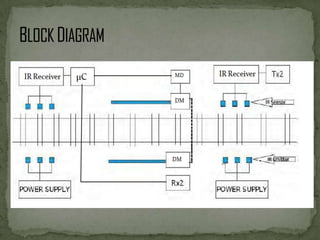
 This project utilizes two powerful IR transmitters and two receivers: one

pair of transmitter and receiver is fixed at up side (from where the train
comes) at a level higher than a human being in exact alignment and
similarly the other pair is fixed at down side of the train direction.
 When foreside receiver gets activated, the gate motor is turned on in one
direction and the gate is closed and stays closed until the train crosses the
gate and reaches aft side sensors. When aft side receiver gets activated
motor turns in opposite direction and gate opens and motor stops.
 The reference point settings depend on the following factors:
1. Minimum breaking distance.
2. Speed allowed on that particular track.
3. Road traffic density, so as to clear the traffic before actually the gate is
closed.
 Modulation used: ASK(Amplitude Shift Keying)

 ASK is a form of amplitude modulation that

represents digital data as variations in the amplitude of a
carrier wave.
 Also called On-Off keying.
 Carrier frequency: 434 MHz
 Baud Rate: 4800 bps
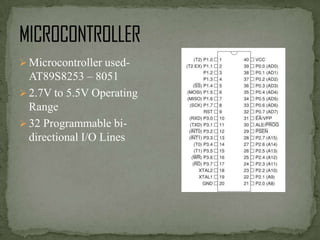
 Microcontroller used-

AT89S8253 – 8051
 2.7V to 5.5V Operating
Range
 32 Programmable bidirectional I/O Lines
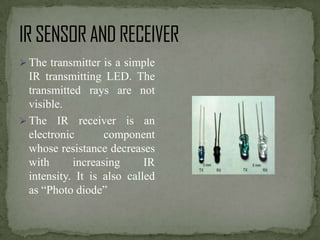
 The transmitter is a simple

IR transmitting LED. The
transmitted rays are not
visible.
 The IR receiver is an
electronic
component
whose resistance decreases
with
increasing
IR
intensity. It is also called
as “Photo diode”
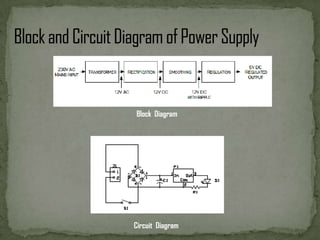
Block Diagram

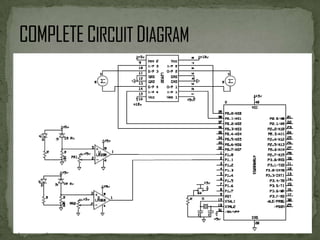
Circuit Diagram
 The advantage of this system is that human error is

eliminated from the picture.
 The problem of accident risks at unmanned level

crossings is solved.
 Installation of this system will lead to accurate and

precise regulation of railway crossings.
 Financial burden on railways is reduced due to reduction

of manpower.
Automatic Railway Gate controller can be successfully implemented

using both wired and wireless techniques. This type of designs are
well suited in the field of communications. Based on this design we
can transmit any information in the form of pulses. Since it is a

demonstration part, the range of the transmitter is limited, the
limitation being the power transmitted by the transmitter and
antenna. However the range can be increased by increasing the
power radiating capacity of the transmitter.
 B. P. Lathi, Modern Digital and Analog Communication

Systems, Oxford University Press, 3rd edition, 1998.
 VSRD International Journal of Electrical, Electronics &

Communication Engineering.
 G. K. Mithal and Ravi Mittal, Radio Engineering,

Khanna Publishers, 17th edition, 1992
 D. Roy Chowdhury and Shail B. Jain, Linear Integrated

Circuits, New Age International Publishers.
 M.Morris Mano, Digital Design, Pearson Education,

3rd edition, 2007 and edition, 2003.
–
The
Free
Encyclopedia
http://en.wikipedia.org/wiki/Frequency_Modulation.

 Wikipedia

 http://www.alldatasheet.com.
 J. B. Gupta, Theory and Performance of Electrical

Machines, S. K. Kataria & Sons, 14th edition, 2005-06.
 http://www.datasheetcatalog.com
X
Automatized railway gate controller

Automatized railway gate controller

  • 1.
  • 2.
     The aimof this project is to automatize the railway crossings in order to avoid accidents due to human negligence.  To control the opening or closing of gate two reference points are required to be fixed at either side of crossing. RF1 and RF2 are the two reference points at which actuation for closing and opening of gate respectively are to be initiated. When the train approaches RF1, the gate is closed and when train levels RF2, gate is opened and vice-versa.
  • 4.
     This projectutilizes two powerful IR transmitters and two receivers: one pair of transmitter and receiver is fixed at up side (from where the train comes) at a level higher than a human being in exact alignment and similarly the other pair is fixed at down side of the train direction.  When foreside receiver gets activated, the gate motor is turned on in one direction and the gate is closed and stays closed until the train crosses the gate and reaches aft side sensors. When aft side receiver gets activated motor turns in opposite direction and gate opens and motor stops.  The reference point settings depend on the following factors: 1. Minimum breaking distance. 2. Speed allowed on that particular track. 3. Road traffic density, so as to clear the traffic before actually the gate is closed.
  • 5.
     Modulation used:ASK(Amplitude Shift Keying)  ASK is a form of amplitude modulation that represents digital data as variations in the amplitude of a carrier wave.  Also called On-Off keying.  Carrier frequency: 434 MHz  Baud Rate: 4800 bps
  • 7.
     Microcontroller used- AT89S8253– 8051  2.7V to 5.5V Operating Range  32 Programmable bidirectional I/O Lines
  • 8.
     The transmitteris a simple IR transmitting LED. The transmitted rays are not visible.  The IR receiver is an electronic component whose resistance decreases with increasing IR intensity. It is also called as “Photo diode”
  • 10.
  • 11.
     The advantageof this system is that human error is eliminated from the picture.  The problem of accident risks at unmanned level crossings is solved.  Installation of this system will lead to accurate and precise regulation of railway crossings.  Financial burden on railways is reduced due to reduction of manpower.
  • 12.
    Automatic Railway Gatecontroller can be successfully implemented using both wired and wireless techniques. This type of designs are well suited in the field of communications. Based on this design we can transmit any information in the form of pulses. Since it is a demonstration part, the range of the transmitter is limited, the limitation being the power transmitted by the transmitter and antenna. However the range can be increased by increasing the power radiating capacity of the transmitter.
  • 13.
     B. P.Lathi, Modern Digital and Analog Communication Systems, Oxford University Press, 3rd edition, 1998.  VSRD International Journal of Electrical, Electronics & Communication Engineering.  G. K. Mithal and Ravi Mittal, Radio Engineering, Khanna Publishers, 17th edition, 1992  D. Roy Chowdhury and Shail B. Jain, Linear Integrated Circuits, New Age International Publishers.  M.Morris Mano, Digital Design, Pearson Education, 3rd edition, 2007 and edition, 2003. – The Free Encyclopedia http://en.wikipedia.org/wiki/Frequency_Modulation.  Wikipedia  http://www.alldatasheet.com.  J. B. Gupta, Theory and Performance of Electrical Machines, S. K. Kataria & Sons, 14th edition, 2005-06.  http://www.datasheetcatalog.com
  • 14.