


Design Care of a Patient Care
Unit: Ergonomics Consideration
Presented by:
1
Objectives
 The objectives of the project are:
o Study the existing layout of a simple Patient Care Unit
o Identify the various limitations with the design and the reasons behind
them
o Suggest the improvements in the layout while considering ergonomics
for a newcomer
o Present the complete new layout with ergonomics consideration

 Additional work:
•
•
•

Suggest the safety considerations to be considered
Servicing levels that should be present in the unit
Housekeeping considered is also to be considered
2
What is a Patient Care Unit ?
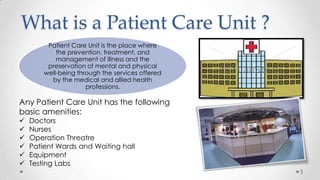
Patient Care Unit is the place where
the prevention, treatment, and
management of illness and the
preservation of mental and physical
well-being through the services offered
by the medical and allied health
professions.

Any Patient Care Unit has the following
basic amenities:







Doctors
Nurses
Operation Threatre
Patient Wards and Waiting hall
Equipment
Testing Labs

3
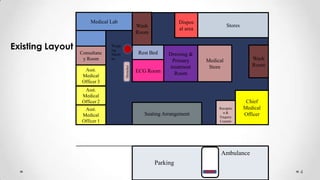
Medical Lab

Consultanc
y Room
Asst.
Medical
Officer 3

Weigh
ing
Machi
ne

Rest Bed
Stretcher

Existing Layout

Dispos
al area

Wash
Room

ECG Room

Dressing &
Primary
treatment
Room

Stores

Asst.
Medical
Officer 2
Asst.
Medical
Officer 1

Seating Arrangement

Wash
Room

Medical
Store

Receptio
n&
Enquiry
Counter

Chief
Medical
Officer

Ambulance
Parking
4
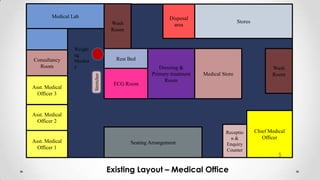
Medical Lab

Disposal
area

Wash
Room

Asst. Medical
Officer 3

Rest Bed
Stretcher

Consultancy
Room

Weighi
ng
Machin
e

Stores

ECG Room

Dressing &
Primary treatment
Room

Medical Store

Wash
Room

Asst. Medical
Officer 2

Asst. Medical
Officer 1

Seating Arrangement

Receptio
n&
Enquiry
Counter

Existing Layout – Medical Office

Chief Medical
Officer
5
Basic Requirements in Patient care unit

for convenience of visitors
( patients, their family and care takers)
Includes the requirements in any Patient Care Unit, some of
which are lagging in existing layout

6
Relatives’ waiting room with a telephone, tv, beverage facilities etc

Location should be chosen so that the unit is adjacent to, or within direct elevator travel to and from, the
emergency department, operating room, intermediate care units, and the radiology department

Patients must be situated so that direct or indirect (E.g. by video monitor) visualization by healthcare
providers is possible at all times

The preferred design is to allow a direct line of vision between the patient and the central nursing
station

Modular design – sliding glass doors & partitions to facilitate visibility

Floor coverings and ceiling with sound absorption properties

7
Lighting – focussed & central lighting.

Air-conditioning (central) 25 ± 2 degrees centigrade.
Cleaning – vacuum cleaning & wet mopping of the floor.
Fumigation is no longer recommended
Natural illumination and view - windows are an important aspect
of sensory orientation; helps to reinforce day/night orientation.
Window treatments should be durable and easy to clean, and a
schedule for their cleaning must be established.
Handwashing areas – uninterrupted water supply, disposable
paper towels / hand drier. (No cloth towels please)
Telephones & computers for communication.
8
Additional approaches to improving sensory orientation for patients may include the provision of a clock,
calendar

Bulletin board, and/or pillow speaker connected to radio and television

Shelving & cabinets off the ground for storage

Waste & sharps disposal

Work areas and storage for critical supplies should be located immediately adjacent to each ICU
There should be a separate medication area of at least 50 square feet containing a refrigerator for
pharmaceuticals, a double locking safe for controlled substances, and a table top for preparation of drugs
and infusions
9
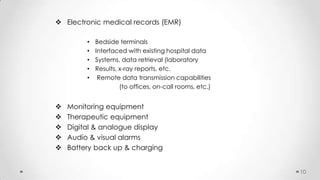
 Electronic medical records (EMR)
•
•
•
•
•







Bedside terminals
Interfaced with existing hospital data
Systems, data retrieval (laboratory
Results, x-ray reports, etc.
Remote data transmission capabilities
(to offices, on-call rooms, etc.)

Monitoring equipment
Therapeutic equipment
Digital & analogue display
Audio & visual alarms
Battery back up & charging
10
Infrastructure


Patients must be situated so that direct or indirect (E.g. By video monitor) visualization by
healthcare providers is possible at all times



The preferred design is to allow a direct line of vision between the patient and the central
nursing station



Modular design – sliding glass doors & partitions to facilitate visibility



Signals & alarms – add to the sensory overload; need to be modulated



Floor coverings and ceiling with sound absorption properties



Doorways – offset to minimise sound transmission



Light & soft music (except 10 pm to 6 am)
11
Contd…


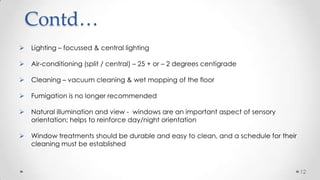
Lighting – focussed & central lighting



Air-conditioning (split / central) – 25 + or – 2 degrees centigrade



Cleaning – vacuum cleaning & wet mopping of the floor



Fumigation is no longer recommended



Natural illumination and view - windows are an important aspect of sensory
orientation; helps to reinforce day/night orientation



Window treatments should be durable and easy to clean, and a schedule for their
cleaning must be established

12
Proposed Layout
Ergonomics Consideration

13
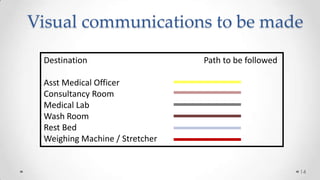
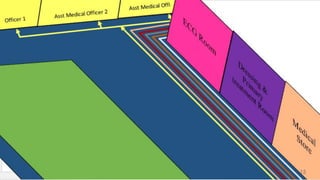
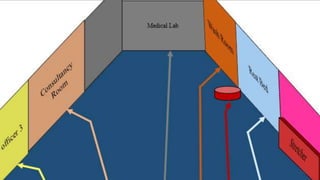
Visual communications to be made
Destination

Path to be followed

Asst Medical Officer
Consultancy Room
Medical Lab
Wash Room
Rest Bed
Weighing Machine / Stretcher

14
15
16
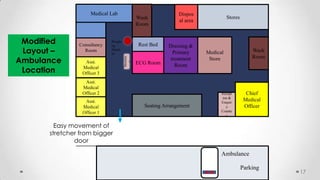
Medical Lab

Consultancy
Room

Weighi
ng
Machi
ne

Asst.
Medical
Officer 3

Rest Bed
Stretche
r

Modified
Layout –
Ambulance
Location

Wash
Room

ECG Room

Dispos
al area

Dressing &
Primary
treatment
Room

Asst.
Medical
Officer 2
Asst.
Medical
Officer 1

Seating Arrangement

Stores

Wash
Room

Medical
Store

Recept
ion &
Enquir
y
Counte
r

Chief
Medical
Officer

Easy movement of
stretcher from bigger
door
Ambulance
Parking

17
Improvements
Improve
Patient
Confidenti
ality and
Privacy

Risk factors
involved in
patient
falls in
hospitals.

External
building
cues
Administrat
ive and
procedural
information

Improve
ments
Local
information
Global
structure
18
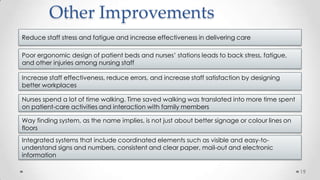
Other Improvements
Reduce staff stress and fatigue and increase effectiveness in delivering care
Poor ergonomic design of patient beds and nurses’ stations leads to back stress, fatigue,
and other injuries among nursing staff
Increase staff effectiveness, reduce errors, and increase staff satisfaction by designing
better workplaces
Nurses spend a lot of time walking. Time saved walking was translated into more time spent
on patient-care activities and interaction with family members
Way finding system, as the name implies, is not just about better signage or colour lines on
floors
Integrated systems that include coordinated elements such as visible and easy-tounderstand signs and numbers, consistent and clear paper, mail-out and electronic
information
19
Characteristics of a Good Patient Care Unit
• Effective
Communication
• Compassionate
Care
• Responsiveness
• Accountability
• Teamwork
• Respect
20
Housekeeping


Hand washing areas – uninterrupted water supply, disposable paper towels / hand
drier



Sterilising area – large water boiler / geyser & exhaust fans



Clean and a dirty utility with no interconnection



Shelving & cabinets off the ground for storage



Waste & sharps disposal



Work areas and storage for critical supplies should be located immediately adjacent
to each ICU



There should be a separate medication area of at least 50 square feet containing a
refrigerator for pharmaceuticals, a double locking safe for controlled substances, and
a table top for preparation of drugs and infusions
21
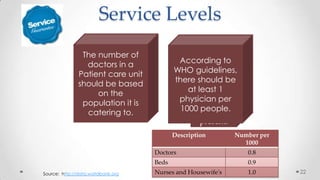
Service Levels
The number of
doctors in a
Patient care unit
should be based
on the
population it is
catering to.

According to
WHO guidelines,
there should be
at least 1
physician per
1000 people.
At
present:
Description

Number per
1000

Doctors
Beds
Source: http://data.worldbank.org

0.8
0.9

Nurses and Housewife's

1.0

22
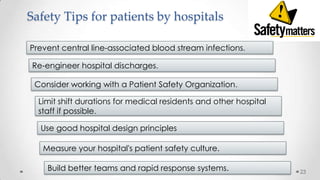
Safety Tips for patients by hospitals
Prevent central line-associated blood stream infections.
Re-engineer hospital discharges.
Consider working with a Patient Safety Organization.

Limit shift durations for medical residents and other hospital
staff if possible.
Use good hospital design principles
Measure your hospital's patient safety culture.
Build better teams and rapid response systems.

23
Queries
24

Ergonomics patient care unit

  • 1.
    Design Care ofa Patient Care Unit: Ergonomics Consideration Presented by: 1
  • 2.
    Objectives  The objectivesof the project are: o Study the existing layout of a simple Patient Care Unit o Identify the various limitations with the design and the reasons behind them o Suggest the improvements in the layout while considering ergonomics for a newcomer o Present the complete new layout with ergonomics consideration  Additional work: • • • Suggest the safety considerations to be considered Servicing levels that should be present in the unit Housekeeping considered is also to be considered 2
  • 3.
    What is aPatient Care Unit ? Patient Care Unit is the place where the prevention, treatment, and management of illness and the preservation of mental and physical well-being through the services offered by the medical and allied health professions. Any Patient Care Unit has the following basic amenities:       Doctors Nurses Operation Threatre Patient Wards and Waiting hall Equipment Testing Labs 3
  • 4.
    Medical Lab Consultanc y Room Asst. Medical Officer3 Weigh ing Machi ne Rest Bed Stretcher Existing Layout Dispos al area Wash Room ECG Room Dressing & Primary treatment Room Stores Asst. Medical Officer 2 Asst. Medical Officer 1 Seating Arrangement Wash Room Medical Store Receptio n& Enquiry Counter Chief Medical Officer Ambulance Parking 4
  • 5.
    Medical Lab Disposal area Wash Room Asst. Medical Officer3 Rest Bed Stretcher Consultancy Room Weighi ng Machin e Stores ECG Room Dressing & Primary treatment Room Medical Store Wash Room Asst. Medical Officer 2 Asst. Medical Officer 1 Seating Arrangement Receptio n& Enquiry Counter Existing Layout – Medical Office Chief Medical Officer 5
  • 6.
    Basic Requirements inPatient care unit for convenience of visitors ( patients, their family and care takers) Includes the requirements in any Patient Care Unit, some of which are lagging in existing layout 6
  • 7.
    Relatives’ waiting roomwith a telephone, tv, beverage facilities etc Location should be chosen so that the unit is adjacent to, or within direct elevator travel to and from, the emergency department, operating room, intermediate care units, and the radiology department Patients must be situated so that direct or indirect (E.g. by video monitor) visualization by healthcare providers is possible at all times The preferred design is to allow a direct line of vision between the patient and the central nursing station Modular design – sliding glass doors & partitions to facilitate visibility Floor coverings and ceiling with sound absorption properties 7
  • 8.
    Lighting – focussed& central lighting. Air-conditioning (central) 25 ± 2 degrees centigrade. Cleaning – vacuum cleaning & wet mopping of the floor. Fumigation is no longer recommended Natural illumination and view - windows are an important aspect of sensory orientation; helps to reinforce day/night orientation. Window treatments should be durable and easy to clean, and a schedule for their cleaning must be established. Handwashing areas – uninterrupted water supply, disposable paper towels / hand drier. (No cloth towels please) Telephones & computers for communication. 8
  • 9.
    Additional approaches toimproving sensory orientation for patients may include the provision of a clock, calendar Bulletin board, and/or pillow speaker connected to radio and television Shelving & cabinets off the ground for storage Waste & sharps disposal Work areas and storage for critical supplies should be located immediately adjacent to each ICU There should be a separate medication area of at least 50 square feet containing a refrigerator for pharmaceuticals, a double locking safe for controlled substances, and a table top for preparation of drugs and infusions 9
  • 10.
     Electronic medicalrecords (EMR) • • • • •      Bedside terminals Interfaced with existing hospital data Systems, data retrieval (laboratory Results, x-ray reports, etc. Remote data transmission capabilities (to offices, on-call rooms, etc.) Monitoring equipment Therapeutic equipment Digital & analogue display Audio & visual alarms Battery back up & charging 10
  • 11.
    Infrastructure  Patients must besituated so that direct or indirect (E.g. By video monitor) visualization by healthcare providers is possible at all times  The preferred design is to allow a direct line of vision between the patient and the central nursing station  Modular design – sliding glass doors & partitions to facilitate visibility  Signals & alarms – add to the sensory overload; need to be modulated  Floor coverings and ceiling with sound absorption properties  Doorways – offset to minimise sound transmission  Light & soft music (except 10 pm to 6 am) 11
  • 12.
    Contd…  Lighting – focussed& central lighting  Air-conditioning (split / central) – 25 + or – 2 degrees centigrade  Cleaning – vacuum cleaning & wet mopping of the floor  Fumigation is no longer recommended  Natural illumination and view - windows are an important aspect of sensory orientation; helps to reinforce day/night orientation  Window treatments should be durable and easy to clean, and a schedule for their cleaning must be established 12
  • 13.
  • 14.
    Visual communications tobe made Destination Path to be followed Asst Medical Officer Consultancy Room Medical Lab Wash Room Rest Bed Weighing Machine / Stretcher 14
  • 15.
  • 16.
  • 17.
    Medical Lab Consultancy Room Weighi ng Machi ne Asst. Medical Officer 3 RestBed Stretche r Modified Layout – Ambulance Location Wash Room ECG Room Dispos al area Dressing & Primary treatment Room Asst. Medical Officer 2 Asst. Medical Officer 1 Seating Arrangement Stores Wash Room Medical Store Recept ion & Enquir y Counte r Chief Medical Officer Easy movement of stretcher from bigger door Ambulance Parking 17
  • 18.
    Improvements Improve Patient Confidenti ality and Privacy Risk factors involvedin patient falls in hospitals. External building cues Administrat ive and procedural information Improve ments Local information Global structure 18
  • 19.
    Other Improvements Reduce staffstress and fatigue and increase effectiveness in delivering care Poor ergonomic design of patient beds and nurses’ stations leads to back stress, fatigue, and other injuries among nursing staff Increase staff effectiveness, reduce errors, and increase staff satisfaction by designing better workplaces Nurses spend a lot of time walking. Time saved walking was translated into more time spent on patient-care activities and interaction with family members Way finding system, as the name implies, is not just about better signage or colour lines on floors Integrated systems that include coordinated elements such as visible and easy-tounderstand signs and numbers, consistent and clear paper, mail-out and electronic information 19
  • 20.
    Characteristics of aGood Patient Care Unit • Effective Communication • Compassionate Care • Responsiveness • Accountability • Teamwork • Respect 20
  • 21.
    Housekeeping  Hand washing areas– uninterrupted water supply, disposable paper towels / hand drier  Sterilising area – large water boiler / geyser & exhaust fans  Clean and a dirty utility with no interconnection  Shelving & cabinets off the ground for storage  Waste & sharps disposal  Work areas and storage for critical supplies should be located immediately adjacent to each ICU  There should be a separate medication area of at least 50 square feet containing a refrigerator for pharmaceuticals, a double locking safe for controlled substances, and a table top for preparation of drugs and infusions 21
  • 22.
    Service Levels The numberof doctors in a Patient care unit should be based on the population it is catering to. According to WHO guidelines, there should be at least 1 physician per 1000 people. At present: Description Number per 1000 Doctors Beds Source: http://data.worldbank.org 0.8 0.9 Nurses and Housewife's 1.0 22
  • 23.
    Safety Tips forpatients by hospitals Prevent central line-associated blood stream infections. Re-engineer hospital discharges. Consider working with a Patient Safety Organization. Limit shift durations for medical residents and other hospital staff if possible. Use good hospital design principles Measure your hospital's patient safety culture. Build better teams and rapid response systems. 23
  • 24.