PROGRESS    SEMINAR ON
AUTOMATIC RAIL GATE CONTROL


PRESENTED BY:

SAJAL DAS (94026)
MITUL THAKURIA (94027)

ABHIJIT BARUAH (104132)   Guided by
A.VILASH REDDY (94050)    M. BABITA DEVI:
PLAN OF TALK:
   INTRODUCTION
   BLOCK DIAGRAM
   WORKING PRINCIPLE
   EXPLANATION OF
           IC AT89C2051
         • IC 74LS245

         • STEPPER MOTOR

         • RELAY
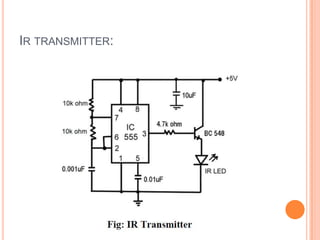
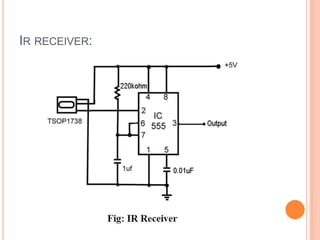
         •   INFRARED
 ALGORITHM
 CONCLUSION
INTRODUCTION:
 An automatic railway gate control at unmanned level
  crossings replacing the gates operated by gate keepers
  and also the semi automatically operated gates. It deals
  with two things.
 Firstly, it deals with the reduction of time for which the
  gate is being kept closed.
 And secondly, to provide safety to the road users by
  reducing the accidents that usually occur due to
  carelessness of road users and at times errors made by
  the gatekeepers.
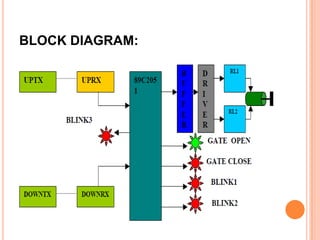
BLOCK DIAGRAM:
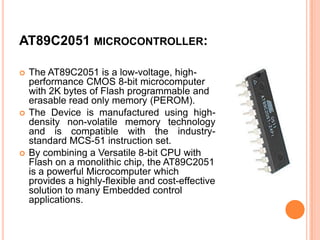
AT89C2051 MICROCONTROLLER:

   The AT89C2051 is a low-voltage, high-
    performance CMOS 8-bit microcomputer
    with 2K bytes of Flash programmable and
    erasable read only memory (PEROM).
   The Device is manufactured using high-
    density non-volatile memory technology
    and is compatible with the industry-
    standard MCS-51 instruction set.
   By combining a Versatile 8-bit CPU with
    Flash on a monolithic chip, the AT89C2051
    is a powerful Microcomputer which
    provides a highly-flexible and cost-effective
    solution to many Embedded control
    applications.
FEATURES:

   Compatible with MCS-51™ Products
   2K Bytes of Reprogrammable Flash Memory
   Endurance: 1,000 Write/Erase Cycles
   2.7V to 6V Operating Range
   Fully Static Operation: 0 Hz to 24 MHz
   Two-level Program Memory Lock
   128 x 8-bit Internal RAM
   15 Programmable I/O Lines
   Two 16-bit Timer/Counters
   Six Interrupt Sources
   Programmable Serial UART Channel
   Direct LED Drive Outputs
   On-chip Analog Comparator
   Low-power Idle and Power-down Modes

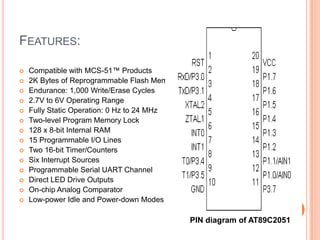
                                              PIN diagram of AT89C2051
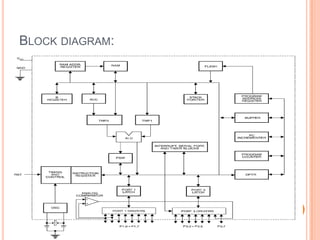
BLOCK DIAGRAM:
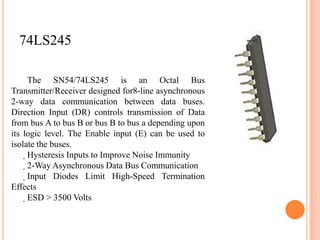
74LS245

     The SN54/74LS245 is an Octal Bus
Transmitter/Receiver designed for8-line asynchronous
2-way data communication between data buses.
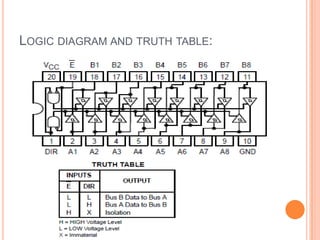
Direction Input (DR) controls transmission of Data
from bus A to bus B or bus B to bus a depending upon
its logic level. The Enable input (E) can be used to
isolate the buses.
     Hysteresis Inputs to Improve Noise Immunity
      2-Way Asynchronous Data Bus Communication
       Input Diodes Limit High-Speed Termination
Effects
        ESD > 3500 Volts
LOGIC DIAGRAM AND TRUTH TABLE:
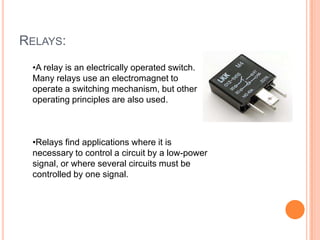
RELAYS:
 •A relay is an electrically operated switch.
 Many relays use an electromagnet to
 operate a switching mechanism, but other
 operating principles are also used.


 •Relays find applications where it is
 necessary to control a circuit by a low-power
 signal, or where several circuits must be
 controlled by one signal.
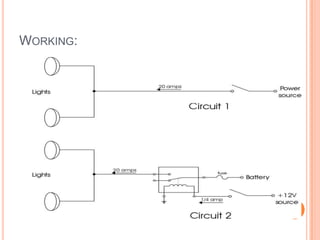
WORKING:
USES OF RELAYS:
•Control a high-voltage circuit with a low-voltage signal, as in some types of
modems or audio amplifiers,


•Control a high-current circuit with a low-current signal, as in the starter
solenoid of an automobile,


•Detect and isolate faults on transmission and distribution lines by opening and
closing circuit breakers (protection relays),
IR TRANSMITTER:
IR RECEIVER:
STEPPER MOTOR:
• A stepper motor (or step motor) is a
brushless, synchronous electric motor that can divide
a full rotation into a large number of steps.

• The motor's position can be controlled precisely
without any feedback mechanism, as long as the
motor is carefully sized to the application.
   .
CHARACTERISTICS:

•Stepper motors are constant power devices.


•As motor speed increases, torque decreases.

•Steppers exhibit more vibration than other motor types, as the
discrete step tends to snap the rotor from one position to another.


•This vibration can become very bad at some speeds and can cause
the motor to lose torque (or lose direction).
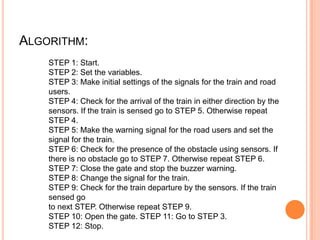
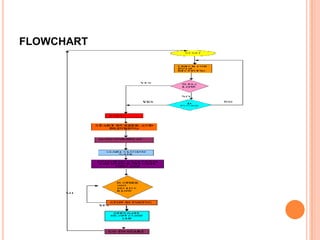
ALGORITHM:
    STEP 1: Start.
    STEP 2: Set the variables.
    STEP 3: Make initial settings of the signals for the train and road
    users.
    STEP 4: Check for the arrival of the train in either direction by the
    sensors. If the train is sensed go to STEP 5. Otherwise repeat
    STEP 4.
    STEP 5: Make the warning signal for the road users and set the
    signal for the train.
    STEP 6: Check for the presence of the obstacle using sensors. If
    there is no obstacle go to STEP 7. Otherwise repeat STEP 6.
    STEP 7: Close the gate and stop the buzzer warning.
    STEP 8: Change the signal for the train.
    STEP 9: Check for the train departure by the sensors. If the train
    sensed go
    to next STEP. Otherwise repeat STEP 9.
    STEP 10: Open the gate. STEP 11: Go to STEP 3.
    STEP 12: Stop.
FLOWCHART
CONCLUSION:
   The project is an approach to provide the security to our
INDIAN RAILWAY transportation. This electronics project
is developed for the reduction of human effort. This
electronic project is an approach to the modern
transportation system.
REFERENCE:


      •http://www.seminarprojects.com/search.php

      •WWW.SKITRONICS.COM

      •WWW.WIKIPEDIA.ORG

      •WWW.GOOGLE.COM

Rail gate controller ppt

  • 1.
    PROGRESS SEMINAR ON AUTOMATIC RAIL GATE CONTROL PRESENTED BY: SAJAL DAS (94026) MITUL THAKURIA (94027) ABHIJIT BARUAH (104132) Guided by A.VILASH REDDY (94050) M. BABITA DEVI:
  • 2.
    PLAN OF TALK:  INTRODUCTION  BLOCK DIAGRAM  WORKING PRINCIPLE  EXPLANATION OF IC AT89C2051 • IC 74LS245 • STEPPER MOTOR • RELAY • INFRARED  ALGORITHM  CONCLUSION
  • 3.
    INTRODUCTION:  An automaticrailway gate control at unmanned level crossings replacing the gates operated by gate keepers and also the semi automatically operated gates. It deals with two things.  Firstly, it deals with the reduction of time for which the gate is being kept closed.  And secondly, to provide safety to the road users by reducing the accidents that usually occur due to carelessness of road users and at times errors made by the gatekeepers.
  • 4.
  • 5.
    AT89C2051 MICROCONTROLLER:  The AT89C2051 is a low-voltage, high- performance CMOS 8-bit microcomputer with 2K bytes of Flash programmable and erasable read only memory (PEROM).  The Device is manufactured using high- density non-volatile memory technology and is compatible with the industry- standard MCS-51 instruction set.  By combining a Versatile 8-bit CPU with Flash on a monolithic chip, the AT89C2051 is a powerful Microcomputer which provides a highly-flexible and cost-effective solution to many Embedded control applications.
  • 6.
    FEATURES:  Compatible with MCS-51™ Products  2K Bytes of Reprogrammable Flash Memory  Endurance: 1,000 Write/Erase Cycles  2.7V to 6V Operating Range  Fully Static Operation: 0 Hz to 24 MHz  Two-level Program Memory Lock  128 x 8-bit Internal RAM  15 Programmable I/O Lines  Two 16-bit Timer/Counters  Six Interrupt Sources  Programmable Serial UART Channel  Direct LED Drive Outputs  On-chip Analog Comparator  Low-power Idle and Power-down Modes PIN diagram of AT89C2051
  • 7.
  • 8.
    74LS245 The SN54/74LS245 is an Octal Bus Transmitter/Receiver designed for8-line asynchronous 2-way data communication between data buses. Direction Input (DR) controls transmission of Data from bus A to bus B or bus B to bus a depending upon its logic level. The Enable input (E) can be used to isolate the buses. Hysteresis Inputs to Improve Noise Immunity 2-Way Asynchronous Data Bus Communication Input Diodes Limit High-Speed Termination Effects ESD > 3500 Volts
  • 9.
    LOGIC DIAGRAM ANDTRUTH TABLE:
  • 10.
    RELAYS: •A relayis an electrically operated switch. Many relays use an electromagnet to operate a switching mechanism, but other operating principles are also used. •Relays find applications where it is necessary to control a circuit by a low-power signal, or where several circuits must be controlled by one signal.
  • 11.
  • 12.
    USES OF RELAYS: •Controla high-voltage circuit with a low-voltage signal, as in some types of modems or audio amplifiers, •Control a high-current circuit with a low-current signal, as in the starter solenoid of an automobile, •Detect and isolate faults on transmission and distribution lines by opening and closing circuit breakers (protection relays),
  • 13.
  • 15.
  • 16.
    STEPPER MOTOR: • Astepper motor (or step motor) is a brushless, synchronous electric motor that can divide a full rotation into a large number of steps. • The motor's position can be controlled precisely without any feedback mechanism, as long as the motor is carefully sized to the application. .
  • 17.
    CHARACTERISTICS: •Stepper motors areconstant power devices. •As motor speed increases, torque decreases. •Steppers exhibit more vibration than other motor types, as the discrete step tends to snap the rotor from one position to another. •This vibration can become very bad at some speeds and can cause the motor to lose torque (or lose direction).
  • 18.
    ALGORITHM: STEP 1: Start. STEP 2: Set the variables. STEP 3: Make initial settings of the signals for the train and road users. STEP 4: Check for the arrival of the train in either direction by the sensors. If the train is sensed go to STEP 5. Otherwise repeat STEP 4. STEP 5: Make the warning signal for the road users and set the signal for the train. STEP 6: Check for the presence of the obstacle using sensors. If there is no obstacle go to STEP 7. Otherwise repeat STEP 6. STEP 7: Close the gate and stop the buzzer warning. STEP 8: Change the signal for the train. STEP 9: Check for the train departure by the sensors. If the train sensed go to next STEP. Otherwise repeat STEP 9. STEP 10: Open the gate. STEP 11: Go to STEP 3. STEP 12: Stop.
  • 19.
  • 20.
    CONCLUSION: The project is an approach to provide the security to our INDIAN RAILWAY transportation. This electronics project is developed for the reduction of human effort. This electronic project is an approach to the modern transportation system.
  • 21.
    REFERENCE: •http://www.seminarprojects.com/search.php •WWW.SKITRONICS.COM •WWW.WIKIPEDIA.ORG •WWW.GOOGLE.COM