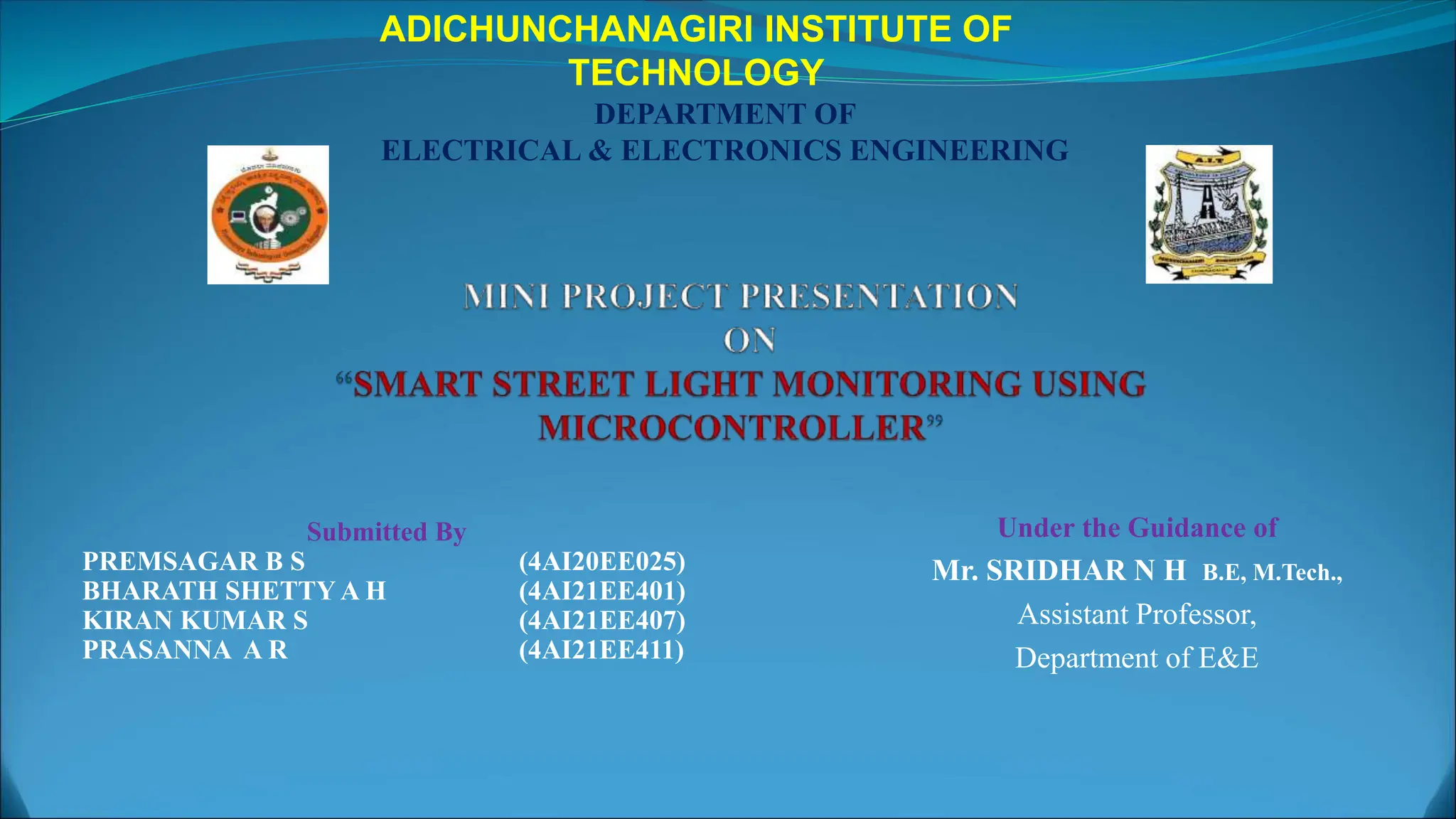
Under the Guidance of
Mr. SRIDHAR N H B.E, M.Tech.,
Assistant Professor,
Department of E&E
Submitted By
PREMSAGAR B S (4AI20EE025)
BHARATH SHETTY A H (4AI21EE401)
KIRAN KUMAR S (4AI21EE407)
PRASANNA A R (4AI21EE411)
ADICHUNCHANAGIRI INSTITUTE OF
TECHNOLOGY
DEPARTMENT OF
ELECTRICAL & ELECTRONICS ENGINEERING
CONTENTS
 Abstract
 Introduction
 Literature survey
 Methodology
 Block Diagram
 Circuit Diagram
 Hardware Description
 Software description
 Results
 Advantages
 Disadvantages
 Application
 Conclusion
 References
ABSTRACT
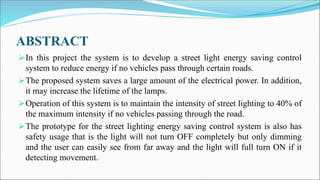
In this project the system is to develop a street light energy saving control
system to reduce energy if no vehicles pass through certain roads.
The proposed system saves a large amount of the electrical power. In addition,
it may increase the lifetime of the lamps.
Operation of this system is to maintain the intensity of street lighting to 40% of
the maximum intensity if no vehicles passing through the road.
The prototype for the street lighting energy saving control system is also has
safety usage that is the light will not turn OFF completely but only dimming
and the user can easily see from far away and the light will full turn ON if it
detecting movement.
INTRODUCTION
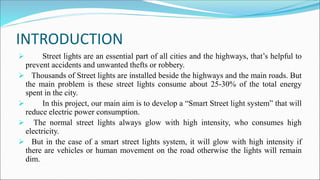
 Street lights are an essential part of all cities and the highways, that’s helpful to
prevent accidents and unwanted thefts or robbery.
 Thousands of Street lights are installed beside the highways and the main roads. But
the main problem is these street lights consume about 25-30% of the total energy
spent in the city.
 In this project, our main aim is to develop a “Smart Street light system” that will
reduce electric power consumption.
 The normal street lights always glow with high intensity, who consumes high
electricity.
 But in the case of a smart street lights system, it will glow with high intensity if
there are vehicles or human movement on the road otherwise the lights will remain
dim.
LITERATURE SURVEY
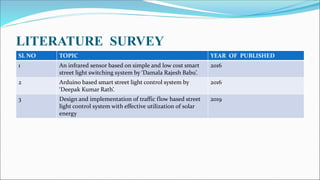
SL NO TOPIC YEAR OF PUBLISHED
1 An infrared sensor based on simple and low cost smart
street light switching system by ‘Damala Rajesh Babu’.
2016
2 Arduino based smart street light control system by
‘Deepak Kumar Rath’.
2016
3 Design and implementation of traffic flow based street
light control system with effective utilization of solar
energy
2019
METHODOLOGY
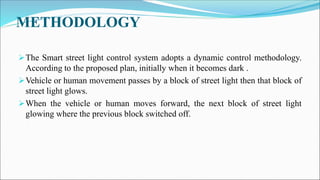
The Smart street light control system adopts a dynamic control methodology.
According to the proposed plan, initially when it becomes dark .
Vehicle or human movement passes by a block of street light then that block of
street light glows.
When the vehicle or human moves forward, the next block of street light
glowing where the previous block switched off.
BLOCK DIAGRAM
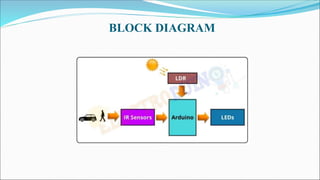
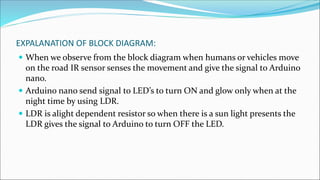
EXPALANATION OF BLOCK DIAGRAM:
 When we observe from the block diagram when humans or vehicles move
on the road IR sensor senses the movement and give the signal to Arduino
nano.
 Arduino nano send signal to LED’s to turn ON and glow only when at the
night time by using LDR.
 LDR is alight dependent resistor so when there is a sun light presents the
LDR gives the signal to Arduino to turn OFF the LED.
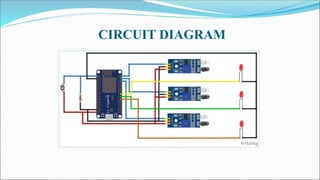
CIRCUIT DIAGRAM
HARDWARE REQUIREMENT
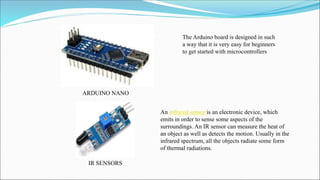
 ARDUINO NANO
 IR SENSOR
 LED’S
 LDR
The Arduino board is designed in such
a way that it is very easy for beginners
to get started with microcontrollers
ARDUINO NANO
IR SENSORS
An infrared sensor is an electronic device, which
emits in order to sense some aspects of the
surroundings. An IR sensor can measure the heat of
an object as well as detects the motion. Usually in the
infrared spectrum, all the objects radiate some form
of thermal radiations.
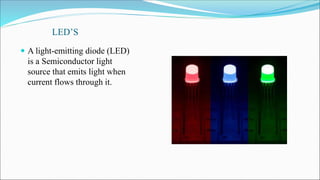
LED’S
 A light-emitting diode (LED)
is a Semiconductor light
source that emits light when
current flows through it.
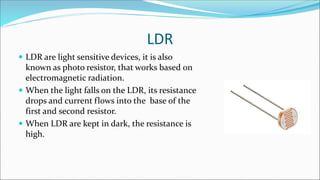
LDR
 LDR are light sensitive devices, it is also
known as photo resistor, that works based on
electromagnetic radiation.
 When the light falls on the LDR, its resistance
drops and current flows into the base of the
first and second resistor.
 When LDR are kept in dark, the resistance is
high.
SOFTWARE DESCRIPTION
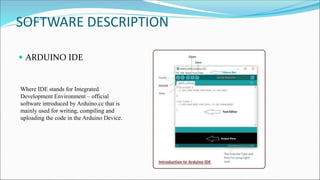
 ARDUINO IDE
Where IDE stands for Integrated
Development Environment – official
software introduced by Arduino.cc that is
mainly used for writing, compiling and
uploading the code in the Arduino Device.
RESULTS
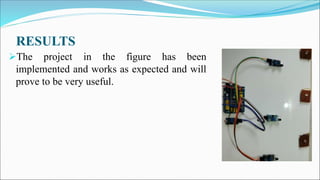
The project in the figure has been
implemented and works as expected and will
prove to be very useful.
ADVANTAGES
 Automatic switching ON and OFF of street lights, so there is no need of manpower.
 Cost-effective.
 Maintenance cost is less.
 Power saving.
DISADVANTAGES
 Implementation cost is high.
 In case of defect or repair, troubleshooting of the system is complex.
 System is subjected to damage by environmental conditions.
APPLICATIONS
 It is used for digital signage.
 It could also be equipped with charging station for electric vehicles.
 Highways, parking lights, garden lights etc.
CONCLUSION
 If we use this idea and implement it into our society it will be very useful in saving
enough amount of electricity and ofcourse money.
 The energy will be conserved and given to the next generation.
 This idea & implementation will also conserves the natural resources.
FUTURE SCOPE
 An smart street lighting system can cut municipal street lighting costs as much as
50% - 70%.
 These smart lights will help cities reduce electricity costs and improve maintenance.
 In addition to enabling cities to provide the proper amount of street light for local
conditions, installing smart lighting will help improve citizen satisfaction regarding
security and safety, while bringing municipalities significant savings in power
consumption and lighting system maintenance.
REFERENCES
 S. Suganya, R. Sinduja, T. Sowmiya & S. Senthilkumar, Street light glow on
detecting vehicle movement using sensor.
 K.Santha Sheela, S. Padmadevi , Survey on Street Lighting System Based
On Vehicle Movements.
 M.Abhishek, Syed ajram shah, K. Chetan, K. Arun Kumar, Design and
implementation of
traffic flow based street light control system with effective utilization of
solar energy.
THANK YOU

Smart street light using microcontroller

  • 1.
    Under the Guidanceof Mr. SRIDHAR N H B.E, M.Tech., Assistant Professor, Department of E&E Submitted By PREMSAGAR B S (4AI20EE025) BHARATH SHETTY A H (4AI21EE401) KIRAN KUMAR S (4AI21EE407) PRASANNA A R (4AI21EE411) ADICHUNCHANAGIRI INSTITUTE OF TECHNOLOGY DEPARTMENT OF ELECTRICAL & ELECTRONICS ENGINEERING
  • 2.
    CONTENTS  Abstract  Introduction Literature survey  Methodology  Block Diagram  Circuit Diagram  Hardware Description  Software description  Results  Advantages  Disadvantages  Application  Conclusion  References
  • 3.
    ABSTRACT In this projectthe system is to develop a street light energy saving control system to reduce energy if no vehicles pass through certain roads. The proposed system saves a large amount of the electrical power. In addition, it may increase the lifetime of the lamps. Operation of this system is to maintain the intensity of street lighting to 40% of the maximum intensity if no vehicles passing through the road. The prototype for the street lighting energy saving control system is also has safety usage that is the light will not turn OFF completely but only dimming and the user can easily see from far away and the light will full turn ON if it detecting movement.
  • 4.
    INTRODUCTION  Street lightsare an essential part of all cities and the highways, that’s helpful to prevent accidents and unwanted thefts or robbery.  Thousands of Street lights are installed beside the highways and the main roads. But the main problem is these street lights consume about 25-30% of the total energy spent in the city.  In this project, our main aim is to develop a “Smart Street light system” that will reduce electric power consumption.  The normal street lights always glow with high intensity, who consumes high electricity.  But in the case of a smart street lights system, it will glow with high intensity if there are vehicles or human movement on the road otherwise the lights will remain dim.
  • 5.
    LITERATURE SURVEY SL NOTOPIC YEAR OF PUBLISHED 1 An infrared sensor based on simple and low cost smart street light switching system by ‘Damala Rajesh Babu’. 2016 2 Arduino based smart street light control system by ‘Deepak Kumar Rath’. 2016 3 Design and implementation of traffic flow based street light control system with effective utilization of solar energy 2019
  • 6.
    METHODOLOGY The Smart streetlight control system adopts a dynamic control methodology. According to the proposed plan, initially when it becomes dark . Vehicle or human movement passes by a block of street light then that block of street light glows. When the vehicle or human moves forward, the next block of street light glowing where the previous block switched off.
  • 7.
  • 8.
    EXPALANATION OF BLOCKDIAGRAM:  When we observe from the block diagram when humans or vehicles move on the road IR sensor senses the movement and give the signal to Arduino nano.  Arduino nano send signal to LED’s to turn ON and glow only when at the night time by using LDR.  LDR is alight dependent resistor so when there is a sun light presents the LDR gives the signal to Arduino to turn OFF the LED.
  • 9.
  • 10.
    HARDWARE REQUIREMENT  ARDUINONANO  IR SENSOR  LED’S  LDR
  • 11.
    The Arduino boardis designed in such a way that it is very easy for beginners to get started with microcontrollers ARDUINO NANO IR SENSORS An infrared sensor is an electronic device, which emits in order to sense some aspects of the surroundings. An IR sensor can measure the heat of an object as well as detects the motion. Usually in the infrared spectrum, all the objects radiate some form of thermal radiations.
  • 12.
    LED’S  A light-emittingdiode (LED) is a Semiconductor light source that emits light when current flows through it.
  • 13.
    LDR  LDR arelight sensitive devices, it is also known as photo resistor, that works based on electromagnetic radiation.  When the light falls on the LDR, its resistance drops and current flows into the base of the first and second resistor.  When LDR are kept in dark, the resistance is high.
  • 14.
    SOFTWARE DESCRIPTION  ARDUINOIDE Where IDE stands for Integrated Development Environment – official software introduced by Arduino.cc that is mainly used for writing, compiling and uploading the code in the Arduino Device.
  • 15.
    RESULTS The project inthe figure has been implemented and works as expected and will prove to be very useful.
  • 16.
    ADVANTAGES  Automatic switchingON and OFF of street lights, so there is no need of manpower.  Cost-effective.  Maintenance cost is less.  Power saving.
  • 17.
    DISADVANTAGES  Implementation costis high.  In case of defect or repair, troubleshooting of the system is complex.  System is subjected to damage by environmental conditions.
  • 18.
    APPLICATIONS  It isused for digital signage.  It could also be equipped with charging station for electric vehicles.  Highways, parking lights, garden lights etc.
  • 19.
    CONCLUSION  If weuse this idea and implement it into our society it will be very useful in saving enough amount of electricity and ofcourse money.  The energy will be conserved and given to the next generation.  This idea & implementation will also conserves the natural resources.
  • 20.
    FUTURE SCOPE  Ansmart street lighting system can cut municipal street lighting costs as much as 50% - 70%.  These smart lights will help cities reduce electricity costs and improve maintenance.  In addition to enabling cities to provide the proper amount of street light for local conditions, installing smart lighting will help improve citizen satisfaction regarding security and safety, while bringing municipalities significant savings in power consumption and lighting system maintenance.
  • 21.
    REFERENCES  S. Suganya,R. Sinduja, T. Sowmiya & S. Senthilkumar, Street light glow on detecting vehicle movement using sensor.  K.Santha Sheela, S. Padmadevi , Survey on Street Lighting System Based On Vehicle Movements.  M.Abhishek, Syed ajram shah, K. Chetan, K. Arun Kumar, Design and implementation of traffic flow based street light control system with effective utilization of solar energy.
  • 22.