Solar Powered LED Street Lighting
Martin Waldo
Abstract— The project is designed for LED based Street Lights with an auto-intensity control that uses solar power from photovoltaic cells. A
charge controller circuit is used to control the charging of the battery, and an LDR is used to sense the ambient light on day time.We have also at-
tempted to measure the solar cell parameters through multiple sensor data acquisition. In this system, different parameters of the solar panel like
light intensity, voltage, current and temperature are monitored using a microcontroller of the PIC16F8 family.The intensity of street lights is re-
quired to be kept high during the peak hours. The street lights are switched on at the dusk and then switched off at the dawn automatically by us-
ing a sensing device LDR LED lights are the future of lighting, because of their low energy consumption and long life they are fast replacing con-
ventional lights world over. White light emitting diode (LED) replaces the HID lamps where intensity control is possible by pulse width modulation. A
programmable microcontroller of the 8051 family is engaged to provide different intensities at different times of the night using PWM technique, for
energy saving for solar based system, also using a charge controller for protecting the battery from over charging, overload and deep dis- charge
protection. A light sensing device LDR (Light Dependent Resistance) is used , whose resistance reduces drastically in day light for sens- ing
purposes.In the measuring circuit the light intensity is monitored using an LDR sensor, the voltage by voltage divider principle, the current by
current sensor and the temperature by temperature sensor. All these data are displayed on a 16X2 LCD interfaced to thePIC microcontroller.

1 INTRODUCTION
The main consideration in the present field technologies are
Automation, Power consumption and cost effectiveness. Pro-
viding street lighting is one of the most important and expen-
sive responsibilities of a city. Energy efficient technologies and
design mechanism can reduce cost of the street lighting drasti-
cally. There are various numbers of control strategy and
methods in controlling the street light system to ensure that it
consumes less energy and is efficient in terms of money and
usage. Led Drivers are more demanding these days
1.2 Problem Definition
The idea of designing a new system for the streetlight that do
not consume huge amount of electricity and illuminate large
areas with the highest intensity of light is concerning each en-
gineer working in this field. Inefficient lighting wastes signifi-
cant financial resources every year, and poor lighting creates
unsafe conditions. Energy efficient technologies and design
mechanism can reduce cost of the street lighting drastically.
2 Implemented method for street lighting
This circuit consists of a battery charge controller circuit that is
charged by the solar panel. The battery gives supply to the
micro-controller which is programmed to work as a PWM
connected to the LDR which gives high/low signal based on
the light intensity. When the microcontroller gives a high sig-
nal to the mosfet the LED Lighting is OFF. Once the MOSFET
gets a low signal it turns ON and the LED glows. The circuit
also consists of measurement circuit for the measurement of
photovoltaic power and the variation of light for the amount of
sunlight obtained. The current is sensed by the current sensor,
and temperature by the temperature sensor and voltage is
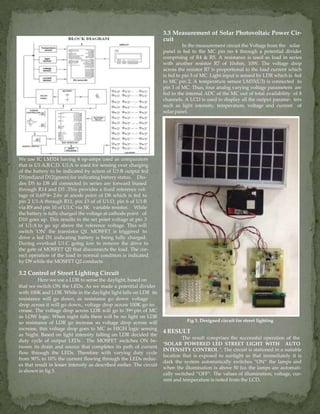
noted by the potential divider circuit. The block diagram is
shown below in fig. 2.1.
3 WORKING
3.1 Solar Panel Section:
Battery B1 is charged via D10 and fuse. When battery gets
fully charged Q1 conducts from output of comparator.
This results Q2 to conduct and divert the solar power
through D11 and Q2 such that battery is not over charged.
We use IC LM324 having 4 op-amps used as comparators
that is U1:A,B,C,D. U1:A is used for sensing over charging
of the battery to be indicated by action of U1:B output fed
D1(red)and D12(green) for indicating battery status. Dio-
des D5 to D8 all connected in series are forward biased
through R14 and D3 .This provides a fixed reference vol-
tage of 0.65*4= 2.6v at anode point of D8 which is fed to
pin 2 U1:A through R11, pin 13 of of U1:D, pin 6 of U1:B
via R9 and pin 10 of U1:C via 5K variable resistor. While
the battery is fully charged the voltage at cathode point of
D10 goes up. This results in the set point voltage at pin 3
of U1:A to go up above the reference voltage. This will
switch ‘ON’ the transistor Q1. MOSFET is triggered to
drive a led D1 indicating battery is being fully charged.
During overload U1:C going low to remove the drive to
the gate of MOSFET Q2 that disconnects the load. The cor-
rect operation of the load in normal condition is indicated
by D9 while the MOSFET Q2 conducts.
3.2 Control of Street Lighting Circuit
Here we use a LDR to sense the daylight, based on
that we switch ON the LEDs. As we made a potential divider
with 100K and LDR. While in the daylight light falls on LDR its
resistance will go down, as resistance go down voltage
drop across it will go down., voltage drop across 100K go in-
crease. The voltage drop across LDR will go to 39th pin of MC
as LOW logic. When night falls there will be no light on LDR
so resistance of LDR go increase so voltage drop across will
increase, this voltage drop goes to MC as HIGH logic sensing
as Night. Based on light intensity falling on LDR decided the
duty cycle of output LEDs . The MOSFET switches ON be-
tween its drain and source that completes its path of current
flow through the LEDs. Therefore with varying duty cycle
from 90% to 10% the current flowing through the LEDs reduc-
es that result in lesser intensity as described earlier. The circuit
is shown in fig 3.
3.3 Measurement of Solar Photovoltaic Power Cir-
cuit
In the measurement circuit the Voltage from the solar
panel is fed to the MC pin no 4 through a potential divider
comprising of R4 & R5. A resistance is used as load in series
with another resistor R7 of 10ohm, 10W. The voltage drop
across the resistor R7 is proportional to the load current which
is fed to pin 5 of MC. Light input is sensed by LDR which is fed
to MC pin 2. A temperature sensor LM35(U3) is connected to
pin 3 of MC. Thus, four analog varying voltage parameters are
fed to the internal ADC of the MC out of total availability of 8
channels. A LCD is used to display all the output parame- ters
such as light intensity, temperature, voltage and current of
solarpanel.
4 RESULT
The result comprises the successful operation of the
‘SOLAR POWERED LED STREET LIGHT WITH AUTO
INTENSITY CONTROL ’. The circuit is stationed in a suitable
location that is exposed to sunlight so that immediately it is
dark the system automatically switches “ON” the lamps and
when the illumination is above 50 lux the lamps are automati-
cally switched “OFF”. The values of illumination, voltage, cur-
rent and temperature is noted from the LCD.
Fig 3. Designed circuit for street lighting
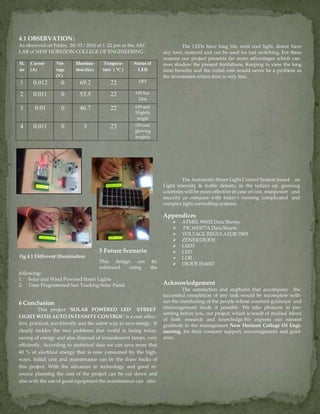
4.1 OBSERVATION :
As observed on Friday, 20/ 05 / 2016 at 1 :22 pm in the AEC
LAB of NEW HORIZION COLLEGE OF ENGINEERING :
Sl.
no
.
Curent
(A)
Vol-
tage
(V)
Illumina-
tion (lux)
Tempera-
ture ( ºC )
Statusof
LED
1 0.012 0 69.2 22 OFF
2 0.011 0 53.5 22 ONbut
Dim
3 0.01 0 46.7 22 ONand
Slightly
bright
4 0.011 0 3 23 ONand
glowing
brightly
5 Future Scenario
This design can be
theenhanced using
following:
1. Solar and Wind Powered Street Lights
2. Time Programmed Sun Tracking Solar Panel
6 Conclusion
This project ‘SOLAR POWERED LED STREET
LIGHT WITH AUTO INTENSITY CONTROL’ is a cost effec-
tive, practical, eco-friendly and the safest way to save energy. It
clearly tackles the two problems that world is facing today,
saving of energy and also disposal of incandescent lamps, very
efficiently. According to statistical data we can save more that
40 % of electrical energy that is now consumed by the high-
ways. Initial cost and maintenance can be the draw backs of
this project. With the advances in technology and good re-
source planning the cost of the project can be cut down and
also with the use of good equipment the maintenance can also
The LEDs have long life, emit cool light, donor have
any toxic material and can be used for fast switching. For these
reasons our project presents far more advantages which can
over shadow the present limitations. Keeping in view the long
term benefits and the initial cost would never be a problem as
the investment return time is very less.
The Automatic Street Light Control System based on
Light intensity & traffic density, in the todays up growing
countries will be more effective in case of cost, manpower and
security as compare with today's running complicated and
complex light controlling systems.
Appendices
 ATMEL 89S52 Data Sheets.
 PIC16F877A Data Sheets.
 VOLTAGE REGULATOR 7805
 ZENERDIODE
 LM35
 LED
 LDR
 DIODE IN4007
Acknowledgement
The satisfaction and euphoria that accompany the
successful completion of any task would be incomplete with-
out the mentioning of the people whose constant guidance and
encouragement made it possible. We take pleasure in pre-
senting before you, our project, which is result of studied blend
of both research and knowledge.We express our earnest
gratitude to the management New Horizon College Of Engi-
neering, for their constant support, encouragement and guid-
ance.
fig 4.1 Different illumination
 Conclusion
 This project ‘SOLAR POWERED LED STREET LIGHT WITH AUTO INTENSITY
CONTROL’ is a cost effective, practical, eco-friendly and the safest way to save energy. It clearly
tackles the two problems that world is facing today, saving of energy and also disposal of
incandescent lamps, very efficiently. According to statistical data we can save more that 40 % of
electrical energy that is now consumed by the high- ways. Initial cost and maintenance can be the
draw backs of this project.

Solar powered led street lighting

  • 1.
    Solar Powered LEDStreet Lighting Martin Waldo Abstract— The project is designed for LED based Street Lights with an auto-intensity control that uses solar power from photovoltaic cells. A charge controller circuit is used to control the charging of the battery, and an LDR is used to sense the ambient light on day time.We have also at- tempted to measure the solar cell parameters through multiple sensor data acquisition. In this system, different parameters of the solar panel like light intensity, voltage, current and temperature are monitored using a microcontroller of the PIC16F8 family.The intensity of street lights is re- quired to be kept high during the peak hours. The street lights are switched on at the dusk and then switched off at the dawn automatically by us- ing a sensing device LDR LED lights are the future of lighting, because of their low energy consumption and long life they are fast replacing con- ventional lights world over. White light emitting diode (LED) replaces the HID lamps where intensity control is possible by pulse width modulation. A programmable microcontroller of the 8051 family is engaged to provide different intensities at different times of the night using PWM technique, for energy saving for solar based system, also using a charge controller for protecting the battery from over charging, overload and deep dis- charge protection. A light sensing device LDR (Light Dependent Resistance) is used , whose resistance reduces drastically in day light for sens- ing purposes.In the measuring circuit the light intensity is monitored using an LDR sensor, the voltage by voltage divider principle, the current by current sensor and the temperature by temperature sensor. All these data are displayed on a 16X2 LCD interfaced to thePIC microcontroller.  1 INTRODUCTION The main consideration in the present field technologies are Automation, Power consumption and cost effectiveness. Pro- viding street lighting is one of the most important and expen- sive responsibilities of a city. Energy efficient technologies and design mechanism can reduce cost of the street lighting drasti- cally. There are various numbers of control strategy and methods in controlling the street light system to ensure that it consumes less energy and is efficient in terms of money and usage. Led Drivers are more demanding these days 1.2 Problem Definition The idea of designing a new system for the streetlight that do not consume huge amount of electricity and illuminate large areas with the highest intensity of light is concerning each en- gineer working in this field. Inefficient lighting wastes signifi- cant financial resources every year, and poor lighting creates unsafe conditions. Energy efficient technologies and design mechanism can reduce cost of the street lighting drastically. 2 Implemented method for street lighting This circuit consists of a battery charge controller circuit that is charged by the solar panel. The battery gives supply to the micro-controller which is programmed to work as a PWM connected to the LDR which gives high/low signal based on the light intensity. When the microcontroller gives a high sig- nal to the mosfet the LED Lighting is OFF. Once the MOSFET gets a low signal it turns ON and the LED glows. The circuit also consists of measurement circuit for the measurement of photovoltaic power and the variation of light for the amount of sunlight obtained. The current is sensed by the current sensor, and temperature by the temperature sensor and voltage is noted by the potential divider circuit. The block diagram is shown below in fig. 2.1. 3 WORKING 3.1 Solar Panel Section: Battery B1 is charged via D10 and fuse. When battery gets fully charged Q1 conducts from output of comparator. This results Q2 to conduct and divert the solar power through D11 and Q2 such that battery is not over charged.
  • 2.
    We use ICLM324 having 4 op-amps used as comparators that is U1:A,B,C,D. U1:A is used for sensing over charging of the battery to be indicated by action of U1:B output fed D1(red)and D12(green) for indicating battery status. Dio- des D5 to D8 all connected in series are forward biased through R14 and D3 .This provides a fixed reference vol- tage of 0.65*4= 2.6v at anode point of D8 which is fed to pin 2 U1:A through R11, pin 13 of of U1:D, pin 6 of U1:B via R9 and pin 10 of U1:C via 5K variable resistor. While the battery is fully charged the voltage at cathode point of D10 goes up. This results in the set point voltage at pin 3 of U1:A to go up above the reference voltage. This will switch ‘ON’ the transistor Q1. MOSFET is triggered to drive a led D1 indicating battery is being fully charged. During overload U1:C going low to remove the drive to the gate of MOSFET Q2 that disconnects the load. The cor- rect operation of the load in normal condition is indicated by D9 while the MOSFET Q2 conducts. 3.2 Control of Street Lighting Circuit Here we use a LDR to sense the daylight, based on that we switch ON the LEDs. As we made a potential divider with 100K and LDR. While in the daylight light falls on LDR its resistance will go down, as resistance go down voltage drop across it will go down., voltage drop across 100K go in- crease. The voltage drop across LDR will go to 39th pin of MC as LOW logic. When night falls there will be no light on LDR so resistance of LDR go increase so voltage drop across will increase, this voltage drop goes to MC as HIGH logic sensing as Night. Based on light intensity falling on LDR decided the duty cycle of output LEDs . The MOSFET switches ON be- tween its drain and source that completes its path of current flow through the LEDs. Therefore with varying duty cycle from 90% to 10% the current flowing through the LEDs reduc- es that result in lesser intensity as described earlier. The circuit is shown in fig 3. 3.3 Measurement of Solar Photovoltaic Power Cir- cuit In the measurement circuit the Voltage from the solar panel is fed to the MC pin no 4 through a potential divider comprising of R4 & R5. A resistance is used as load in series with another resistor R7 of 10ohm, 10W. The voltage drop across the resistor R7 is proportional to the load current which is fed to pin 5 of MC. Light input is sensed by LDR which is fed to MC pin 2. A temperature sensor LM35(U3) is connected to pin 3 of MC. Thus, four analog varying voltage parameters are fed to the internal ADC of the MC out of total availability of 8 channels. A LCD is used to display all the output parame- ters such as light intensity, temperature, voltage and current of solarpanel. 4 RESULT The result comprises the successful operation of the ‘SOLAR POWERED LED STREET LIGHT WITH AUTO INTENSITY CONTROL ’. The circuit is stationed in a suitable location that is exposed to sunlight so that immediately it is dark the system automatically switches “ON” the lamps and when the illumination is above 50 lux the lamps are automati- cally switched “OFF”. The values of illumination, voltage, cur- rent and temperature is noted from the LCD. Fig 3. Designed circuit for street lighting Fig 3. Designed circuit for street lighting
  • 3.
    4.1 OBSERVATION : Asobserved on Friday, 20/ 05 / 2016 at 1 :22 pm in the AEC LAB of NEW HORIZION COLLEGE OF ENGINEERING : Sl. no . Curent (A) Vol- tage (V) Illumina- tion (lux) Tempera- ture ( ºC ) Statusof LED 1 0.012 0 69.2 22 OFF 2 0.011 0 53.5 22 ONbut Dim 3 0.01 0 46.7 22 ONand Slightly bright 4 0.011 0 3 23 ONand glowing brightly 5 Future Scenario This design can be theenhanced using following: 1. Solar and Wind Powered Street Lights 2. Time Programmed Sun Tracking Solar Panel 6 Conclusion This project ‘SOLAR POWERED LED STREET LIGHT WITH AUTO INTENSITY CONTROL’ is a cost effec- tive, practical, eco-friendly and the safest way to save energy. It clearly tackles the two problems that world is facing today, saving of energy and also disposal of incandescent lamps, very efficiently. According to statistical data we can save more that 40 % of electrical energy that is now consumed by the high- ways. Initial cost and maintenance can be the draw backs of this project. With the advances in technology and good re- source planning the cost of the project can be cut down and also with the use of good equipment the maintenance can also The LEDs have long life, emit cool light, donor have any toxic material and can be used for fast switching. For these reasons our project presents far more advantages which can over shadow the present limitations. Keeping in view the long term benefits and the initial cost would never be a problem as the investment return time is very less. The Automatic Street Light Control System based on Light intensity & traffic density, in the todays up growing countries will be more effective in case of cost, manpower and security as compare with today's running complicated and complex light controlling systems. Appendices  ATMEL 89S52 Data Sheets.  PIC16F877A Data Sheets.  VOLTAGE REGULATOR 7805  ZENERDIODE  LM35  LED  LDR  DIODE IN4007 Acknowledgement The satisfaction and euphoria that accompany the successful completion of any task would be incomplete with- out the mentioning of the people whose constant guidance and encouragement made it possible. We take pleasure in pre- senting before you, our project, which is result of studied blend of both research and knowledge.We express our earnest gratitude to the management New Horizon College Of Engi- neering, for their constant support, encouragement and guid- ance. fig 4.1 Different illumination
  • 4.
     Conclusion  Thisproject ‘SOLAR POWERED LED STREET LIGHT WITH AUTO INTENSITY CONTROL’ is a cost effective, practical, eco-friendly and the safest way to save energy. It clearly tackles the two problems that world is facing today, saving of energy and also disposal of incandescent lamps, very efficiently. According to statistical data we can save more that 40 % of electrical energy that is now consumed by the high- ways. Initial cost and maintenance can be the draw backs of this project.