Downloaded 12 times
![IJRET: International Journal of Research in Engineering and Technology eISSN: 2319-1163 | pISSN: 2321-7308
_______________________________________________________________________________________
Volume: 04 Issue: 05 | May-2015, Available @ http://www.ijret.org 482
AUTOMATIC HEADLIGHT BEAM INTENSITY SWITCHER
Ramya Dhawle1
, Rohit Anvekar2
, Shivaji Kulkarni3
, Shrihari Durg4
1
Electronics and Communication, BVBCET, Hubli, Karnataka, India
2
Electronics and Communication, BVBCET, Hubli, Karnataka, India
3
Electronics and Communication, BVBCET, Hubli, Karnataka, India
4
Electronics and Communication, BVBCET, Hubli, Karnataka, India
Abstract
The evolution in the technology of automobiles has reached its peak. One of the most innovative features is the invention of driver
less car or an autonomous car. An autonomous car controls the motion, sensor activation and action automatically without any
human intervention. Such vehicles ensure high degree of safety, comfort and ease of driving. The project aims at designing a
system to be used in such autonomous cars. The project is to develop an automatic headlight beam intensity switcher. Such a
system will sense the beam status of opposing vehicle and switch the beam intensity of headlight. A sensor based mechanism is
utilized to develop the system. The beam intensity switcher plays a very important role while driving. During night time, when two
vehicles approach each other in opposite direction the high intensity headlight creates an effect called “Troxler effect”. This
effect creates a temporary blindness for some seconds thus resulting in unfortunate accidents. Thus, the high beam of both the
vehicles must be switched to low so as to have a comfortable driving. The use of such a device in cars can prevent accidents at
night time due to driver inattentiveness and provides an ease of driving. We have used the Arduino UNO board as our micro-
controller and application specific sensors. In our project we have designed a device which is a combination of software and
hardware coding. The sensor used is a light intensity sensor named BH1750 which has a wide range of sensing capacity. The light
sensor takes the “lux ” reading of the headlight rays from the opposing vehicle and checks for a threshold value assigned in the
coding. Based on the threshold value the beam switches from high to low state and vice-versa when both the vehicles pass by each
other. The same process takes place in opposite vehicle too. This device can be implanted on the front part of the car at an
appropriate position and angle.
Keywords: automatic, low cost, accurate, headlight beam intensity switcher, Troxler effect, sensor based mechanism
and lux readings.
--------------------------------------------------------------------***----------------------------------------------------------------------
1. INTRODUCTION
As per some international surveys around the world, most of
accidents occur at night time. These accidents are mainly
because of driver inattentiveness while driving. Thus an
autonomous car will ensure a safe and easy driving without
much human intervention. The effect at night time due to
high intensity beam too is responsible for fatal accidents.
Thus, an automatic beam switcher helps to switch the high
beam to low beam even when driver is inattentive, thereby
preventing accidents. The project aims at developing a
device or a system to sense the intensity of headlight from
opposing vehicle and switching the intensity of headlight
automatically based on readings from sensor. The operation
of system doesn’t depend on human actions.
1.1 Problem Statement
The problem statement for our project is to design a low
cost, accurate, easy to use and automatic headlight beam
intensity switcher to switch the beam intensity from either
high to low or vice-versa based on sensor inputs so as to
provide safety to the driver and assist in driving.
1.2 Survey
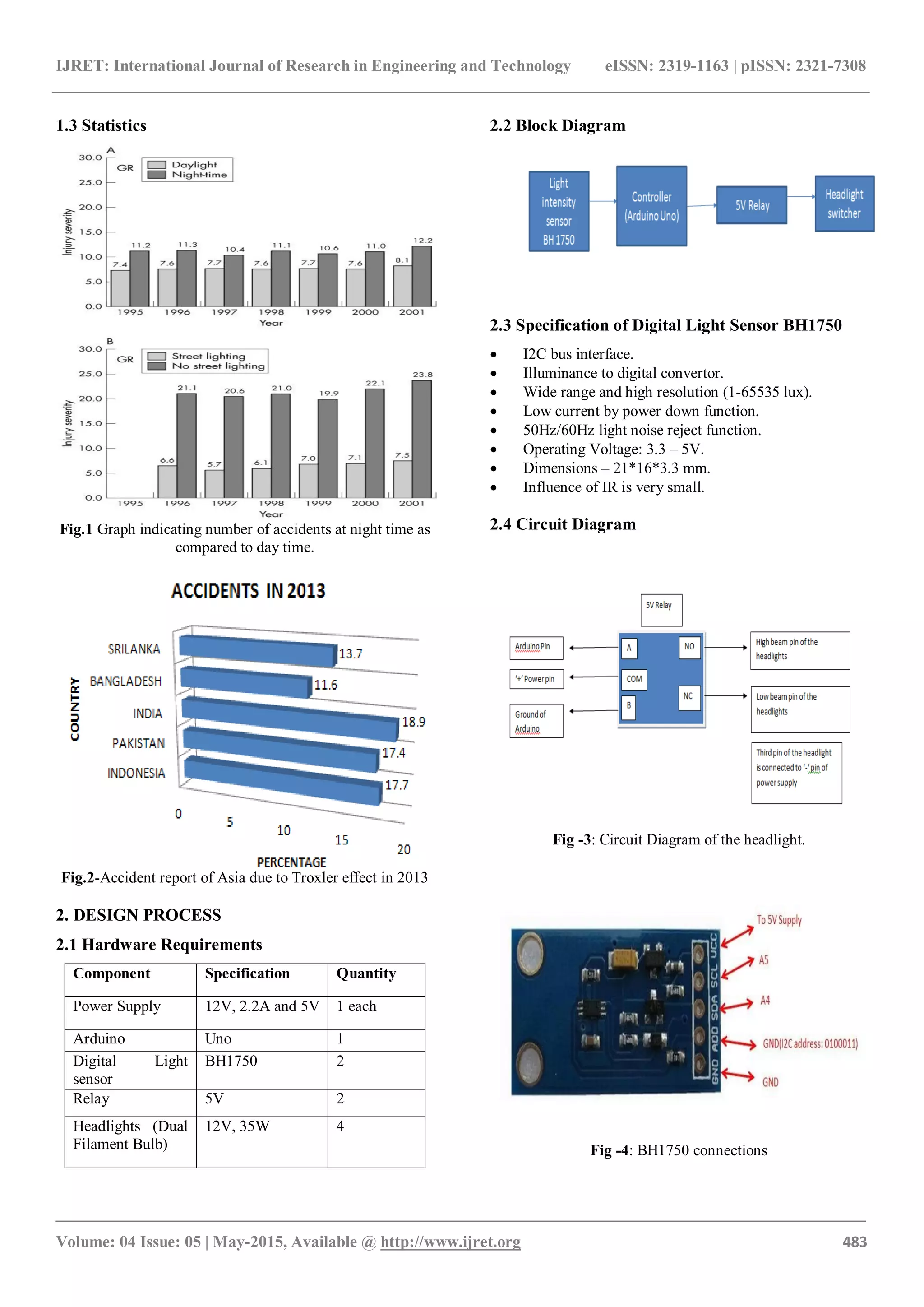
Road accidents are more in night than during day due
to low visual conditions. [4]
More than 40 percent of all automobile accidents
resulting in death occur at night, despite the fact that
there is up to 80 percent less traffic on the road than
during the day. (Germany's Federal Statistics Bureau).
The major reason is Troxler effect.[3]
In 2012, road accidents increased by 3.3% when
compared to 2011 (Courtesy: NHTSA- Nat. High.
Traffic Safety Admin.)
The National Safety Council says traffic death rates are
three times greater at night then during the day.](https://image.slidesharecdn.com/automaticheadlightbeamintensityswitcher-160903075500/75/Automatic-headlight-beam-intensity-switcher-1-2048.jpg)
![IJRET: International Journal of Research in Engineering and Technology eISSN: 2319-1163 | pISSN: 2321-7308
_______________________________________________________________________________________
Volume: 04 Issue: 05 | May-2015, Available @ http://www.ijret.org 484
2.5 Working
Initially the intensity values from the opposing vehicle are
read by the BH1750 digital light sensor. These readings are
sent to the Arduino board. If the value exceeds the limit of
around 100lux, indicating that the vehicle is nearing us, the
device switches the beam of the headlight from high to low
using a 5V relay. Simultaneously, the similar process takes
place in the opposing vehicle as well. Once the vehicles
have passed by each other the intensity again goes from low
to high. Thus the system automates the headlights and
assists the driver.
2.6 Arduino Code
/*
Sample code for the BH1750 Light sensor
Website :www.elecrow.com
Connection:
VCC-5v
GND-GND
SCL-SCL(analog pin 5)
SDA-SDA(analog pin 4)
ADD-NC or GND
*/
#include <Wire.h> //BH1750 IIC Mode
#include <math.h>
int BH1750address = 0x23; //setting i2c address
byte buff[2];
int led = 11,led1=12;
void setup()
{
Wire.begin();
Serial.begin(57600);//init Serail band rate
pinMode(led, OUTPUT);
pinMode(led1, OUTPUT);
}
void loop()
{
int i;
uint16_t val=0;
BH1750_Init(BH1750address);
delay(200);
if(2==BH1750_Read(BH1750address))
{
val=((buff[0]<<8)|buff[1])/1.2;
Serial.print(val,DEC);
Serial.println("[lx]");
}
delay(150);
if(val <= 250)
{
analogWrite(led, 255);
analogWrite(led1, 255);
}
else
{
analogWrite(led, 10);
analogWrite(led1, 10);
}
}
int BH1750_Read(int address) //
{
int i=0;
Wire.beginTransmission(address);
Wire.requestFrom(address, 2);
while(Wire.available()) //
{
buff[i] = Wire.read(); // receive one byte
i++;
}
Wire.endTransmission();
return i;
}
void BH1750_Init(int address)
{
Wire.beginTransmission(address);
Wire.write(0x10);//1lx reolution 120ms
Wire.endTransmission();
}
3. OUTPUT RESULTS
Fig-5: Output/Results of the product
3.1 Budget Approximation
Components Price (in Rs.)
1. Battery 3000/-
2. BH1750 530/-
3. Relay 25/-
4. Arduino
UNO
1500/-
5. Headlights 160/-
Total 5215/-
4. CONCLUSION
The working product thus achieves the aim of switching the
beam from high to low or vice-versa. This system not only
assists the driver but also protects him from the temporary
blindness due to the opposing headlight glare. Thus, the
product provides safety to the driver especially during the
night time. The product is low cost, accurate and small in
size.](https://image.slidesharecdn.com/automaticheadlightbeamintensityswitcher-160903075500/75/Automatic-headlight-beam-intensity-switcher-3-2048.jpg)
![IJRET: International Journal of Research in Engineering and Technology eISSN: 2319-1163 | pISSN: 2321-7308
_______________________________________________________________________________________
Volume: 04 Issue: 05 | May-2015, Available @ http://www.ijret.org 485
ACKNOWLEDGEMENTS
We are grateful to Dr. Uma Mudengudi, Head of the
Electronics and communication department, and our guide
Prof. Suhas Shirol for all the facilities provided in carrying
out our project. We avail this opportunity to thank Dr.
Ashok Shettar, Principal, B.V.B. College of Engineering
and Technology, Hubli, for all the facilities provided to us
and supporting us in all academic endeavors.
REFERENCES
[1]. http://www.micro4you.com/store/bh1750-light-
sensor.html
[2].http://www.elecrow.com/wiki/index.php?title=Digital_li
ght_Sensor
[3]. Automatic headlight dimmer a prototype for vehicles
Muralikrishnan , B.E, Electrical and Electronics
Engineering, Sri Venkateswara College of Engineering,
Tamil Nadu, India IJRET: International Journal of Research
in Engineering and Technology eISSN: 2319-1163 | pISSN:
2321-7308
[4].http://www.ncbi.nlm.nih.gov/pmc/articles/PMC2564438/
figure/fig3.
BIOGRAPHIES
Name – Shivaji Kulkarni, CGPA – 8.98,
currently pursuing 7th
semester, B.E in
electronics and communication.
Name- Rohit Anvekar, CGPA - 7.87,
currently pursuing 7th
semester, B.E in
electronics and communication.
Name- Ramya Dhawle, CGPA- 9.12,
currently pursuing 7th
semester, B.E in
electronics and communication.
Name – Shrihari Durg, CGPA - ,currently
pursuing 7th semester, B.E. in electronics
and Communication.](https://image.slidesharecdn.com/automaticheadlightbeamintensityswitcher-160903075500/75/Automatic-headlight-beam-intensity-switcher-4-2048.jpg)

The document outlines the design and implementation of an automatic headlight beam intensity switcher for autonomous cars, aimed at enhancing nighttime driving safety by preventing temporary blindness caused by high beam headlights from oncoming vehicles. Utilizing a BH1750 light intensity sensor and an Arduino microcontroller, the system automatically switches headlight beams from high to low based on detected light intensity, thereby supporting driver safety and reducing accident risks during night driving. The project emphasizes the importance of such technology in reducing accidents and outlines cost-effective hardware components needed for its implementation.


