© 2022, IRJET | Impact Factor value: 7.529 | ISO 9001:2008 Certified Journal | Page 3591
Fire fighting robot
Abhishek Kandpal1, Tanish Varshney1, Yash Dixit1
1students, dept. of Electronics and Communication, IMS Engineering College, Ghaziabad, UP, India
---------------------------------------------------------------------***--------------------------------------------------------------------
Abstract:
One of the objective of today's schools, institutions, and our research prototype is to build an firefighting robot that is
controlled by Arduino which is used for exhausting big fire flames remotely. An Arduino, a water tank, and a pump that
sprays water as needed make up the prototype. This project use an Arduino Uno microcontroller board to achieve these
objectives. The IR sensor that is: infrared receiver: on this prototype come in use for measuring the pack of fire flames. The
position of the fire is determined by the heat values of the flame. The motors, which control the vehicle's forward,
backward, left, and right motions, receive these data. The Infrared sensor on this is attached to a microcontroller which is
an to an Arduino Uno for the function. When the Arduino receives input signal, a driver IC is used to control the motors for
motion prototype. It also has a sprinkler that sprays water in a predetermined pattern.
Key words: Arduino Uno Microcontroller, IR Sensor(Infrared Receiver), PV: Prototype vehicle, IC: Integrated chip.
1.INTRODUCTION
The most basic version of the prototype is working on the principle of Embedded System. It is one system that has been
specifically designed for a certain purpose and the device it is controlling on the computer which is totally connected in it.
Unlike a personal computer, an embedded system only processes few functionality that the specifically pre-defined.
Because this system is determined to specific functions, engineers that are designers may optimize it, decreasing the
prototype's area length and price. Because embedded systems are usually produced in very large quantities, low cost can
produce a large profit in finance. An embedded systems are considered as a computer which is purposely designed to
perform task that are certain. In contrast to a general-purpose computer, such as a personal computer, which is frequently
used for highly specialised tasks. An embedded system is a computer that performs a set of pre-programmed activities.
Because the system is dedicated to certain duties, design engineers may reduce the product's size and cost. An embedded
system is made up of both hardware and software components. In areas such as industrial automation, household
appliances, cars, and aeronautics, embedded systems are becoming more common. Embedded technology is used to fulfill
an integrated defined goal utilising assembly language programming or embedded C. Our power consumption capacity is
rapidly increasing as a developing country to meet the increasing needs of our population. Stacks of some technology are
mentioned in the section below.
2. STACK OF TECHNOLOGY
2.1 Hardware Component Used: Arduino Uno Microcontroller, Solar panel, fire sensor (MQ135).
2.1.1 ATmega328P microcontroller (Arduino UNO):
The ATmega328P microcontroller is used in the Arduino Uno board, which is a development board. The Arduino Uno is a
microcontroller on a flat board that uses ATmega328P technology. It has 14 digital transmission pins, six analogue inputs,
a 16 MHz quartz crystal, a USB connection, a power pin, an ICSP header, and a reset button. Everything you'll need to get
started with the microcontroller is included.
Fire Sensor (MQ135):
A flame sensor is more sensitive to white light than other sensors. Because of its properties, we employ this component in
flame alarms. These sensors can detect the flame of a fire from a heat or fire source with a wavelength of 760 nm to 1100
nm. These sensors may become shorted or damaged if exposed to severe temperatures. As a result, these sensors must be
placed well away from the fire's flame. With a measuring angle of 600, the flames may be spotted from a distance of
100cm. These sensors' output signals are either analogue or digital. To warn of a fire hazard, these sensors are used as an
alert in firefighting robots.
International Research Journal of Engineering and Technology (IRJET) e-ISSN: 2395-0056
Volume: 09 Issue: 04 | Apr 2022 www.irjet.net p-ISSN: 2395-0072
© 2022, IRJET | Impact Factor value: 7.529 | ISO 9001:2008 Certified Journal | Page 3592
Solar panel:
Sun radiation is used as a source of energy in solar panels; these sources are also known as Sun's Electromagnetic
Radiation. Sun radiation is converted into electrical energy using solar devices such as photovoltaic cells or glass mirrors
that focus solar radiation on a specific location. Solar energy can be used efficiently and effectively to save power costs and
contribute to a more robust electrical system. This will ensure that economic growth and backup power may be generated
on a small and big scale with equal efficiency. A battery can be used as a substitute. We utilized a solar panel in a
firefighting robot to charge the prototype's batteries, which constitute the prototype's energy source.
Motor Drivers:
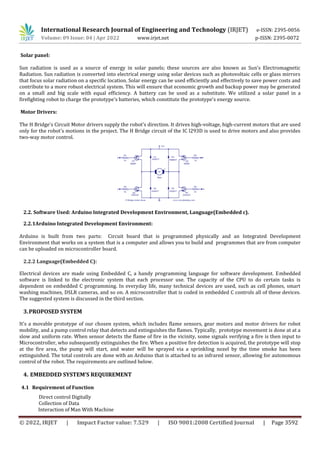
The H Bridge's Circuit Motor drivers supply the robot's direction. It drives high-voltage, high-current motors that are used
only for the robot's motions in the project. The H Bridge circuit of the IC l293D is used to drive motors and also provides
two-way motor control.
2.2. Software Used: Arduino Integrated Development Environment, Language(Embedded c).
2.2.1Arduino Integrated Development Environment:
Arduino is built from two parts: Circuit board that is programmed physically and an Integrated Development
Environment that works on a system that is a computer and allows you to build and programmes that are from computer
can be uploaded on microcontroller board.
2.2.2 Language(Embedded C):
Electrical devices are made using Embedded C, a handy programming language for software development. Embedded
software is linked to the electronic system that each processor use. The capacity of the CPU to do certain tasks is
dependent on embedded C programming. In everyday life, many technical devices are used, such as cell phones, smart
washing machines, DSLR cameras, and so on. A microcontroller that is coded in embedded C controls all of these devices.
The suggested system is discussed in the third section.
3.PROPOSED SYSTEM
It's a movable prototype of our chosen system, which includes flame sensors, gear motors and motor drivers for robot
mobility, and a pump control relay that detects and extinguishes the flames. Typically, prototype movement is done at at a
slow and uniform rate. When sensor detects the flame of fire in the vicinity, some signals verifying a fire is then input to
Microcontroller, who subsequently extinguishes the fire. When a positive fire detection is acquired, the prototype will stop
at the fire area, the pump will start, and water will be sprayed via a sprinkling nozel by the time smoke has been
extinguished. The total controls are done with an Arduino that is attached to an infrared sensor, allowing for autonomous
control of the robot. The requirements are outlined below.
4. EMBEDDED SYSTEM’S REQUIREMENT
4.1 Requirement of Function
Direct control Digitally
Collection of Data
Interaction of Man With Machine
International Research Journal of Engineering and Technology (IRJET) e-ISSN: 2395-0056
Volume: 09 Issue: 04 | Apr 2022 www.irjet.net p-ISSN: 2395-0072
© 2022, IRJET | Impact Factor value: 7.529 | ISO 9001:2008 Certified Journal | Page 3593
4.2 Requirement of Temporal
Deadlines of Task
Detection of minimal error latency
Requirement of Time
Requirements of Human-Interface.
4.3 Requirement of Dependability
Reliability
Protection
Available
Maintainance
Safety
Overview mentioned below.
5. OVERVIEW
SRC's process programme is created using a software design technique that works on the top layer. The programme is
developed on a computer with an integrated development environment (IDE) and a Java virtual machine, as well as a
compatible operating system like Linux, Windows, or Mac. The Arduino's Atmel microcontroller chip receives the C
programme, which is written in the C programming language. Data is transferred two-way or bi-directionally between the
two levels via a COM Serial connection. The three components of the software that is being handled are serial
transmission, output GUI display, and computerization. To communicate with the C code, you'll need to use a serial
communication mechanism. The user interface was installed in the system to provide a comfortable and feedback system
that are easy to read and visual. The basic arithmetic functions are handled by algorithms that run computer.
Diagrammatically, it is shown in below Figure 5.1. Algorithms are present farther down the page.
ARDUINO INTERFACE WITH WATER PUMP AND MOTOR
Figure.5.1. Water Pump and Motor Interfaces in Arduino
6. CONCLUSION
The goal of our project is making a firefighting robot which is controlled by an Arduino uno which we can use to put out
fire’s flame in places like schools, colleges, and institutions. Using this technology, we can prevent fire dangers and human
physical intervention in fire suppression.
The following is a list of references.
A
R
D
U
I
N
O
U
N
O
SOLAR PANEL
FIRE SENSOR (MQ135)
MOTOR DRIVER (L293D)
WHEELS OF THE ROBOT
RELAY FOR PUMP
CONTROL
SPRINKLER
SERVO MOTOR
BATTERY
(12V)
International Research Journal of Engineering and Technology (IRJET) e-ISSN: 2395-0056
Volume: 09 Issue: 04 | Apr 2022 www.irjet.net p-ISSN: 2395-0072
© 2022, IRJET | Impact Factor value: 7.529 | ISO 9001:2008 Certified Journal | Page 3594
7. REFERENCES
1 Selection and Dimensioning of High-Voltage Insulators Intended for Use in Polluted Conditions – Part 1: Definitions,
Information and General Principles, IEC/TS 60815-1, 2008.
2 IEEE Standard for High-Voltage Testing Techniques, IEEE Std 2013.
3 Fahy, R. F & LeBlanc, P. R. & Molis, J. L. (2018, June). NFPA report – Firefighter fatalities in the United States - 2017.
Retrieved October 20, 2018,
4 S. VenNataraman and R. S. Gorur,” Prediction of Flashover Voltage of Non-ceramic Insulators under Contaminated
Conditions,” Power, Dielectric and Energy Management at NERIST (ICPDEN), pp. 1-5, 2015.
5 A. BaniN, S. Dalai and B. Chatterjee,” Studies the Effect of Equivalent Salt Deposit Density on LeaNage Current and
Flashover Voltage of Artificially Contaminated Disc Insulators,” IEEE Trans. Dielectr. Electr. Insul., Vol. 19, No. 3, pp. 1037-
1043, 2012.
6 Mora, W.R [2005, June]. "UNDERSTANDING AND SOLVING FIREFIGHTER DISORIENTATION." Fire Engineering
103,104,106,109-110,112-114. ProQuest. Web. 17 Sep. 2018
7 S. VenNataraman and R. S. Gorur,” A Novel Method for Prediction of Flashover of In-service EPDM Insulators,” IEEE Conf.
Electr. Insul. Dielectr. Phenomena, pp. 385-388, 2006.
8 Phos-CheN LC-95A Material Safety Data Sheet,” ICL Performance Products LP 2015.
9 Preeti Dhiman, Noble Tawra, Rakesh Nagar, Rishab Singh and Varun Kaushik, “ Intelligent Fire Extinguisher
Vehicle”,International Journal of Emerging Trends in Electrical and Electronics Vol. 2, No.2.
10 Rutuja Jadkar, Rutuja Wadekar, Shweta Khatade, Sayali Dugane, Prof. Dr.S.N. Kini, Fire Fighting Robot Controlled Using
Android Application, International Journal of Innovative Research in Science, Engineering and
Technology, Vol. 5, Issue 5, May 2016.
International Research Journal of Engineering and Technology (IRJET) e-ISSN: 2395-0056
Volume: 09 Issue: 04 | Apr 2022 www.irjet.net p-ISSN: 2395-0072

Fire fighting robot

  • 1.
    © 2022, IRJET| Impact Factor value: 7.529 | ISO 9001:2008 Certified Journal | Page 3591 Fire fighting robot Abhishek Kandpal1, Tanish Varshney1, Yash Dixit1 1students, dept. of Electronics and Communication, IMS Engineering College, Ghaziabad, UP, India ---------------------------------------------------------------------***-------------------------------------------------------------------- Abstract: One of the objective of today's schools, institutions, and our research prototype is to build an firefighting robot that is controlled by Arduino which is used for exhausting big fire flames remotely. An Arduino, a water tank, and a pump that sprays water as needed make up the prototype. This project use an Arduino Uno microcontroller board to achieve these objectives. The IR sensor that is: infrared receiver: on this prototype come in use for measuring the pack of fire flames. The position of the fire is determined by the heat values of the flame. The motors, which control the vehicle's forward, backward, left, and right motions, receive these data. The Infrared sensor on this is attached to a microcontroller which is an to an Arduino Uno for the function. When the Arduino receives input signal, a driver IC is used to control the motors for motion prototype. It also has a sprinkler that sprays water in a predetermined pattern. Key words: Arduino Uno Microcontroller, IR Sensor(Infrared Receiver), PV: Prototype vehicle, IC: Integrated chip. 1.INTRODUCTION The most basic version of the prototype is working on the principle of Embedded System. It is one system that has been specifically designed for a certain purpose and the device it is controlling on the computer which is totally connected in it. Unlike a personal computer, an embedded system only processes few functionality that the specifically pre-defined. Because this system is determined to specific functions, engineers that are designers may optimize it, decreasing the prototype's area length and price. Because embedded systems are usually produced in very large quantities, low cost can produce a large profit in finance. An embedded systems are considered as a computer which is purposely designed to perform task that are certain. In contrast to a general-purpose computer, such as a personal computer, which is frequently used for highly specialised tasks. An embedded system is a computer that performs a set of pre-programmed activities. Because the system is dedicated to certain duties, design engineers may reduce the product's size and cost. An embedded system is made up of both hardware and software components. In areas such as industrial automation, household appliances, cars, and aeronautics, embedded systems are becoming more common. Embedded technology is used to fulfill an integrated defined goal utilising assembly language programming or embedded C. Our power consumption capacity is rapidly increasing as a developing country to meet the increasing needs of our population. Stacks of some technology are mentioned in the section below. 2. STACK OF TECHNOLOGY 2.1 Hardware Component Used: Arduino Uno Microcontroller, Solar panel, fire sensor (MQ135). 2.1.1 ATmega328P microcontroller (Arduino UNO): The ATmega328P microcontroller is used in the Arduino Uno board, which is a development board. The Arduino Uno is a microcontroller on a flat board that uses ATmega328P technology. It has 14 digital transmission pins, six analogue inputs, a 16 MHz quartz crystal, a USB connection, a power pin, an ICSP header, and a reset button. Everything you'll need to get started with the microcontroller is included. Fire Sensor (MQ135): A flame sensor is more sensitive to white light than other sensors. Because of its properties, we employ this component in flame alarms. These sensors can detect the flame of a fire from a heat or fire source with a wavelength of 760 nm to 1100 nm. These sensors may become shorted or damaged if exposed to severe temperatures. As a result, these sensors must be placed well away from the fire's flame. With a measuring angle of 600, the flames may be spotted from a distance of 100cm. These sensors' output signals are either analogue or digital. To warn of a fire hazard, these sensors are used as an alert in firefighting robots. International Research Journal of Engineering and Technology (IRJET) e-ISSN: 2395-0056 Volume: 09 Issue: 04 | Apr 2022 www.irjet.net p-ISSN: 2395-0072
  • 2.
    © 2022, IRJET| Impact Factor value: 7.529 | ISO 9001:2008 Certified Journal | Page 3592 Solar panel: Sun radiation is used as a source of energy in solar panels; these sources are also known as Sun's Electromagnetic Radiation. Sun radiation is converted into electrical energy using solar devices such as photovoltaic cells or glass mirrors that focus solar radiation on a specific location. Solar energy can be used efficiently and effectively to save power costs and contribute to a more robust electrical system. This will ensure that economic growth and backup power may be generated on a small and big scale with equal efficiency. A battery can be used as a substitute. We utilized a solar panel in a firefighting robot to charge the prototype's batteries, which constitute the prototype's energy source. Motor Drivers: The H Bridge's Circuit Motor drivers supply the robot's direction. It drives high-voltage, high-current motors that are used only for the robot's motions in the project. The H Bridge circuit of the IC l293D is used to drive motors and also provides two-way motor control. 2.2. Software Used: Arduino Integrated Development Environment, Language(Embedded c). 2.2.1Arduino Integrated Development Environment: Arduino is built from two parts: Circuit board that is programmed physically and an Integrated Development Environment that works on a system that is a computer and allows you to build and programmes that are from computer can be uploaded on microcontroller board. 2.2.2 Language(Embedded C): Electrical devices are made using Embedded C, a handy programming language for software development. Embedded software is linked to the electronic system that each processor use. The capacity of the CPU to do certain tasks is dependent on embedded C programming. In everyday life, many technical devices are used, such as cell phones, smart washing machines, DSLR cameras, and so on. A microcontroller that is coded in embedded C controls all of these devices. The suggested system is discussed in the third section. 3.PROPOSED SYSTEM It's a movable prototype of our chosen system, which includes flame sensors, gear motors and motor drivers for robot mobility, and a pump control relay that detects and extinguishes the flames. Typically, prototype movement is done at at a slow and uniform rate. When sensor detects the flame of fire in the vicinity, some signals verifying a fire is then input to Microcontroller, who subsequently extinguishes the fire. When a positive fire detection is acquired, the prototype will stop at the fire area, the pump will start, and water will be sprayed via a sprinkling nozel by the time smoke has been extinguished. The total controls are done with an Arduino that is attached to an infrared sensor, allowing for autonomous control of the robot. The requirements are outlined below. 4. EMBEDDED SYSTEM’S REQUIREMENT 4.1 Requirement of Function Direct control Digitally Collection of Data Interaction of Man With Machine International Research Journal of Engineering and Technology (IRJET) e-ISSN: 2395-0056 Volume: 09 Issue: 04 | Apr 2022 www.irjet.net p-ISSN: 2395-0072
  • 3.
    © 2022, IRJET| Impact Factor value: 7.529 | ISO 9001:2008 Certified Journal | Page 3593 4.2 Requirement of Temporal Deadlines of Task Detection of minimal error latency Requirement of Time Requirements of Human-Interface. 4.3 Requirement of Dependability Reliability Protection Available Maintainance Safety Overview mentioned below. 5. OVERVIEW SRC's process programme is created using a software design technique that works on the top layer. The programme is developed on a computer with an integrated development environment (IDE) and a Java virtual machine, as well as a compatible operating system like Linux, Windows, or Mac. The Arduino's Atmel microcontroller chip receives the C programme, which is written in the C programming language. Data is transferred two-way or bi-directionally between the two levels via a COM Serial connection. The three components of the software that is being handled are serial transmission, output GUI display, and computerization. To communicate with the C code, you'll need to use a serial communication mechanism. The user interface was installed in the system to provide a comfortable and feedback system that are easy to read and visual. The basic arithmetic functions are handled by algorithms that run computer. Diagrammatically, it is shown in below Figure 5.1. Algorithms are present farther down the page. ARDUINO INTERFACE WITH WATER PUMP AND MOTOR Figure.5.1. Water Pump and Motor Interfaces in Arduino 6. CONCLUSION The goal of our project is making a firefighting robot which is controlled by an Arduino uno which we can use to put out fire’s flame in places like schools, colleges, and institutions. Using this technology, we can prevent fire dangers and human physical intervention in fire suppression. The following is a list of references. A R D U I N O U N O SOLAR PANEL FIRE SENSOR (MQ135) MOTOR DRIVER (L293D) WHEELS OF THE ROBOT RELAY FOR PUMP CONTROL SPRINKLER SERVO MOTOR BATTERY (12V) International Research Journal of Engineering and Technology (IRJET) e-ISSN: 2395-0056 Volume: 09 Issue: 04 | Apr 2022 www.irjet.net p-ISSN: 2395-0072
  • 4.
    © 2022, IRJET| Impact Factor value: 7.529 | ISO 9001:2008 Certified Journal | Page 3594 7. REFERENCES 1 Selection and Dimensioning of High-Voltage Insulators Intended for Use in Polluted Conditions – Part 1: Definitions, Information and General Principles, IEC/TS 60815-1, 2008. 2 IEEE Standard for High-Voltage Testing Techniques, IEEE Std 2013. 3 Fahy, R. F & LeBlanc, P. R. & Molis, J. L. (2018, June). NFPA report – Firefighter fatalities in the United States - 2017. Retrieved October 20, 2018, 4 S. VenNataraman and R. S. Gorur,” Prediction of Flashover Voltage of Non-ceramic Insulators under Contaminated Conditions,” Power, Dielectric and Energy Management at NERIST (ICPDEN), pp. 1-5, 2015. 5 A. BaniN, S. Dalai and B. Chatterjee,” Studies the Effect of Equivalent Salt Deposit Density on LeaNage Current and Flashover Voltage of Artificially Contaminated Disc Insulators,” IEEE Trans. Dielectr. Electr. Insul., Vol. 19, No. 3, pp. 1037- 1043, 2012. 6 Mora, W.R [2005, June]. "UNDERSTANDING AND SOLVING FIREFIGHTER DISORIENTATION." Fire Engineering 103,104,106,109-110,112-114. ProQuest. Web. 17 Sep. 2018 7 S. VenNataraman and R. S. Gorur,” A Novel Method for Prediction of Flashover of In-service EPDM Insulators,” IEEE Conf. Electr. Insul. Dielectr. Phenomena, pp. 385-388, 2006. 8 Phos-CheN LC-95A Material Safety Data Sheet,” ICL Performance Products LP 2015. 9 Preeti Dhiman, Noble Tawra, Rakesh Nagar, Rishab Singh and Varun Kaushik, “ Intelligent Fire Extinguisher Vehicle”,International Journal of Emerging Trends in Electrical and Electronics Vol. 2, No.2. 10 Rutuja Jadkar, Rutuja Wadekar, Shweta Khatade, Sayali Dugane, Prof. Dr.S.N. Kini, Fire Fighting Robot Controlled Using Android Application, International Journal of Innovative Research in Science, Engineering and Technology, Vol. 5, Issue 5, May 2016. International Research Journal of Engineering and Technology (IRJET) e-ISSN: 2395-0056 Volume: 09 Issue: 04 | Apr 2022 www.irjet.net p-ISSN: 2395-0072