IJRET: International Journal of Research in Engineering and Technology eISSN: 2319-1163 | pISSN: 2321-7308
_______________________________________________________________________________________
Volume: 04 Issue: 05 | May-2015, Available @ http://www.ijret.org 46
MICROCONTROLLER BASED SMART WEAR FOR DRIVER SAFETY
Abhinav Anand1
, Kumar Harsh2
, Kushal Kumar3
, Sourav Gouthi4
1
Department of Instrumentation Technology, Dayananda Sagar College of Engineering, Bangalore, India
2
Department of Instrumentation Technology, Dayananda Sagar College of Engineering, Bangalore, India
3
Department of Instrumentation Technology, Dayananda Sagar College of Engineering, Bangalore, India
4
Asst. Professor Ekta Maini, Department of Instrumentation Technology, Dayananda Sagar College of Engineering,
Bangalore, India
Abstract
An accident is a specific, unexpected, unusual and unintended external action which occurs in a particular time and place, with
no apparent and deliberate cause but with marked effects. Carelessness of the driver is the major factor of such accidents. The
traffic authorities give a lot of instructions to the vehicle operators. But many of them do not obey the rules. Nowadays most of the
countries are forcing the motor riders to wear the helmet and not to use the vehicles when the person is in drunken condition. But
still the rules are being violated by the users. India has the largest number of road accidents in the world out of which 22.4% of
victims are occupants of two wheelers, 30% of road accidents victims die at crash site, 14% in ambulance and rest in hospital.
Our proposal is to reduce the number of deaths which occur at crash site and on the way to the hospital due to delay in
Emergency Trauma Care Services.
Keywords- accident, carelessness, helmet, drunken driving, two wheelers
--------------------------------------------------------------------***------------------------------------------------------------------
1. INTRODUCTION
Providing safety to a person while riding the bike is of prime
concern. One of the way to do this is by making it
mandatory to wear helmet while riding a bike. This is
difficult to implement as every time the concerned people
can’t keep an eye on everybody. So detecting whether the
driver has worn a helmet or not, as well whether he has
consumed alcohol or not is the main problem. The system
what we have planned to design provides solution to this
problem. The system makes it mandatory for the rider to
wear helmet before starting the vehicle and also he shouldn’t
have consumed alcohol. If the rider fail to do so then the
vehicle cannot be started. This system also provides security
to the vehicle as every bike will have a unique helmet and
without which a person fails to start that particular bike.
This project includes a helmet body and an integrated
electronic system disposed in the helmet body. It is operated
through a wireless control system. The components of the
electronic system are sufficiently small and rugged for use
in the helmet, ensuring that the helmet is lightweight and
durable. Moreover, the components are spaced about the
helmet to provide even weight distribution to promote
overall balance and safety
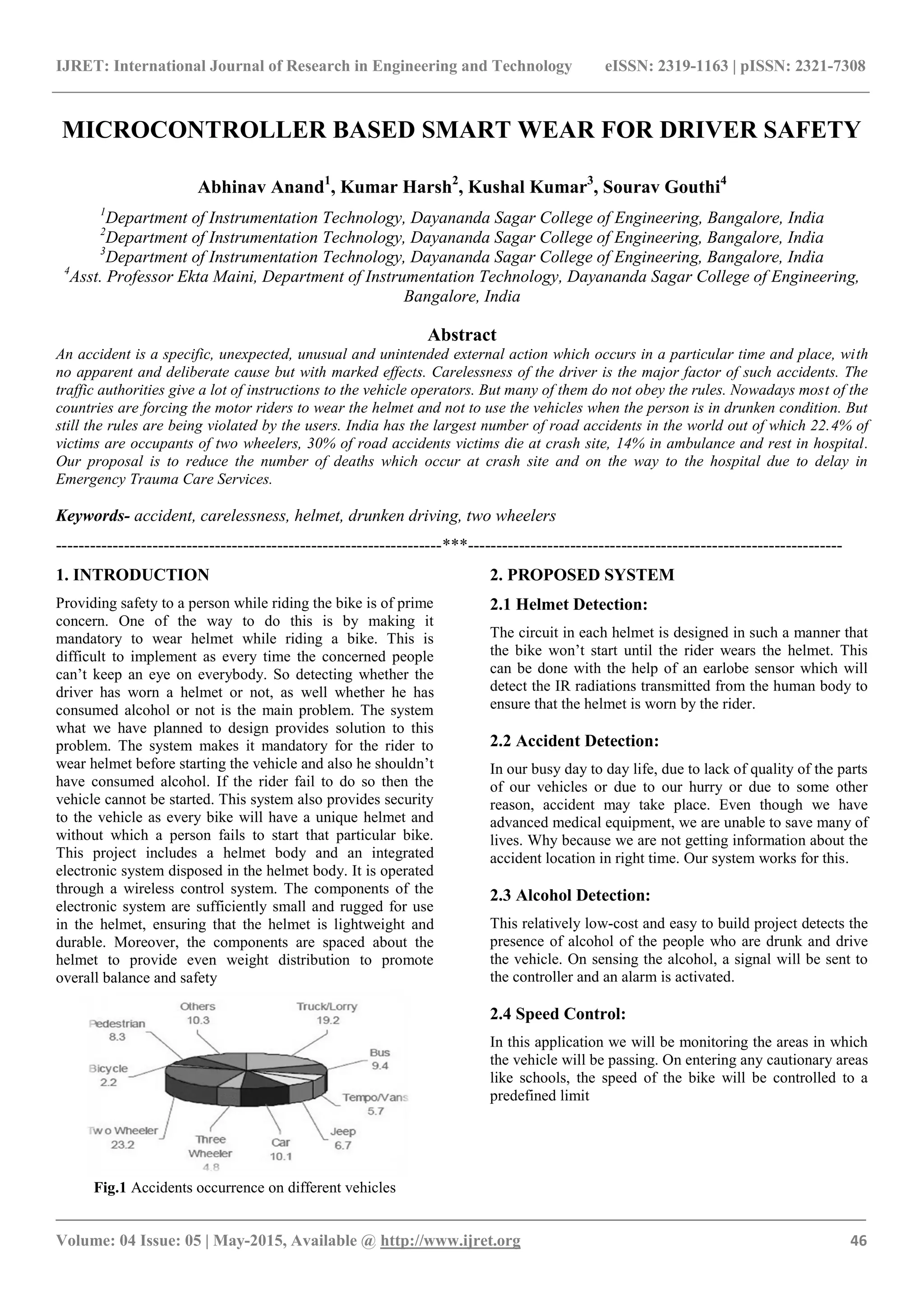
Fig.1 Accidents occurrence on different vehicles
2. PROPOSED SYSTEM
2.1 Helmet Detection:
The circuit in each helmet is designed in such a manner that
the bike won’t start until the rider wears the helmet. This
can be done with the help of an earlobe sensor which will
detect the IR radiations transmitted from the human body to
ensure that the helmet is worn by the rider.
2.2 Accident Detection:
In our busy day to day life, due to lack of quality of the parts
of our vehicles or due to our hurry or due to some other
reason, accident may take place. Even though we have
advanced medical equipment, we are unable to save many of
lives. Why because we are not getting information about the
accident location in right time. Our system works for this.
2.3 Alcohol Detection:
This relatively low-cost and easy to build project detects the
presence of alcohol of the people who are drunk and drive
the vehicle. On sensing the alcohol, a signal will be sent to
the controller and an alarm is activated.
2.4 Speed Control:
In this application we will be monitoring the areas in which
the vehicle will be passing. On entering any cautionary areas
like schools, the speed of the bike will be controlled to a
predefined limit
IJRET: International Journal of Research in Engineering and Technology eISSN: 2319-1163 | pISSN: 2321-7308
_______________________________________________________________________________________
Volume: 04 Issue: 05 | May-2015, Available @ http://www.ijret.org 47
3. BLOCK DIAGRAM
Fig.2. Helmet section of the safety gear
Fig.3. Section of the safety gear in the bike
Earlobe Sensor: The earlobe sensor is used to detect
weather the rider is wearing the helmet. It is an Infrared
sensor which detects radiation that is being emitted by the
human body.
Fig.4. An IR Sensor
Alcohol Sensor: MQ-3 gas detector (alcohol sensor) is
suitable for detecting alcohol content from the breath. So it
can be placed just below the face defend and above the
additional face protection. The surface of the sensor is
sensitive to various alcoholic concentrations. It detects the
alcohol from the rider’s breath; the resistance value drops
leads to change in voltage (Temperature variation
occurs).Generally the illegal consumption of alcohol during
driving is 0.08mg/L as per the government act. Except for
demonstration purpose, we have a tendency to program the
drink limit as 0.04 mg/L. Threshold will be adjusted
mistreatment exploitation.
Fig.5.Alcohol sensor
Accident Detection: Accident occurrence will be detected
by the piezoelectric sensor and further this information is
given to microcontroller. The GPS will be tracking the
location of the vehicle at where the accident has occurred.
GPS can get the graphical location of the vehicle. The
location values are given to microcontroller. Controller
gives this information to GSM module. By using GSM we
can send the message to family members, emergency
medical service and nearest hospital.
Fig.6. Piezoelectric sensor
RF Transmitter: This is 2-channel Radio Frequency
Transmitter specially tuned with its RF Receiver part in
carrier frequency. Each zone are set with one channel and
transmits their presence to moving vehicle’s RF Receiver
unit.
RF Receiver: This is also a 2-channel RF Receiver specially
tuned with its counterpart RF Transmitter in carrier
frequency. When vehicle enters into any zone that zones RF
signals are received by this unit. Thus depend upon the
channel signals it receives from transmitting end that
channel output of RF Receiver goes HIGH. This HIGH
signal is fed to Microcontroller chip through Buffer &
Driver and Switching stage for further processing.
Buffer & Driver: The Buffer provides unit gain
amplification to inputted signal and fed it to Driver for
driving relay. The Driver is power amplifier, which provides
high current and voltage to relay coil for proper switching
action.
Switching Stage: This stage is comprised of suitable
voltage rated relays energized by HIGH signal given to
respective Buffer & Driver stage.
Microcontroller Chip: The chip has software module
inherited in its memory and which scans continuously its
input port pins for HIGH signal. When RF Receiver sends
any HIGH signal that is fed to Buffer & Driver and
energizes one relay. This relay’s N/O [Normally Open] pins
IJRET: International Journal of Research in Engineering and Technology eISSN: 2319-1163 | pISSN: 2321-7308
_______________________________________________________________________________________
Volume: 04 Issue: 05 | May-2015, Available @ http://www.ijret.org 48
come into action and in turn supplies exact +5 Volts to input
port pin of chip. This is necessary because chip accepts TTL
compatible signals [i.e., LOW = 0 V and HIGH = exact +5
V] at its input port. After receiving any HIGH signal at its
input port, software module identifies the zone by HIGH
input pin number and accordingly generates alert message
and control signal to output port. The alert message is sent
to output port where LCD Module is connected for display
purpose. The control signal is fed to Buffer& Driver and
Switching Stage for execution of control signal.
LCD Module: This is a output device connected to output
port of chip and displays alert message depends upon the
zone in which vehicle enters.
Variable Power Supply: This specially designed power
supply provides two voltages, Normal and Low to control
the loads.
Power Supply Unit: The system needs regulated power
supply which provides necessary voltages for proper
working of its blocks. This unit is specially designed to
gives out all necessary voltage levels required for working
of all blocks
4. FLOWCHART REPRESENTATION
Fig.7. Flowchart representation of the proposed system
5. RESULT
Some of the snapshots of the result are shown below
Fig.8. LCD module displaying the message to wear helmet
Fig.9.LCD showing no alcohol is consumed by driver
Fig.10.LCD showing alcohol is consumed by the driver
Fig.9. and Fig.10. shows that when the alcohol consumed by
the driver is above a pre-set limit, the ignition will not turn
on.
Fig.11.Accident occurred message displayed on LCD
Fig.12.Latitude and longitude values of the place where
accident occurred
Fig.11. and Fig.12 shows the message which will be
displayed in case of an accident. In case of an accident a
alarm system will be generated which can be manually
turned off. If it is not turned off within a specified time, the
location where the accident has occurred will be sent to the
nearest hospital so that the injured driver can get the
necessary medical attention as soon as possible
IJRET: International Journal of Research in Engineering and Technology eISSN: 2319-1163 | pISSN: 2321-7308
_______________________________________________________________________________________
Volume: 04 Issue: 05 | May-2015, Available @ http://www.ijret.org 49
6. CONCLUSION
This project can be used to secure and avoid road accidents.
It is easy to install an easy to operate. Moreover, manpower
can be saved by the use of auto detecting circuits. The main
aim of this project is to encourage the people to wear the
helmet and to avoid the road accidents.This project ensures
safety of riders and prevention of road accidents to some
extent. The helmet incorporates a very simple and cost
effective technology. Also as a future scope it can be
combined with many existing technologies to provide
guidance and on road track facility
REFERENCES
[1]. M. Pieve, F. Tesauri, and A. Spadoni, “Mitigation
accident risk in powered two wheelers domain: Improving
effectiveness of human machine interface collision
avoidance system in two wheelers,” in Proc. 2nd. Conf.
Human Syst. Interact., Catania, Italy, May 21–23, 2009, pp.
603–607
[2]. E.D.Bekiaris, A.Spadoni, and S.I.Nikolaou,
“SAFERIDER project: New safety and comfort in powered
two wheelers,” in Proc. 2nd Conf. Human Syst. Interact.,
Catania, Italy, May 21–23, 2009, pp. 600–602.
[3]. M.Cellario,“Human-centered intelligent vehicles:
Toward multimodal interface integration,” IEEE Intell.
Syst., vol. 16, no. 4, p. 78, Jul. 2001.

Microcontroller based smart wear for driver safety

  • 1.
    IJRET: International Journalof Research in Engineering and Technology eISSN: 2319-1163 | pISSN: 2321-7308 _______________________________________________________________________________________ Volume: 04 Issue: 05 | May-2015, Available @ http://www.ijret.org 46 MICROCONTROLLER BASED SMART WEAR FOR DRIVER SAFETY Abhinav Anand1 , Kumar Harsh2 , Kushal Kumar3 , Sourav Gouthi4 1 Department of Instrumentation Technology, Dayananda Sagar College of Engineering, Bangalore, India 2 Department of Instrumentation Technology, Dayananda Sagar College of Engineering, Bangalore, India 3 Department of Instrumentation Technology, Dayananda Sagar College of Engineering, Bangalore, India 4 Asst. Professor Ekta Maini, Department of Instrumentation Technology, Dayananda Sagar College of Engineering, Bangalore, India Abstract An accident is a specific, unexpected, unusual and unintended external action which occurs in a particular time and place, with no apparent and deliberate cause but with marked effects. Carelessness of the driver is the major factor of such accidents. The traffic authorities give a lot of instructions to the vehicle operators. But many of them do not obey the rules. Nowadays most of the countries are forcing the motor riders to wear the helmet and not to use the vehicles when the person is in drunken condition. But still the rules are being violated by the users. India has the largest number of road accidents in the world out of which 22.4% of victims are occupants of two wheelers, 30% of road accidents victims die at crash site, 14% in ambulance and rest in hospital. Our proposal is to reduce the number of deaths which occur at crash site and on the way to the hospital due to delay in Emergency Trauma Care Services. Keywords- accident, carelessness, helmet, drunken driving, two wheelers --------------------------------------------------------------------***------------------------------------------------------------------ 1. INTRODUCTION Providing safety to a person while riding the bike is of prime concern. One of the way to do this is by making it mandatory to wear helmet while riding a bike. This is difficult to implement as every time the concerned people can’t keep an eye on everybody. So detecting whether the driver has worn a helmet or not, as well whether he has consumed alcohol or not is the main problem. The system what we have planned to design provides solution to this problem. The system makes it mandatory for the rider to wear helmet before starting the vehicle and also he shouldn’t have consumed alcohol. If the rider fail to do so then the vehicle cannot be started. This system also provides security to the vehicle as every bike will have a unique helmet and without which a person fails to start that particular bike. This project includes a helmet body and an integrated electronic system disposed in the helmet body. It is operated through a wireless control system. The components of the electronic system are sufficiently small and rugged for use in the helmet, ensuring that the helmet is lightweight and durable. Moreover, the components are spaced about the helmet to provide even weight distribution to promote overall balance and safety Fig.1 Accidents occurrence on different vehicles 2. PROPOSED SYSTEM 2.1 Helmet Detection: The circuit in each helmet is designed in such a manner that the bike won’t start until the rider wears the helmet. This can be done with the help of an earlobe sensor which will detect the IR radiations transmitted from the human body to ensure that the helmet is worn by the rider. 2.2 Accident Detection: In our busy day to day life, due to lack of quality of the parts of our vehicles or due to our hurry or due to some other reason, accident may take place. Even though we have advanced medical equipment, we are unable to save many of lives. Why because we are not getting information about the accident location in right time. Our system works for this. 2.3 Alcohol Detection: This relatively low-cost and easy to build project detects the presence of alcohol of the people who are drunk and drive the vehicle. On sensing the alcohol, a signal will be sent to the controller and an alarm is activated. 2.4 Speed Control: In this application we will be monitoring the areas in which the vehicle will be passing. On entering any cautionary areas like schools, the speed of the bike will be controlled to a predefined limit
  • 2.
    IJRET: International Journalof Research in Engineering and Technology eISSN: 2319-1163 | pISSN: 2321-7308 _______________________________________________________________________________________ Volume: 04 Issue: 05 | May-2015, Available @ http://www.ijret.org 47 3. BLOCK DIAGRAM Fig.2. Helmet section of the safety gear Fig.3. Section of the safety gear in the bike Earlobe Sensor: The earlobe sensor is used to detect weather the rider is wearing the helmet. It is an Infrared sensor which detects radiation that is being emitted by the human body. Fig.4. An IR Sensor Alcohol Sensor: MQ-3 gas detector (alcohol sensor) is suitable for detecting alcohol content from the breath. So it can be placed just below the face defend and above the additional face protection. The surface of the sensor is sensitive to various alcoholic concentrations. It detects the alcohol from the rider’s breath; the resistance value drops leads to change in voltage (Temperature variation occurs).Generally the illegal consumption of alcohol during driving is 0.08mg/L as per the government act. Except for demonstration purpose, we have a tendency to program the drink limit as 0.04 mg/L. Threshold will be adjusted mistreatment exploitation. Fig.5.Alcohol sensor Accident Detection: Accident occurrence will be detected by the piezoelectric sensor and further this information is given to microcontroller. The GPS will be tracking the location of the vehicle at where the accident has occurred. GPS can get the graphical location of the vehicle. The location values are given to microcontroller. Controller gives this information to GSM module. By using GSM we can send the message to family members, emergency medical service and nearest hospital. Fig.6. Piezoelectric sensor RF Transmitter: This is 2-channel Radio Frequency Transmitter specially tuned with its RF Receiver part in carrier frequency. Each zone are set with one channel and transmits their presence to moving vehicle’s RF Receiver unit. RF Receiver: This is also a 2-channel RF Receiver specially tuned with its counterpart RF Transmitter in carrier frequency. When vehicle enters into any zone that zones RF signals are received by this unit. Thus depend upon the channel signals it receives from transmitting end that channel output of RF Receiver goes HIGH. This HIGH signal is fed to Microcontroller chip through Buffer & Driver and Switching stage for further processing. Buffer & Driver: The Buffer provides unit gain amplification to inputted signal and fed it to Driver for driving relay. The Driver is power amplifier, which provides high current and voltage to relay coil for proper switching action. Switching Stage: This stage is comprised of suitable voltage rated relays energized by HIGH signal given to respective Buffer & Driver stage. Microcontroller Chip: The chip has software module inherited in its memory and which scans continuously its input port pins for HIGH signal. When RF Receiver sends any HIGH signal that is fed to Buffer & Driver and energizes one relay. This relay’s N/O [Normally Open] pins
  • 3.
    IJRET: International Journalof Research in Engineering and Technology eISSN: 2319-1163 | pISSN: 2321-7308 _______________________________________________________________________________________ Volume: 04 Issue: 05 | May-2015, Available @ http://www.ijret.org 48 come into action and in turn supplies exact +5 Volts to input port pin of chip. This is necessary because chip accepts TTL compatible signals [i.e., LOW = 0 V and HIGH = exact +5 V] at its input port. After receiving any HIGH signal at its input port, software module identifies the zone by HIGH input pin number and accordingly generates alert message and control signal to output port. The alert message is sent to output port where LCD Module is connected for display purpose. The control signal is fed to Buffer& Driver and Switching Stage for execution of control signal. LCD Module: This is a output device connected to output port of chip and displays alert message depends upon the zone in which vehicle enters. Variable Power Supply: This specially designed power supply provides two voltages, Normal and Low to control the loads. Power Supply Unit: The system needs regulated power supply which provides necessary voltages for proper working of its blocks. This unit is specially designed to gives out all necessary voltage levels required for working of all blocks 4. FLOWCHART REPRESENTATION Fig.7. Flowchart representation of the proposed system 5. RESULT Some of the snapshots of the result are shown below Fig.8. LCD module displaying the message to wear helmet Fig.9.LCD showing no alcohol is consumed by driver Fig.10.LCD showing alcohol is consumed by the driver Fig.9. and Fig.10. shows that when the alcohol consumed by the driver is above a pre-set limit, the ignition will not turn on. Fig.11.Accident occurred message displayed on LCD Fig.12.Latitude and longitude values of the place where accident occurred Fig.11. and Fig.12 shows the message which will be displayed in case of an accident. In case of an accident a alarm system will be generated which can be manually turned off. If it is not turned off within a specified time, the location where the accident has occurred will be sent to the nearest hospital so that the injured driver can get the necessary medical attention as soon as possible
  • 4.
    IJRET: International Journalof Research in Engineering and Technology eISSN: 2319-1163 | pISSN: 2321-7308 _______________________________________________________________________________________ Volume: 04 Issue: 05 | May-2015, Available @ http://www.ijret.org 49 6. CONCLUSION This project can be used to secure and avoid road accidents. It is easy to install an easy to operate. Moreover, manpower can be saved by the use of auto detecting circuits. The main aim of this project is to encourage the people to wear the helmet and to avoid the road accidents.This project ensures safety of riders and prevention of road accidents to some extent. The helmet incorporates a very simple and cost effective technology. Also as a future scope it can be combined with many existing technologies to provide guidance and on road track facility REFERENCES [1]. M. Pieve, F. Tesauri, and A. Spadoni, “Mitigation accident risk in powered two wheelers domain: Improving effectiveness of human machine interface collision avoidance system in two wheelers,” in Proc. 2nd. Conf. Human Syst. Interact., Catania, Italy, May 21–23, 2009, pp. 603–607 [2]. E.D.Bekiaris, A.Spadoni, and S.I.Nikolaou, “SAFERIDER project: New safety and comfort in powered two wheelers,” in Proc. 2nd Conf. Human Syst. Interact., Catania, Italy, May 21–23, 2009, pp. 600–602. [3]. M.Cellario,“Human-centered intelligent vehicles: Toward multimodal interface integration,” IEEE Intell. Syst., vol. 16, no. 4, p. 78, Jul. 2001.