Course Title: Enviromental Physics
Course Code: PHYS-414
Submitted To: Ma'am khadija Zaman
Submitted By: Qareen e Zahra(22022410-019)
Laiba Javed(22022410-003)
Aleena Yousaf(22022410-013)
Noor Fatima(22022410-018)
Laiba Shahzadi(22022410-021)
■ SOLAR UV AND LIFE
● Definition
● Types
● Sources
● Factors
● Effects on life (positive and negative)
● Safety measures
■Definition:
Solar ultraviolet radiation is defined as:
"The electromagnetic radiation emitted by the sun, with
wavelengths shorter than visible light, but longer than X-rays that
can be harmful to living organisms and the environment."
In simpler terms, Solar UV radiation is:
- Energy from the sun
- Invisible to the human eye
- Can be harmful to skin, eyes and living things
■Types of UV Radiations:
Following are the types of UV radiations:
1. Ultraviolet A:
- Wavelength: 320-400 nanometers (nm)
- Penetrates deep into skin causing skin aging, tanning,
wrinkles, and skin cancer
- Can pass through clouds and glass
2. Ultraviolet B:
- Wavelength: 290-320 nm
- Responsible for sunburn, redness and skin cancer
- Mostly absorbed by the atmosphere but some reaches
the Earth's surface
3. Ultraviolet C :
- Wavelength: 220-290 nm
- Most harmful, but completely absorbed by the Earth's
atmosphere and does not reach the surface
These types of solar UV radiation have different effects
on human skin and the environment.
■Types of UV Radiations:
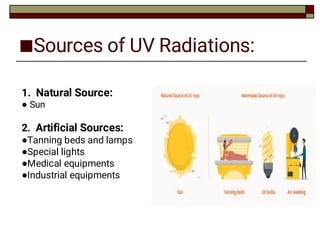
■Sources of UV Radiations:
1. Natural Source:
● Sun
2. Artificial Sources:
●Tanning beds and lamps
●Special lights
●Medical equipments
●Industrial equipments
■Factors affecting the UV
Radiations:
● Solar intensity: The strength of the sun's energy output.
● Atmospheric conditions: The Earth's atmosphere absorbs
and scatters UV radiation.
● Ozone layer: The ozone layer absorbs most of UV radiations.
● Cloud cover: Clouds can absorb and scatter UV radiation.
● Altitude: UV radiation levels increase at higher altitudes.
● Season: UV radiation levels vary by season, with more
radiation during summer months.
● Time of day: UV radiation levels are highest during peak sun
hours (usually between 10am and 4pm).
■Effects of UV Radiations on life:
●Positive Effects:
1. Vitamin D production: UV radiation triggers the production of
vitamin D in the skin, essential for bone health.
2. Mood improvement: UV radiation can boost serotonin levels,
helping to reduce stress and improve mood.
3. Pain relief: UV radiation has been shown to reduce pain
levels in some individuals.
4. Immune system support: UV radiation can help stimulate the
immune system.
5. Circadian rhythm regulation: Exposure to UV radiation helps
regulate the body's internal clock.
●Negative Effects:
1. Skin cancer: Prolonged exposure to UV radiation increases
the risk of skin cancer.
2. Sunburn: UV radiation can cause painful sunburn, leading to
redness, swelling, and blistering.
3. Premature aging: UV radiation can lead to wrinkles, fine lines,
and age spots.
4. Eye damage: Prolonged exposure to UV radiation can cause
cataracts, macular degeneration, and eye irritation.
5. Immune system suppression: Excessive UV radiation can
weaken the immune system.
■Effects of UV Radiations on life:
■Safety Measures:
Following safety measures are necessary for the protection
form UV radiations:
1. Seek shade, especially during peak sun hours (10am-4pm)
2. Wear protective clothing, hats, and sunglasses
3. Apply sunscreen with appropriate SPF (at least 30)
4. Avoid artificial sources of UV radiation (tanning beds, etc)
Practice sun safety and take appropriate precautions to balance
the benefits and risks of solar UV radiation!
THANK YOU.....!

This is my Environmental physics presentation

  • 1.
    Course Title: EnviromentalPhysics Course Code: PHYS-414 Submitted To: Ma'am khadija Zaman Submitted By: Qareen e Zahra(22022410-019) Laiba Javed(22022410-003) Aleena Yousaf(22022410-013) Noor Fatima(22022410-018) Laiba Shahzadi(22022410-021)
  • 2.
    ■ SOLAR UVAND LIFE ● Definition ● Types ● Sources ● Factors ● Effects on life (positive and negative) ● Safety measures
  • 3.
    ■Definition: Solar ultraviolet radiationis defined as: "The electromagnetic radiation emitted by the sun, with wavelengths shorter than visible light, but longer than X-rays that can be harmful to living organisms and the environment." In simpler terms, Solar UV radiation is: - Energy from the sun - Invisible to the human eye - Can be harmful to skin, eyes and living things
  • 4.
    ■Types of UVRadiations: Following are the types of UV radiations: 1. Ultraviolet A: - Wavelength: 320-400 nanometers (nm) - Penetrates deep into skin causing skin aging, tanning, wrinkles, and skin cancer - Can pass through clouds and glass 2. Ultraviolet B: - Wavelength: 290-320 nm - Responsible for sunburn, redness and skin cancer - Mostly absorbed by the atmosphere but some reaches the Earth's surface
  • 5.
    3. Ultraviolet C: - Wavelength: 220-290 nm - Most harmful, but completely absorbed by the Earth's atmosphere and does not reach the surface These types of solar UV radiation have different effects on human skin and the environment. ■Types of UV Radiations:
  • 7.
    ■Sources of UVRadiations: 1. Natural Source: ● Sun 2. Artificial Sources: ●Tanning beds and lamps ●Special lights ●Medical equipments ●Industrial equipments
  • 8.
    ■Factors affecting theUV Radiations: ● Solar intensity: The strength of the sun's energy output. ● Atmospheric conditions: The Earth's atmosphere absorbs and scatters UV radiation. ● Ozone layer: The ozone layer absorbs most of UV radiations. ● Cloud cover: Clouds can absorb and scatter UV radiation. ● Altitude: UV radiation levels increase at higher altitudes. ● Season: UV radiation levels vary by season, with more radiation during summer months. ● Time of day: UV radiation levels are highest during peak sun hours (usually between 10am and 4pm).
  • 9.
    ■Effects of UVRadiations on life: ●Positive Effects: 1. Vitamin D production: UV radiation triggers the production of vitamin D in the skin, essential for bone health. 2. Mood improvement: UV radiation can boost serotonin levels, helping to reduce stress and improve mood. 3. Pain relief: UV radiation has been shown to reduce pain levels in some individuals. 4. Immune system support: UV radiation can help stimulate the immune system. 5. Circadian rhythm regulation: Exposure to UV radiation helps regulate the body's internal clock.
  • 10.
    ●Negative Effects: 1. Skincancer: Prolonged exposure to UV radiation increases the risk of skin cancer. 2. Sunburn: UV radiation can cause painful sunburn, leading to redness, swelling, and blistering. 3. Premature aging: UV radiation can lead to wrinkles, fine lines, and age spots. 4. Eye damage: Prolonged exposure to UV radiation can cause cataracts, macular degeneration, and eye irritation. 5. Immune system suppression: Excessive UV radiation can weaken the immune system. ■Effects of UV Radiations on life:
  • 11.
    ■Safety Measures: Following safetymeasures are necessary for the protection form UV radiations: 1. Seek shade, especially during peak sun hours (10am-4pm) 2. Wear protective clothing, hats, and sunglasses 3. Apply sunscreen with appropriate SPF (at least 30) 4. Avoid artificial sources of UV radiation (tanning beds, etc) Practice sun safety and take appropriate precautions to balance the benefits and risks of solar UV radiation!
  • 13.