Introduction to
Solar Energy
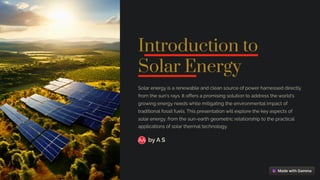
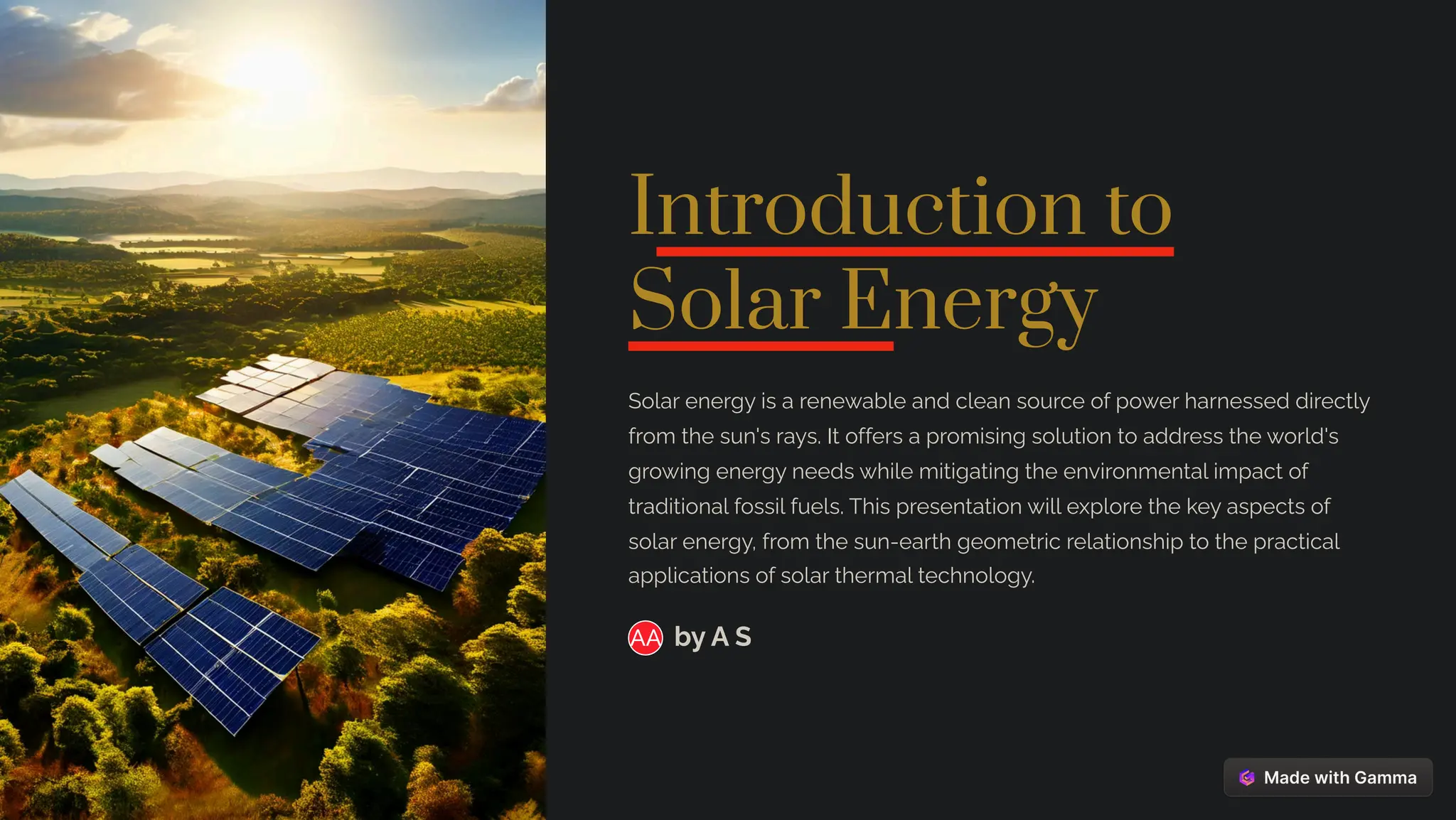
Solar energy is a renewable and clean source of power harnessed directly
from the sun's rays. It offers a promising solution to address the world's
growing energy needs while mitigating the environmental impact of
traditional fossil fuels. This presentation will explore the key aspects of
solar energy, from the sun-earth geometric relationship to the practical
applications of solar thermal technology.
by A S
AA
Sun-Earth Geometric Relationship
1 Earth's Orbit
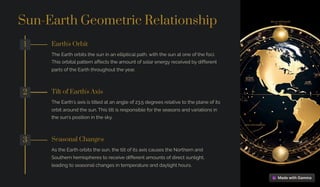
The Earth orbits the sun in an elliptical path, with the sun at one of the foci.
This orbital pattern affects the amount of solar energy received by different
parts of the Earth throughout the year.
2 Tilt of Earth's Axis
The Earth's axis is tilted at an angle of 23.5 degrees relative to the plane of its
orbit around the sun. This tilt is responsible for the seasons and variations in
the sun's position in the sky.
3 Seasonal Changes
As the Earth orbits the sun, the tilt of its axis causes the Northern and
Southern hemispheres to receive different amounts of direct sunlight,
leading to seasonal changes in temperature and daylight hours.
Layers of the Sun
Core
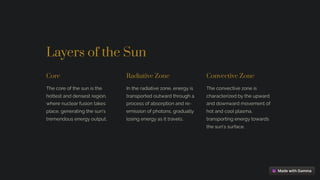
The core of the sun is the
hottest and densest region,
where nuclear fusion takes
place, generating the sun's
tremendous energy output.
Radiative Zone
In the radiative zone, energy is
transported outward through a
process of absorption and re-
emission of photons, gradually
losing energy as it travels.
Convective Zone
The convective zone is
characterized by the upward
and downward movement of
hot and cool plasma,
transporting energy towards
the sun's surface.
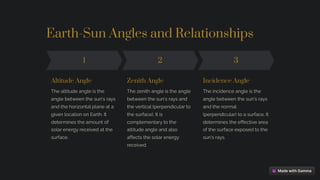
Earth-Sun Angles and Relationships
1
Altitude Angle
The altitude angle is the
angle between the sun's rays
and the horizontal plane at a
given location on Earth. It
determines the amount of
solar energy received at the
surface.
2
Zenith Angle
The zenith angle is the angle
between the sun's rays and
the vertical (perpendicular to
the surface). It is
complementary to the
altitude angle and also
affects the solar energy
received.
3
Incidence Angle
The incidence angle is the
angle between the sun's rays
and the normal
(perpendicular) to a surface. It
determines the effective area
of the surface exposed to the
sun's rays.
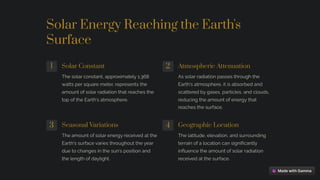
Solar Energy Reaching the Earth's
Surface
1 Solar Constant
The solar constant, approximately 1,368
watts per square meter, represents the
amount of solar radiation that reaches the
top of the Earth's atmosphere.
2 Atmospheric Attenuation
As solar radiation passes through the
Earth's atmosphere, it is absorbed and
scattered by gases, particles, and clouds,
reducing the amount of energy that
reaches the surface.
3 Seasonal Variations
The amount of solar energy received at the
Earth's surface varies throughout the year
due to changes in the sun's position and
the length of daylight.
4 Geographic Location
The latitude, elevation, and surrounding
terrain of a location can significantly
influence the amount of solar radiation
received at the surface.
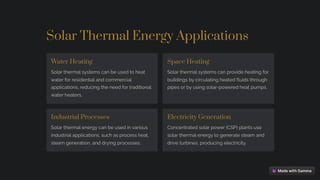
Solar Thermal Energy Applications
Water Heating
Solar thermal systems can be used to heat
water for residential and commercial
applications, reducing the need for traditional
water heaters.
Space Heating
Solar thermal systems can provide heating for
buildings by circulating heated fluids through
pipes or by using solar-powered heat pumps.
Industrial Processes
Solar thermal energy can be used in various
industrial applications, such as process heat,
steam generation, and drying processes.
Electricity Generation
Concentrated solar power (CSP) plants use
solar thermal energy to generate steam and
drive turbines, producing electricity.
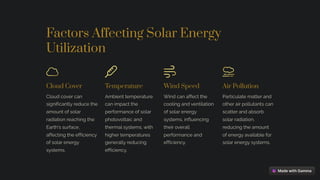
Factors Affecting Solar Energy
Utilization
Cloud Cover
Cloud cover can
significantly reduce the
amount of solar
radiation reaching the
Earth's surface,
affecting the efficiency
of solar energy
systems.
Temperature
Ambient temperature
can impact the
performance of solar
photovoltaic and
thermal systems, with
higher temperatures
generally reducing
efficiency.
Wind Speed
Wind can affect the
cooling and ventilation
of solar energy
systems, influencing
their overall
performance and
efficiency.
Air Pollution
Particulate matter and
other air pollutants can
scatter and absorb
solar radiation,
reducing the amount
of energy available for
solar energy systems.
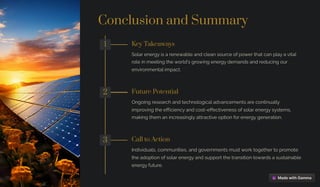
Conclusion and Summary
1 Key Takeaways
Solar energy is a renewable and clean source of power that can play a vital
role in meeting the world's growing energy demands and reducing our
environmental impact.
2 Future Potential
Ongoing research and technological advancements are continually
improving the efficiency and cost-effectiveness of solar energy systems,
making them an increasingly attractive option for energy generation.
3 Call to Action
Individuals, communities, and governments must work together to promote
the adoption of solar energy and support the transition towards a sustainable
energy future.

introduction to solar energy for engineering.pdf

  • 1.
    Introduction to Solar Energy Solarenergy is a renewable and clean source of power harnessed directly from the sun's rays. It offers a promising solution to address the world's growing energy needs while mitigating the environmental impact of traditional fossil fuels. This presentation will explore the key aspects of solar energy, from the sun-earth geometric relationship to the practical applications of solar thermal technology. by A S AA
  • 2.
    Sun-Earth Geometric Relationship 1Earth's Orbit The Earth orbits the sun in an elliptical path, with the sun at one of the foci. This orbital pattern affects the amount of solar energy received by different parts of the Earth throughout the year. 2 Tilt of Earth's Axis The Earth's axis is tilted at an angle of 23.5 degrees relative to the plane of its orbit around the sun. This tilt is responsible for the seasons and variations in the sun's position in the sky. 3 Seasonal Changes As the Earth orbits the sun, the tilt of its axis causes the Northern and Southern hemispheres to receive different amounts of direct sunlight, leading to seasonal changes in temperature and daylight hours.
  • 3.
    Layers of theSun Core The core of the sun is the hottest and densest region, where nuclear fusion takes place, generating the sun's tremendous energy output. Radiative Zone In the radiative zone, energy is transported outward through a process of absorption and re- emission of photons, gradually losing energy as it travels. Convective Zone The convective zone is characterized by the upward and downward movement of hot and cool plasma, transporting energy towards the sun's surface.
  • 4.
    Earth-Sun Angles andRelationships 1 Altitude Angle The altitude angle is the angle between the sun's rays and the horizontal plane at a given location on Earth. It determines the amount of solar energy received at the surface. 2 Zenith Angle The zenith angle is the angle between the sun's rays and the vertical (perpendicular to the surface). It is complementary to the altitude angle and also affects the solar energy received. 3 Incidence Angle The incidence angle is the angle between the sun's rays and the normal (perpendicular) to a surface. It determines the effective area of the surface exposed to the sun's rays.
  • 5.
    Solar Energy Reachingthe Earth's Surface 1 Solar Constant The solar constant, approximately 1,368 watts per square meter, represents the amount of solar radiation that reaches the top of the Earth's atmosphere. 2 Atmospheric Attenuation As solar radiation passes through the Earth's atmosphere, it is absorbed and scattered by gases, particles, and clouds, reducing the amount of energy that reaches the surface. 3 Seasonal Variations The amount of solar energy received at the Earth's surface varies throughout the year due to changes in the sun's position and the length of daylight. 4 Geographic Location The latitude, elevation, and surrounding terrain of a location can significantly influence the amount of solar radiation received at the surface.
  • 6.
    Solar Thermal EnergyApplications Water Heating Solar thermal systems can be used to heat water for residential and commercial applications, reducing the need for traditional water heaters. Space Heating Solar thermal systems can provide heating for buildings by circulating heated fluids through pipes or by using solar-powered heat pumps. Industrial Processes Solar thermal energy can be used in various industrial applications, such as process heat, steam generation, and drying processes. Electricity Generation Concentrated solar power (CSP) plants use solar thermal energy to generate steam and drive turbines, producing electricity.
  • 7.
    Factors Affecting SolarEnergy Utilization Cloud Cover Cloud cover can significantly reduce the amount of solar radiation reaching the Earth's surface, affecting the efficiency of solar energy systems. Temperature Ambient temperature can impact the performance of solar photovoltaic and thermal systems, with higher temperatures generally reducing efficiency. Wind Speed Wind can affect the cooling and ventilation of solar energy systems, influencing their overall performance and efficiency. Air Pollution Particulate matter and other air pollutants can scatter and absorb solar radiation, reducing the amount of energy available for solar energy systems.
  • 8.
    Conclusion and Summary 1Key Takeaways Solar energy is a renewable and clean source of power that can play a vital role in meeting the world's growing energy demands and reducing our environmental impact. 2 Future Potential Ongoing research and technological advancements are continually improving the efficiency and cost-effectiveness of solar energy systems, making them an increasingly attractive option for energy generation. 3 Call to Action Individuals, communities, and governments must work together to promote the adoption of solar energy and support the transition towards a sustainable energy future.