INTRODUCTION
AUTOMATION:-
Means the use of machines and equipments for performing physical and
mental operations in a production process in place of human being.
Is a system of doing work where material handling , production process and
product designs are integrated through mechanism of thoughts and efforts
to achieve a set regulating & controlling system.
Is the result of Industrialization , driven by the need to increase
productivity & to achieve consistent quality products
It can be done at various levels of manufacturing system-
 Handling of raw materials, semi-finished goods or finished goods
 During production process (efficient machines are used )
 In Inspection and Quality control operations.
 AUTOMATION IN PHARMACEUTICAL INDUSTRY
Basic purpose of AUTOMATION in Manufacturing industry is:-
 To increase Productivity.
 Improve quality of products & to reduce waste.
 To reduce the costs.
 For safe handling of Hazardous substances.
 To take heavy work from workers.
Regulation is a major consideration for Automation as it
ensures compliance with safety considerations and guidelines.
 ADVANTAGES:-
 It provides better quality of goods and service.
 It causes reduction in direct labor costs.
 There is effective control on operation.
 There is greater accuracy, more output and greater speed.
 The production planning and control is to be done in the beginning only
 The working conditions can be improved
 Safety of workers is improved.
 Minimization of wastage
 The service to the consumer is enhanced.
 The quality of product improves as human input is minimized.
DISADVANTAGES:-
 Huge capital investment is required.
 The maintenance cost is very high because maintenance labor of high
caliber is required.
 It can create unemployment.
 Continuous power supply is required.
 Large inventories are required.
 Any breakdown , anywhere would lead to complete shut down.
 Requires highly skilled manpower.
 There are restrictions in designing and construction of the building.
Classification of industrial and
laboratory automation-:
PROCESS AUTOMATION- deals mainly with
handling of raw materials in forms such as liquids or
powders. E.g. in oil refinery, oil& gas and chemical
industries.
DISCRETE AUTOMATION- essentially deals with
assembly of parts requiring high levels of mechanical
motion to produce consumer electronic products and
products for the automotive industries.
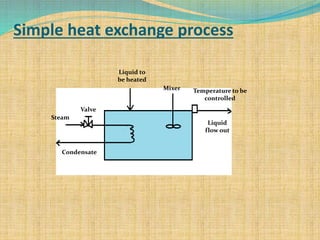
 In this process, the in flowing liquid is to be heated to
the required temperature by the steam flowing through
heating coils.
 The temperature of exit flow is affected by the processes
variable such as-temperature and flow rate of the
flowing liquid, temperature and flow rate of the steam,
heat capacity of the fluids, and heat loss from the vessel
and mixer speed.
 Liquid to be heated Mixer, Temperature to be controlled,
Liquid flow out Valve, Steam Condensate - Simple heat
exchange process.
GENERAL AUTOMATIC CONTROL SYSTEM
Liquid to
be heated
Mixer Temperature to be
controlled
Liquid
flow out
Condensate
Valve
Steam
Simple heat exchange process
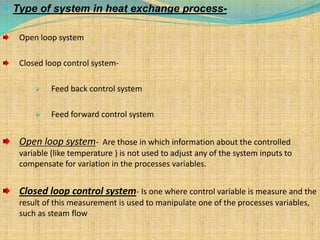
 Type of system in heat exchange process-
Open loop system
Closed loop control system-
 Feed back control system
 Feed forward control system
Open loop system- Are those in which information about the controlled
variable (like temperature ) is not used to adjust any of the system inputs to
compensate for variation in the processes variables.
Closed loop control system- Is one where control variable is measure and the
result of this measurement is used to manipulate one of the processes variables,
such as steam flow
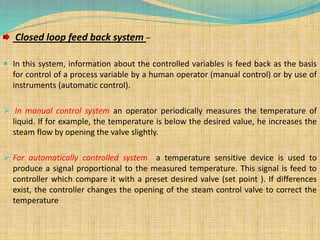
Closed loop feed back system –
 In this system, information about the controlled variables is feed back as the basis
for control of a process variable by a human operator (manual control) or by use of
instruments (automatic control).
 In manual control system an operator periodically measures the temperature of
liquid. If for example, the temperature is below the desired value, he increases the
steam flow by opening the valve slightly.
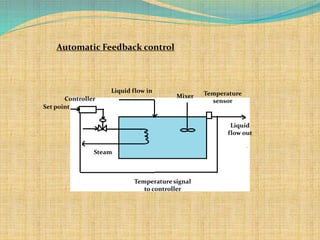
 For automatically controlled system a temperature sensitive device is used to
produce a signal proportional to the measured temperature. This signal is feed to
controller which compare it with a preset desired valve (set point ). If differences
exist, the controller changes the opening of the steam control valve to correct the
temperature
Set point
Controller
Liquid flow in
Mixer Temperature
sensor
Liquid
flow out
Temperature signal
to controller
Steam
Automatic Feedback control
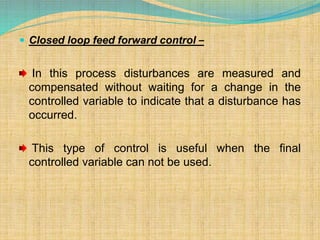
 Closed loop feed forward control –
In this process disturbances are measured and
compensated without waiting for a change in the
controlled variable to indicate that a disturbance has
occurred.
This type of control is useful when the final
controlled variable can not be used.
INSTRUMENTS FOR MEASURING VACUUM
 Simple manometers
 Compression gauges
 Thermal gauges
 Ionization gauges
 Diaphragm gauges
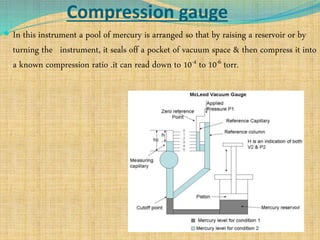
Compression gauge
 In this instrument a pool of mercury is arranged so that by raising a reservoir or by
turning the instrument, it seals off a pocket of vacuum space & then compress it into
a known compression ratio .it can read down to 10-4 to 10-6 torr.
Uses of pharma industry
 To determine batch quality
 To determine consistency in manufacture
 To aid in the design process
 To reduce material costs and achieve lean
manufacturing goals
 To ensure compliance with international and industry
standards
Thermal (Pirani type) gauge-
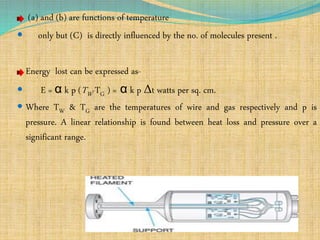
Gauges are based on the fact that energy lost from a heated wire in a partial vacuum is a
function of the concentration of the residual molecules and therefore the absolute pressure.
The total energy lost consists of-
a. Radiation
b. Heat conduction from the ends of wire into the supports or leads and
c. Energy lost as a result of the average energy of the incident molecules being smaller than
that of those leaving the wire, i.e. they become heated and release energy anyway .
(a) and (b) are functions of temperature
 only but (C) is directly influenced by the no. of molecules present .
Energy lost can be expressed as-
 E = α k p (TW-TG ) = α k p Δt watts per sq. cm.
 Where TW & TG are the temperatures of wire and gas respectively and p is
pressure. A linear relationship is found between heat loss and pressure over a
significant range.
 Ionization gauge-
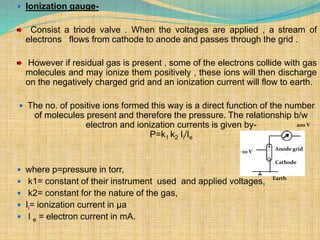
Consist a triode valve . When the voltages are applied , a stream of
electrons flows from cathode to anode and passes through the grid .
However if residual gas is present , some of the electrons collide with gas
molecules and may ionize them positively , these ions will then discharge
on the negatively charged grid and an ionization current will flow to earth.
 The no. of positive ions formed this way is a direct function of the number
of molecules present and therefore the pressure. The relationship b/w
electron and ionization currents is given by-
P=k1 k2 Ii/Ie
 where p=pressure in torr,
 k1= constant of their instrument used and applied voltages,
 k2= constant for the nature of the gas,
 Ii= ionization current in µa
 I e = electron current in mA.
Anode grid
Cathode
Earth
-10 V
200 V
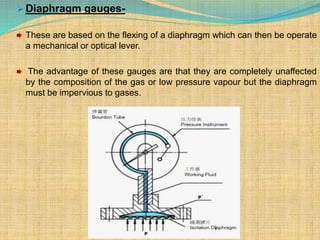
 Diaphragm gauges-
These are based on the flexing of a diaphragm which can then be operate
a mechanical or optical lever.
The advantage of these gauges are that they are completely unaffected
by the composition of the gas or low pressure vapour but the diaphragm
must be impervious to gases.
 Radiometer gauges-
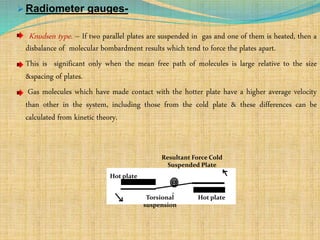
Knudsen type. – If two parallel plates are suspended in gas and one of them is heated, then a
disbalance of molecular bombardment results which tend to force the plates apart.
This is significant only when the mean free path of molecules is large relative to the size
&spacing of plates.
Gas molecules which have made contact with the hotter plate have a higher average velocity
than other in the system, including those from the cold plate & these differences can be
calculated from kinetic theory.
Hot plate
Resultant Force Cold
Suspended Plate
Torsional
suspension
Hot plate
 INSTRUMENTS FOR MEASURING
TEMPERATURE
 Thermocouples
 Resistance thermometers
 Filled – in thermometers
 Bimetal thermometer
 Liquid – in – glass thermometer
 Pyrometer
THERMOCOUPLES-
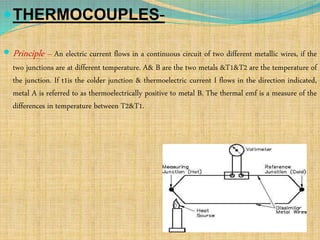
 Principle – An electric current flows in a continuous circuit of two different metallic wires, if the
two junctions are at different temperature. A& B are the two metals &T1&T2 are the temperature of
the junction. If t1is the colder junction & thermoelectric current I flows in the direction indicated,
metal A is referred to as thermoelectrically positive to metal B. The thermal emf is a measure of the
differences in temperature between T2&T1.
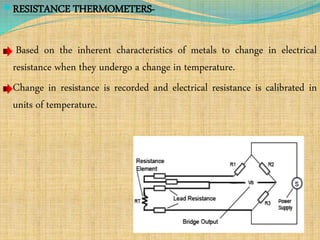
 RESISTANCE THERMOMETERS-
Based on the inherent characteristics of metals to change in electrical
resistance when they undergo a change in temperature.
Change in resistance is recorded and electrical resistance is calibrated in
units of temperature.
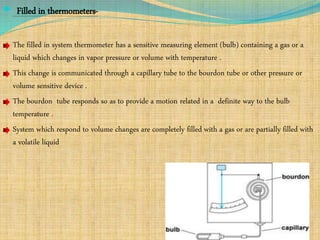
 Filled in thermometers-
The filled in system thermometer has a sensitive measuring element (bulb) containing a gas or a
liquid which changes in vapor pressure or volume with temperature .
This change is communicated through a capillary tube to the bourdon tube or other pressure or
volume sensitive device .
The bourdon tube responds so as to provide a motion related in a definite way to the bulb
temperature .
System which respond to volume changes are completely filled with a gas or are partially filled with
a volatile liquid
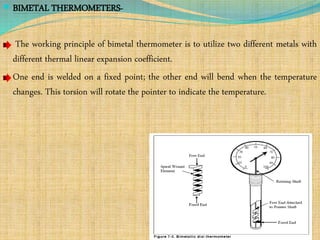
 BIMETAL THERMOMETERS-
The working principle of bimetal thermometer is to utilize two different metals with
different thermal linear expansion coefficient.
One end is welded on a fixed point; the other end will bend when the temperature
changes. This torsion will rotate the pointer to indicate the temperature.
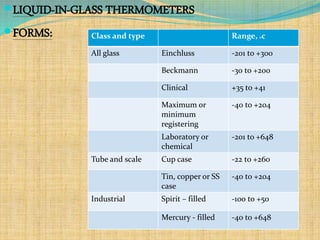
LIQUID-IN-GLASS THERMOMETERS
FORMS: Class and type Range, oc
All glass Einchluss -201 to +300
Beckmann -30 to +200
Clinical +35 to +41
Maximum or
minimum
registering
-40 to +204
Laboratory or
chemical
-201 to +648
Tube and scale Cup case -22 to +260
Tin, copper or SS
case
-40 to +204
Industrial Spirit – filled -100 to +50
Mercury - filled -40 to +648
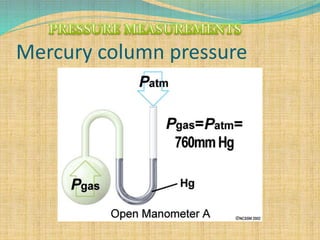
Mercury column pressure
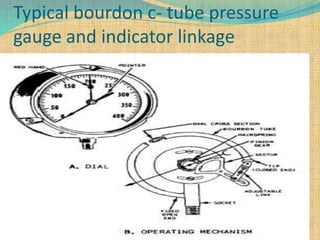
Typical bourdon c- tube pressure
gauge and indicator linkage
In the hierarchy of computer control of a process.
 Five levels can be identified-
A. Unit operation control
B. Unit process control
C. Plant control
D. And E. Departmental and corporate control level of a
company.
 Without computer control at the plant or unit process level,
the study state plant operating period tend to become,
several days.
Thank
you

Automated process control systems

  • 2.
    INTRODUCTION AUTOMATION:- Means the useof machines and equipments for performing physical and mental operations in a production process in place of human being. Is a system of doing work where material handling , production process and product designs are integrated through mechanism of thoughts and efforts to achieve a set regulating & controlling system. Is the result of Industrialization , driven by the need to increase productivity & to achieve consistent quality products It can be done at various levels of manufacturing system-  Handling of raw materials, semi-finished goods or finished goods  During production process (efficient machines are used )  In Inspection and Quality control operations.
  • 3.
     AUTOMATION INPHARMACEUTICAL INDUSTRY Basic purpose of AUTOMATION in Manufacturing industry is:-  To increase Productivity.  Improve quality of products & to reduce waste.  To reduce the costs.  For safe handling of Hazardous substances.  To take heavy work from workers. Regulation is a major consideration for Automation as it ensures compliance with safety considerations and guidelines.
  • 4.
     ADVANTAGES:-  Itprovides better quality of goods and service.  It causes reduction in direct labor costs.  There is effective control on operation.  There is greater accuracy, more output and greater speed.  The production planning and control is to be done in the beginning only  The working conditions can be improved  Safety of workers is improved.  Minimization of wastage  The service to the consumer is enhanced.  The quality of product improves as human input is minimized.
  • 5.
    DISADVANTAGES:-  Huge capitalinvestment is required.  The maintenance cost is very high because maintenance labor of high caliber is required.  It can create unemployment.  Continuous power supply is required.  Large inventories are required.  Any breakdown , anywhere would lead to complete shut down.  Requires highly skilled manpower.  There are restrictions in designing and construction of the building.
  • 6.
    Classification of industrialand laboratory automation-: PROCESS AUTOMATION- deals mainly with handling of raw materials in forms such as liquids or powders. E.g. in oil refinery, oil& gas and chemical industries. DISCRETE AUTOMATION- essentially deals with assembly of parts requiring high levels of mechanical motion to produce consumer electronic products and products for the automotive industries.
  • 7.
     In thisprocess, the in flowing liquid is to be heated to the required temperature by the steam flowing through heating coils.  The temperature of exit flow is affected by the processes variable such as-temperature and flow rate of the flowing liquid, temperature and flow rate of the steam, heat capacity of the fluids, and heat loss from the vessel and mixer speed.  Liquid to be heated Mixer, Temperature to be controlled, Liquid flow out Valve, Steam Condensate - Simple heat exchange process. GENERAL AUTOMATIC CONTROL SYSTEM
  • 8.
    Liquid to be heated MixerTemperature to be controlled Liquid flow out Condensate Valve Steam Simple heat exchange process
  • 9.
     Type ofsystem in heat exchange process- Open loop system Closed loop control system-  Feed back control system  Feed forward control system Open loop system- Are those in which information about the controlled variable (like temperature ) is not used to adjust any of the system inputs to compensate for variation in the processes variables. Closed loop control system- Is one where control variable is measure and the result of this measurement is used to manipulate one of the processes variables, such as steam flow
  • 10.
    Closed loop feedback system –  In this system, information about the controlled variables is feed back as the basis for control of a process variable by a human operator (manual control) or by use of instruments (automatic control).  In manual control system an operator periodically measures the temperature of liquid. If for example, the temperature is below the desired value, he increases the steam flow by opening the valve slightly.  For automatically controlled system a temperature sensitive device is used to produce a signal proportional to the measured temperature. This signal is feed to controller which compare it with a preset desired valve (set point ). If differences exist, the controller changes the opening of the steam control valve to correct the temperature
  • 11.
    Set point Controller Liquid flowin Mixer Temperature sensor Liquid flow out Temperature signal to controller Steam Automatic Feedback control
  • 12.
     Closed loopfeed forward control – In this process disturbances are measured and compensated without waiting for a change in the controlled variable to indicate that a disturbance has occurred. This type of control is useful when the final controlled variable can not be used.
  • 13.
    INSTRUMENTS FOR MEASURINGVACUUM  Simple manometers  Compression gauges  Thermal gauges  Ionization gauges  Diaphragm gauges
  • 14.
    Compression gauge  Inthis instrument a pool of mercury is arranged so that by raising a reservoir or by turning the instrument, it seals off a pocket of vacuum space & then compress it into a known compression ratio .it can read down to 10-4 to 10-6 torr.
  • 15.
    Uses of pharmaindustry  To determine batch quality  To determine consistency in manufacture  To aid in the design process  To reduce material costs and achieve lean manufacturing goals  To ensure compliance with international and industry standards
  • 16.
    Thermal (Pirani type)gauge- Gauges are based on the fact that energy lost from a heated wire in a partial vacuum is a function of the concentration of the residual molecules and therefore the absolute pressure. The total energy lost consists of- a. Radiation b. Heat conduction from the ends of wire into the supports or leads and c. Energy lost as a result of the average energy of the incident molecules being smaller than that of those leaving the wire, i.e. they become heated and release energy anyway .
  • 17.
    (a) and (b)are functions of temperature  only but (C) is directly influenced by the no. of molecules present . Energy lost can be expressed as-  E = α k p (TW-TG ) = α k p Δt watts per sq. cm.  Where TW & TG are the temperatures of wire and gas respectively and p is pressure. A linear relationship is found between heat loss and pressure over a significant range.
  • 18.
     Ionization gauge- Consista triode valve . When the voltages are applied , a stream of electrons flows from cathode to anode and passes through the grid . However if residual gas is present , some of the electrons collide with gas molecules and may ionize them positively , these ions will then discharge on the negatively charged grid and an ionization current will flow to earth.  The no. of positive ions formed this way is a direct function of the number of molecules present and therefore the pressure. The relationship b/w electron and ionization currents is given by- P=k1 k2 Ii/Ie  where p=pressure in torr,  k1= constant of their instrument used and applied voltages,  k2= constant for the nature of the gas,  Ii= ionization current in µa  I e = electron current in mA. Anode grid Cathode Earth -10 V 200 V
  • 19.
     Diaphragm gauges- Theseare based on the flexing of a diaphragm which can then be operate a mechanical or optical lever. The advantage of these gauges are that they are completely unaffected by the composition of the gas or low pressure vapour but the diaphragm must be impervious to gases.
  • 20.
     Radiometer gauges- Knudsentype. – If two parallel plates are suspended in gas and one of them is heated, then a disbalance of molecular bombardment results which tend to force the plates apart. This is significant only when the mean free path of molecules is large relative to the size &spacing of plates. Gas molecules which have made contact with the hotter plate have a higher average velocity than other in the system, including those from the cold plate & these differences can be calculated from kinetic theory. Hot plate Resultant Force Cold Suspended Plate Torsional suspension Hot plate
  • 21.
     INSTRUMENTS FORMEASURING TEMPERATURE  Thermocouples  Resistance thermometers  Filled – in thermometers  Bimetal thermometer  Liquid – in – glass thermometer  Pyrometer
  • 22.
    THERMOCOUPLES-  Principle –An electric current flows in a continuous circuit of two different metallic wires, if the two junctions are at different temperature. A& B are the two metals &T1&T2 are the temperature of the junction. If t1is the colder junction & thermoelectric current I flows in the direction indicated, metal A is referred to as thermoelectrically positive to metal B. The thermal emf is a measure of the differences in temperature between T2&T1.
  • 23.
     RESISTANCE THERMOMETERS- Basedon the inherent characteristics of metals to change in electrical resistance when they undergo a change in temperature. Change in resistance is recorded and electrical resistance is calibrated in units of temperature.
  • 24.
     Filled inthermometers- The filled in system thermometer has a sensitive measuring element (bulb) containing a gas or a liquid which changes in vapor pressure or volume with temperature . This change is communicated through a capillary tube to the bourdon tube or other pressure or volume sensitive device . The bourdon tube responds so as to provide a motion related in a definite way to the bulb temperature . System which respond to volume changes are completely filled with a gas or are partially filled with a volatile liquid
  • 25.
     BIMETAL THERMOMETERS- Theworking principle of bimetal thermometer is to utilize two different metals with different thermal linear expansion coefficient. One end is welded on a fixed point; the other end will bend when the temperature changes. This torsion will rotate the pointer to indicate the temperature.
  • 26.
    LIQUID-IN-GLASS THERMOMETERS FORMS: Classand type Range, oc All glass Einchluss -201 to +300 Beckmann -30 to +200 Clinical +35 to +41 Maximum or minimum registering -40 to +204 Laboratory or chemical -201 to +648 Tube and scale Cup case -22 to +260 Tin, copper or SS case -40 to +204 Industrial Spirit – filled -100 to +50 Mercury - filled -40 to +648
  • 27.
  • 28.
    Typical bourdon c-tube pressure gauge and indicator linkage
  • 29.
    In the hierarchyof computer control of a process.  Five levels can be identified- A. Unit operation control B. Unit process control C. Plant control D. And E. Departmental and corporate control level of a company.  Without computer control at the plant or unit process level, the study state plant operating period tend to become, several days.
  • 30.