Contents
 Introduction to Automation
 General Automatic Control System
 Automatic Controllers
 Computer Process Control
 Process Measurement
 Temperature Measurement
 Pressure Measurement Devices
 Automation in Tablet Manufacturing
INTRODUCTION
AUTOMATION:-
Means the use of machines and equipments for performing
physical and mental operations in a production process in
place of human being.
Is a system of doing work where material handling ,
production process and product designs are integrated
through mechanism of thoughts and efforts to achieve a set
regulating & controlling system.
Classification of industrial and
laboratory automation:-
PROCESS AUTOMATION-
It deals mainly with handling of raw materials in
forms such as liquids or powders. E.g. in oil refinery, oil& gas and
chemical industries.
DISCRETE AUTOMATION-
essentially deals with assembly of parts requiring
high levels of mechanical motion to produce consumer electronics
products and products for the automotive industries.
ADVANTAGES:-
 It provides better quality of goods and service.
 It causes reduction in direct labor costs.
 There is effective control on operation.
 There is greater accuracy, more output and greater speed.
 The production planning and control is to be done in the beginning only.
 The working conditions can be improved
 Safety of workers is improved.
 Minimization of wastage
 The quality of product improves as human input is minimized.
DISADVANTAGES:-
 Huge capital investment is required.
 The maintenance cost is very high because maintenance labor of high caliber is
required.
 It can create unemployment.
 Continuous power supply is required.
 Large inventories are required.
 Any breakdown , anywhere would lead to complete shut down.
 Requires highly skilled manpower.
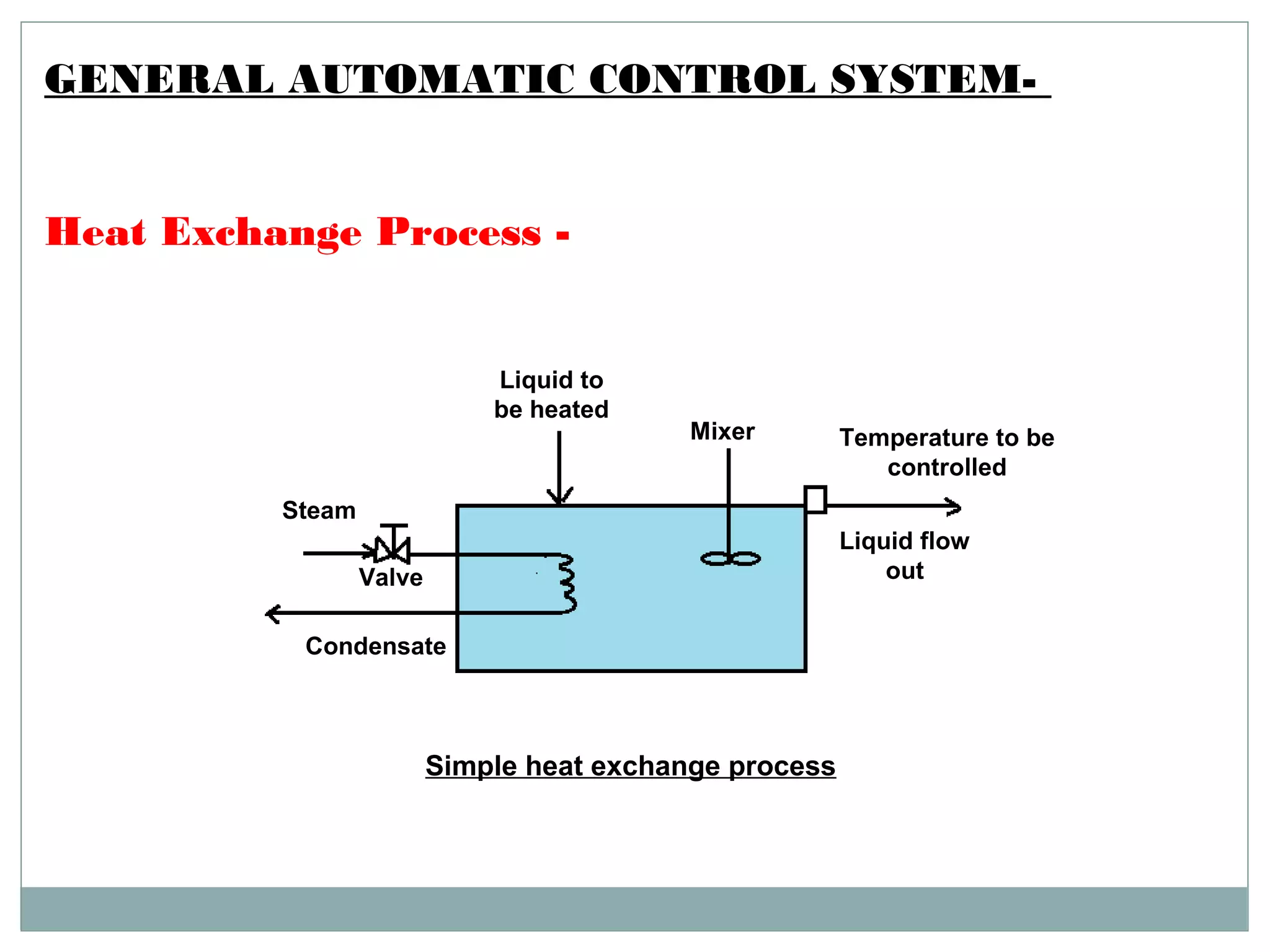
GENERAL AUTOMATIC CONTROL SYSTEM-
Heat Exchange Process -
Liquid to
be heated
Mixer Temperature to be
controlled
Liquid flow
outValve
Steam
Condensate
Simple heat exchange process
Types of Heat Exchange Process-
Open loop system :-
Closed loop control system :-
 Feed back control system
 Feed forward control system
Open loop system:- are those in which information about the
controlled variable (like temperature ) is not used to adjust any of
the system inputs to compensate for variation in the processes
variables.
Closed loop control system- Is one where control variable is
measure and the result of this measurement is used to manipulate
one of the processes variables, such as steam flow
Closed loop Feed back system –
In this system, information about the controlled
variables is feed back as the basis for control of a process variable by
a human operator (manual control) or by use of instruments (automatic
control).
Closed loop Feed forward control –
•In this process disturbances are measured and compensated without
waiting for a change in the controlled variable to indicate that a
disturbance has occurred.
•This type of control is useful when the final controlled variable can
not be used.
AUTOMATIC CONTROLLERS.
Three general type of controllers-
1)Self operated controller-
 On off controllers
 Proportional controller
2) Electronic controller
3) Pneumatic controller
1) Self operated controllers:-
Some control systems obtain the power require to
operate the error detector and final control element from the controller
medium of the process by way of the sensing element .such controller
are self operated controller , used for temperature , liquid and pressure
controller .
Types
a)On off controller –
b) Proportional controllers-
2) Electronic controllers- Are extensively used for process
control .
The reason for their increase usage are-
 solid state circuit
 Easier servicing
 Smaller particle size
 can easily be linked with process control computer
 cost completive compare to pneumatic controller
 may be more accurately tuned.
3) Pneumatic controllers - Its basic purpose is to supply
compressed air to a pneumatic valve actuator in response to an error
signal, based on the deviation of measured variable from the set
point.
Computer process control
In the process of computer control Five levels can be
identified -
 Unit operation control
 Unit process control
 Plant control
 Departmental and corporate control level of a company.
Types :-
1. Analog computer
2. Digital computer
PROCESS MEASUREMENT
Instrument for Measuring Vacuum :
 Compression gauge- Simple manometer.
 Thermal gauge
 Ionization gauge
 Diaphragm gauge
 Radiometer gauge
TEMPERATURE MEASUREMENT
 Thermocouples
 Resistance thermometers
 Filled in thermometers
 Bimetal thermometer
 Liquid in glass thermometers
 Pyrometers
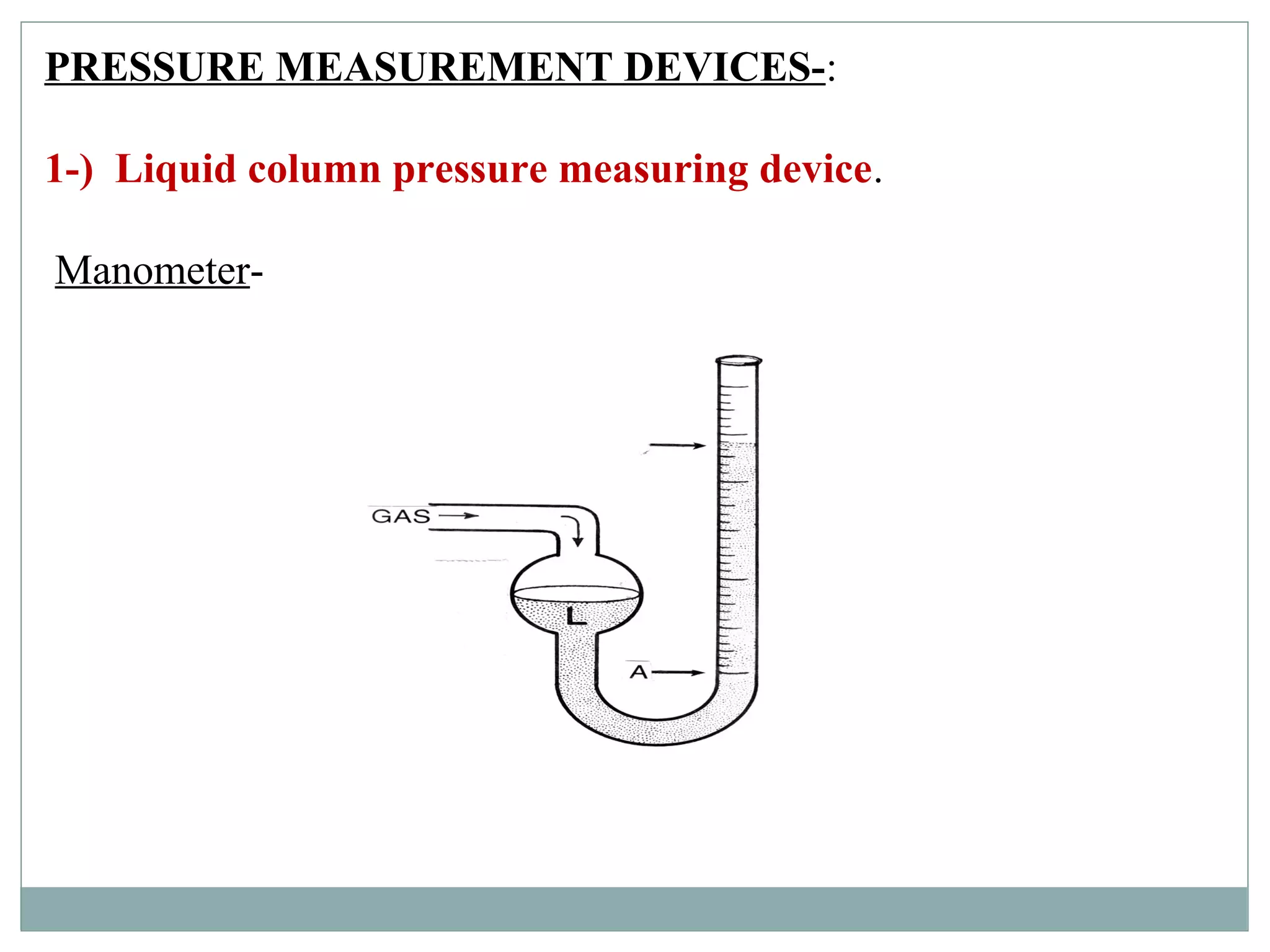
PRESSURE MEASUREMENT DEVICES-:
1-) Liquid column pressure measuring device.
Manometer-
2- Elastic element pressure measuring devices -
These devices may be broadly classified into 3 types-
 Bourdon type e.g. C- spring bourdon
 Bellows type
 Diaphragm type.
3- Electric sensing devices-:
• e.g.- Strain gauge
AUTOMATION IN TABLET MANUFACTURING
Benefits of automation in tablet production-
Improve material handling.
Improve specific unit operation-
 Particle size reduction
 Sieving
 Mixing.
 Particle size enlargement.
 Drying.
 Compression.
 Sorting.
 Coating.
 Packaging.
Eliminate or combine processing steps.
Incorporate automated process control of unit operation and processes.
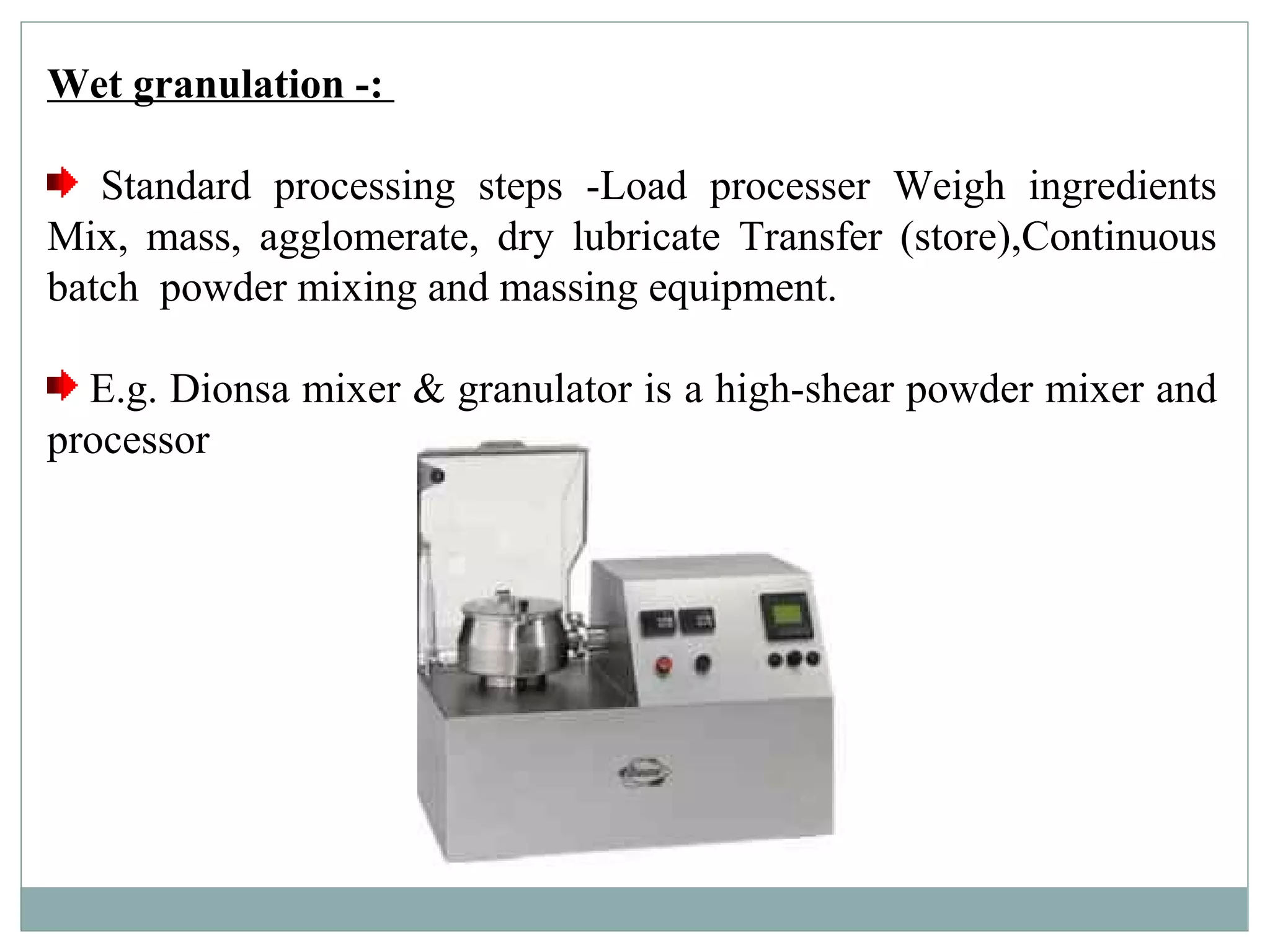
Wet granulation -:
Standard processing steps -Load processer Weigh ingredients
Mix, mass, agglomerate, dry lubricate Transfer (store),Continuous
batch powder mixing and massing equipment.
E.g. Dionsa mixer & granulator is a high-shear powder mixer and
processor
Fluid bed Spray Granulator :-
•A Suction fan generates air flow necessary for fluidization of
powder
•Air heater to heat the air to desired temperature.
•Air is drawn through pre filter to remove any impurities.
•Material to be processed kept in container just below the spray inlet.
•The liquid granulating agent is pumped from its container & is
sprayed as a fine mist through a spray head onto a fluidized powder.
•Exaust filters are mounted above the product retainer to retain dust
and fine particles.
Also available on Youtube!
Youtube :- https://youtube.com/vishalshelke99
Instagram :- https://instagram.com/vishal_stagram
24

Basics of Automation in Solid Dosage Form Production (Formulation & Developement M.Pharm Sem II)

  • 2.
    Contents  Introduction toAutomation  General Automatic Control System  Automatic Controllers  Computer Process Control  Process Measurement  Temperature Measurement  Pressure Measurement Devices  Automation in Tablet Manufacturing
  • 3.
    INTRODUCTION AUTOMATION:- Means the useof machines and equipments for performing physical and mental operations in a production process in place of human being. Is a system of doing work where material handling , production process and product designs are integrated through mechanism of thoughts and efforts to achieve a set regulating & controlling system.
  • 4.
    Classification of industrialand laboratory automation:- PROCESS AUTOMATION- It deals mainly with handling of raw materials in forms such as liquids or powders. E.g. in oil refinery, oil& gas and chemical industries. DISCRETE AUTOMATION- essentially deals with assembly of parts requiring high levels of mechanical motion to produce consumer electronics products and products for the automotive industries.
  • 5.
    ADVANTAGES:-  It providesbetter quality of goods and service.  It causes reduction in direct labor costs.  There is effective control on operation.  There is greater accuracy, more output and greater speed.  The production planning and control is to be done in the beginning only.  The working conditions can be improved  Safety of workers is improved.  Minimization of wastage  The quality of product improves as human input is minimized.
  • 6.
    DISADVANTAGES:-  Huge capitalinvestment is required.  The maintenance cost is very high because maintenance labor of high caliber is required.  It can create unemployment.  Continuous power supply is required.  Large inventories are required.  Any breakdown , anywhere would lead to complete shut down.  Requires highly skilled manpower.
  • 7.
    GENERAL AUTOMATIC CONTROLSYSTEM- Heat Exchange Process - Liquid to be heated Mixer Temperature to be controlled Liquid flow outValve Steam Condensate Simple heat exchange process
  • 8.
    Types of HeatExchange Process- Open loop system :- Closed loop control system :-  Feed back control system  Feed forward control system Open loop system:- are those in which information about the controlled variable (like temperature ) is not used to adjust any of the system inputs to compensate for variation in the processes variables. Closed loop control system- Is one where control variable is measure and the result of this measurement is used to manipulate one of the processes variables, such as steam flow
  • 9.
    Closed loop Feedback system – In this system, information about the controlled variables is feed back as the basis for control of a process variable by a human operator (manual control) or by use of instruments (automatic control). Closed loop Feed forward control – •In this process disturbances are measured and compensated without waiting for a change in the controlled variable to indicate that a disturbance has occurred. •This type of control is useful when the final controlled variable can not be used.
  • 10.
    AUTOMATIC CONTROLLERS. Three generaltype of controllers- 1)Self operated controller-  On off controllers  Proportional controller 2) Electronic controller 3) Pneumatic controller
  • 11.
    1) Self operatedcontrollers:- Some control systems obtain the power require to operate the error detector and final control element from the controller medium of the process by way of the sensing element .such controller are self operated controller , used for temperature , liquid and pressure controller . Types a)On off controller – b) Proportional controllers-
  • 12.
    2) Electronic controllers-Are extensively used for process control . The reason for their increase usage are-  solid state circuit  Easier servicing  Smaller particle size  can easily be linked with process control computer  cost completive compare to pneumatic controller  may be more accurately tuned. 3) Pneumatic controllers - Its basic purpose is to supply compressed air to a pneumatic valve actuator in response to an error signal, based on the deviation of measured variable from the set point.
  • 13.
    Computer process control Inthe process of computer control Five levels can be identified -  Unit operation control  Unit process control  Plant control  Departmental and corporate control level of a company. Types :- 1. Analog computer 2. Digital computer
  • 14.
    PROCESS MEASUREMENT Instrument forMeasuring Vacuum :  Compression gauge- Simple manometer.  Thermal gauge  Ionization gauge  Diaphragm gauge  Radiometer gauge
  • 15.
    TEMPERATURE MEASUREMENT  Thermocouples Resistance thermometers  Filled in thermometers  Bimetal thermometer  Liquid in glass thermometers  Pyrometers
  • 16.
    PRESSURE MEASUREMENT DEVICES-: 1-)Liquid column pressure measuring device. Manometer-
  • 17.
    2- Elastic elementpressure measuring devices - These devices may be broadly classified into 3 types-  Bourdon type e.g. C- spring bourdon  Bellows type  Diaphragm type. 3- Electric sensing devices-: • e.g.- Strain gauge
  • 18.
    AUTOMATION IN TABLETMANUFACTURING Benefits of automation in tablet production- Improve material handling. Improve specific unit operation-  Particle size reduction  Sieving  Mixing.  Particle size enlargement.  Drying.  Compression.  Sorting.  Coating.  Packaging. Eliminate or combine processing steps. Incorporate automated process control of unit operation and processes.
  • 19.
    Wet granulation -: Standardprocessing steps -Load processer Weigh ingredients Mix, mass, agglomerate, dry lubricate Transfer (store),Continuous batch powder mixing and massing equipment. E.g. Dionsa mixer & granulator is a high-shear powder mixer and processor
  • 20.
    Fluid bed SprayGranulator :- •A Suction fan generates air flow necessary for fluidization of powder •Air heater to heat the air to desired temperature. •Air is drawn through pre filter to remove any impurities. •Material to be processed kept in container just below the spray inlet. •The liquid granulating agent is pumped from its container & is sprayed as a fine mist through a spray head onto a fluidized powder. •Exaust filters are mounted above the product retainer to retain dust and fine particles.
  • 23.
    Also available onYoutube! Youtube :- https://youtube.com/vishalshelke99 Instagram :- https://instagram.com/vishal_stagram
  • 24.