Autoclave
Presented by:-
S.Raghavigneshwari, Nimisha &
Soni
CCT, DCCT & DMLT (2018) 1st
sem
What is Autoclave?
• Autoclave is a piece of equipment used for sterilizing
various requirements in the lab through by using
pressure, temperature & steam.
• It is used to eradicate bio-hazardous waste from the
surface of tools or instruments.
• The word sterilizing means the destruction of all
forms of life (microbial, as well as spores) present in
inanimate objects by means of physical, chemical or
gaseous procedures.
• It was invented by Charles Chamberland in the
18th centaury.
• Autoclaves are basically used in any field where
tools come in contact with biological matter. This
would include tattooing, podiatry, funeral homes
and prosthetics.
How does it work?
• The instruments to be sterilized are stored in a
chamber in the belly of the autoclave.
• As soon as the autoclave is switched on, a dense
cloud of steam is fed into the chamber.
• At that point, the pressure and temperature begin to
increase. Generally, most autoclaves aspire to
maintain a temperature of around 120 °C (about
250 °F).
• These conditions are maintained for about 15
minutes, which is enough time to kill every
microorganism and all the spores.
• The apparatus also includes multiple valves and
pipes to allow the steam to enter the chamber and
steer the contaminated air towards the exit.
• After the necessary time has elapsed, the steam is
removed, and pressure is gradually decreased.
• The process destroys the internal parts of a
microorganism & effectively ceases its existence.
• The process is based on displacing the contaminated
air in the chamber with saturated steam and forcing
this steam to persist so that the extended
exposure can ensure effective sterility.
• It is to be carefully noted that the steam is neither
superheated nor allowed to contain more
than 5% moisture.
• One must ensure that safety measures are
religiously followed, such as the use of gloves
throughout the entire procedure and avoiding
harmful burns by not touching the insides of the
chamber while handling the articles inside.
• The process must provide a Sterility Assurance
Level (SAL) of 10^-6 or better.
• The procedure can be executed in two ways,
formally known as autoclave “cycles”.
Gravity or Fast exhaust
• The first one is Gravity or fast exhaust, in which the
chamber endures high pressure and temperature for
a particular period of time; at the end of this period,
the valve is opened and the chamber swiftly returns
to atmospheric pressure.
• This method is used to clean dry goods, glassware &
plastics.
• Glassware: empty and inverted
• Dry hard items, either unwrapped or in porous wrap
• Metal items with porous parts
• Other porous materials
Liquid or Slow exhaust
• The cycle prevents a sterilized liquid from boiling.
• The steam is exhausted slowly at the end of the
cycle, gradually cooling the superheated liquid.
• The cycle is primarily used for liquids, as the name
suggests, but it can also be used for certain other
materials.
• Liquid media
• Non-flammable liquids
• Aqueous solutions
• Liquid biological waste
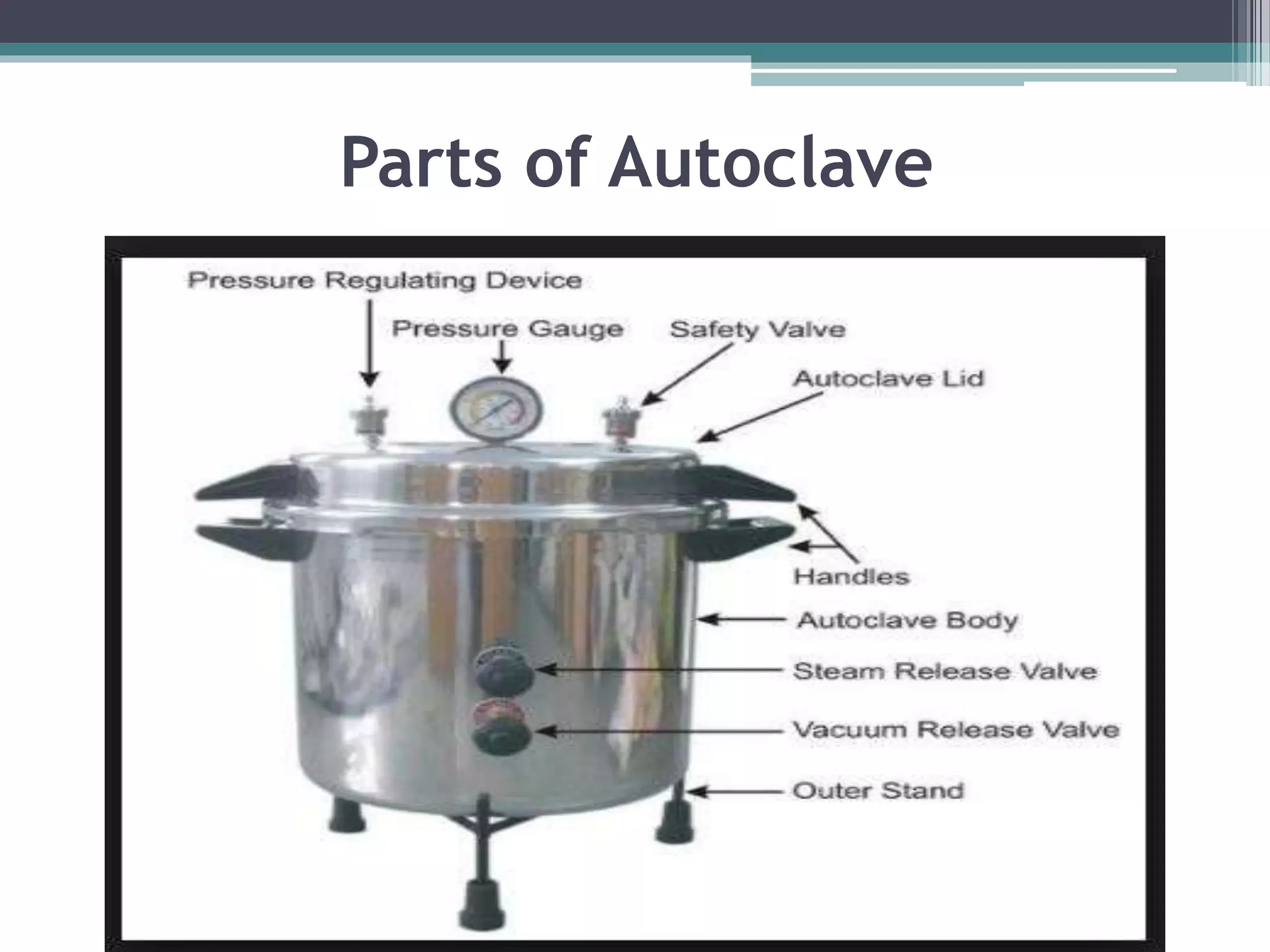
Parts of Autoclave
AUTOCLAVE-COMPATIBLE
MATERIALS
AUTOCLAVE-
INCOMPATIBLE MATERIALS
• Tissue Culture Flasks
• Surgical Instruments
• Glassware
• Pipette tips
• Media Solutions
• Animal food and bedding
• Waste
• Polypropylene
(Secondary containers)
• Stainless steel
• Gloves
• Acids, bases and organic
solvent
• Chlorides, sulphates
• Seawater
• Chlorine, hypochlorite,
bleach
• Non-stainless steel
• Polystyrene(PS)
• Polyethylene(PE)
• Low density (LDPE) and
High density
polyethylene(HDPE)
• Polyurethane
Thank you

Autoclave

  • 1.
    Autoclave Presented by:- S.Raghavigneshwari, Nimisha& Soni CCT, DCCT & DMLT (2018) 1st sem
  • 3.
    What is Autoclave? •Autoclave is a piece of equipment used for sterilizing various requirements in the lab through by using pressure, temperature & steam. • It is used to eradicate bio-hazardous waste from the surface of tools or instruments. • The word sterilizing means the destruction of all forms of life (microbial, as well as spores) present in inanimate objects by means of physical, chemical or gaseous procedures. • It was invented by Charles Chamberland in the 18th centaury. • Autoclaves are basically used in any field where tools come in contact with biological matter. This would include tattooing, podiatry, funeral homes and prosthetics.
  • 4.
    How does itwork? • The instruments to be sterilized are stored in a chamber in the belly of the autoclave. • As soon as the autoclave is switched on, a dense cloud of steam is fed into the chamber. • At that point, the pressure and temperature begin to increase. Generally, most autoclaves aspire to maintain a temperature of around 120 °C (about 250 °F). • These conditions are maintained for about 15 minutes, which is enough time to kill every microorganism and all the spores. • The apparatus also includes multiple valves and pipes to allow the steam to enter the chamber and steer the contaminated air towards the exit.
  • 5.
    • After thenecessary time has elapsed, the steam is removed, and pressure is gradually decreased. • The process destroys the internal parts of a microorganism & effectively ceases its existence. • The process is based on displacing the contaminated air in the chamber with saturated steam and forcing this steam to persist so that the extended exposure can ensure effective sterility. • It is to be carefully noted that the steam is neither superheated nor allowed to contain more than 5% moisture. • One must ensure that safety measures are religiously followed, such as the use of gloves throughout the entire procedure and avoiding harmful burns by not touching the insides of the chamber while handling the articles inside.
  • 6.
    • The processmust provide a Sterility Assurance Level (SAL) of 10^-6 or better. • The procedure can be executed in two ways, formally known as autoclave “cycles”.
  • 8.
    Gravity or Fastexhaust • The first one is Gravity or fast exhaust, in which the chamber endures high pressure and temperature for a particular period of time; at the end of this period, the valve is opened and the chamber swiftly returns to atmospheric pressure. • This method is used to clean dry goods, glassware & plastics. • Glassware: empty and inverted • Dry hard items, either unwrapped or in porous wrap • Metal items with porous parts • Other porous materials
  • 9.
    Liquid or Slowexhaust • The cycle prevents a sterilized liquid from boiling. • The steam is exhausted slowly at the end of the cycle, gradually cooling the superheated liquid. • The cycle is primarily used for liquids, as the name suggests, but it can also be used for certain other materials. • Liquid media • Non-flammable liquids • Aqueous solutions • Liquid biological waste
  • 10.
  • 11.
    AUTOCLAVE-COMPATIBLE MATERIALS AUTOCLAVE- INCOMPATIBLE MATERIALS • TissueCulture Flasks • Surgical Instruments • Glassware • Pipette tips • Media Solutions • Animal food and bedding • Waste • Polypropylene (Secondary containers) • Stainless steel • Gloves • Acids, bases and organic solvent • Chlorides, sulphates • Seawater • Chlorine, hypochlorite, bleach • Non-stainless steel • Polystyrene(PS) • Polyethylene(PE) • Low density (LDPE) and High density polyethylene(HDPE) • Polyurethane
  • 12.