MADE BY:
RENUKA SHARMA
ROLL NO-17
Definition

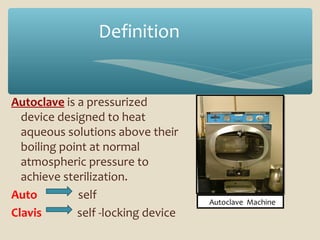
Autoclave is a pressurized
device designed to heat
aqueous solutions above their
boiling point at normal
atmospheric pressure to
achieve sterilization.
Auto
self
Clavis
self -locking device

Autoclave Machine
Brief History
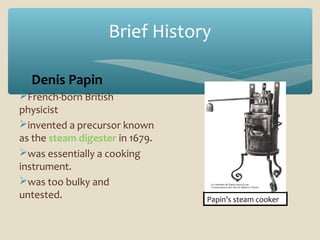
Denis Papin
French-born British
physicist
invented a precursor known
as the steam digester in 1679.
was essentially a cooking
instrument.
was too bulky and
untested.

Papin’s steam cooker
Role of Chamberland
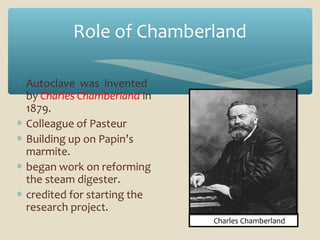
∗ Autoclave was invented
by Charles Chamberland in
1879.
∗ Colleague of Pasteur
∗ Building up on Papin’s
marmite.
∗ began work on reforming
the steam digester.
∗ credited for starting the
research project.
Charles Chamberland
Principle
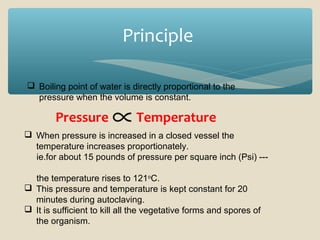
 Boiling point of water is directly proportional to the
pressure when the volume is constant.

Pressure

Temperature

 When pressure is increased in a closed vessel the
temperature increases proportionately.
ie.for about 15 pounds of pressure per square inch (Psi) --the temperature rises to 121oC.
 This pressure and temperature is kept constant for 20
minutes during autoclaving.
 It is sufficient to kill all the vegetative forms and spores of
the organism.
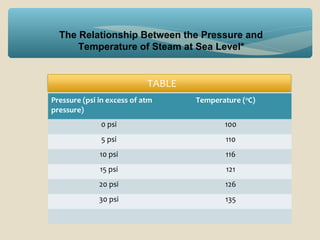
The Relationship Between the Pressure and
Temperature of Steam at Sea Level*

TABLE
Pressure (psi in excess of atm
pressure)

Temperature (oC)

0 psi

100

5 psi

110

10 psi

116

15 psi

121

20 psi

126

30 psi

135
Construction
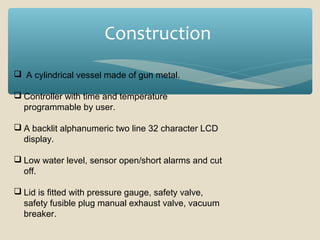
 A cylindrical vessel made of gun metal.
 Controller with time and temperature
programmable by user.
 A backlit alphanumeric two line 32 character LCD
display.
 Low water level, sensor open/short alarms and cut
off.
 Lid is fitted with pressure gauge, safety valve,
safety fusible plug manual exhaust valve, vacuum
breaker.
Construction
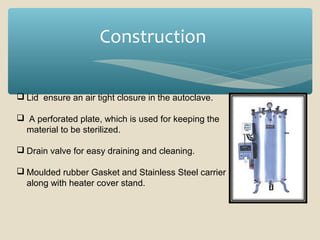
 Lid ensure an air tight closure in the autoclave.
 A perforated plate, which is used for keeping the
material to be sterilized.
 Drain valve for easy draining and cleaning.
 Moulded rubber Gasket and Stainless Steel carrier
along with heater cover stand.
Working
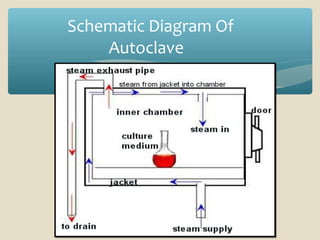
 Most autoclaves contain
- a sterilizing chamber to place articles
- a steam jacket where steam is maintained.
 steam flows from the steam jacket into the sterilizing chamber
 cool air is forced out
 a special valve increases the pressure to 15 pounds/square
inch above normal atmospheric pressure.
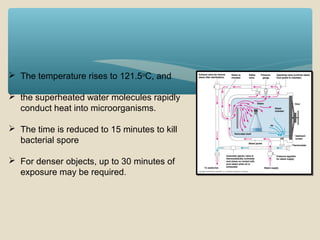
 The temperature rises to 121.5oC, and
 the superheated water molecules rapidly
conduct heat into microorganisms.
 The time is reduced to 15 minutes to kill
bacterial spore
 For denser objects, up to 30 minutes of
exposure may be required.
Schematic Diagram Of
Autoclave
Air Removal

Various methods involved are :
∗ Downward displacement
∗ Steam pulsing
∗ Vacuums pumps
∗ Superatmospheric cycles
∗ Subatmospheric cycles
TYPES OF STERILISATON
 Dry sterilisation
 Wet sterilisation
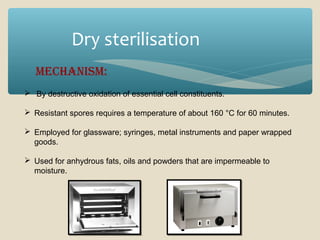
Dry sterilisation
MechanisM:
 By destructive oxidation of essential cell constituents.
 Resistant spores requires a temperature of about 160 °C for 60 minutes.
 Employed for glassware; syringes, metal instruments and paper wrapped
goods.
 Used for anhydrous fats, oils and powders that are impermeable to
moisture.
Wet sterilisation
MechanisM:
 By coagulating and denaturing enzymes and structural protein.
 Resistant spores generally requires 121 °C for 15-30 minutes.
 Used for the sterilization of culture media, and all other materials through
which steam can penetrate.
 Moist heat is more effective than dry heat.
 Lower temperatures in a given time at a shorter duration.
 Wet proteins release free -sh groups.
Different types of autoclaves
Heat autoclaves: The most common source for autoclaving is heating. Here
the autoclaves should maintain a temperature of at least 246 degrees for half an
hour. Both dry heat or steam heat are used. For steam heat autoclaves, heated
water vapors are used. Dry heat autoclaves are used for moisture sensitive surgical
products or instruments.

Gas autoclaves: Also known as chemicalves, gas autoclaves use a vapor
solution to sterilize its contents. Formaldehyde gas and Ethylene oxide are the
sterilizing agents used in gas autoclaves. They consume lesser heat and take lesser
time to complete the cycle.

Ultraviolet autoclaves: They produce UV light that kills the unwanted
disease causing organisms.
Cold sterilization autoclaves:

They use a cold sterilization liquid

to sterilize the contents.

Laboratory autoclaves: They are used for general lab work,
component and stability testing, core hardening, drying glassware, and
sterilizing.

Stovetop autoclaves: In such autoclaves, the tools should always
be separated to allow the steam to penetrate the load evenly. It is the
simplest autoclave.
 Autoclaves are available in many sizes.
 The smallest is a stovetop pressure cooker.
 Countertop models are used in dentist's offices and small medical
clinics.
 Large solid-state controlled autoclaves are common in
laboratories and hospitals.
 All autoclaves have temperature and pressure gauges, as well as
a timer.
 Quarterly calibration of the autoclave timer and gauges is
important to insure that proper sterilization is occurring.
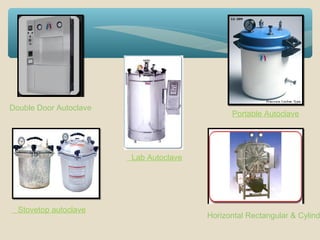
Double Door Autoclave

Portable Autoclave

Lab Autoclave

Stovetop autoclave

Horizontal Rectangular & Cylind
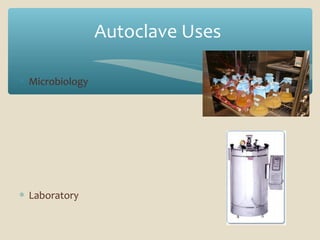
Autoclave Uses
∗ Microbiology

∗ Laboratory
Autoclave Uses
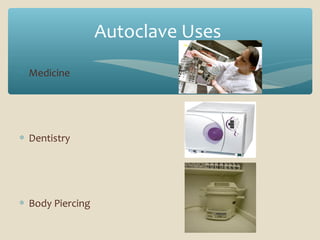
∗ Medicine

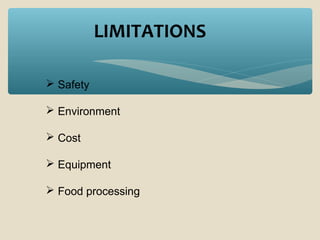
∗ Dentistry

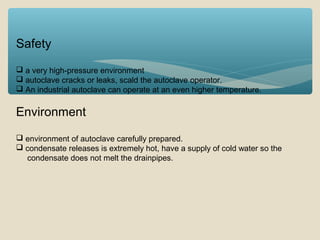
∗ Body Piercing
LIMITATIONS
 Safety
 Environment
 Cost
 Equipment
 Food processing
Safety
 a very high-pressure environment
 autoclave cracks or leaks, scald the autoclave operator.
 An industrial autoclave can operate at an even higher temperature.

Environment
 environment of autoclave carefully prepared.
 condensate releases is extremely hot, have a supply of cold water so the
condensate does not melt the drainpipes.
Cost
Building a large autoclave is expensive, because it needs insulation,
water supply and sturdy metal construction.
 cannot easily be disassembled into smaller parts.
Steam autoclaves do not supply enough heat for some industrial
processes, so need another fuel, such as gas or oil.

Equipment
 reliable sterilize
 melt plastic equipment with its steam.
 can't sterilize some cloth and linens without destroying them.

Food Processing

An autoclave produces steam that is too hot for some sterilization processes.
According to Raritan Valley Community College, farms don't use an autoclave to kil
bacteria in milk, because the heat changes the taste of the milk
Autoclave the hit sterilisation

Autoclave the hit sterilisation

  • 1.
  • 2.
    Definition Autoclave is apressurized device designed to heat aqueous solutions above their boiling point at normal atmospheric pressure to achieve sterilization. Auto self Clavis self -locking device Autoclave Machine
  • 3.
    Brief History Denis Papin French-bornBritish physicist invented a precursor known as the steam digester in 1679. was essentially a cooking instrument. was too bulky and untested. Papin’s steam cooker
  • 4.
    Role of Chamberland ∗Autoclave was invented by Charles Chamberland in 1879. ∗ Colleague of Pasteur ∗ Building up on Papin’s marmite. ∗ began work on reforming the steam digester. ∗ credited for starting the research project. Charles Chamberland
  • 5.
    Principle  Boiling pointof water is directly proportional to the pressure when the volume is constant. Pressure Temperature  When pressure is increased in a closed vessel the temperature increases proportionately. ie.for about 15 pounds of pressure per square inch (Psi) --the temperature rises to 121oC.  This pressure and temperature is kept constant for 20 minutes during autoclaving.  It is sufficient to kill all the vegetative forms and spores of the organism.
  • 6.
    The Relationship Betweenthe Pressure and Temperature of Steam at Sea Level* TABLE Pressure (psi in excess of atm pressure) Temperature (oC) 0 psi 100 5 psi 110 10 psi 116 15 psi 121 20 psi 126 30 psi 135
  • 7.
    Construction  A cylindricalvessel made of gun metal.  Controller with time and temperature programmable by user.  A backlit alphanumeric two line 32 character LCD display.  Low water level, sensor open/short alarms and cut off.  Lid is fitted with pressure gauge, safety valve, safety fusible plug manual exhaust valve, vacuum breaker.
  • 8.
    Construction  Lid ensurean air tight closure in the autoclave.  A perforated plate, which is used for keeping the material to be sterilized.  Drain valve for easy draining and cleaning.  Moulded rubber Gasket and Stainless Steel carrier along with heater cover stand.
  • 9.
    Working  Most autoclavescontain - a sterilizing chamber to place articles - a steam jacket where steam is maintained.  steam flows from the steam jacket into the sterilizing chamber  cool air is forced out  a special valve increases the pressure to 15 pounds/square inch above normal atmospheric pressure.
  • 10.
     The temperaturerises to 121.5oC, and  the superheated water molecules rapidly conduct heat into microorganisms.  The time is reduced to 15 minutes to kill bacterial spore  For denser objects, up to 30 minutes of exposure may be required.
  • 11.
  • 12.
    Air Removal Various methodsinvolved are : ∗ Downward displacement ∗ Steam pulsing ∗ Vacuums pumps ∗ Superatmospheric cycles ∗ Subatmospheric cycles
  • 13.
    TYPES OF STERILISATON Dry sterilisation  Wet sterilisation
  • 14.
    Dry sterilisation MechanisM:  Bydestructive oxidation of essential cell constituents.  Resistant spores requires a temperature of about 160 °C for 60 minutes.  Employed for glassware; syringes, metal instruments and paper wrapped goods.  Used for anhydrous fats, oils and powders that are impermeable to moisture.
  • 15.
    Wet sterilisation MechanisM:  Bycoagulating and denaturing enzymes and structural protein.  Resistant spores generally requires 121 °C for 15-30 minutes.  Used for the sterilization of culture media, and all other materials through which steam can penetrate.  Moist heat is more effective than dry heat.  Lower temperatures in a given time at a shorter duration.  Wet proteins release free -sh groups.
  • 16.
    Different types ofautoclaves Heat autoclaves: The most common source for autoclaving is heating. Here the autoclaves should maintain a temperature of at least 246 degrees for half an hour. Both dry heat or steam heat are used. For steam heat autoclaves, heated water vapors are used. Dry heat autoclaves are used for moisture sensitive surgical products or instruments. Gas autoclaves: Also known as chemicalves, gas autoclaves use a vapor solution to sterilize its contents. Formaldehyde gas and Ethylene oxide are the sterilizing agents used in gas autoclaves. They consume lesser heat and take lesser time to complete the cycle. Ultraviolet autoclaves: They produce UV light that kills the unwanted disease causing organisms.
  • 17.
    Cold sterilization autoclaves: Theyuse a cold sterilization liquid to sterilize the contents. Laboratory autoclaves: They are used for general lab work, component and stability testing, core hardening, drying glassware, and sterilizing. Stovetop autoclaves: In such autoclaves, the tools should always be separated to allow the steam to penetrate the load evenly. It is the simplest autoclave.
  • 18.
     Autoclaves areavailable in many sizes.  The smallest is a stovetop pressure cooker.  Countertop models are used in dentist's offices and small medical clinics.  Large solid-state controlled autoclaves are common in laboratories and hospitals.  All autoclaves have temperature and pressure gauges, as well as a timer.  Quarterly calibration of the autoclave timer and gauges is important to insure that proper sterilization is occurring.
  • 19.
    Double Door Autoclave PortableAutoclave Lab Autoclave Stovetop autoclave Horizontal Rectangular & Cylind
  • 20.
  • 21.
    Autoclave Uses ∗ Medicine ∗Dentistry ∗ Body Piercing
  • 22.
    LIMITATIONS  Safety  Environment Cost  Equipment  Food processing
  • 23.
    Safety  a veryhigh-pressure environment  autoclave cracks or leaks, scald the autoclave operator.  An industrial autoclave can operate at an even higher temperature. Environment  environment of autoclave carefully prepared.  condensate releases is extremely hot, have a supply of cold water so the condensate does not melt the drainpipes.
  • 24.
    Cost Building a largeautoclave is expensive, because it needs insulation, water supply and sturdy metal construction.  cannot easily be disassembled into smaller parts. Steam autoclaves do not supply enough heat for some industrial processes, so need another fuel, such as gas or oil. Equipment  reliable sterilize  melt plastic equipment with its steam.  can't sterilize some cloth and linens without destroying them. Food Processing An autoclave produces steam that is too hot for some sterilization processes. According to Raritan Valley Community College, farms don't use an autoclave to kil bacteria in milk, because the heat changes the taste of the milk