Leadership Workshop
     March 25, 2011
Why a Leadership Model?

•Develop a shared vision of what we aspire to as
 leaders

•Provide focus and direction on how to realize the
 vision

•Provide an objective framework for measuring
 progress

•Define what success looks like


                                                     2
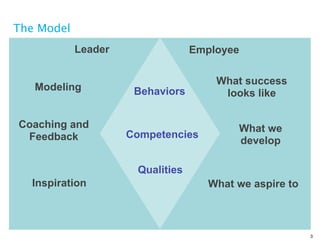
The Model
            Leader                Employee

                                      What success
   Modeling           Behaviors        looks like

Coaching and                              What we
 Feedback            Competencies
                                          develop

                      Qualities
  Inspiration                        What we aspire to


                                                         3
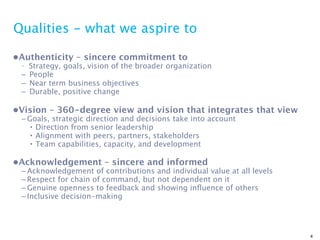
Qualities - what we aspire to

•Authenticity – sincere commitment to
 – Strategy, goals, vision of the broader organization
 – People
 – Near term business objectives
 – Durable, positive change

•Vision – 360-degree view and vision that integrates that view
 – Goals, strategic direction and decisions take into account
    • Direction from senior leadership
    • Alignment with peers, partners, stakeholders
    • Team capabilities, capacity, and development

•Acknowledgement – sincere and informed
 – Acknowledgement of contributions and individual value at all levels
 – Respect for chain of command, but not dependent on it
 – Genuine openness to feedback and showing influence of others
 – Inclusive decision-making


                                                                         4
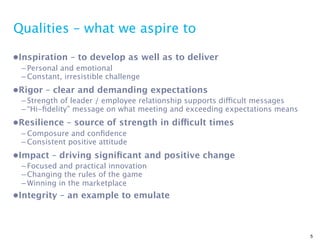
Qualities – what we aspire to

•Inspiration – to develop as well as to deliver
 – Personal and emotional
 – Constant, irresistible challenge
•Rigor – clear and demanding expectations
 – Strength of leader / employee relationship supports difficult messages
 – “Hi-fidelity” message on what meeting and exceeding expectations means
•Resilience – source of strength in difficult times
 – Composure and confidence
 – Consistent positive attitude
•Impact – driving significant and positive change
 – Focused and practical innovation
 – Changing the rules of the game
 – Winning in the marketplace
•Integrity – an example to emulate


                                                                            5
So how do we do this?
Leadership Competencies
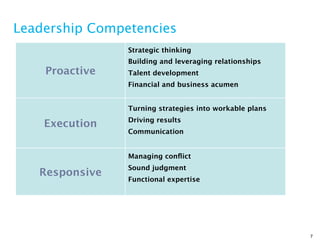
                Strategic thinking
                Building and leveraging relationships
    Proactive   Talent development
                Financial and business acumen


                Turning strategies into workable plans
                Driving results
    Execution
                Communication


                Managing conflict
                Sound judgment
   Responsive
                Functional expertise


                                                         7
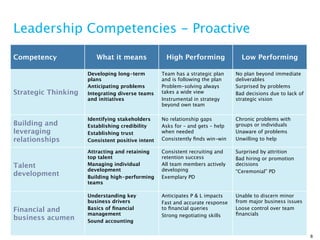
Leadership Competencies - Proactive

Competency              What it means              High Performing               Low Performing

                     Developing long-term         Team has a strategic plan    No plan beyond immediate
                     plans                        and is following the plan    deliverables
                     Anticipating problems        Problem-solving always       Surprised by problems
Strategic Thinking   Integrating diverse teams    takes a wide view            Bad decisions due to lack of
                     and initiatives              Instrumental in strategy     strategic vision
                                                  beyond own team

                     Identifying stakeholders     No relationship gaps         Chronic problems with
Building and         Establishing credibility     Asks for – and gets – help   groups or individuals
leveraging           Establishing trust           when needed                  Unaware of problems
relationships        Consistent positive intent   Consistently finds win-win    Unwilling to help

                     Attracting and retaining     Consistent recruiting and    Surprised by attrition
                     top talent                   retention success            Bad hiring or promotion
Talent               Managing individual          All team members actively    decisions
                     development                  developing                   “Ceremonial” PD
development          Building high-performing     Exemplary PD
                     teams

                     Understanding key            Anticipates P & L impacts    Unable to discern minor
                     business drivers             Fast and accurate response   from major business issues
Financial and        Basics of financial           to financial queries          Loose control over team
                     management                   Strong negotiating skills    financials
business acumen      Sound accounting


                                                                                                              8
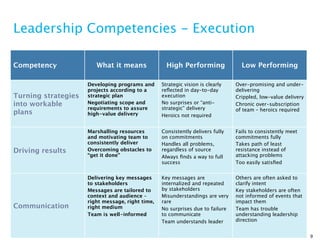
Leadership Competencies - Execution

Competency              What it means               High Performing               Low Performing

                     Developing programs and      Strategic vision is clearly   Over-promising and under-
                     projects according to a      reflected in day-to-day        delivering
Turning strategies   strategic plan               execution                     Crippled, low-value delivery
into workable        Negotiating scope and        No surprises or “anti-        Chronic over-subscription
                     requirements to assure       strategic” delivery           of team – heroics required
plans                high-value delivery          Heroics not required


                     Marshalling resources        Consistently delivers fully   Fails to consistently meet
                     and motivating team to       on commitments                commitments fully
                     consistently deliver         Handles all problems,         Takes path of least
Driving results      Overcoming obstacles to      regardless of source          resistance instead of
                     “get it done”                Always finds a way to full     attacking problems
                                                  success                       Too easily satisfied


                     Delivering key messages      Key messages are              Others are often asked to
                     to stakeholders              internalized and repeated     clarify intent
                     Messages are tailored to     by stakeholders               Key stakeholders are often
                     context and audience –       Misunderstandings are very    not informed of events that
                     right message, right time,   rare                          impact them
Communication        right medium                 No surprises due to failure   Team has trouble
                     Team is well-informed        to communicate                understanding leadership
                                                  Team understands leader       direction


                                                                                                               9
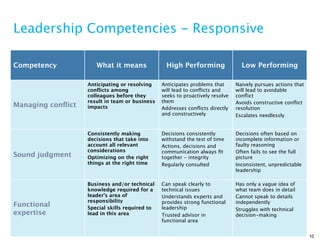
Leadership Competencies - Responsive

Competency            What it means               High Performing                Low Performing

                   Anticipating or resolving    Anticipates problems that      Naively pursues actions that
                   conflicts among               will lead to conflicts and      will lead to avoidable
                   colleagues before they       seeks to proactively resolve   conflict
                   result in team or business   them                           Avoids constructive conflict
Managing conflict   impacts                      Addresses conflicts directly    resolution
                                                and constructively             Escalates needlessly


                   Consistently making          Decisions consistently         Decisions often based on
                   decisions that take into     withstand the test of time     incomplete information or
                   account all relevant         Actions, decisions and         faulty reasoning
                   considerations               communication always fit        Often fails to see the full
Sound judgment     Optimizing on the right      together - integrity           picture
                   things at the right time     Regularly consulted            Inconsistent, unpredictable
                                                                               leadership

                   Business and/or technical    Can speak clearly to           Has only a vague idea of
                   knowledge required for a     technical issues               what team does in detail
                   leader’s area of             Understands experts and        Cannot speak to details
                   responsibility               provides strong functional     independently
Functional         Special skills required to   leadership                     Struggles with technical
expertise          lead in this area            Trusted advisor in             decision-making
                                                functional area


                                                                                                              10
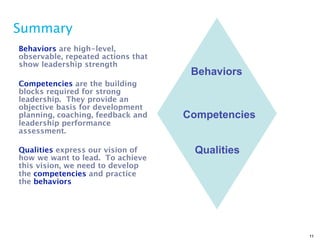
Summary
Behaviors are high-level,
observable, repeated actions that
show leadership strength
                                     Behaviors
Competencies are the building
blocks required for strong
leadership. They provide an
objective basis for development
planning, coaching, feedback and    Competencies
leadership performance
assessment.

Qualities express our vision of      Qualities
how we want to lead. To achieve
this vision, we need to develop
the competencies and practice
the behaviors


                                                   11
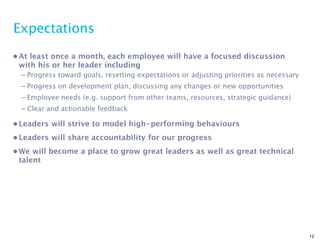
Expectations
• At least once a month, each employee will have a focused discussion
  with his or her leader including
  – Progress toward goals, resetting expectations or adjusting priorities as necessary
  – Progress on development plan, discussing any changes or new opportunities
  – Employee needs (e.g. support from other teams, resources, strategic guidance)
  – Clear and actionable feedback

• Leaders will strive to model high-performing behaviours
• Leaders will share accountability for our progress
• We will become a place to grow great leaders as well as great technical
  talent


                                                                                         12
Developing Leadership Competencies
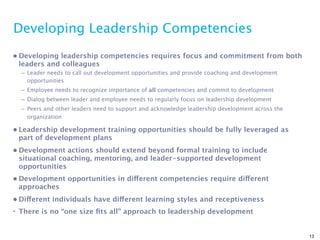
• Developing leadership competencies requires focus and commitment from both
  leaders and colleagues
  – Leader needs to call out development opportunities and provide coaching and development
    opportunities
  – Employee needs to recognize importance of all competencies and commit to development
  – Dialog between leader and employee needs to regularly focus on leadership development
  – Peers and other leaders need to support and acknowledge leadership development across the
    organization

• Leadership development training opportunities should be fully leveraged as
  part of development plans
• Development actions should extend beyond formal training to include
  situational coaching, mentoring, and leader-supported development
  opportunities
• Development opportunities in different competencies require different
  approaches
• Different individuals have different learning styles and receptiveness
• There is no “one size fits all” approach to leadership development


                                                                                                13
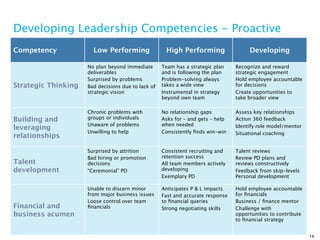
Developing Leadership Competencies - Proactive
Competency             Low Performing                High Performing                  Developing

                     No plan beyond immediate       Team has a strategic plan    Recognize and reward
                     deliverables                   and is following the plan    strategic engagement
                     Surprised by problems          Problem-solving always       Hold employee accountable
Strategic Thinking   Bad decisions due to lack of   takes a wide view            for decisions
                     strategic vision               Instrumental in strategy     Create opportunities to
                                                    beyond own team              take broader view

                     Chronic problems with          No relationship gaps         Assess key relationships
Building and         groups or individuals          Asks for – and gets – help   Action 360 feedback
                     Unaware of problems            when needed                  Identify role model/mentor
leveraging
                     Unwilling to help              Consistently finds win-win    Situational coaching
relationships

                     Surprised by attrition         Consistent recruiting and    Talent reviews
                     Bad hiring or promotion        retention success            Review PD plans and
Talent               decisions                      All team members actively    reviews constructively
development          “Ceremonial” PD                developing                   Feedback from skip-levels
                                                    Exemplary PD                 Personal development

                     Unable to discern minor        Anticipates P & L impacts    Hold employee accountable
                     from major business issues     Fast and accurate response   for financials
                     Loose control over team        to financial queries          Business / finance mentor
Financial and        financials                      Strong negotiating skills    Challenge with
business acumen                                                                  opportunities to contribute
                                                                                 to financial strategy


                                                                                                               14
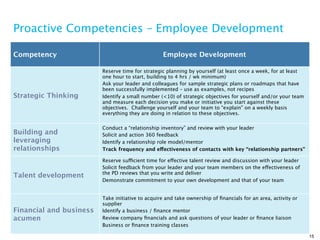
Proactive Competencies – Employee Development

Competency                                        Employee Development

                         Reserve time for strategic planning by yourself (at least once a week, for at least
                         one hour to start, building to 4 hrs / wk minimum)
                         Ask your leader and colleagues for sample strategic plans or roadmaps that have
                         been successfully implemented – use as examples, not recipes
Strategic Thinking       Identify a small number (<10) of strategic objectives for yourself and/or your team
                         and measure each decision you make or initiative you start against these
                         objectives. Challenge yourself and your team to “explain” on a weekly basis
                         everything they are doing in relation to these objectives.
                         Conduct a “relationship inventory” and review with your leader
Building and             Solicit and action 360 feedback
leveraging               Identify a relationship role model/mentor
relationships            Track frequency and effectiveness of contacts with key “relationship partners”

                         Reserve sufficient time for effective talent review and discussion with your leader
                         Solicit feedback from your leader and your team members on the effectiveness of
                         the PD reviews that you write and deliver
Talent development
                         Demonstrate commitment to your own development and that of your team


                         Take initiative to acquire and take ownership of financials for an area, activity or
                         supplier
Financial and business   Identify a business / finance mentor
acumen                   Review company financials and ask questions of your leader or finance liaison
                         Business or finance training classes

                                                                                                               15
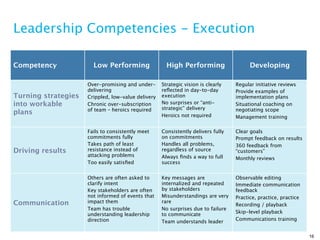
Leadership Competencies - Execution

Competency             Low Performing                 High Performing                   Developing

                     Over-promising and under-      Strategic vision is clearly   Regular initiative reviews
                     delivering                     reflected in day-to-day        Provide examples of
Turning strategies   Crippled, low-value delivery   execution                     implementation plans
into workable        Chronic over-subscription      No surprises or “anti-        Situational coaching on
                     of team – heroics required     strategic” delivery           negotiating scope
plans                                               Heroics not required          Management training

                     Fails to consistently meet     Consistently delivers fully   Clear goals
                     commitments fully              on commitments                Prompt feedback on results
                     Takes path of least            Handles all problems,         360 feedback from
Driving results      resistance instead of          regardless of source          “customers”
                     attacking problems             Always finds a way to full     Monthly reviews
                     Too easily satisfied            success


                     Others are often asked to      Key messages are              Observable editing
                     clarify intent                 internalized and repeated     Immediate communication
                     Key stakeholders are often     by stakeholders               feedback
                     not informed of events that    Misunderstandings are very    Practice, practice, practice
Communication        impact them                    rare
                                                                                  Recording / playback
                     Team has trouble               No surprises due to failure
                                                                                  Skip-level playback
                     understanding leadership       to communicate
                     direction                                                    Communications training
                                                    Team understands leader

                                                                                                                 16
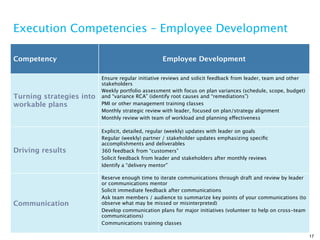
Execution Competencies – Employee Development

Competency                                        Employee Development

                          Ensure regular initiative reviews and solicit feedback from leader, team and other
                          stakeholders
                          Weekly portfolio assessment with focus on plan variances (schedule, scope, budget)
Turning strategies into   and “variance RCA” (identify root causes and “remediations”)
workable plans            PMI or other management training classes
                          Monthly strategic review with leader, focused on plan/strategy alignment
                          Monthly review with team of workload and planning effectiveness

                          Explicit, detailed, regular (weekly) updates with leader on goals
                          Regular (weekly) partner / stakeholder updates emphasizing specific
                          accomplishments and deliverables
Driving results           360 feedback from “customers”
                          Solicit feedback from leader and stakeholders after monthly reviews
                          Identify a “delivery mentor”

                          Reserve enough time to iterate communications through draft and review by leader
                          or communications mentor
                          Solicit immediate feedback after communications
                          Ask team members / audience to summarize key points of your communications (to
Communication             observe what may be missed or misinterpreted)
                          Develop communication plans for major initiatives (volunteer to help on cross-team
                          communications)
                          Communications training classes

                                                                                                               17
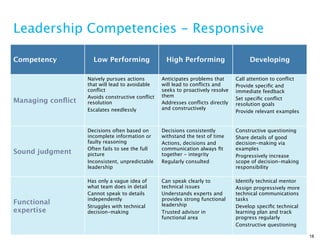
Leadership Competencies - Responsive

Competency           Low Performing                High Performing                   Developing

                   Naively pursues actions       Anticipates problems that      Call attention to conflict
                   that will lead to avoidable   will lead to conflicts and      Provide specific and
                   conflict                       seeks to proactively resolve   immediate feedback
                   Avoids constructive conflict   them
                                                                                Set specific conflict
Managing conflict   resolution                    Addresses conflicts directly    resolution goals
                   Escalates needlessly          and constructively
                                                                                Provide relevant examples


                   Decisions often based on      Decisions consistently         Constructive questioning
                   incomplete information or     withstand the test of time     Share details of good
                   faulty reasoning              Actions, decisions and         decision-making via
                   Often fails to see the full   communication always fit        examples
Sound judgment     picture                       together - integrity           Progressively increase
                   Inconsistent, unpredictable   Regularly consulted            scope of decision-making
                   leadership                                                   responsibility

                   Has only a vague idea of      Can speak clearly to           Identify technical mentor
                   what team does in detail      technical issues               Assign progressively more
                   Cannot speak to details       Understands experts and        technical communications
                   independently                 provides strong functional     tasks
Functional                                       leadership
                   Struggles with technical                                     Develop specific technical
expertise          decision-making               Trusted advisor in             learning plan and track
                                                 functional area                progress regularly
                                                                                Constructive questioning

                                                                                                            18
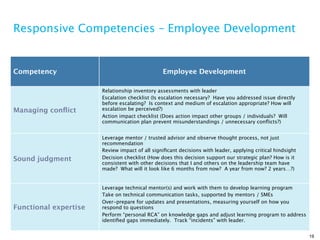
Responsive Competencies – Employee Development


Competency                                      Employee Development

                       Relationship inventory assessments with leader
                       Escalation checklist (Is escalation necessary? Have you addressed issue directly
                       before escalating? Is context and medium of escalation appropriate? How will
Managing conflict       escalation be perceived?)
                       Action impact checklist (Does action impact other groups / individuals? Will
                       communication plan prevent misunderstandings / unnecessary conflicts?)


                       Leverage mentor / trusted advisor and observe thought process, not just
                       recommendation
                       Review impact of all significant decisions with leader, applying critical hindsight
Sound judgment         Decision checklist (How does this decision support our strategic plan? How is it
                       consistent with other decisions that I and others on the leadership team have
                       made? What will it look like 6 months from now? A year from now? 2 years…?)


                       Leverage technical mentor(s) and work with them to develop learning program
                       Take on technical communication tasks, supported by mentors / SMEs
                       Over-prepare for updates and presentations, measuring yourself on how you
Functional expertise   respond to questions
                       Perform “personal RCA” on knowledge gaps and adjust learning program to address
                       identified gaps immediately. Track “incidents” with leader.


                                                                                                            19
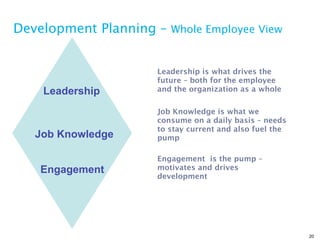
Development Planning – Whole Employee View


                      Leadership is what drives the
                      future – both for the employee
    Leadership        and the organization as a whole


                      Job Knowledge is what we
                      consume on a daily basis – needs
                      to stay current and also fuel the
   Job Knowledge      pump

                      Engagement is the pump –
    Engagement        motivates and drives
                      development


                                                          20
Development Plan Questions
• Does the plan make progress on leadership competencies?
  – Which competencies and how?
  – Does the plan address the leadership areas of opportunity identified in PD?


• Does the plan enhance technical knowledge and skills?
  – How exactly – i.e., what skills and knowledge and why are these valuable?
  – How will we assess progress?


• Does the plan promise to improve engagement?
  – What parts of the plan will be most interesting to the employee?
  – What parts of the plan open new doors?
  – What parts of the plan may improve engagement of other colleagues?


                                                                                 21
Monitoring Development – “KPIs”
• Examples of leadership competency improvement (or challenge)
  – Link and label these for the employee and tie back to development plan

• Informal assessment of tech knowledge / opportunities to demonstrate
  – Use probing, but supportive, questioning to assess progress
  – Provide opportunities to present ideas / make decisions / produce deliverables
• Formal certifications
• Accomplishments
  – Link and label, tying back to development plan and actions

• Is discretionary time being applied to development activities?
  – Look for signs of interest / self-motivation and if lacking, revisit the plan

• Is employee actively sharing / exercising new knowledge and skills?
  – Recognize and reward

• Is employee participating more actively in team activities and meetings


                                                                                     22
Evaluating Training Options
• Does the training contribute significantly to leadership, technical and engagement goals in
  development plans?
   – How does the training fit into individual development plans?
   – How does the training contribute to group / organizational development goals?


• What is the “useful life” of the training?
   – Is it immediately valuable? If not, when will employee(s) leverage it?
   – How long will it deliver value for the employee(s)?


• How much primary value is provided by the training itself?
   – Does the training provide a unique opportunity that is not available via self-study or other means?
   – Is the training time- and resource - efficient?


• How much secondary value does the training provide?
   – Can the benefits of the training be shared more broadly beyond those directly involved? If yes, is there a
     commitment to do so?
   – Does the training enable new business or technical opportunities for the organization as a whole?


                                                                                                                 23
Evaluating Stretch Assignments
• Does the assignment contribute significantly to leadership, technical and engagement goals for
  the individual(s)?
  – How does the assignment fit into individual development plans?
  – How does the assignment contribute to group / organizational development goals?


• How will development be supported via the assignment?
  – What are the specific development objectives associated with the assignment?
  – How will development be monitored and supported?
  – What are the key success or risk indicators?


• What is the opportunity cost associated with the assignment?
  – Is there a potential productivity cost? Are we prepared to compensate for any such cost?
  – What other areas of development may be negatively impacted by the assignment?


• How will the assignment be integrated into the individuals PD plan and assessment?
  – How will the “stretch” nature of the assignment be weighed in assessing performance?
  – What are the performance risks associated with the assignment and are these risks understood and accepted by
    all parties?


                                                                                                                   24
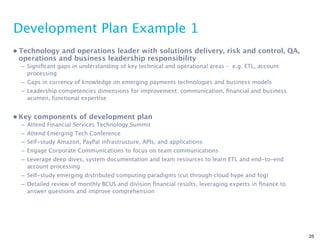
Development Plan Example 1
• Technology and operations leader with solutions delivery, risk and control, QA,
  operations and business leadership responsibility
  – Significant gaps in understanding of key technical and operational areas – e.g. ETL, account
    processing
  – Gaps in currency of knowledge on emerging payments technologies and business models
  – Leadership competencies dimensions for improvement: communication, financial and business
    acumen, functional expertise


• Key components of development plan
  – Attend Financial Services Technology Summit
  – Attend Emerging Tech Conference
  – Self-study Amazon, PayPal infrastructure, APIs, and applications
  – Engage Corporate Communications to focus on team communications
  – Leverage deep dives, system documentation and team resources to learn ETL and end-to-end
    account processing
  – Self-study emerging distributed computing paradigms (cut through cloud hype and fog)
  – Detailed review of monthly BCUS and division financial results, leveraging experts in finance to
    answer questions and improve comprehension


                                                                                                     25
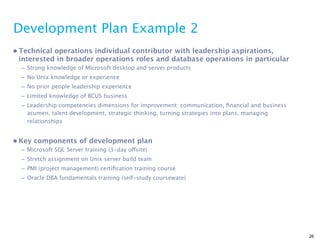
Development Plan Example 2
• Technical operations individual contributor with leadership aspirations,
  interested in broader operations roles and database operations in particular
  – Strong knowledge of Microsoft desktop and server products
  – No Unix knowledge or experience
  – No prior people leadership experience
  – Limited knowledge of BCUS business
  – Leadership competencies dimensions for improvement: communication, financial and business
    acumen, talent development, strategic thinking, turning strategies into plans, managing
    relationships


• Key components of development plan
  – Microsoft SQL Server training (3-day offsite)
  – Stretch assignment on Unix server build team
  – PMI (project management) certification training course
  – Oracle DBA fundamentals training (self-study courseware)


                                                                                               26
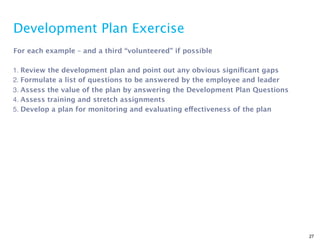
Development Plan Exercise
For each example – and a third “volunteered” if possible

1. Review the development plan and point out any obvious significant gaps
2. Formulate a list of questions to be answered by the employee and leader
3. Assess the value of the plan by answering the Development Plan Questions
4. Assess training and stretch assignments
5. Develop a plan for monitoring and evaluating effectiveness of the plan


                                                                              27
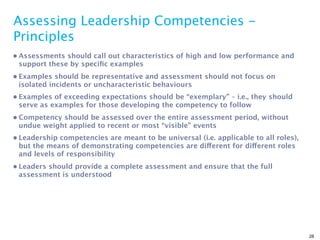
Assessing Leadership Competencies -
Principles
• Assessments should call out characteristics of high and low performance and
  support these by specific examples
• Examples should be representative and assessment should not focus on
  isolated incidents or uncharacteristic behaviours
• Examples of exceeding expectations should be “exemplary” – i.e., they should
  serve as examples for those developing the competency to follow
• Competency should be assessed over the entire assessment period, without
  undue weight applied to recent or most “visible” events
• Leadership competencies are meant to be universal (i.e. applicable to all roles),
  but the means of demonstrating competencies are different for different roles
  and levels of responsibility
• Leaders should provide a complete assessment and ensure that the full
  assessment is understood


                                                                                      28
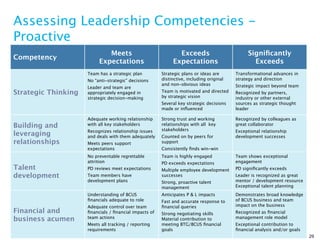
Assessing Leadership Competencies -
Proactive
                             Meets                            Exceeds                         Significantly
Competency
                          Expectations                      Expectations                        Exceeds
                     Team has a strategic plan         Strategic plans or ideas are      Transformational advances in
                     No “anti-strategic” decisions     distinctive, including original   strategy and direction
                                                       and non-obvious ideas             Strategic impact beyond team
                     Leader and team are
Strategic Thinking   appropriately engaged in          Team is motivated and directed    Recognized by partners,
                     strategic decision-making         by strategic vision               industry or other external
                                                       Several key strategic decisions   sources as strategic thought
                                                       made or influenced                 leader

                     Adequate working relationship     Strong trust and working          Recognized by colleagues as
Building and         with all key stakeholders         relationships with all key        great collaborator
                     Recognizes relationship issues    stakeholders                      Exceptional relationship
leveraging           and deals with them adequately    Counted on by peers for           development successes
relationships        Meets peers support               support
                     expectations                      Consistently finds win-win
                     No preventable regrettable        Team is highly engaged            Team shows exceptional
                     attrition                         PD exceeds expectations           engagement
Talent               PD reviews meet expectations      Multiple employee development     PD significantly exceeds
development          Team members have                 successes                         Leader is recognized as great
                     development plans                 Strong, proactive talent          mentor / development resource
                                                       management                        Exceptional talent planning
                     Understanding of BCUS             Anticipates P & L impacts         Demonstrates broad knowledge
                     financials adequate to role        Fast and accurate response to     of BCUS business and team
                     Adequate control over team        financial queries                  impact on the business
Financial and        financials / financial impacts of   Strong negotiating skills         Recognized as financial
business acumen      team actions                      Material contribution to          management role model
                     Meets all tracking / reporting    meeting BTG/BCUS financial         Exceptional contribution to
                     requirements                      goals                             financial analysis and/or goals
                                                                                                                          29
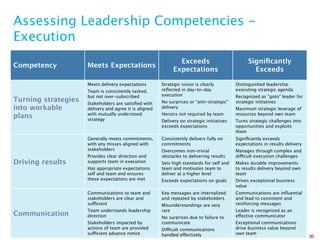
Assessing Leadership Competencies -
Execution
                                                               Exceeds                            Significantly
Competency           Meets Expectations
                                                             Expectations                           Exceeds

                     Meets delivery expectations        Strategic vision is clearly         Distinguished leadership
                     Team is consistently tasked,       reflected in day-to-day              executing strategic agenda
                     but not over-subscribed            execution                           Recognized as “goto” leader for
Turning strategies   Stakeholders are satisfied with     No surprises or “anti-strategic”    strategic initiatives
into workable        delivery and agree it is aligned   delivery                            Maximum strategic leverage of
                     with mutually understood           Heroics not required by team        resources beyond own team
plans                strategy                           Delivery on strategic initiatives   Turns strategic challenges into
                                                        exceeds expectations                opportunities and exploits
                                                                                            them
                     Generally meets commitments,       Consistently delivers fully on      Significantly exceeds
                     with any misses aligned with       commitments                         expectations in results delivery
                     stakeholders                       Overcomes non-trivial               Manages through complex and
                     Provides clear direction and       obstacles to delivering results     difficult execution challenges
Driving results      supports team in execution         Sets high standards for self and    Makes durable improvements
                     Has appropriate expectations       team and motivates team to          to results delivery beyond own
                     self and team and ensures          deliver at a higher level           team
                     these expectations are met         Exceeds expectations on goals       Drives exceptional business
                                                                                            value
                     Communications to team and         Key messages are internalized       Communications are influential
                     stakeholders are clear and         and repeated by stakeholders        and lead to consistent and
                     sufficient                         Misunderstandings are very          reinforcing messages
                     Team understands leadership        rare                                Leader is recognized as an
Communication        direction                          No surprises due to failure to      effective communicator
                     Stakeholders impacted by           communicate                         Exceptional communications
                     actions of team are provided       Difficult communications            drive business value beyond
                     sufficient advance notice          handled effectively                 own team
                                                                                                                               30
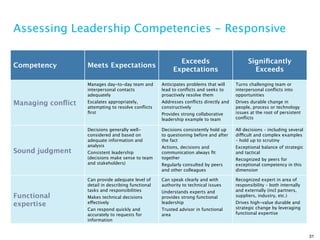
Assessing Leadership Competencies - Responsive

                                                            Exceeds                          Significantly
Competency         Meets Expectations
                                                          Expectations                         Exceeds

                   Manages day-to-day team and       Anticipates problems that will    Turns challenging team or
                   interpersonal contacts            lead to conflicts and seeks to     interpersonal conflicts into
                   adequately                        proactively resolve them          opportunities

Managing conflict   Escalates appropriately,          Addresses conflicts directly and   Drives durable change in
                   attempting to resolve conflicts    constructively                    people, process or technology
                   first                              Provides strong collaborative     issues at the root of persistent
                                                     leadership example to team        conflicts

                   Decisions generally well-         Decisions consistently hold up    All decisions – including several
                   considered and based on           to questioning before and after   difficult and complex examples
                   adequate information and          the fact                          – hold up to scrutiny
                   analysis                          Actions, decisions and            Exceptional balance of strategic
Sound judgment     Consistent leadership             communication always fit           and tactical
                   (decisions make sense to team     together                          Recognized by peers for
                   and stakeholders)                 Regularly consulted by peers      exceptional competency in this
                                                     and other colleagues              dimension

                   Can provide adequate level of     Can speak clearly and with        Recognized expert in area of
                   detail in describing functional   authority to technical issues     responsibility – both internally
                   tasks and responsibilities        Understands experts and           and externally (incl partners,
Functional         Makes technical decisions         provides strong functional        suppliers, industry, etc.)

expertise          effectively                       leadership                        Drives high-value durable and
                                                                                       strategic change by leveraging
                   Can respond quickly and           Trusted advisor in functional
                   accurately to requests for        area                              functional expertise
                   information


                                                                                                                           31
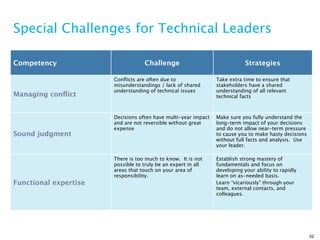
Special Challenges for Technical Leaders

Competency                         Challenge                                Strategies

                       Conflicts are often due to                Take extra time to ensure that
                       misunderstandings / lack of shared       stakeholders have a shared
                       understanding of technical issues        understanding of all relevant
Managing conflict                                                technical facts


                       Decisions often have multi-year impact   Make sure you fully understand the
                       and are not reversible without great     long-term impact of your decisions
                       expense                                  and do not allow near-term pressure
Sound judgment                                                  to cause you to make hasty decisions
                                                                without full facts and analysis. Use
                                                                your leader.

                       There is too much to know. It is not     Establish strong mastery of
                       possible to truly be an expert in all    fundamentals and focus on
                       areas that touch on your area of         developing your ability to rapidly
                       responsibility.                          learn on as-needed basis.
Functional expertise                                            Learn “vicariously” through your
                                                                team, external contacts, and
                                                                colleagues.


                                                                                                       32
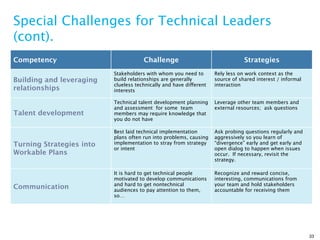
Special Challenges for Technical Leaders
(cont).
Competency                            Challenge                                 Strategies
                          Stakeholders with whom you need to        Rely less on work context as the
Building and leveraging   build relationships are generally         source of shared interest / informal
                          clueless technically and have different   interaction
relationships             interests

                          Technical talent development planning     Leverage other team members and
                          and assessment for some team              external resources; ask questions
Talent development        members may require knowledge that
                          you do not have

                          Best laid technical implementation        Ask probing questions regularly and
                          plans often run into problems, causing    aggressively so you learn of
Turning Strategies into   implementation to stray from strategy     “divergence” early and get early and
                          or intent                                 open dialog to happen when issues
Workable Plans                                                      occur. If necessary, revisit the
                                                                    strategy.

                          It is hard to get technical people        Recognize and reward concise,
                          motivated to develop communications       interesting, communications from
                          and hard to get nontechnical              your team and hold stakeholders
Communication             audiences to pay attention to them,       accountable for receiving them
                          so…


                                                                                                           33
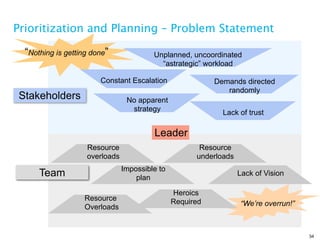
Prioritization and Planning – Problem Statement

  “Nothing is getting done”              Unplanned, uncoordinated
                                           “astrategic” workload

                        Constant Escalation                Demands directed
                                                              randomly
Stakeholders                     No apparent
                                  strategy                   Lack of trust

                                         Leader
                    Resource                           Resource
                    overloads                         underloads
                                Impossible to
      Team                          plan
                                                                   Lack of Vision

                                                Heroics
                   Resource                     Required
                   Overloads                                       “We’re overrun!”


                                                                                      34
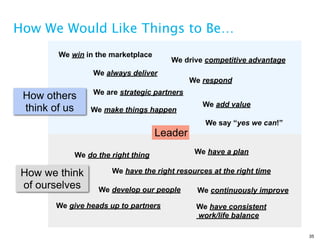
How We Would Like Things to Be…
        We win in the marketplace
                                       We drive competitive advantage
                 We always deliver
                                             We respond
                 We are strategic partners
 How others
                                                We add value
 think of us    We make things happen
                                                We say “yes we can!”
                                    Leader

            We do the right thing             We have a plan

 How we think         We have the right resources at the right time

 of ourselves     We develop our people       We continuously improve

       We give heads up to partners           We have consistent
                                              work/life balance

                                                                        35
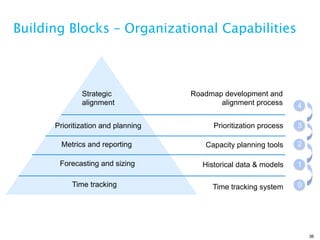
Building Blocks – Organizational Capabilities


              Strategic             Roadmap development and
              alignment                    alignment process       4

      Prioritization and planning         Prioritization process   3

        Metrics and reporting          Capacity planning tools     2

       Forecasting and sizing          Historical data & models    1

           Time tracking                  Time tracking system     0


                                                                       36
Understanding Team Capacity
• When setting up time tracking, resist the temptation to create large buckets for
  “BAU” – you need to understand the components of this
• Use historical data to designate “Run the Engine” (RTE) or “BAU” activities and
  carve out capacity for these. Aim should be to continuously improve efficiency
  so these activities can be executed at lower cost.
• Set “utilization targets” for subteams and/or individuals, expressing the
  proportion of time resources can be allocated to non-RTE work
• Where possible, link RTE demand to business drivers and forecast accordingly
• Capacity for non-RTE work – what you spend most of your prioritization time
  and energy to – is what remains when RTE demand has been forecasted
• Where possible, implement a variable resourcing model that allows “fixed” FTE
  resources to be augmented by “variable” resources that can go up and down as
  demand fluctuates
• To make “variabilization” work, forecasting must be accurate


                                                                                     37
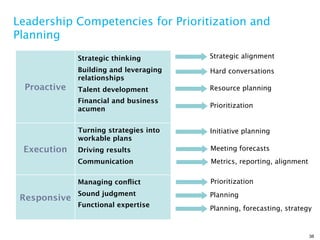
Leadership Competencies for Prioritization and
Planning
              Strategic thinking        Strategic alignment

              Building and leveraging   Hard conversations
              relationships
  Proactive   Talent development        Resource planning
              Financial and business
                                        Prioritization
              acumen


              Turning strategies into   Initiative planning
              workable plans
 Execution    Driving results           Meeting forecasts
              Communication             Metrics, reporting, alignment

              Managing conflict          Prioritization
              Sound judgment            Planning
 Responsive
              Functional expertise
                                        Planning, forecasting, strategy


                                                                        38

Leadership model

  • 1.
    Leadership Workshop March 25, 2011
  • 2.
    Why a LeadershipModel? •Develop a shared vision of what we aspire to as leaders •Provide focus and direction on how to realize the vision •Provide an objective framework for measuring progress •Define what success looks like 2
  • 3.
    The Model Leader Employee What success Modeling Behaviors looks like Coaching and What we Feedback Competencies develop Qualities Inspiration What we aspire to 3
  • 4.
    Qualities - whatwe aspire to •Authenticity – sincere commitment to – Strategy, goals, vision of the broader organization – People – Near term business objectives – Durable, positive change •Vision – 360-degree view and vision that integrates that view – Goals, strategic direction and decisions take into account • Direction from senior leadership • Alignment with peers, partners, stakeholders • Team capabilities, capacity, and development •Acknowledgement – sincere and informed – Acknowledgement of contributions and individual value at all levels – Respect for chain of command, but not dependent on it – Genuine openness to feedback and showing influence of others – Inclusive decision-making 4
  • 5.
    Qualities – whatwe aspire to •Inspiration – to develop as well as to deliver – Personal and emotional – Constant, irresistible challenge •Rigor – clear and demanding expectations – Strength of leader / employee relationship supports difficult messages – “Hi-fidelity” message on what meeting and exceeding expectations means •Resilience – source of strength in difficult times – Composure and confidence – Consistent positive attitude •Impact – driving significant and positive change – Focused and practical innovation – Changing the rules of the game – Winning in the marketplace •Integrity – an example to emulate 5
  • 6.
    So how dowe do this? Leadership Competencies
  • 7.
    Leadership Competencies Strategic thinking Building and leveraging relationships Proactive Talent development Financial and business acumen Turning strategies into workable plans Driving results Execution Communication Managing conflict Sound judgment Responsive Functional expertise 7
  • 8.
    Leadership Competencies -Proactive Competency What it means High Performing Low Performing Developing long-term Team has a strategic plan No plan beyond immediate plans and is following the plan deliverables Anticipating problems Problem-solving always Surprised by problems Strategic Thinking Integrating diverse teams takes a wide view Bad decisions due to lack of and initiatives Instrumental in strategy strategic vision beyond own team Identifying stakeholders No relationship gaps Chronic problems with Building and Establishing credibility Asks for – and gets – help groups or individuals leveraging Establishing trust when needed Unaware of problems relationships Consistent positive intent Consistently finds win-win Unwilling to help Attracting and retaining Consistent recruiting and Surprised by attrition top talent retention success Bad hiring or promotion Talent Managing individual All team members actively decisions development developing “Ceremonial” PD development Building high-performing Exemplary PD teams Understanding key Anticipates P & L impacts Unable to discern minor business drivers Fast and accurate response from major business issues Financial and Basics of financial to financial queries Loose control over team management Strong negotiating skills financials business acumen Sound accounting 8
  • 9.
    Leadership Competencies -Execution Competency What it means High Performing Low Performing Developing programs and Strategic vision is clearly Over-promising and under- projects according to a reflected in day-to-day delivering Turning strategies strategic plan execution Crippled, low-value delivery into workable Negotiating scope and No surprises or “anti- Chronic over-subscription requirements to assure strategic” delivery of team – heroics required plans high-value delivery Heroics not required Marshalling resources Consistently delivers fully Fails to consistently meet and motivating team to on commitments commitments fully consistently deliver Handles all problems, Takes path of least Driving results Overcoming obstacles to regardless of source resistance instead of “get it done” Always finds a way to full attacking problems success Too easily satisfied Delivering key messages Key messages are Others are often asked to to stakeholders internalized and repeated clarify intent Messages are tailored to by stakeholders Key stakeholders are often context and audience – Misunderstandings are very not informed of events that right message, right time, rare impact them Communication right medium No surprises due to failure Team has trouble Team is well-informed to communicate understanding leadership Team understands leader direction 9
  • 10.
    Leadership Competencies -Responsive Competency What it means High Performing Low Performing Anticipating or resolving Anticipates problems that Naively pursues actions that conflicts among will lead to conflicts and will lead to avoidable colleagues before they seeks to proactively resolve conflict result in team or business them Avoids constructive conflict Managing conflict impacts Addresses conflicts directly resolution and constructively Escalates needlessly Consistently making Decisions consistently Decisions often based on decisions that take into withstand the test of time incomplete information or account all relevant Actions, decisions and faulty reasoning considerations communication always fit Often fails to see the full Sound judgment Optimizing on the right together - integrity picture things at the right time Regularly consulted Inconsistent, unpredictable leadership Business and/or technical Can speak clearly to Has only a vague idea of knowledge required for a technical issues what team does in detail leader’s area of Understands experts and Cannot speak to details responsibility provides strong functional independently Functional Special skills required to leadership Struggles with technical expertise lead in this area Trusted advisor in decision-making functional area 10
  • 11.
    Summary Behaviors are high-level, observable,repeated actions that show leadership strength Behaviors Competencies are the building blocks required for strong leadership. They provide an objective basis for development planning, coaching, feedback and Competencies leadership performance assessment. Qualities express our vision of Qualities how we want to lead. To achieve this vision, we need to develop the competencies and practice the behaviors 11
  • 12.
    Expectations • At leastonce a month, each employee will have a focused discussion with his or her leader including – Progress toward goals, resetting expectations or adjusting priorities as necessary – Progress on development plan, discussing any changes or new opportunities – Employee needs (e.g. support from other teams, resources, strategic guidance) – Clear and actionable feedback • Leaders will strive to model high-performing behaviours • Leaders will share accountability for our progress • We will become a place to grow great leaders as well as great technical talent 12
  • 13.
    Developing Leadership Competencies •Developing leadership competencies requires focus and commitment from both leaders and colleagues – Leader needs to call out development opportunities and provide coaching and development opportunities – Employee needs to recognize importance of all competencies and commit to development – Dialog between leader and employee needs to regularly focus on leadership development – Peers and other leaders need to support and acknowledge leadership development across the organization • Leadership development training opportunities should be fully leveraged as part of development plans • Development actions should extend beyond formal training to include situational coaching, mentoring, and leader-supported development opportunities • Development opportunities in different competencies require different approaches • Different individuals have different learning styles and receptiveness • There is no “one size fits all” approach to leadership development 13
  • 14.
    Developing Leadership Competencies- Proactive Competency Low Performing High Performing Developing No plan beyond immediate Team has a strategic plan Recognize and reward deliverables and is following the plan strategic engagement Surprised by problems Problem-solving always Hold employee accountable Strategic Thinking Bad decisions due to lack of takes a wide view for decisions strategic vision Instrumental in strategy Create opportunities to beyond own team take broader view Chronic problems with No relationship gaps Assess key relationships Building and groups or individuals Asks for – and gets – help Action 360 feedback Unaware of problems when needed Identify role model/mentor leveraging Unwilling to help Consistently finds win-win Situational coaching relationships Surprised by attrition Consistent recruiting and Talent reviews Bad hiring or promotion retention success Review PD plans and Talent decisions All team members actively reviews constructively development “Ceremonial” PD developing Feedback from skip-levels Exemplary PD Personal development Unable to discern minor Anticipates P & L impacts Hold employee accountable from major business issues Fast and accurate response for financials Loose control over team to financial queries Business / finance mentor Financial and financials Strong negotiating skills Challenge with business acumen opportunities to contribute to financial strategy 14
  • 15.
    Proactive Competencies –Employee Development Competency Employee Development Reserve time for strategic planning by yourself (at least once a week, for at least one hour to start, building to 4 hrs / wk minimum) Ask your leader and colleagues for sample strategic plans or roadmaps that have been successfully implemented – use as examples, not recipes Strategic Thinking Identify a small number (<10) of strategic objectives for yourself and/or your team and measure each decision you make or initiative you start against these objectives. Challenge yourself and your team to “explain” on a weekly basis everything they are doing in relation to these objectives. Conduct a “relationship inventory” and review with your leader Building and Solicit and action 360 feedback leveraging Identify a relationship role model/mentor relationships Track frequency and effectiveness of contacts with key “relationship partners” Reserve sufficient time for effective talent review and discussion with your leader Solicit feedback from your leader and your team members on the effectiveness of the PD reviews that you write and deliver Talent development Demonstrate commitment to your own development and that of your team Take initiative to acquire and take ownership of financials for an area, activity or supplier Financial and business Identify a business / finance mentor acumen Review company financials and ask questions of your leader or finance liaison Business or finance training classes 15
  • 16.
    Leadership Competencies -Execution Competency Low Performing High Performing Developing Over-promising and under- Strategic vision is clearly Regular initiative reviews delivering reflected in day-to-day Provide examples of Turning strategies Crippled, low-value delivery execution implementation plans into workable Chronic over-subscription No surprises or “anti- Situational coaching on of team – heroics required strategic” delivery negotiating scope plans Heroics not required Management training Fails to consistently meet Consistently delivers fully Clear goals commitments fully on commitments Prompt feedback on results Takes path of least Handles all problems, 360 feedback from Driving results resistance instead of regardless of source “customers” attacking problems Always finds a way to full Monthly reviews Too easily satisfied success Others are often asked to Key messages are Observable editing clarify intent internalized and repeated Immediate communication Key stakeholders are often by stakeholders feedback not informed of events that Misunderstandings are very Practice, practice, practice Communication impact them rare Recording / playback Team has trouble No surprises due to failure Skip-level playback understanding leadership to communicate direction Communications training Team understands leader 16
  • 17.
    Execution Competencies –Employee Development Competency Employee Development Ensure regular initiative reviews and solicit feedback from leader, team and other stakeholders Weekly portfolio assessment with focus on plan variances (schedule, scope, budget) Turning strategies into and “variance RCA” (identify root causes and “remediations”) workable plans PMI or other management training classes Monthly strategic review with leader, focused on plan/strategy alignment Monthly review with team of workload and planning effectiveness Explicit, detailed, regular (weekly) updates with leader on goals Regular (weekly) partner / stakeholder updates emphasizing specific accomplishments and deliverables Driving results 360 feedback from “customers” Solicit feedback from leader and stakeholders after monthly reviews Identify a “delivery mentor” Reserve enough time to iterate communications through draft and review by leader or communications mentor Solicit immediate feedback after communications Ask team members / audience to summarize key points of your communications (to Communication observe what may be missed or misinterpreted) Develop communication plans for major initiatives (volunteer to help on cross-team communications) Communications training classes 17
  • 18.
    Leadership Competencies -Responsive Competency Low Performing High Performing Developing Naively pursues actions Anticipates problems that Call attention to conflict that will lead to avoidable will lead to conflicts and Provide specific and conflict seeks to proactively resolve immediate feedback Avoids constructive conflict them Set specific conflict Managing conflict resolution Addresses conflicts directly resolution goals Escalates needlessly and constructively Provide relevant examples Decisions often based on Decisions consistently Constructive questioning incomplete information or withstand the test of time Share details of good faulty reasoning Actions, decisions and decision-making via Often fails to see the full communication always fit examples Sound judgment picture together - integrity Progressively increase Inconsistent, unpredictable Regularly consulted scope of decision-making leadership responsibility Has only a vague idea of Can speak clearly to Identify technical mentor what team does in detail technical issues Assign progressively more Cannot speak to details Understands experts and technical communications independently provides strong functional tasks Functional leadership Struggles with technical Develop specific technical expertise decision-making Trusted advisor in learning plan and track functional area progress regularly Constructive questioning 18
  • 19.
    Responsive Competencies –Employee Development Competency Employee Development Relationship inventory assessments with leader Escalation checklist (Is escalation necessary? Have you addressed issue directly before escalating? Is context and medium of escalation appropriate? How will Managing conflict escalation be perceived?) Action impact checklist (Does action impact other groups / individuals? Will communication plan prevent misunderstandings / unnecessary conflicts?) Leverage mentor / trusted advisor and observe thought process, not just recommendation Review impact of all significant decisions with leader, applying critical hindsight Sound judgment Decision checklist (How does this decision support our strategic plan? How is it consistent with other decisions that I and others on the leadership team have made? What will it look like 6 months from now? A year from now? 2 years…?) Leverage technical mentor(s) and work with them to develop learning program Take on technical communication tasks, supported by mentors / SMEs Over-prepare for updates and presentations, measuring yourself on how you Functional expertise respond to questions Perform “personal RCA” on knowledge gaps and adjust learning program to address identified gaps immediately. Track “incidents” with leader. 19
  • 20.
    Development Planning –Whole Employee View Leadership is what drives the future – both for the employee Leadership and the organization as a whole Job Knowledge is what we consume on a daily basis – needs to stay current and also fuel the Job Knowledge pump Engagement is the pump – Engagement motivates and drives development 20
  • 21.
    Development Plan Questions •Does the plan make progress on leadership competencies? – Which competencies and how? – Does the plan address the leadership areas of opportunity identified in PD? • Does the plan enhance technical knowledge and skills? – How exactly – i.e., what skills and knowledge and why are these valuable? – How will we assess progress? • Does the plan promise to improve engagement? – What parts of the plan will be most interesting to the employee? – What parts of the plan open new doors? – What parts of the plan may improve engagement of other colleagues? 21
  • 22.
    Monitoring Development –“KPIs” • Examples of leadership competency improvement (or challenge) – Link and label these for the employee and tie back to development plan • Informal assessment of tech knowledge / opportunities to demonstrate – Use probing, but supportive, questioning to assess progress – Provide opportunities to present ideas / make decisions / produce deliverables • Formal certifications • Accomplishments – Link and label, tying back to development plan and actions • Is discretionary time being applied to development activities? – Look for signs of interest / self-motivation and if lacking, revisit the plan • Is employee actively sharing / exercising new knowledge and skills? – Recognize and reward • Is employee participating more actively in team activities and meetings 22
  • 23.
    Evaluating Training Options •Does the training contribute significantly to leadership, technical and engagement goals in development plans? – How does the training fit into individual development plans? – How does the training contribute to group / organizational development goals? • What is the “useful life” of the training? – Is it immediately valuable? If not, when will employee(s) leverage it? – How long will it deliver value for the employee(s)? • How much primary value is provided by the training itself? – Does the training provide a unique opportunity that is not available via self-study or other means? – Is the training time- and resource - efficient? • How much secondary value does the training provide? – Can the benefits of the training be shared more broadly beyond those directly involved? If yes, is there a commitment to do so? – Does the training enable new business or technical opportunities for the organization as a whole? 23
  • 24.
    Evaluating Stretch Assignments •Does the assignment contribute significantly to leadership, technical and engagement goals for the individual(s)? – How does the assignment fit into individual development plans? – How does the assignment contribute to group / organizational development goals? • How will development be supported via the assignment? – What are the specific development objectives associated with the assignment? – How will development be monitored and supported? – What are the key success or risk indicators? • What is the opportunity cost associated with the assignment? – Is there a potential productivity cost? Are we prepared to compensate for any such cost? – What other areas of development may be negatively impacted by the assignment? • How will the assignment be integrated into the individuals PD plan and assessment? – How will the “stretch” nature of the assignment be weighed in assessing performance? – What are the performance risks associated with the assignment and are these risks understood and accepted by all parties? 24
  • 25.
    Development Plan Example1 • Technology and operations leader with solutions delivery, risk and control, QA, operations and business leadership responsibility – Significant gaps in understanding of key technical and operational areas – e.g. ETL, account processing – Gaps in currency of knowledge on emerging payments technologies and business models – Leadership competencies dimensions for improvement: communication, financial and business acumen, functional expertise • Key components of development plan – Attend Financial Services Technology Summit – Attend Emerging Tech Conference – Self-study Amazon, PayPal infrastructure, APIs, and applications – Engage Corporate Communications to focus on team communications – Leverage deep dives, system documentation and team resources to learn ETL and end-to-end account processing – Self-study emerging distributed computing paradigms (cut through cloud hype and fog) – Detailed review of monthly BCUS and division financial results, leveraging experts in finance to answer questions and improve comprehension 25
  • 26.
    Development Plan Example2 • Technical operations individual contributor with leadership aspirations, interested in broader operations roles and database operations in particular – Strong knowledge of Microsoft desktop and server products – No Unix knowledge or experience – No prior people leadership experience – Limited knowledge of BCUS business – Leadership competencies dimensions for improvement: communication, financial and business acumen, talent development, strategic thinking, turning strategies into plans, managing relationships • Key components of development plan – Microsoft SQL Server training (3-day offsite) – Stretch assignment on Unix server build team – PMI (project management) certification training course – Oracle DBA fundamentals training (self-study courseware) 26
  • 27.
    Development Plan Exercise Foreach example – and a third “volunteered” if possible 1. Review the development plan and point out any obvious significant gaps 2. Formulate a list of questions to be answered by the employee and leader 3. Assess the value of the plan by answering the Development Plan Questions 4. Assess training and stretch assignments 5. Develop a plan for monitoring and evaluating effectiveness of the plan 27
  • 28.
    Assessing Leadership Competencies- Principles • Assessments should call out characteristics of high and low performance and support these by specific examples • Examples should be representative and assessment should not focus on isolated incidents or uncharacteristic behaviours • Examples of exceeding expectations should be “exemplary” – i.e., they should serve as examples for those developing the competency to follow • Competency should be assessed over the entire assessment period, without undue weight applied to recent or most “visible” events • Leadership competencies are meant to be universal (i.e. applicable to all roles), but the means of demonstrating competencies are different for different roles and levels of responsibility • Leaders should provide a complete assessment and ensure that the full assessment is understood 28
  • 29.
    Assessing Leadership Competencies- Proactive Meets Exceeds Significantly Competency Expectations Expectations Exceeds Team has a strategic plan Strategic plans or ideas are Transformational advances in No “anti-strategic” decisions distinctive, including original strategy and direction and non-obvious ideas Strategic impact beyond team Leader and team are Strategic Thinking appropriately engaged in Team is motivated and directed Recognized by partners, strategic decision-making by strategic vision industry or other external Several key strategic decisions sources as strategic thought made or influenced leader Adequate working relationship Strong trust and working Recognized by colleagues as Building and with all key stakeholders relationships with all key great collaborator Recognizes relationship issues stakeholders Exceptional relationship leveraging and deals with them adequately Counted on by peers for development successes relationships Meets peers support support expectations Consistently finds win-win No preventable regrettable Team is highly engaged Team shows exceptional attrition PD exceeds expectations engagement Talent PD reviews meet expectations Multiple employee development PD significantly exceeds development Team members have successes Leader is recognized as great development plans Strong, proactive talent mentor / development resource management Exceptional talent planning Understanding of BCUS Anticipates P & L impacts Demonstrates broad knowledge financials adequate to role Fast and accurate response to of BCUS business and team Adequate control over team financial queries impact on the business Financial and financials / financial impacts of Strong negotiating skills Recognized as financial business acumen team actions Material contribution to management role model Meets all tracking / reporting meeting BTG/BCUS financial Exceptional contribution to requirements goals financial analysis and/or goals 29
  • 30.
    Assessing Leadership Competencies- Execution Exceeds Significantly Competency Meets Expectations Expectations Exceeds Meets delivery expectations Strategic vision is clearly Distinguished leadership Team is consistently tasked, reflected in day-to-day executing strategic agenda but not over-subscribed execution Recognized as “goto” leader for Turning strategies Stakeholders are satisfied with No surprises or “anti-strategic” strategic initiatives into workable delivery and agree it is aligned delivery Maximum strategic leverage of with mutually understood Heroics not required by team resources beyond own team plans strategy Delivery on strategic initiatives Turns strategic challenges into exceeds expectations opportunities and exploits them Generally meets commitments, Consistently delivers fully on Significantly exceeds with any misses aligned with commitments expectations in results delivery stakeholders Overcomes non-trivial Manages through complex and Provides clear direction and obstacles to delivering results difficult execution challenges Driving results supports team in execution Sets high standards for self and Makes durable improvements Has appropriate expectations team and motivates team to to results delivery beyond own self and team and ensures deliver at a higher level team these expectations are met Exceeds expectations on goals Drives exceptional business value Communications to team and Key messages are internalized Communications are influential stakeholders are clear and and repeated by stakeholders and lead to consistent and sufficient Misunderstandings are very reinforcing messages Team understands leadership rare Leader is recognized as an Communication direction No surprises due to failure to effective communicator Stakeholders impacted by communicate Exceptional communications actions of team are provided Difficult communications drive business value beyond sufficient advance notice handled effectively own team 30
  • 31.
    Assessing Leadership Competencies- Responsive Exceeds Significantly Competency Meets Expectations Expectations Exceeds Manages day-to-day team and Anticipates problems that will Turns challenging team or interpersonal contacts lead to conflicts and seeks to interpersonal conflicts into adequately proactively resolve them opportunities Managing conflict Escalates appropriately, Addresses conflicts directly and Drives durable change in attempting to resolve conflicts constructively people, process or technology first Provides strong collaborative issues at the root of persistent leadership example to team conflicts Decisions generally well- Decisions consistently hold up All decisions – including several considered and based on to questioning before and after difficult and complex examples adequate information and the fact – hold up to scrutiny analysis Actions, decisions and Exceptional balance of strategic Sound judgment Consistent leadership communication always fit and tactical (decisions make sense to team together Recognized by peers for and stakeholders) Regularly consulted by peers exceptional competency in this and other colleagues dimension Can provide adequate level of Can speak clearly and with Recognized expert in area of detail in describing functional authority to technical issues responsibility – both internally tasks and responsibilities Understands experts and and externally (incl partners, Functional Makes technical decisions provides strong functional suppliers, industry, etc.) expertise effectively leadership Drives high-value durable and strategic change by leveraging Can respond quickly and Trusted advisor in functional accurately to requests for area functional expertise information 31
  • 32.
    Special Challenges forTechnical Leaders Competency Challenge Strategies Conflicts are often due to Take extra time to ensure that misunderstandings / lack of shared stakeholders have a shared understanding of technical issues understanding of all relevant Managing conflict technical facts Decisions often have multi-year impact Make sure you fully understand the and are not reversible without great long-term impact of your decisions expense and do not allow near-term pressure Sound judgment to cause you to make hasty decisions without full facts and analysis. Use your leader. There is too much to know. It is not Establish strong mastery of possible to truly be an expert in all fundamentals and focus on areas that touch on your area of developing your ability to rapidly responsibility. learn on as-needed basis. Functional expertise Learn “vicariously” through your team, external contacts, and colleagues. 32
  • 33.
    Special Challenges forTechnical Leaders (cont). Competency Challenge Strategies Stakeholders with whom you need to Rely less on work context as the Building and leveraging build relationships are generally source of shared interest / informal clueless technically and have different interaction relationships interests Technical talent development planning Leverage other team members and and assessment for some team external resources; ask questions Talent development members may require knowledge that you do not have Best laid technical implementation Ask probing questions regularly and plans often run into problems, causing aggressively so you learn of Turning Strategies into implementation to stray from strategy “divergence” early and get early and or intent open dialog to happen when issues Workable Plans occur. If necessary, revisit the strategy. It is hard to get technical people Recognize and reward concise, motivated to develop communications interesting, communications from and hard to get nontechnical your team and hold stakeholders Communication audiences to pay attention to them, accountable for receiving them so… 33
  • 34.
    Prioritization and Planning– Problem Statement “Nothing is getting done” Unplanned, uncoordinated “astrategic” workload Constant Escalation Demands directed randomly Stakeholders No apparent strategy Lack of trust Leader Resource Resource overloads underloads Impossible to Team plan Lack of Vision Heroics Resource Required Overloads “We’re overrun!” 34
  • 35.
    How We WouldLike Things to Be… We win in the marketplace We drive competitive advantage We always deliver We respond We are strategic partners How others We add value think of us We make things happen We say “yes we can!” Leader We do the right thing We have a plan How we think We have the right resources at the right time of ourselves We develop our people We continuously improve We give heads up to partners We have consistent work/life balance 35
  • 36.
    Building Blocks –Organizational Capabilities Strategic Roadmap development and alignment alignment process 4 Prioritization and planning Prioritization process 3 Metrics and reporting Capacity planning tools 2 Forecasting and sizing Historical data & models 1 Time tracking Time tracking system 0 36
  • 37.
    Understanding Team Capacity •When setting up time tracking, resist the temptation to create large buckets for “BAU” – you need to understand the components of this • Use historical data to designate “Run the Engine” (RTE) or “BAU” activities and carve out capacity for these. Aim should be to continuously improve efficiency so these activities can be executed at lower cost. • Set “utilization targets” for subteams and/or individuals, expressing the proportion of time resources can be allocated to non-RTE work • Where possible, link RTE demand to business drivers and forecast accordingly • Capacity for non-RTE work – what you spend most of your prioritization time and energy to – is what remains when RTE demand has been forecasted • Where possible, implement a variable resourcing model that allows “fixed” FTE resources to be augmented by “variable” resources that can go up and down as demand fluctuates • To make “variabilization” work, forecasting must be accurate 37
  • 38.
    Leadership Competencies forPrioritization and Planning Strategic thinking Strategic alignment Building and leveraging Hard conversations relationships Proactive Talent development Resource planning Financial and business Prioritization acumen Turning strategies into Initiative planning workable plans Execution Driving results Meeting forecasts Communication Metrics, reporting, alignment Managing conflict Prioritization Sound judgment Planning Responsive Functional expertise Planning, forecasting, strategy 38