Authority
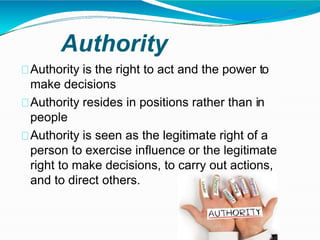
Authority is the right to act and the power to
make decisions
Authority resides in positions rather than in
people
Authority is seen as the legitimate right of a
person to exercise influence or the legitimate
right to make decisions, to carry out actions,
and to direct others.
Characteristics of
authority:
It is legitimate right to command and control
subordinates.
Authority is granted to achieve the
predetermined goal of the enterprise.
Authority is right to direct others to get things
done.
Authority is delegated downwards.
Authority is delegated
downwards:
Middle level
Low level
Workers
T
op level Authority
Theories of Authority
There are three theories which explain the
emergence of authority
Formal theory ofAuthority
Acceptance theory ofAuthority
Competence theory of Authority
Formal Authority Theory
This theory states that authority flows from the
top to bottom through the structure of
organisation. It means that authority flow from
the top manager to his subordinate and, in turn,
from his subordinate to another working under
him and so on..
Board of Directors
General Manager
Sales manager
Sales Representative
Worker
Acceptance theory of Authority
This theory states that a manager’s authority restson
worker’s acceptance of his right to give orders and to
expect compliance. Workers have to believe that a
manager can legitimately give orders and there is a
legitimate expectation that the orders will be carried
out.
Management theorist Barnard believed organizations
need to be both effective and efficient. Effectivemeans
meeting organizational goals in a timely way and
efficient means the degree to which the organization
can satisfy the motives of itsemployees.
Competence theory of
Authority
According to this theory, the source of authority is the
competence of the managerial personnel. A manager’s
authority is accepted not because of any position he
holds in the organisation but because of his technical
competence, intelligence, and other personal qualities.
In organisations there are certain persons withoutany
formal authority, but they command respect and
authority because of their technical competence and
intelligence.
Limits of Authority
Extent of authority
Limits of
authority
In an organisation, the quantum of authority decreases
at successively lower levels i.e It is maximum at highest
level and minimum at lowest level
Highest level
Lowest level
Various limitations are as follows:
LegalLimitations:A managers authority is restricted
by enterprise goals and objectives which are governed by
the articles and memorandum of association.
Limits of Authority
Biological Limitations: A subordinate cannot be
asked to do a job which is impossible to beperformed
due to biological constraints.
Physical Limitations: Physical limitations such as
climate, geography, etc. Put limits on authority
Economic Limitations: Sometimes economic factor
such as competitions, prices of product also affect
authority.
Responsibility
Definition:
“Responsibility is defined as the obligation of a
subordinate to whom a duty has been assigned to
perform.”
-Koontz Donnel
OR
“ The obligation of an Individual to carry out assigned
activities of the best of his or her ability.”
-Terry and Franklin
Characteristics of responsibility
Responsibility is to assign duty to human beings only.
Responsibility always flows upwards from juniors to
seniors
Responsibility is result of dutyassigned
Responsibility is the obligation to complete the job as
per instructions
Responsibility can never be delegated. It is the
personal obligation ,and absolutealso.
Difference between
Authority and Responsibility
Basic of
distinction
Authority Responsibility
Meaning
The power or right of a
superior to give orderto
others
It is an obligation to
perform the assigned duty
or order
Sourcesof
origin
It emerges from a formal
position in the organisation
It emerges from superior
subordinate relationship
Direction of
flow
It flows downwards i.e. From
top to bottom
It flows upwards i.e. From
bottom level to top.
Purpose Its purpose is to make
decisions and get the decisions
executed
Its purpose is to execute
the duties assigned bythe
superior.
Top level
Middle level
Low level
Workers
Authority
Responsibility
Accountability
Every employee/manager is accountable for the job
assigned to him. He is supposed to complete the jobas
per the expectations and inform his superior
accordingly.
Accountability is the liability created for the useof
authority.
It is the answerability for performance of the assigned
duties.
Definition: According to McFarland “accountability” is
the obligation of an individual to report formally tohis
superior about the work he has done to discharge the
responsibility.
Difference between
Responsibility and Accountability
Basis of distinction Responsibility Accountability
It is an obligation byan It is the obligation
Meaning employee to perform
certain duties or tomake
sure that they are
completed
created by accepting
duties and
responsibilities from
higher management.
NATURE It flows downwards It flows upwards
DELEGATION
It can be delegated but not
entirely
It cannot be delegated.
Delegation of Authority
Delegation is the transfer of authority to
subordinates to enable them to make decisions
and use resources.
Entrusting responsibility and authority to others
who then become responsible to us for their
results but we remain accountable to our boss
what our subordinates do.
Characteristics of Delegation
of Authority
It enables a manager to function independently within
the broad limits of authority specified by the superior.
The superior does not delegate total authority, but
retains a part of that for himself orherself.
A manager cannot delegate what he or she does not
posses.
Delegation does not mean giving awayauthority.
The superior, who delegates the authority cannot
escape responsibilities for the activities of
subordinates whom authority has beendelegated.
Why Delegate ?
It takes a strong person and agood leader to effectively
delegate tasks.
Efficiency
Development
Saves Time
What to Delegate
Things subordinate can dobetter.
Things subordinate needs to do forgrowth.
Operational work
Things for which you don’t havetime
What not to Delegate
What you yourself is not able todo
Work your subordinates cannot performeffectively
Management decisions
Personal Accountability
Delegation
Proces
s
Types of Delegation
Upward Delegation
Downward Delegation
Sidewise Delegation
Disadvantages of delegation
Misuse of power
Failure to fulfill the task
Delay
Impact on quality ofwork
Non-delegableduties
Burden on employees
And,
finally.......
“The secret of success is not in doing yourown
work but in recognizing the right [person]
to do it.”
~Andrew Carnegie

Authority Responsibility.pptx

  • 2.
    Authority Authority is theright to act and the power to make decisions Authority resides in positions rather than in people Authority is seen as the legitimate right of a person to exercise influence or the legitimate right to make decisions, to carry out actions, and to direct others.
  • 3.
    Characteristics of authority: It islegitimate right to command and control subordinates. Authority is granted to achieve the predetermined goal of the enterprise. Authority is right to direct others to get things done. Authority is delegated downwards.
  • 4.
    Authority is delegated downwards: Middlelevel Low level Workers T op level Authority
  • 5.
    Theories of Authority Thereare three theories which explain the emergence of authority Formal theory ofAuthority Acceptance theory ofAuthority Competence theory of Authority
  • 6.
    Formal Authority Theory Thistheory states that authority flows from the top to bottom through the structure of organisation. It means that authority flow from the top manager to his subordinate and, in turn, from his subordinate to another working under him and so on.. Board of Directors General Manager Sales manager Sales Representative Worker
  • 7.
    Acceptance theory ofAuthority This theory states that a manager’s authority restson worker’s acceptance of his right to give orders and to expect compliance. Workers have to believe that a manager can legitimately give orders and there is a legitimate expectation that the orders will be carried out. Management theorist Barnard believed organizations need to be both effective and efficient. Effectivemeans meeting organizational goals in a timely way and efficient means the degree to which the organization can satisfy the motives of itsemployees.
  • 8.
    Competence theory of Authority Accordingto this theory, the source of authority is the competence of the managerial personnel. A manager’s authority is accepted not because of any position he holds in the organisation but because of his technical competence, intelligence, and other personal qualities. In organisations there are certain persons withoutany formal authority, but they command respect and authority because of their technical competence and intelligence.
  • 9.
    Limits of Authority Extentof authority Limits of authority In an organisation, the quantum of authority decreases at successively lower levels i.e It is maximum at highest level and minimum at lowest level Highest level Lowest level Various limitations are as follows: LegalLimitations:A managers authority is restricted by enterprise goals and objectives which are governed by the articles and memorandum of association.
  • 10.
    Limits of Authority BiologicalLimitations: A subordinate cannot be asked to do a job which is impossible to beperformed due to biological constraints. Physical Limitations: Physical limitations such as climate, geography, etc. Put limits on authority Economic Limitations: Sometimes economic factor such as competitions, prices of product also affect authority.
  • 11.
    Responsibility Definition: “Responsibility is definedas the obligation of a subordinate to whom a duty has been assigned to perform.” -Koontz Donnel OR “ The obligation of an Individual to carry out assigned activities of the best of his or her ability.” -Terry and Franklin
  • 12.
    Characteristics of responsibility Responsibilityis to assign duty to human beings only. Responsibility always flows upwards from juniors to seniors Responsibility is result of dutyassigned Responsibility is the obligation to complete the job as per instructions Responsibility can never be delegated. It is the personal obligation ,and absolutealso.
  • 13.
    Difference between Authority andResponsibility Basic of distinction Authority Responsibility Meaning The power or right of a superior to give orderto others It is an obligation to perform the assigned duty or order Sourcesof origin It emerges from a formal position in the organisation It emerges from superior subordinate relationship Direction of flow It flows downwards i.e. From top to bottom It flows upwards i.e. From bottom level to top. Purpose Its purpose is to make decisions and get the decisions executed Its purpose is to execute the duties assigned bythe superior.
  • 14.
    Top level Middle level Lowlevel Workers Authority Responsibility
  • 15.
    Accountability Every employee/manager isaccountable for the job assigned to him. He is supposed to complete the jobas per the expectations and inform his superior accordingly. Accountability is the liability created for the useof authority. It is the answerability for performance of the assigned duties. Definition: According to McFarland “accountability” is the obligation of an individual to report formally tohis superior about the work he has done to discharge the responsibility.
  • 16.
    Difference between Responsibility andAccountability Basis of distinction Responsibility Accountability It is an obligation byan It is the obligation Meaning employee to perform certain duties or tomake sure that they are completed created by accepting duties and responsibilities from higher management. NATURE It flows downwards It flows upwards DELEGATION It can be delegated but not entirely It cannot be delegated.
  • 18.
    Delegation of Authority Delegationis the transfer of authority to subordinates to enable them to make decisions and use resources. Entrusting responsibility and authority to others who then become responsible to us for their results but we remain accountable to our boss what our subordinates do.
  • 19.
    Characteristics of Delegation ofAuthority It enables a manager to function independently within the broad limits of authority specified by the superior. The superior does not delegate total authority, but retains a part of that for himself orherself. A manager cannot delegate what he or she does not posses. Delegation does not mean giving awayauthority. The superior, who delegates the authority cannot escape responsibilities for the activities of subordinates whom authority has beendelegated.
  • 20.
    Why Delegate ? Ittakes a strong person and agood leader to effectively delegate tasks. Efficiency Development Saves Time
  • 23.
    What to Delegate Thingssubordinate can dobetter. Things subordinate needs to do forgrowth. Operational work Things for which you don’t havetime
  • 24.
    What not toDelegate What you yourself is not able todo Work your subordinates cannot performeffectively Management decisions Personal Accountability
  • 25.
  • 26.
    Types of Delegation UpwardDelegation Downward Delegation Sidewise Delegation
  • 28.
    Disadvantages of delegation Misuseof power Failure to fulfill the task Delay Impact on quality ofwork Non-delegableduties Burden on employees
  • 29.
    And, finally....... “The secret ofsuccess is not in doing yourown work but in recognizing the right [person] to do it.” ~Andrew Carnegie