Organizational
Behavior
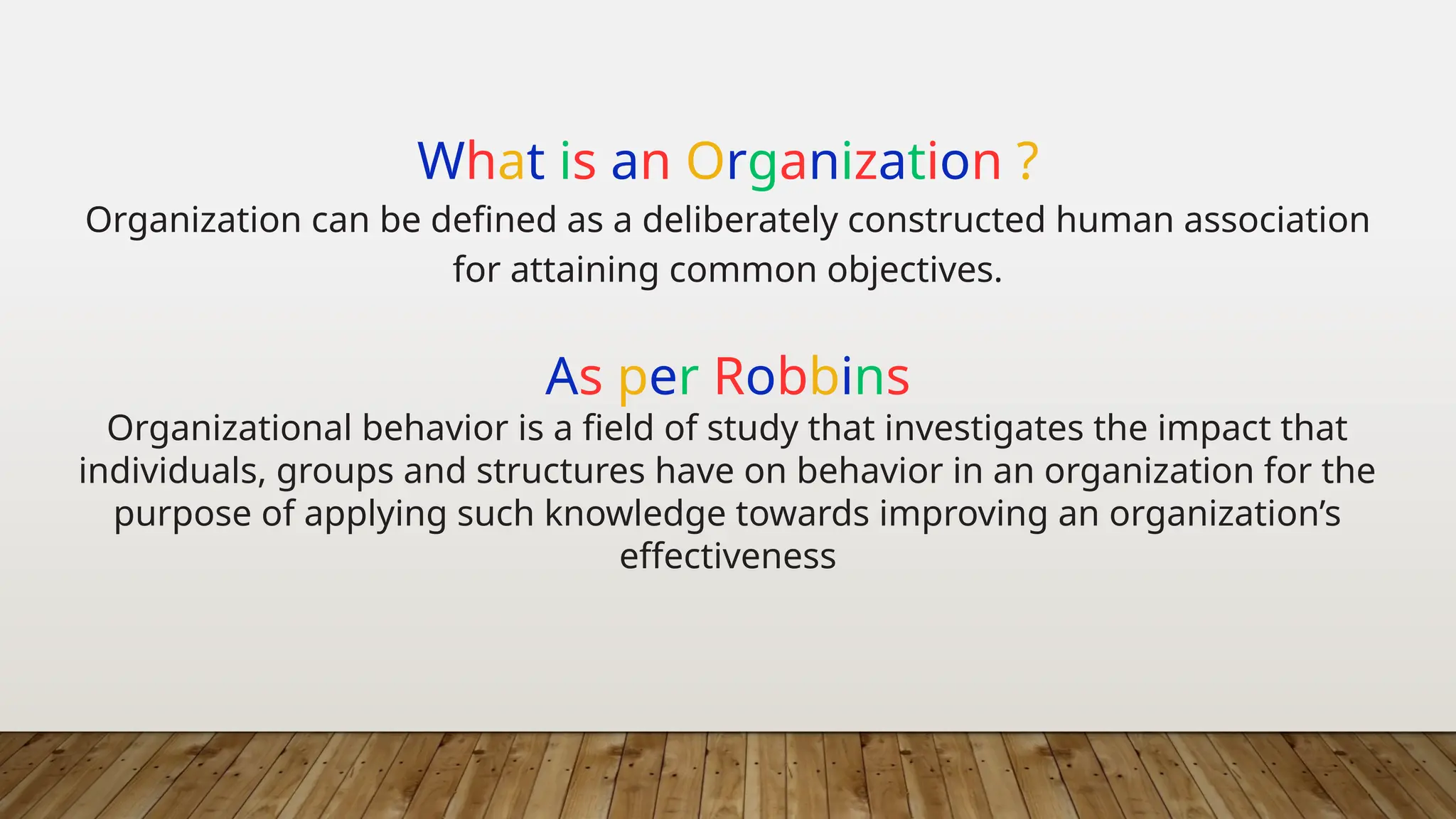
As per Robbins
Organizational behavior is a field of study that investigates the impact that
individuals, groups and structures have on behavior in an organization for the
purpose of applying such knowledge towards improving an organization’s
effectiveness
What is an Organization ?
Organization can be defined as a deliberately constructed human association
for attaining common objectives.
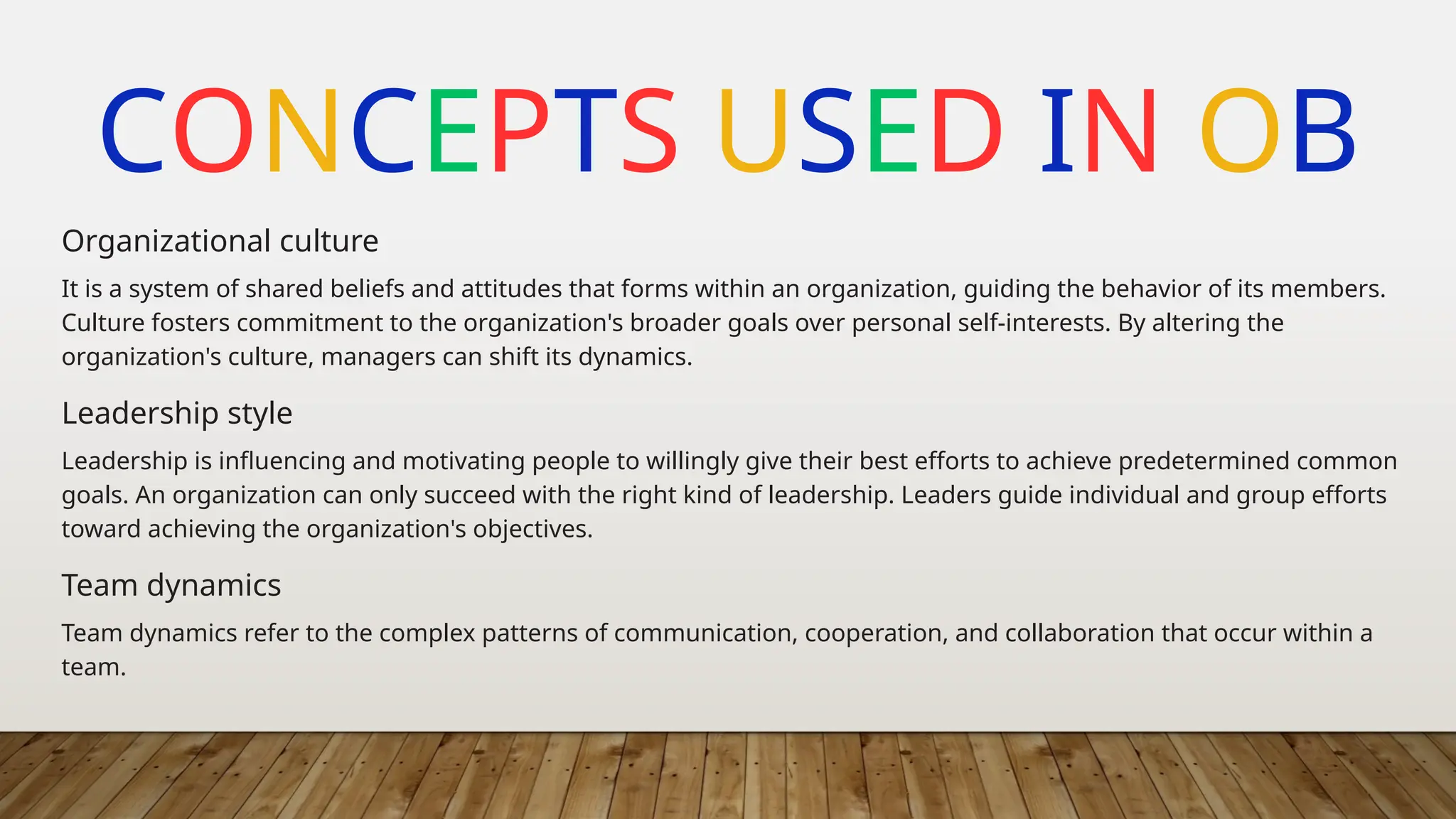
CONCEPTS USED IN OB
It is a system of shared beliefs and attitudes that forms within an organization, guiding the behavior of its members.
Culture fosters commitment to the organization's broader goals over personal self-interests. By altering the
organization's culture, managers can shift its dynamics.
Organizational culture
Leadership is influencing and motivating people to willingly give their best efforts to achieve predetermined common
goals. An organization can only succeed with the right kind of leadership. Leaders guide individual and group efforts
toward achieving the organization's objectives.
Leadership style
Team dynamics refer to the complex patterns of communication, cooperation, and collaboration that occur within a
team.
Team dynamics
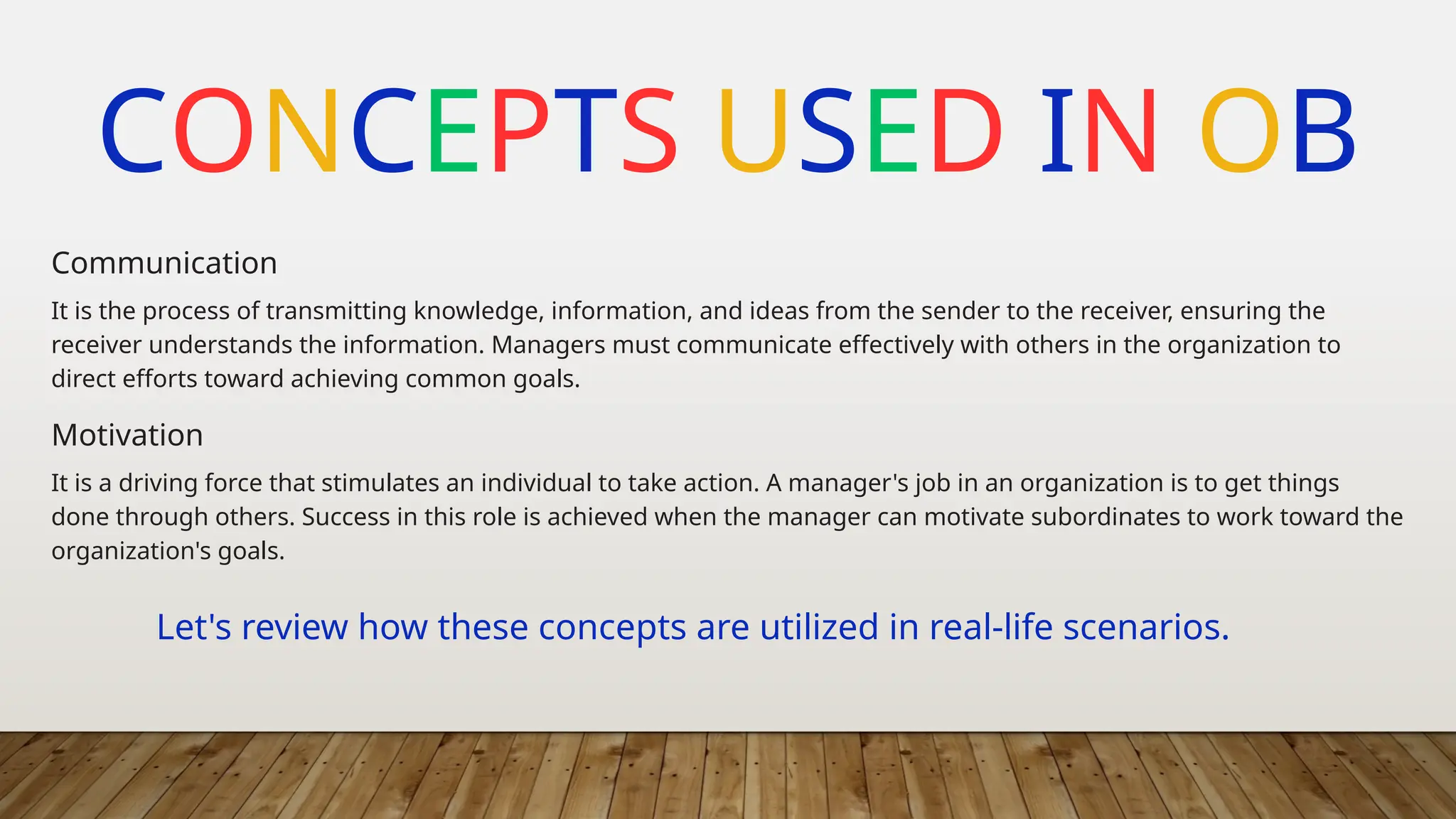
CONCEPTS USED IN OB
It is the process of transmitting knowledge, information, and ideas from the sender to the receiver, ensuring the
receiver understands the information. Managers must communicate effectively with others in the organization to
direct efforts toward achieving common goals.
Communication
It is a driving force that stimulates an individual to take action. A manager's job in an organization is to get things
done through others. Success in this role is achieved when the manager can motivate subordinates to work toward the
organization's goals.
Motivation
Let's review how these concepts are utilized in real-life scenarios.
Case Study: Enhancing Team
Effectiveness at Google
INTRODUCTION
- Organization Overview: Founded in 1998, Google LLC is a multinational technology
company specializing in internet services and products, such as search engines, online
advertising, cloud computing, and software. With a global workforce of over 150,000
employees, Google is renowned for its innovative culture and high levels of employee
satisfaction.
- Context: In 2012, Google launched a comprehensive initiative called “Project Aristotle” to
understand what makes its teams effective. Despite the company's overall success, it
noticed that some teams were performing better than others and aimed to identify the
factors contributing to high performance.
Problem Statement
- Identifying the Issue: Despite having many talented and skilled employees, Google was
experiencing variability in team performance. Some teams were significantly more
effective than others, leading to inconsistent project outcomes and employee satisfaction.
- Impact: The variability in team effectiveness was affecting the efficiency of project
delivery, innovation, and overall company performance. It also impacted employee morale
and retention, as less effective teams struggled to meet their goals
Analysis
- Organizational Culture: Google fosters a culture of openness and collaboration,
encouraging employees to share ideas and work together. The company's flat
organizational structure supports this culture by minimizing bureaucracy.
- Leadership Style: Google's leadership prioritizes empowerment and autonomy, with
leaders expected to create an environment where team members feel valued and listened
to.
- Team Dynamics: Project Aristotle found that teams with high emotional safety—where
members felt secure in taking risks and being vulnerable—tended to perform better. This
was identified as a key factor in effective team performance.
Analysis
- Communication: Effective communication was recognized as essential. Teams that
engaged in open and frequent communication were more successful.
- Motivation: Google offers a range of incentives, including financial rewards, career
development opportunities, and a supportive work environment. Teams that felt valued
and supported demonstrated higher levels of engagement and motivation.
Possible Solutions
- Solution 1: Implement Team-Building Workshops
- Pros: Can enhance team cohesion and improve communication. Helps team members
understand each other’s strengths and weaknesses.
- Cons: Requires time and resources. The impact may be limited if underlying issues are
not addressed.
- Solution 2: Enhance Managerial Training
- Pros: Provides managers with skills to foster emotional safety and better team
dynamics. Helps improve overall team performance.
- Cons: Needs ongoing commitment and may face resistance from managers who prefer
existing practices.
Possible Solutions
- Solution 3: Regularly Monitor and Assess Team Dynamics
- Pros: Allows for continuous improvement and timely interventions. Helps identify and
address issues before they become significant problems.
- Cons: Requires additional resources and time for assessments and follow-up.
Chosen Solution: Enhance managerial training to focus on
creating a safe and supportive environment for teams.
- Implementation Plan:
- Steps:
1. Develop Training Programs: Create training modules for managers on emotional
safety, effective communication, and team dynamics.
2. Launch Training: Roll out the training program across the company, with an initial
focus on high-impact teams.
3. Monitor Progress: Establish metrics to assess the effectiveness of the training and
gather feedback from employees.
4. Adjust and Scale: Refine the training based on feedback and expand it to other teams
as needed.
Chosen Solution: Enhance managerial training to focus on
creating a safe and supportive environment for teams.
- Resources Needed: External consultants for training development, internal resources
for program implementation, and tools for monitoring and evaluation.
- Timeline: Initial training program development and rollout within 6 months, with
ongoing assessments and refinements.
Conclusion
- Summary: Google's Project Aristotle identified emotional safety as a crucial factor in
team effectiveness. By enhancing managerial training to emphasize creating supportive
and communicative team environments, Google aims to improve overall team
performance and employee satisfaction.
This case study demonstrates how Google used research to enhance team effectiveness
by focusing on emotional safety and management practices. It underscores the
importance of understanding team dynamics and implementing targeted solutions to
boost performance.
- Expected Outcomes: Enhanced team effectiveness, improved communication, increased
employee satisfaction, and superior overall project outcomes.
References
- Google’s Project Aristotle Research (published by Google).
- Articles on team dynamics and emotional safety (e.g., "The Five Keys to a Successful
Team" by Google’s re:Work).
- Books and studies on organizational behavior and management practices.
OTHER CASE STUDIES ON ORGANIZATIONAL
BEHAVIOR
• Case Study on Zingerman's Community of Businesses
• Case Study on Titan Company Limited
• Case Study on Infosys Limited
• Case Study on Organizational Behavior and Management Practices of the International
Olympic Committee

OB Google case study- Organisational behaviour

  • 1.
  • 2.
    As per Robbins Organizationalbehavior is a field of study that investigates the impact that individuals, groups and structures have on behavior in an organization for the purpose of applying such knowledge towards improving an organization’s effectiveness What is an Organization ? Organization can be defined as a deliberately constructed human association for attaining common objectives.
  • 3.
    CONCEPTS USED INOB It is a system of shared beliefs and attitudes that forms within an organization, guiding the behavior of its members. Culture fosters commitment to the organization's broader goals over personal self-interests. By altering the organization's culture, managers can shift its dynamics. Organizational culture Leadership is influencing and motivating people to willingly give their best efforts to achieve predetermined common goals. An organization can only succeed with the right kind of leadership. Leaders guide individual and group efforts toward achieving the organization's objectives. Leadership style Team dynamics refer to the complex patterns of communication, cooperation, and collaboration that occur within a team. Team dynamics
  • 4.
    CONCEPTS USED INOB It is the process of transmitting knowledge, information, and ideas from the sender to the receiver, ensuring the receiver understands the information. Managers must communicate effectively with others in the organization to direct efforts toward achieving common goals. Communication It is a driving force that stimulates an individual to take action. A manager's job in an organization is to get things done through others. Success in this role is achieved when the manager can motivate subordinates to work toward the organization's goals. Motivation Let's review how these concepts are utilized in real-life scenarios.
  • 5.
    Case Study: EnhancingTeam Effectiveness at Google
  • 6.
    INTRODUCTION - Organization Overview:Founded in 1998, Google LLC is a multinational technology company specializing in internet services and products, such as search engines, online advertising, cloud computing, and software. With a global workforce of over 150,000 employees, Google is renowned for its innovative culture and high levels of employee satisfaction. - Context: In 2012, Google launched a comprehensive initiative called “Project Aristotle” to understand what makes its teams effective. Despite the company's overall success, it noticed that some teams were performing better than others and aimed to identify the factors contributing to high performance.
  • 7.
    Problem Statement - Identifyingthe Issue: Despite having many talented and skilled employees, Google was experiencing variability in team performance. Some teams were significantly more effective than others, leading to inconsistent project outcomes and employee satisfaction. - Impact: The variability in team effectiveness was affecting the efficiency of project delivery, innovation, and overall company performance. It also impacted employee morale and retention, as less effective teams struggled to meet their goals
  • 8.
    Analysis - Organizational Culture:Google fosters a culture of openness and collaboration, encouraging employees to share ideas and work together. The company's flat organizational structure supports this culture by minimizing bureaucracy. - Leadership Style: Google's leadership prioritizes empowerment and autonomy, with leaders expected to create an environment where team members feel valued and listened to. - Team Dynamics: Project Aristotle found that teams with high emotional safety—where members felt secure in taking risks and being vulnerable—tended to perform better. This was identified as a key factor in effective team performance.
  • 9.
    Analysis - Communication: Effectivecommunication was recognized as essential. Teams that engaged in open and frequent communication were more successful. - Motivation: Google offers a range of incentives, including financial rewards, career development opportunities, and a supportive work environment. Teams that felt valued and supported demonstrated higher levels of engagement and motivation.
  • 10.
    Possible Solutions - Solution1: Implement Team-Building Workshops - Pros: Can enhance team cohesion and improve communication. Helps team members understand each other’s strengths and weaknesses. - Cons: Requires time and resources. The impact may be limited if underlying issues are not addressed. - Solution 2: Enhance Managerial Training - Pros: Provides managers with skills to foster emotional safety and better team dynamics. Helps improve overall team performance. - Cons: Needs ongoing commitment and may face resistance from managers who prefer existing practices.
  • 11.
    Possible Solutions - Solution3: Regularly Monitor and Assess Team Dynamics - Pros: Allows for continuous improvement and timely interventions. Helps identify and address issues before they become significant problems. - Cons: Requires additional resources and time for assessments and follow-up.
  • 12.
    Chosen Solution: Enhancemanagerial training to focus on creating a safe and supportive environment for teams. - Implementation Plan: - Steps: 1. Develop Training Programs: Create training modules for managers on emotional safety, effective communication, and team dynamics. 2. Launch Training: Roll out the training program across the company, with an initial focus on high-impact teams. 3. Monitor Progress: Establish metrics to assess the effectiveness of the training and gather feedback from employees. 4. Adjust and Scale: Refine the training based on feedback and expand it to other teams as needed.
  • 13.
    Chosen Solution: Enhancemanagerial training to focus on creating a safe and supportive environment for teams. - Resources Needed: External consultants for training development, internal resources for program implementation, and tools for monitoring and evaluation. - Timeline: Initial training program development and rollout within 6 months, with ongoing assessments and refinements.
  • 14.
    Conclusion - Summary: Google'sProject Aristotle identified emotional safety as a crucial factor in team effectiveness. By enhancing managerial training to emphasize creating supportive and communicative team environments, Google aims to improve overall team performance and employee satisfaction. This case study demonstrates how Google used research to enhance team effectiveness by focusing on emotional safety and management practices. It underscores the importance of understanding team dynamics and implementing targeted solutions to boost performance. - Expected Outcomes: Enhanced team effectiveness, improved communication, increased employee satisfaction, and superior overall project outcomes.
  • 15.
    References - Google’s ProjectAristotle Research (published by Google). - Articles on team dynamics and emotional safety (e.g., "The Five Keys to a Successful Team" by Google’s re:Work). - Books and studies on organizational behavior and management practices.
  • 16.
    OTHER CASE STUDIESON ORGANIZATIONAL BEHAVIOR • Case Study on Zingerman's Community of Businesses • Case Study on Titan Company Limited • Case Study on Infosys Limited • Case Study on Organizational Behavior and Management Practices of the International Olympic Committee