1
Authority, Responsibility & Accountability
• Authority – The right to give orders or valid
instructions
• Responsibility – This is Obligation to achieve certain
objectives
• Accountability – This is the obligation to report (give
an account) to higher authority for the discharge of
those responsibilities.
• Power – The ability of individuals or groups to
influence the beliefs or actions of other persons or
groups and is more complicated than authority.
2
Relationship
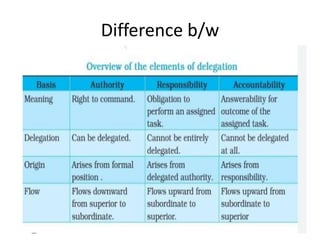
• Accountability flows upwards in an organization,
while responsibility is assigned downwards.
• Responsibility and authority must go hand in hand
• Accountability cannot be expected and flow upwards
unless authority and responsibility have first flowed
down
• Usually subordinates are given responsibility for the
duties assigned to them by their manager and are
accountable to him for their performance
Definition of Responsibility
As per Davis, “Responsibility is an obligation of an individual to
perform assigned duties to the best of his ability under the
direction of his leader.” In the words of Theo Haimann,
“Responsibility is the obligation of a subordinate to perform the
duty as required by his superior”.
As per McFarland, responsibility means, “the duties and activities
assigned to a position or an executive”.
Characteristics
Its importance lies in the creation of the obligation to perform
the work.
It arises from the superior-subordinate relationship.
Unlike Authority, it flows from bottom to top.
It is always in the form of a continuing obligation.
No one can delegate responsibility.
Accountability
• It is nothing but the liability created for the transfer of authority.
Accountability creates the obligation of the subordinate and makes
him answerable for the work done by him/her.
• Hence, it is the answerability for the performance of the assigned
duties. Once a person accepts authority, he deems to accept
Responsibility and Accountability at that time only.
• Definition of Accountability
• As per McFarland, “accountability is the obligation of an individual
to report formally to his superior about the work he has done to
discharge the responsibility.”
Question: How are Authority, Responsibility and
Accountability are inter-related?
• Answer: All of the 3 elements are very much
related to each other as the creation of one leads
to the creation of another two at a similar point of
time. None of the elements can exist in isolation.
That’s why the top management needs a lot of
consideration before deciding the flow of authority.
Once authority to take any action for the
accomplishment of any objective is given, the
remaining 2 elements viz, Responsibility and
Accountability emerges automatically.
Difference b/w
7
Centralization & Decentralization
• Centralization is characterized by decision making
being undertaken at the top levels, while actual work
is carried out at the lower levels.
• Decentralization refers to the systematic devolution
(transference of power) of responsibility and
authority within the structure of an organization.
8
• By centralization or decentralization it does not mean
the division of organization into departments or
sections
• It is where decisions are made that determines the
degree of centralization, and it is quite possible for
an organization to have many divisions, all of which
are strictly controlled from a single central source of
authority
• Organizations cannot be totally centralized or
decentralized.
9
Advantages of Centralization?
• Central authority ensures corporate integrity to the organization and preventing
excessive departmentalism.
• Senior management needs to be seen as providing leadership for the organization
as a whole, ensuring that the various parts perform as a team within corporate
objectives.
• In the event of disputes between departments or division, or between
departments and the corporate whole, central authority takes on the role of
referee in the resolution of conflict.
• Centralized authority is necessary for the making of corporate policy and
determining strategic plans across the whole organization.
• It also fulfills other functions such as standardizing procedure and approaches
which are defining and promoting a unity and style and purpose in respect of issue
and practices across the organization such as equal responsibilities practice.
• It also fulfills the purposes of crisis management which is the determination of
action which can be effective across the whole organization in response in serious
emergencies.
10
Advantages of decentralization?
• Decentralization aims to place the authority to make decisions at points as near as
possible to where there are relevant activities take place.
• It utilizes local and immediate knowledge of situations in order to make the timely and
effective decisions within the defined spare of action.
• This is in contrast to centralized decision making which is remote from the point of
impact.
• There is, therefore a clear potential gain in the quality of decision making, but it must
be confined to those situations which do not have wider impact that the area of
responsibility of the decision maker.
• It encourages initiative, stimulates job satisfaction and includes moral by providing
individuals with more control over their work and involvement with the objectives of
the organization.
• It fosters the development of managerial ability at lower levels.
11
Disadvantages of decentralization?
• The principal problem is one of the autonomy of decentralized units, where
independence from the centre can lead to working against corporate policy.
• Centralized authority can lose touch with the details of operations in decentralized
parts of the organization, and the decentralized unit can lose touch with its role as
parts of the whole.
• It is a disadvantage because of the possibility that decision making is very close to
an often involves the affected parties, it can actually turn out to be relatively slow
and represent a compromise based on the need for acceptance.
• Decentralization depends on effective management at the lower levels, and this is
likely to require extensive training which will be costly to the organization.
• Decentralized operations may lead to the duplication of work which will be again a
cost.
12
So, When do we need
DECENTRALIZATION ?
Decentralization will be needed when the
organization is in the process of growing
in the size, as well as when it wants to
increase the need for flexibility and
responsiveness in its operations.
13
What is it called if u start
DECENTRALIZING?
DELEGATION
Delegation is the passing of responsibility
of one level of management to a lower
level.
14
Why do managers refrain from delegating?
• It takes more time to explain what to do than to do
the work oneself.
• Subordinates lack the knowledge, skills and
experience necessary – if you want something done
properly the only way is to do it yourself – attitude.
• Lack of trust in subordinates
• Subordinates do not want additional responsibility,
especially without additional pay or reward.
• Sometimes managers are scared to delegate because
they are afraid to lose their job of their subordinates
performs better than them.
15
BHAI ….. I Have Delegated My WORK…..
SO, can I take REST ?
• When a manager delegates responsibility to another, he
still is accountable to another senior manager regarding the
delegated matter.
• When a manager delegates he should be prepared to live
with the problems and consequences which will arise out
of the delegated work.
• Subordinate’s performance should be judged against the
objectives and standards associated with the responsibility,
not against how the manager would do it.
16
Empowerment
Empowerment is a development from delegation. When delegation
is integrated into the organization, employees are given increased
responsibility for their own work and are allowed to work with
more independence, they become “empowered” and relieved of
detailed instructions and controls.
• Empowerment is a process to increase efficiency and make greater
use of each individuals contribution.
It implies synergy – the total is greater than the sum of the parts
added.
• Empowerment is also about ownership, it is a way involving
people in the operations of the organization, so that they feel
personal responsibility for their actions.

Authority-Responsibility-Accountability.pptx

  • 1.
    1 Authority, Responsibility &Accountability • Authority – The right to give orders or valid instructions • Responsibility – This is Obligation to achieve certain objectives • Accountability – This is the obligation to report (give an account) to higher authority for the discharge of those responsibilities. • Power – The ability of individuals or groups to influence the beliefs or actions of other persons or groups and is more complicated than authority.
  • 2.
    2 Relationship • Accountability flowsupwards in an organization, while responsibility is assigned downwards. • Responsibility and authority must go hand in hand • Accountability cannot be expected and flow upwards unless authority and responsibility have first flowed down • Usually subordinates are given responsibility for the duties assigned to them by their manager and are accountable to him for their performance
  • 3.
    Definition of Responsibility Asper Davis, “Responsibility is an obligation of an individual to perform assigned duties to the best of his ability under the direction of his leader.” In the words of Theo Haimann, “Responsibility is the obligation of a subordinate to perform the duty as required by his superior”. As per McFarland, responsibility means, “the duties and activities assigned to a position or an executive”. Characteristics Its importance lies in the creation of the obligation to perform the work. It arises from the superior-subordinate relationship. Unlike Authority, it flows from bottom to top. It is always in the form of a continuing obligation. No one can delegate responsibility.
  • 4.
    Accountability • It isnothing but the liability created for the transfer of authority. Accountability creates the obligation of the subordinate and makes him answerable for the work done by him/her. • Hence, it is the answerability for the performance of the assigned duties. Once a person accepts authority, he deems to accept Responsibility and Accountability at that time only. • Definition of Accountability • As per McFarland, “accountability is the obligation of an individual to report formally to his superior about the work he has done to discharge the responsibility.”
  • 5.
    Question: How areAuthority, Responsibility and Accountability are inter-related? • Answer: All of the 3 elements are very much related to each other as the creation of one leads to the creation of another two at a similar point of time. None of the elements can exist in isolation. That’s why the top management needs a lot of consideration before deciding the flow of authority. Once authority to take any action for the accomplishment of any objective is given, the remaining 2 elements viz, Responsibility and Accountability emerges automatically.
  • 6.
  • 7.
    7 Centralization & Decentralization •Centralization is characterized by decision making being undertaken at the top levels, while actual work is carried out at the lower levels. • Decentralization refers to the systematic devolution (transference of power) of responsibility and authority within the structure of an organization.
  • 8.
    8 • By centralizationor decentralization it does not mean the division of organization into departments or sections • It is where decisions are made that determines the degree of centralization, and it is quite possible for an organization to have many divisions, all of which are strictly controlled from a single central source of authority • Organizations cannot be totally centralized or decentralized.
  • 9.
    9 Advantages of Centralization? •Central authority ensures corporate integrity to the organization and preventing excessive departmentalism. • Senior management needs to be seen as providing leadership for the organization as a whole, ensuring that the various parts perform as a team within corporate objectives. • In the event of disputes between departments or division, or between departments and the corporate whole, central authority takes on the role of referee in the resolution of conflict. • Centralized authority is necessary for the making of corporate policy and determining strategic plans across the whole organization. • It also fulfills other functions such as standardizing procedure and approaches which are defining and promoting a unity and style and purpose in respect of issue and practices across the organization such as equal responsibilities practice. • It also fulfills the purposes of crisis management which is the determination of action which can be effective across the whole organization in response in serious emergencies.
  • 10.
    10 Advantages of decentralization? •Decentralization aims to place the authority to make decisions at points as near as possible to where there are relevant activities take place. • It utilizes local and immediate knowledge of situations in order to make the timely and effective decisions within the defined spare of action. • This is in contrast to centralized decision making which is remote from the point of impact. • There is, therefore a clear potential gain in the quality of decision making, but it must be confined to those situations which do not have wider impact that the area of responsibility of the decision maker. • It encourages initiative, stimulates job satisfaction and includes moral by providing individuals with more control over their work and involvement with the objectives of the organization. • It fosters the development of managerial ability at lower levels.
  • 11.
    11 Disadvantages of decentralization? •The principal problem is one of the autonomy of decentralized units, where independence from the centre can lead to working against corporate policy. • Centralized authority can lose touch with the details of operations in decentralized parts of the organization, and the decentralized unit can lose touch with its role as parts of the whole. • It is a disadvantage because of the possibility that decision making is very close to an often involves the affected parties, it can actually turn out to be relatively slow and represent a compromise based on the need for acceptance. • Decentralization depends on effective management at the lower levels, and this is likely to require extensive training which will be costly to the organization. • Decentralized operations may lead to the duplication of work which will be again a cost.
  • 12.
    12 So, When dowe need DECENTRALIZATION ? Decentralization will be needed when the organization is in the process of growing in the size, as well as when it wants to increase the need for flexibility and responsiveness in its operations.
  • 13.
    13 What is itcalled if u start DECENTRALIZING? DELEGATION Delegation is the passing of responsibility of one level of management to a lower level.
  • 14.
    14 Why do managersrefrain from delegating? • It takes more time to explain what to do than to do the work oneself. • Subordinates lack the knowledge, skills and experience necessary – if you want something done properly the only way is to do it yourself – attitude. • Lack of trust in subordinates • Subordinates do not want additional responsibility, especially without additional pay or reward. • Sometimes managers are scared to delegate because they are afraid to lose their job of their subordinates performs better than them.
  • 15.
    15 BHAI ….. IHave Delegated My WORK….. SO, can I take REST ? • When a manager delegates responsibility to another, he still is accountable to another senior manager regarding the delegated matter. • When a manager delegates he should be prepared to live with the problems and consequences which will arise out of the delegated work. • Subordinate’s performance should be judged against the objectives and standards associated with the responsibility, not against how the manager would do it.
  • 16.
    16 Empowerment Empowerment is adevelopment from delegation. When delegation is integrated into the organization, employees are given increased responsibility for their own work and are allowed to work with more independence, they become “empowered” and relieved of detailed instructions and controls. • Empowerment is a process to increase efficiency and make greater use of each individuals contribution. It implies synergy – the total is greater than the sum of the parts added. • Empowerment is also about ownership, it is a way involving people in the operations of the organization, so that they feel personal responsibility for their actions.