STRATEGIC MANAGEMENT
FIVE GENERIC COMPETITIVE STRATEGIES
Competitive strategy relates to all the different strategies a company may do to:
•Gain a competitive advantage
•Retain existing market share
•Capture new market share
•Identify and access new market opportunities
•Satisfy wants and needs
•Provide superior value in a product or service
•Position and differentiate the product
•Optimize manipulation of the marketing mix
•Achieve its goals in the competitive market place
FIVE GENERIC COMPETITIVE STRATEGIES
Competitive strategy then integrates with…
•All other functional level activities
•Operational processes to deliver value to the customer
•Organizational structure
•Technical talent and human capital
•Organizational politics
•Organizational policy
•Budget policy
•Management and leadership
•et al…
…in order to optimize success in the market place.
FIVE GENERIC COMPETITIVE STRATEGIES
Question:
To what extent do you believe that the competitive strategy sets
the tone for the organizational mission and vision of the organization?
Answer:
Likely to a significant extent, because assessment of market opportunities
can give rise to the potential for organizational success and the specific
organizational efforts necessary to satisfy customer wants and needs.
FIVE GENERIC COMPETITIVE STRATEGIES
Broad factors that distinguish one competitive strategy from another:
Whether a company’s target market is broad or narrow, or
Whether the company is pursuing a competitive advantage linked to low costs or
product differentiation.
FIVE GENERIC COMPETITIVE STRATEGIES
1. Low-cost provider strategy…
Targeting:
•Price sensitive markets…price conscious buyers
•Segments with limited incomes
•Price sensitive customers in greater numbers thereby
increasing profits (although thin profit margins)
•Extreme price competitive markets
•Products are essentially the same
•Where brand differences are inconsequential to the consumer
•When substitutes are readily available
•Good strategy for new entrants
FIVE GENERIC COMPETITIVE STRATEGIES
1. Low-cost provider strategy…
Strategic inputs:
•Optimize economies of scale
•Purchase in volume, JIT, keep raw materials costs low
•Utilize bargaining power
•Low cost inputs
•Reduce materials handling and shipping costs
•Advanced production technology and process designs
•Offer incentives
•Minimize operational and administrative staff and cost
•Merge support systems (ordering, procurement, billing, etc.)
•Pursue supply chain efficiency, i.e. limit ‘middle men’
•Efficient utilization of resources (plant, materials, human capital)
•Vertical integration
•Operate at full capacity (full advantage of fixed costs)
•Efficient communications systems and information technology
•Outsource where practicable
•Sell direct to customer (where practicable)
•Continuous improvement
•Continuous learning
FIVE GENERIC COMPETITIVE STRATEGIES
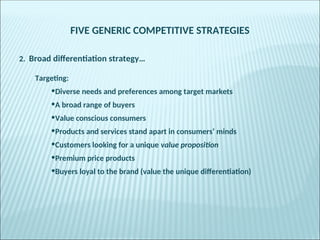
2. Broad differentiation strategy…
Targeting:
•Diverse needs and preferences among target markets
•A broad range of buyers
•Value conscious consumers
•Products and services stand apart in consumers’ minds
•Customers looking for a unique value proposition
•Premium price products
•Buyers loyal to the brand (value the unique differentiation)
FIVE GENERIC COMPETITIVE STRATEGIES
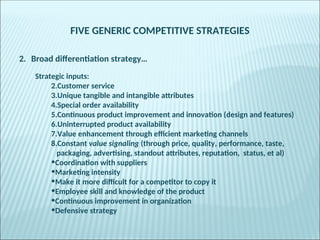
2. Broad differentiation strategy…
Strategic inputs:
2.Customer service
3.Unique tangible and intangible attributes
4.Special order availability
5.Continuous product improvement and innovation (design and features)
6.Uninterrupted product availability
7.Value enhancement through efficient marketing channels
8.Constant value signaling (through price, quality, performance, taste,
packaging, advertising, standout attributes, reputation, status, et al)
•Coordination with suppliers
•Marketing intensity
•Make it more difficult for a competitor to copy it
•Employee skill and knowledge of the product
•Continuous improvement in organization
•Defensive strategy
FIVE GENERIC COMPETITIVE STRATEGIES
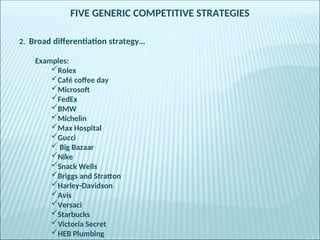
2. Broad differentiation strategy…
Examples:
Rolex
Café coffee day
Microsoft
FedEx
BMW
Michelin
Max Hospital
Gucci
 Big Bazaar
Nike
Snack Wells
Briggs and Stratton
Harley-Davidson
Avis
Versaci
Starbucks
Victoria Secret
HEB Plumbing
FIVE GENERIC COMPETITIVE STRATEGIES
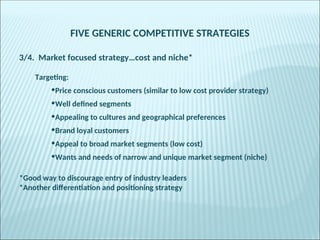
3/4. Market focused strategy…cost and niche*
Targeting:
•Price conscious customers (similar to low cost provider strategy)
•Well defined segments
•Appealing to cultures and geographical preferences
•Brand loyal customers
•Appeal to broad market segments (low cost)
•Wants and needs of narrow and unique market segment (niche)
*Good way to discourage entry of industry leaders
*Another differentiation and positioning strategy
FIVE GENERIC COMPETITIVE STRATEGIES
3/4. Market focused strategy…cost and niche
Strategic inputs (essentially the same as low cost provider strategy):
•Optimize economies of scale
•Purchase in volume, JIT, keep raw materials costs low
•Utilize bargaining power
•Low cost inputs
•Reduce materials handling and shipping costs
•Advanced production technology and process designs
•Offer incentives
•Minimize operational and administrative staff and cost
•Merge support systems (ordering, procurement, billing, etc.)
•Pursue supply chain efficiency, i.e. limit ‘middle men’
•Efficient utilization of resources (plant, materials, human capital)
•Vertical integration
•Operate at full capacity (full advantage of fixed costs)
•Efficient communications systems and information technology
•Outsource where practicable
•Sell direct to customer (where practicable)
•Continuous improvement
•Continuous learning
FIVE GENERIC COMPETITIVE STRATEGIES
3/4. Market focused strategy…cost and niche
Examples:
Community Coffee (niche)
Grand Ole Opry (niche)
Krispy Kreme Doughnuts (niche, cost – now broad)
Red Box (niche, cost)
Best Buy (niche, cost – now broad)
Trader Joe’s (niche)
Tabasco (niche, cost)
Oberweis Dairies (niche)
Haltom’s Jewelers (niche)
Dairy Queen (niche, cost)
Bluebonnet Bakery (niche)
Exparanza’s Bakery (niche)
Micro-breweries and local bars (niche)
Family Dollar, Dollar General, Fred’s (niche, cost – now broad)
Coors (niche, cost, now broad)
Duck Head (niche, cost - now broad)
Local restaurants (niche)
Men’s Warehouse (niche)
Market Basket (niche)
Central market (niche)
FIVE GENERIC COMPETITIVE STRATEGIES
3/4. Market focused strategy…cost and niche
Examples:
NDTV (niche)
Best Buy (niche, cost – now broad)
Escort Heart Institute (niche)
Fun Foods (niche)
Henko (niche)
Pantaloon (niche, cost - now broad)
Sagar restaurants (niche)
Cremica (niche, cost)
Bombay selection(niche)
TATA cars esp nano (niche)
FIVE GENERIC COMPETITIVE STRATEGIES
5. Best cost provider strategy…*
Targeting:
•Low cost, differentiation markets (a hybrid)
•Broad markets and market niches (middle ground)
•Value conscious buyers
•Those who shy away from cheap, low-end products and
expensive high-end products
•Willing to pay a fair price for functionality and performance
•More for the money
*Balances low-cost against emphasis on differentiation and positioning
FIVE GENERIC COMPETITIVE STRATEGIES
5. Best cost provider strategy…
Strategic inputs:
•Positioning near the middle of the market
•Combines other basic strategies
•Medium quality at below average price, or
•Somewhat higher quality at an average or slightly higher price
•Adjust strategy for economic conditions, i.e. more value conscious
•Match strategy to internal resources and capabilities
FIVE GENERIC COMPETITIVE STRATEGIES
5. Best cost provider strategy…
Examples:
Liberty footware
V mart
Savane
Marriott Courtyard
Spalding
UPS
Little Debbie
Bimbo Bakeries
Black Eyed Pea
Ruby Tuesday
King Fischer
Goodyear
FIVE GENERIC COMPETITIVE STRATEGIES
Summary
The differences between the classic five generic competitive strategies is
somewhat subtle to the untrained eye. Admittedly, there is some degree
of overlap. However, they are significant in strategic planning as they
relate to the ability of the organization to gain a competitive advantage.
They offer product and brand distinction in terms of price, value, quality, and
performance, which not only positions the product uniquely, but the brand,
itself.
Thus, the competitive strategy may indeed set the tone for the mission of the
organization, because the entire organization must function jointly to provide
the level of quality and performance in the market place, that is consistent with
the organization’s overall business level strategy.

Five Generic Competitive Strategies wid eg.ppt

  • 1.
    STRATEGIC MANAGEMENT FIVE GENERICCOMPETITIVE STRATEGIES
  • 2.
    FIVE GENERIC COMPETITIVESTRATEGIES Competitive strategy relates to all the different strategies a company may do to: •Gain a competitive advantage •Retain existing market share •Capture new market share •Identify and access new market opportunities •Satisfy wants and needs •Provide superior value in a product or service •Position and differentiate the product •Optimize manipulation of the marketing mix •Achieve its goals in the competitive market place
  • 3.
    FIVE GENERIC COMPETITIVESTRATEGIES Competitive strategy then integrates with… •All other functional level activities •Operational processes to deliver value to the customer •Organizational structure •Technical talent and human capital •Organizational politics •Organizational policy •Budget policy •Management and leadership •et al… …in order to optimize success in the market place.
  • 4.
    FIVE GENERIC COMPETITIVESTRATEGIES Question: To what extent do you believe that the competitive strategy sets the tone for the organizational mission and vision of the organization? Answer: Likely to a significant extent, because assessment of market opportunities can give rise to the potential for organizational success and the specific organizational efforts necessary to satisfy customer wants and needs.
  • 5.
    FIVE GENERIC COMPETITIVESTRATEGIES Broad factors that distinguish one competitive strategy from another: Whether a company’s target market is broad or narrow, or Whether the company is pursuing a competitive advantage linked to low costs or product differentiation.
  • 6.
    FIVE GENERIC COMPETITIVESTRATEGIES 1. Low-cost provider strategy… Targeting: •Price sensitive markets…price conscious buyers •Segments with limited incomes •Price sensitive customers in greater numbers thereby increasing profits (although thin profit margins) •Extreme price competitive markets •Products are essentially the same •Where brand differences are inconsequential to the consumer •When substitutes are readily available •Good strategy for new entrants
  • 7.
    FIVE GENERIC COMPETITIVESTRATEGIES 1. Low-cost provider strategy… Strategic inputs: •Optimize economies of scale •Purchase in volume, JIT, keep raw materials costs low •Utilize bargaining power •Low cost inputs •Reduce materials handling and shipping costs •Advanced production technology and process designs •Offer incentives •Minimize operational and administrative staff and cost •Merge support systems (ordering, procurement, billing, etc.) •Pursue supply chain efficiency, i.e. limit ‘middle men’ •Efficient utilization of resources (plant, materials, human capital) •Vertical integration •Operate at full capacity (full advantage of fixed costs) •Efficient communications systems and information technology •Outsource where practicable •Sell direct to customer (where practicable) •Continuous improvement •Continuous learning
  • 9.
    FIVE GENERIC COMPETITIVESTRATEGIES 2. Broad differentiation strategy… Targeting: •Diverse needs and preferences among target markets •A broad range of buyers •Value conscious consumers •Products and services stand apart in consumers’ minds •Customers looking for a unique value proposition •Premium price products •Buyers loyal to the brand (value the unique differentiation)
  • 10.
    FIVE GENERIC COMPETITIVESTRATEGIES 2. Broad differentiation strategy… Strategic inputs: 2.Customer service 3.Unique tangible and intangible attributes 4.Special order availability 5.Continuous product improvement and innovation (design and features) 6.Uninterrupted product availability 7.Value enhancement through efficient marketing channels 8.Constant value signaling (through price, quality, performance, taste, packaging, advertising, standout attributes, reputation, status, et al) •Coordination with suppliers •Marketing intensity •Make it more difficult for a competitor to copy it •Employee skill and knowledge of the product •Continuous improvement in organization •Defensive strategy
  • 11.
    FIVE GENERIC COMPETITIVESTRATEGIES 2. Broad differentiation strategy… Examples: Rolex Café coffee day Microsoft FedEx BMW Michelin Max Hospital Gucci  Big Bazaar Nike Snack Wells Briggs and Stratton Harley-Davidson Avis Versaci Starbucks Victoria Secret HEB Plumbing
  • 12.
    FIVE GENERIC COMPETITIVESTRATEGIES 3/4. Market focused strategy…cost and niche* Targeting: •Price conscious customers (similar to low cost provider strategy) •Well defined segments •Appealing to cultures and geographical preferences •Brand loyal customers •Appeal to broad market segments (low cost) •Wants and needs of narrow and unique market segment (niche) *Good way to discourage entry of industry leaders *Another differentiation and positioning strategy
  • 13.
    FIVE GENERIC COMPETITIVESTRATEGIES 3/4. Market focused strategy…cost and niche Strategic inputs (essentially the same as low cost provider strategy): •Optimize economies of scale •Purchase in volume, JIT, keep raw materials costs low •Utilize bargaining power •Low cost inputs •Reduce materials handling and shipping costs •Advanced production technology and process designs •Offer incentives •Minimize operational and administrative staff and cost •Merge support systems (ordering, procurement, billing, etc.) •Pursue supply chain efficiency, i.e. limit ‘middle men’ •Efficient utilization of resources (plant, materials, human capital) •Vertical integration •Operate at full capacity (full advantage of fixed costs) •Efficient communications systems and information technology •Outsource where practicable •Sell direct to customer (where practicable) •Continuous improvement •Continuous learning
  • 14.
    FIVE GENERIC COMPETITIVESTRATEGIES 3/4. Market focused strategy…cost and niche Examples: Community Coffee (niche) Grand Ole Opry (niche) Krispy Kreme Doughnuts (niche, cost – now broad) Red Box (niche, cost) Best Buy (niche, cost – now broad) Trader Joe’s (niche) Tabasco (niche, cost) Oberweis Dairies (niche) Haltom’s Jewelers (niche) Dairy Queen (niche, cost) Bluebonnet Bakery (niche) Exparanza’s Bakery (niche) Micro-breweries and local bars (niche) Family Dollar, Dollar General, Fred’s (niche, cost – now broad) Coors (niche, cost, now broad) Duck Head (niche, cost - now broad) Local restaurants (niche) Men’s Warehouse (niche) Market Basket (niche) Central market (niche)
  • 15.
    FIVE GENERIC COMPETITIVESTRATEGIES 3/4. Market focused strategy…cost and niche Examples: NDTV (niche) Best Buy (niche, cost – now broad) Escort Heart Institute (niche) Fun Foods (niche) Henko (niche) Pantaloon (niche, cost - now broad) Sagar restaurants (niche) Cremica (niche, cost) Bombay selection(niche) TATA cars esp nano (niche)
  • 16.
    FIVE GENERIC COMPETITIVESTRATEGIES 5. Best cost provider strategy…* Targeting: •Low cost, differentiation markets (a hybrid) •Broad markets and market niches (middle ground) •Value conscious buyers •Those who shy away from cheap, low-end products and expensive high-end products •Willing to pay a fair price for functionality and performance •More for the money *Balances low-cost against emphasis on differentiation and positioning
  • 17.
    FIVE GENERIC COMPETITIVESTRATEGIES 5. Best cost provider strategy… Strategic inputs: •Positioning near the middle of the market •Combines other basic strategies •Medium quality at below average price, or •Somewhat higher quality at an average or slightly higher price •Adjust strategy for economic conditions, i.e. more value conscious •Match strategy to internal resources and capabilities
  • 18.
    FIVE GENERIC COMPETITIVESTRATEGIES 5. Best cost provider strategy… Examples: Liberty footware V mart Savane Marriott Courtyard Spalding UPS Little Debbie Bimbo Bakeries Black Eyed Pea Ruby Tuesday King Fischer Goodyear
  • 19.
    FIVE GENERIC COMPETITIVESTRATEGIES Summary The differences between the classic five generic competitive strategies is somewhat subtle to the untrained eye. Admittedly, there is some degree of overlap. However, they are significant in strategic planning as they relate to the ability of the organization to gain a competitive advantage. They offer product and brand distinction in terms of price, value, quality, and performance, which not only positions the product uniquely, but the brand, itself. Thus, the competitive strategy may indeed set the tone for the mission of the organization, because the entire organization must function jointly to provide the level of quality and performance in the market place, that is consistent with the organization’s overall business level strategy.