1
Facility Layout
2
Learning Objectives
 Define layout planning and explain its
importance
 Identify and describe different types of
layouts
 Compare process layouts & product
layouts
 Describe the steps involved in designing a
process layout
3
Learning Objectives – con’t
 Describe the steps involved in designing a
product layout
 Explain the advantages of hybrid layouts
 Define the meaning of group technology
(cell) layouts
4
What Is Layout Planning?
Layout planning is deciding the best physical arrangement of
all resources within a facility
 Facility resource arrangement can significantly affect
productivity
 Two broad categories of operations:
 Intermittent processing systems – low volume of many different
products
 Continuous processing systems – high volume of a few
standardized products
5
Types of Layouts
 Four basic layout types consisting of:
 Process layouts - Group similar resources together
 Product layouts - Designed to produce a specific
product efficiently
 Hybrid layouts - Combine aspects of both process
and product layouts
 Fixed-Position layouts - Product is two large to
move; e.g. a building
6
Process Layouts
 Process layout unique characteristics include:
 Resources used are general purpose
 Facilities are less capital intensive
 Facilities are more labor intensive
 Resources have greater flexibility
 Processing rates are slower
 Material handling costs are higher
7
Process Layouts – con’t
 Scheduling resources & work flow is more
complex
 Space requirements are higher
8
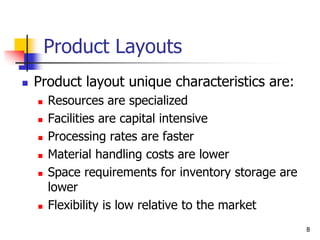
Product Layouts
 Product layout unique characteristics are:
 Resources are specialized
 Facilities are capital intensive
 Processing rates are faster
 Material handling costs are lower
 Space requirements for inventory storage are
lower
 Flexibility is low relative to the market
9
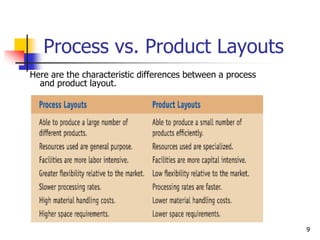
Process vs. Product Layouts
Here are the characteristic differences between a process
and product layout.
10
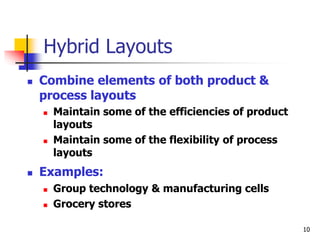
Hybrid Layouts
 Combine elements of both product &
process layouts
 Maintain some of the efficiencies of product
layouts
 Maintain some of the flexibility of process
layouts
 Examples:
 Group technology & manufacturing cells
 Grocery stores
11
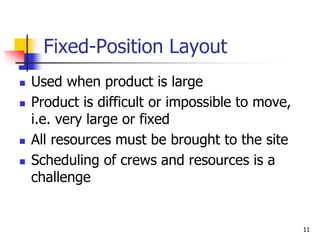
Fixed-Position Layout
 Used when product is large
 Product is difficult or impossible to move,
i.e. very large or fixed
 All resources must be brought to the site
 Scheduling of crews and resources is a
challenge
12
Designing Process Layouts
Step 1: Gather information:
Space needed, space available, identify closeness
measures
Step 2: Develop alternative block plans:
Using trial-and-error or decision support tools
Step 3: Develop a detailed layout:
Consider exact sizes/shapes of departments and
work centers including aisles and stairways
Tools like drawings, 3-D models, and CAD software
are available to facilitate this process
13
Special Cases of Process
Layouts
A number of unique process layouts require
special attention. We will look at two of
these:
 Warehouse layouts
 Office Layouts
14
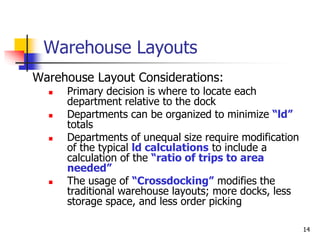
Warehouse Layouts
Warehouse Layout Considerations:
 Primary decision is where to locate each
department relative to the dock
 Departments can be organized to minimize “ld”
totals
 Departments of unequal size require modification
of the typical ld calculations to include a
calculation of the “ratio of trips to area
needed”
 The usage of “Crossdocking” modifies the
traditional warehouse layouts; more docks, less
storage space, and less order picking
15
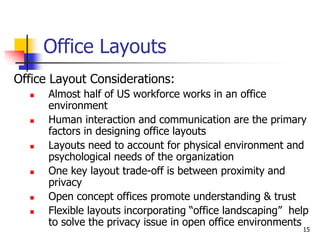
Office Layouts
Office Layout Considerations:
 Almost half of US workforce works in an office
environment
 Human interaction and communication are the primary
factors in designing office layouts
 Layouts need to account for physical environment and
psychological needs of the organization
 One key layout trade-off is between proximity and
privacy
 Open concept offices promote understanding & trust
 Flexible layouts incorporating “office landscaping” help
to solve the privacy issue in open office environments
16
Designing Product Layouts
 Designing product layouts requires
consideration of:
 Sequence of tasks to be performed by each
workstation
 Logical order
 Speed considerations – line balancing
17
Designing Product Layouts –
con’t
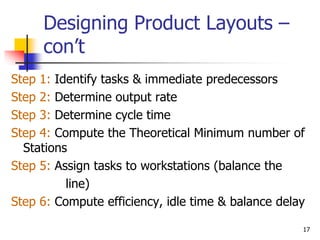
Step 1: Identify tasks & immediate predecessors
Step 2: Determine output rate
Step 3: Determine cycle time
Step 4: Compute the Theoretical Minimum number of
Stations
Step 5: Assign tasks to workstations (balance the
line)
Step 6: Compute efficiency, idle time & balance delay
21
Layout Calculations con’t
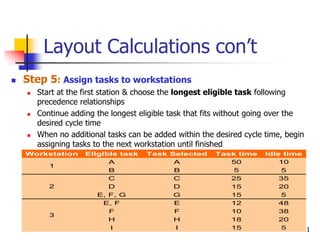
 Step 5: Assign tasks to workstations
 Start at the first station & choose the longest eligible task following
precedence relationships
 Continue adding the longest eligible task that fits without going over the
desired cycle time
 When no additional tasks can be added within the desired cycle time, begin
assigning tasks to the next workstation until finished
Workstation Eligible task Task Selected Task time Idle time
A A 50 10
B B 5 5
C C 25 35
D D 15 20
E, F, G G 15 5
E, F E 12 48
F F 10 38
H H 18 20
I I 15 5
1
2
3
23
Other Product Layout Considerations
 Shape of the line (S, U, O, L):
 Share resources, enhance communication & visibility,
impact location of loading & unloading
 Paced versus Un-paced lines
 Paced lines use an automatically enforced cycle time
 Number of Product Models produced
 Single
 Mixed-model lines
24
Group Technology (CELL)
Layouts
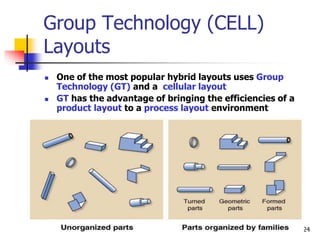
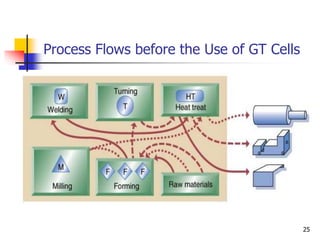
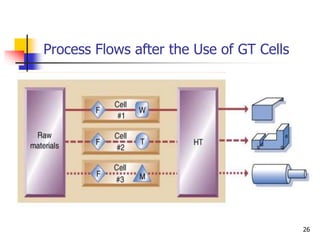
 One of the most popular hybrid layouts uses Group
Technology (GT) and a cellular layout
 GT has the advantage of bringing the efficiencies of a
product layout to a process layout environment
25
Process Flows before the Use of GT Cells
26
Process Flows after the Use of GT Cells
27
Facility Layout Across the
Organization
Layout planning is organizationally important
for an efficient operations
 Marketing is affected by layout especially
when clients come to the site
 Human resources is affected as layout impacts
people
 Finance is involved as layout changes can be
costly endeavors
28
Facility Layout within OM:
How it all fits together
 Layout decisions are directly related to issues of product
design and process selection .
 Job design, as process layouts tend to require greater
worker skills than do product layouts
 Degree of automation, as product layouts tend to be
more capital intensive and use more automation
compared to process layouts
 Layout decisions are also affected by implementation of
just-in-time (JIT) systems, which dictate a line flow and
the use of group technology (GT) cells
 As layout decisions specify the flow of goods through the
facility, they impact all other aspects of operations
management.
29
Highlights
 Layout planning is deciding on the best physical
arrangement of all resources that consumes space within a
facility. Proper layout planning is highly important for the
efficient running of a business. Otherwise, there can be
much wasted time and energy, as well as confusion.
 There are four basic types of layouts: process, product,
hybrid, and fixed position. Process layouts group
resources based on similar processes. Product layouts
arrange resources in straight-line fashion. Hybrid layouts
combine elements of both process and product layouts.
Fixed-position layouts occur when the product is larger
and cannot be moved.
30
Highlights – con’t
 Process layouts provide much flexibility and allow for the
production of many products with differing characteristics.
Product layouts, on the other hand, provide greater
efficiency when producing one type of product.
 The steps for designing process layouts are (1) gather
information about space needs, space availability, and
closeness requirements of departments; (2) developing a
block plan or schematic of the layout; and (3) developing a
detailed layout.
31
Highlights – con’t
 The steps for designing an product layout are (1) identify
tasks that need to be performed and their immediate
predecessors; (2) determine output rate; (3) determine
cycle time; (4) computing the theoretical minimum number
of work stations, (5) assigning tasks to workstations; and
(6) computing efficiency and balance delay.
 Hybrids layouts have advantages over other layout types
because they combine elements of both process and
product layouts to increase efficiency.
32
Highlights – con’t
 An example of hybrid layouts is group technology or cell
layouts. Group technology is the process of crating
groupings of products based on similar processing
requirements. Cells are created for each grouping of
products, resulting in a more orderly flow of products
through the facility.
33
34
35
36
37
Chapter 10 Homework Hints
 10.8: Assign sites based on number of
trips (refer to Example 10.2). There is no
strategy regarding which side of the aisle
to assign—just nearness to the dock.
 10.16: Follow the steps. This is a product
layout (assembly line balancing). The
book has an example on pages 360-366,
which is also on the slides covered in class.
38
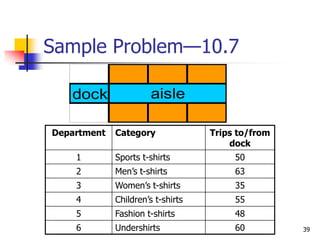
Sample Problem—10.7
dock aisle
Department Category Trips to/from
dock
1 Sports t-shirts 50
2 Men’s t-shirts 63
3 Women’s t-shirts 35
4 Children’s t-shirts 55
5 Fashion t-shirts 48
6 Undershirts 60 39
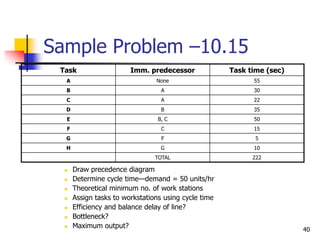
Sample Problem –10.15
 Draw precedence diagram
 Determine cycle time—demand = 50 units/hr
 Theoretical minimum no. of work stations
 Assign tasks to workstations using cycle time
 Efficiency and balance delay of line?
 Bottleneck?
 Maximum output?
Task Imm. predecessor Task time (sec)
A None 55
B A 30
C A 22
D B 35
E B, C 50
F C 15
G F 5
H G 10
TOTAL 222
40

facility layout.ppt

  • 1.
  • 2.
    2 Learning Objectives  Definelayout planning and explain its importance  Identify and describe different types of layouts  Compare process layouts & product layouts  Describe the steps involved in designing a process layout
  • 3.
    3 Learning Objectives –con’t  Describe the steps involved in designing a product layout  Explain the advantages of hybrid layouts  Define the meaning of group technology (cell) layouts
  • 4.
    4 What Is LayoutPlanning? Layout planning is deciding the best physical arrangement of all resources within a facility  Facility resource arrangement can significantly affect productivity  Two broad categories of operations:  Intermittent processing systems – low volume of many different products  Continuous processing systems – high volume of a few standardized products
  • 5.
    5 Types of Layouts Four basic layout types consisting of:  Process layouts - Group similar resources together  Product layouts - Designed to produce a specific product efficiently  Hybrid layouts - Combine aspects of both process and product layouts  Fixed-Position layouts - Product is two large to move; e.g. a building
  • 6.
    6 Process Layouts  Processlayout unique characteristics include:  Resources used are general purpose  Facilities are less capital intensive  Facilities are more labor intensive  Resources have greater flexibility  Processing rates are slower  Material handling costs are higher
  • 7.
    7 Process Layouts –con’t  Scheduling resources & work flow is more complex  Space requirements are higher
  • 8.
    8 Product Layouts  Productlayout unique characteristics are:  Resources are specialized  Facilities are capital intensive  Processing rates are faster  Material handling costs are lower  Space requirements for inventory storage are lower  Flexibility is low relative to the market
  • 9.
    9 Process vs. ProductLayouts Here are the characteristic differences between a process and product layout.
  • 10.
    10 Hybrid Layouts  Combineelements of both product & process layouts  Maintain some of the efficiencies of product layouts  Maintain some of the flexibility of process layouts  Examples:  Group technology & manufacturing cells  Grocery stores
  • 11.
    11 Fixed-Position Layout  Usedwhen product is large  Product is difficult or impossible to move, i.e. very large or fixed  All resources must be brought to the site  Scheduling of crews and resources is a challenge
  • 12.
    12 Designing Process Layouts Step1: Gather information: Space needed, space available, identify closeness measures Step 2: Develop alternative block plans: Using trial-and-error or decision support tools Step 3: Develop a detailed layout: Consider exact sizes/shapes of departments and work centers including aisles and stairways Tools like drawings, 3-D models, and CAD software are available to facilitate this process
  • 13.
    13 Special Cases ofProcess Layouts A number of unique process layouts require special attention. We will look at two of these:  Warehouse layouts  Office Layouts
  • 14.
    14 Warehouse Layouts Warehouse LayoutConsiderations:  Primary decision is where to locate each department relative to the dock  Departments can be organized to minimize “ld” totals  Departments of unequal size require modification of the typical ld calculations to include a calculation of the “ratio of trips to area needed”  The usage of “Crossdocking” modifies the traditional warehouse layouts; more docks, less storage space, and less order picking
  • 15.
    15 Office Layouts Office LayoutConsiderations:  Almost half of US workforce works in an office environment  Human interaction and communication are the primary factors in designing office layouts  Layouts need to account for physical environment and psychological needs of the organization  One key layout trade-off is between proximity and privacy  Open concept offices promote understanding & trust  Flexible layouts incorporating “office landscaping” help to solve the privacy issue in open office environments
  • 16.
    16 Designing Product Layouts Designing product layouts requires consideration of:  Sequence of tasks to be performed by each workstation  Logical order  Speed considerations – line balancing
  • 17.
    17 Designing Product Layouts– con’t Step 1: Identify tasks & immediate predecessors Step 2: Determine output rate Step 3: Determine cycle time Step 4: Compute the Theoretical Minimum number of Stations Step 5: Assign tasks to workstations (balance the line) Step 6: Compute efficiency, idle time & balance delay
  • 18.
    21 Layout Calculations con’t Step 5: Assign tasks to workstations  Start at the first station & choose the longest eligible task following precedence relationships  Continue adding the longest eligible task that fits without going over the desired cycle time  When no additional tasks can be added within the desired cycle time, begin assigning tasks to the next workstation until finished Workstation Eligible task Task Selected Task time Idle time A A 50 10 B B 5 5 C C 25 35 D D 15 20 E, F, G G 15 5 E, F E 12 48 F F 10 38 H H 18 20 I I 15 5 1 2 3
  • 19.
    23 Other Product LayoutConsiderations  Shape of the line (S, U, O, L):  Share resources, enhance communication & visibility, impact location of loading & unloading  Paced versus Un-paced lines  Paced lines use an automatically enforced cycle time  Number of Product Models produced  Single  Mixed-model lines
  • 20.
    24 Group Technology (CELL) Layouts One of the most popular hybrid layouts uses Group Technology (GT) and a cellular layout  GT has the advantage of bringing the efficiencies of a product layout to a process layout environment
  • 21.
    25 Process Flows beforethe Use of GT Cells
  • 22.
    26 Process Flows afterthe Use of GT Cells
  • 23.
    27 Facility Layout Acrossthe Organization Layout planning is organizationally important for an efficient operations  Marketing is affected by layout especially when clients come to the site  Human resources is affected as layout impacts people  Finance is involved as layout changes can be costly endeavors
  • 24.
    28 Facility Layout withinOM: How it all fits together  Layout decisions are directly related to issues of product design and process selection .  Job design, as process layouts tend to require greater worker skills than do product layouts  Degree of automation, as product layouts tend to be more capital intensive and use more automation compared to process layouts  Layout decisions are also affected by implementation of just-in-time (JIT) systems, which dictate a line flow and the use of group technology (GT) cells  As layout decisions specify the flow of goods through the facility, they impact all other aspects of operations management.
  • 25.
    29 Highlights  Layout planningis deciding on the best physical arrangement of all resources that consumes space within a facility. Proper layout planning is highly important for the efficient running of a business. Otherwise, there can be much wasted time and energy, as well as confusion.  There are four basic types of layouts: process, product, hybrid, and fixed position. Process layouts group resources based on similar processes. Product layouts arrange resources in straight-line fashion. Hybrid layouts combine elements of both process and product layouts. Fixed-position layouts occur when the product is larger and cannot be moved.
  • 26.
    30 Highlights – con’t Process layouts provide much flexibility and allow for the production of many products with differing characteristics. Product layouts, on the other hand, provide greater efficiency when producing one type of product.  The steps for designing process layouts are (1) gather information about space needs, space availability, and closeness requirements of departments; (2) developing a block plan or schematic of the layout; and (3) developing a detailed layout.
  • 27.
    31 Highlights – con’t The steps for designing an product layout are (1) identify tasks that need to be performed and their immediate predecessors; (2) determine output rate; (3) determine cycle time; (4) computing the theoretical minimum number of work stations, (5) assigning tasks to workstations; and (6) computing efficiency and balance delay.  Hybrids layouts have advantages over other layout types because they combine elements of both process and product layouts to increase efficiency.
  • 28.
    32 Highlights – con’t An example of hybrid layouts is group technology or cell layouts. Group technology is the process of crating groupings of products based on similar processing requirements. Cells are created for each grouping of products, resulting in a more orderly flow of products through the facility.
  • 29.
  • 30.
  • 31.
  • 32.
  • 33.
  • 34.
    Chapter 10 HomeworkHints  10.8: Assign sites based on number of trips (refer to Example 10.2). There is no strategy regarding which side of the aisle to assign—just nearness to the dock.  10.16: Follow the steps. This is a product layout (assembly line balancing). The book has an example on pages 360-366, which is also on the slides covered in class. 38
  • 35.
    Sample Problem—10.7 dock aisle DepartmentCategory Trips to/from dock 1 Sports t-shirts 50 2 Men’s t-shirts 63 3 Women’s t-shirts 35 4 Children’s t-shirts 55 5 Fashion t-shirts 48 6 Undershirts 60 39
  • 36.
    Sample Problem –10.15 Draw precedence diagram  Determine cycle time—demand = 50 units/hr  Theoretical minimum no. of work stations  Assign tasks to workstations using cycle time  Efficiency and balance delay of line?  Bottleneck?  Maximum output? Task Imm. predecessor Task time (sec) A None 55 B A 30 C A 22 D B 35 E B, C 50 F C 15 G F 5 H G 10 TOTAL 222 40