Middle Ear Implants
Dr. Adhishesh Kaul
Postgraduate Resident – ENT
Moderator: Dr Udayabhanu H.N.
Associate Professor – ENT
Introduction
• AMEI used where conventional hearing aids and bone conduction
devices can not be used
• These devices traditionally send signals to middle ear, which
mechanically vibrates the ossicles, increasing the vibrations going to
cochlea
Middle Ear Actions
Middle ear compensates for loss of energy, lost to reflected from
cochlear fluids
1. Hydraulic Action of Tympanic Membrane
2. Curved membrane effect
3. Lever action of ossicles
Need for development of AMEI
To overcome the short comings of conventional hearing aids
PHYSICAL FACTORS
1. Insufficient gain
2. Distortion of spectral shape and phase shift
3. Non Linear distortion
4. Acoustic Feedback
5. Occlusion effect
6. Discomfort
7. Canal irritation
Benefits of AMEI
Apart from overcoming the shortcomings of conventional hearing aids,
Other benefits include
1. Improved sound clarity
2. Does not use speakers for sound amplification
Shortcomings of AMEI
3. Use of postauricular microphone – causing loss of pinna effect
4. Formulation of a device that is small enough to fit in confines of
middle ear, yet powerful enough to produce required gain.
Characteristics
Transducer is coupled to middle ear ossicles or inner ear fluid
Indications
• SNHL with healthy middle ear
• Mixed hearing loss
• Middle ear abnormalities
Basic Design Features
1. Transducer design
2. Ossicular coupling
Piezoelectric transducer
Electromagnetic transducer
3. Implantable hearing device – Total vs Partial
Partial: external microphone and speech processor
connected to transmitter with external coil
Total: House all components within implanted portion of
device
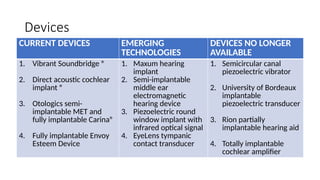
Devices
CURRENT DEVICES EMERGING
TECHNOLOGIES
DEVICES NO LONGER
AVAILABLE
1. Vibrant Soundbridge ®
2. Direct acoustic cochlear
implant ®
3. Otologics semi-
implantable MET and
fully implantable Carina®
4. Fully implantable Envoy
Esteem Device
1. Maxum hearing
implant
2. Semi-implantable
middle ear
electromagnetic
hearing device
3. Piezoelectric round
window implant with
infrared optical signal
4. EyeLens tympanic
contact transducer
1. Semicircular canal
piezoelectric vibrator
2. University of Bordeaux
implantable
piezoelectric transducer
3. Rion partially
implantable hearing aid
4. Totally implantable
cochlear amplifier
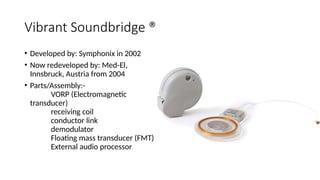
Vibrant Soundbridge ®
• Developed by: Symphonix in 2002
• Now redeveloped by: Med-El,
Innsbruck, Austria from 2004
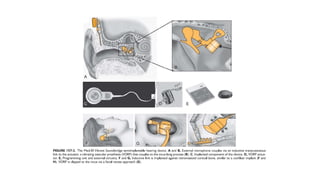
• Parts/Assembly:-
VORP (Electromagnetic
transducer)
receiving coil
conductor link
demodulator
Floating mass transducer (FMT)
External audio processor
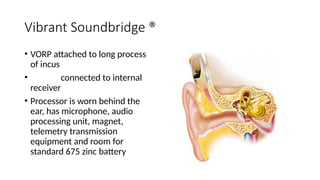
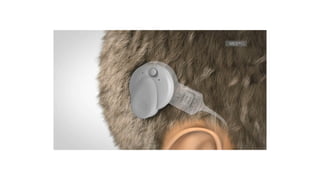
Vibrant Soundbridge ®
• VORP attached to long process
of incus
• connected to internal
receiver
• Processor is worn behind the
ear, has microphone, audio
processing unit, magnet,
telemetry transmission
equipment and room for
standard 675 zinc battery
Vibrant Soundbridge ®
• Mechanism
External processor: similar to conventional hearing aid
Sound picked by microphone and processed by external receiver
Sound sent by telemetry to internal receiver
Sound sent to demodulator – provides safety feature to limit maximum power
output and prevent overstimulation
Demodulator generates current to encode sound and travels to FMT
FMT vibrates through inducive interaction with magnet
Since FMT is firmly attached to Incus – Sound is transmitted to Ossicular Chain
Vibrant Soundbridge ®
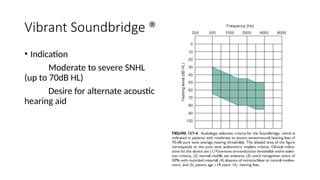
• Indication
Moderate to severe SNHL
(up to 70dB HL)
Desire for alternate acoustic
hearing aid
Vibrant Soundbridge ®
• Procedure
Implantation: Standard transmastoid facial recess approach
VORP: crimpled to long process of incus
Internal processor: placed in bony trough in retrosigmoid bone
• Limitations
Size of VORP: because of confined space between eardrum and
incus: dimension and mass of FMT is limited, restricting output
Incus erosion: due to ischemia at clip attachment site
Vibrant Soundbridge ®
• Results
Statistical improvement in functional gain at all frequencies,
greater than 10dB
No significant gain in Speech Recognition
Otologics™ Middle Ear Transducer
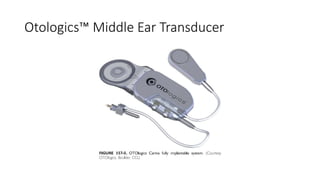
• Current: Fully implantable Carina™ device
• Previous: Semi-implantable – CE approved
• Assembly:
Subcutaneous microphone and receiver connected to transducer
Transducer drives probe connected to incus – body
Transducer tip: Aluminum oxide
Otologics™ Middle Ear Transducer
• Mechanism:
moves incus using linear actuator rigidly connected to edges of
mastoidectomy cavity
Actuator has electromagnetic transducer converting signal current into
axial movement of rods extending out of device to directly contact and
move incus.
Otologics™ Middle Ear Transducer
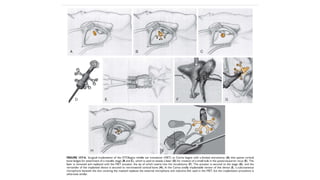
• Placement
Post auricular incision with 2cm superior atticotomy to expose
body of incus and head of malleus
KTP laser is used to create 0.75mm hole in body of incus
Bone well is drilled for electronics and microphone –
posterosuperior to atticotomy
Transducer tip in hole in Incus
Otologics™ Middle Ear Transducer
• Advantage
exert greater force on incus compared to VORP
• Complications
Device extrusion
Device electronic failures
• Results
Implantation caused NO SIGNIFICANT change in A-B gap
Mean gain at 12 months – 28dB
There has been no significant gain in word recognition scores.
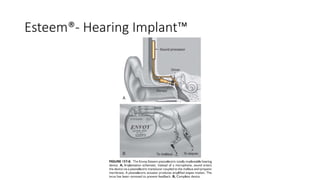
Esteem®- Hearing Implant™
• Fully implantable piezoelectric device
• Developed by Envoy Medical (formerly St. Croix Medical)
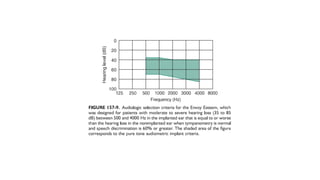
• Indication: Mild to Severe SNHL between 0.5kHz to 4kHz
Healthy ear with normal pneumatization
Normal tympanometry and speech discrimination score (>60%)
• Assembly: Piezoelectric sensor on incus body
Driver on stapes head
• Characteristic:
Use TM and Malleus as microphone diaphragm
Disarticulation of ossicular chain
Removal of lenticular process of incus (to prevent feedback from actuator)
Esteem®- Hearing Implant™
• Mechanism
Piezoelectric sensor transduces malleus motion into signal voltage
Signal Voltage – amplified
drives 2nd
piezoelectric actuator in contact with incus
• Power: Li-ion battery
• Control: radiofrequency transcutaneous link to handheld device
Direct Acoustic Cochlear Implant (DACI)
• Also known as Direct Acoustic Cochlear Stimulator (DACS)
• Implantable electromagnetic transducer
• Mechanism: transfers acoustic energy to inner ear directly via stapes
prosthesis
• Procedure: Stapes is removed in toto and 2nd
stapes prosthesis placed
parallel to 1st
prosthesis into Oval Window attached to Incus – To restore
natural sound transmission ossicular chain
• Indication: Profound hearing loss
Maxum® Hearing Implant
• Designed by: SOUNDTEC Direct Drive Hearing System (DDHS)
• Now sold by Ototronix since 2009
• Semi-implantable with electromagnetic transducer
• Implanted Part: Magnet attached to incudostapedial joint via titanium
alloy wire
• External Part: Electromagnetic coil in deep EAC
• Procedure: transmeatal approach
Semi-Implantable Middle ear electromagnetic
hearing device (SIMEHD)
• Magnet cemented to Incus body
• Titanium frame fixed to temporal bone – supporting implanted
electromagnetic coil
• Both magnet and coil encased in Titanium
• Animal trials – done
Piezoelectric round window implant with IR
optical signal
• Composed of micro transducer – on round window
microphone
sound processor
battery
• Receive power and signal transmission through IR optical transmitter
in external unit
• Advantage: Placed endaurally without mastoidectomy
EarLens Tympanic Contact Transducer
• Consists of magnet placed in silicon lens that sticks to TM by oil
induced surface tension
• Small induction coil is placed in ear canal
Patient Selection
Candidates
1. High frequency SNHL or Mixed HL
failure of amplification with
conventional hearing aids ± stapedotomy
bone conduction implants
2. No skin condition preventing attachment of external component
3. Medically fit for surgery and anesthesia
Audiological
• Mild to Severe SNHL
In case of Mixed / Conductive HL, AMEI helps overcome residual SN
component
• Stable hearing loss
Codacs system (DACI) is aimed for profound HL – otosclerosis
• Tympanometry and Acoustic reflex testing for middle ear function
• Speech audiometry is required to assess retrocochlear loss
WORSE HEARING EAR IS SELECTED FOR AMEI
Otological
• No retrocochlear and central involvement
• Controlled middle ear inflammation and infection
Beleites classification of various AMEI for
specific middle ear pathologies
• TYPE-A VIBROPLASTY: coupling AMEI on intact ossicular chain
mild to moderate SNHL
stapes footplate and head most favorable for
attachment
Ex: VSB, MHI, Carina
• TYPE-B VIBROPLASTY: aided hearing y AMEI coupled to remanent of
ossicular chain
• TYPE-C VIBROPLASTY: coupling of actuator on middle ear windows
• TYPE-D VIBROPLASTY: direct coupling of AMEI with inner ear fluid.
Most commonly used: Oval Window
Osteointegration
• Patients with CHL or Mixed hearing loss are treated with standard
surgical techniques, or rehabilitated with traditional hearing aids
However large subset remain untreated
1. Not fit for surgery
2. Do not tolerate conventional hearing aids
3. Chronically discharging ears
4. Large mastoid bowl or meatoplasty
5. EAC closure for skull base surgeries
FOR THESE PATIENTS OBHP HAVE BEEN DEVELOPED
Osteointegration
• Conventional Bone-conducting hearing aid
Limitations
pain, headache, skin irritation
sound fidelity due to soft tissue attenuation
variable placement of vibrator
flaccidity of securing device
Osteointegration
• Coupling bone vibrator to osseointegrated device by Tjellstorm in 1977
• Titanium has ability to get anchored to bone without interposed soft
tissue and with reaction free epithelial penetration
• Availability of Titanium
pure titanium : 99.75%
Titanium alloy : 90% titanium 6% Aluminum and 4% Vanadium
• Titanium Advantages
tightly bonded corrosion resistant oxide layer on surface of implant
Thank You

Active Middle Ear Implants for hearing rehab

  • 1.
    Middle Ear Implants Dr.Adhishesh Kaul Postgraduate Resident – ENT Moderator: Dr Udayabhanu H.N. Associate Professor – ENT
  • 2.
    Introduction • AMEI usedwhere conventional hearing aids and bone conduction devices can not be used • These devices traditionally send signals to middle ear, which mechanically vibrates the ossicles, increasing the vibrations going to cochlea
  • 3.
    Middle Ear Actions Middleear compensates for loss of energy, lost to reflected from cochlear fluids 1. Hydraulic Action of Tympanic Membrane 2. Curved membrane effect 3. Lever action of ossicles
  • 4.
    Need for developmentof AMEI To overcome the short comings of conventional hearing aids PHYSICAL FACTORS 1. Insufficient gain 2. Distortion of spectral shape and phase shift 3. Non Linear distortion 4. Acoustic Feedback 5. Occlusion effect 6. Discomfort 7. Canal irritation
  • 5.
    Benefits of AMEI Apartfrom overcoming the shortcomings of conventional hearing aids, Other benefits include 1. Improved sound clarity 2. Does not use speakers for sound amplification Shortcomings of AMEI 3. Use of postauricular microphone – causing loss of pinna effect 4. Formulation of a device that is small enough to fit in confines of middle ear, yet powerful enough to produce required gain.
  • 6.
    Characteristics Transducer is coupledto middle ear ossicles or inner ear fluid
  • 7.
    Indications • SNHL withhealthy middle ear • Mixed hearing loss • Middle ear abnormalities
  • 8.
    Basic Design Features 1.Transducer design 2. Ossicular coupling Piezoelectric transducer Electromagnetic transducer 3. Implantable hearing device – Total vs Partial Partial: external microphone and speech processor connected to transmitter with external coil Total: House all components within implanted portion of device
  • 9.
    Devices CURRENT DEVICES EMERGING TECHNOLOGIES DEVICESNO LONGER AVAILABLE 1. Vibrant Soundbridge ® 2. Direct acoustic cochlear implant ® 3. Otologics semi- implantable MET and fully implantable Carina® 4. Fully implantable Envoy Esteem Device 1. Maxum hearing implant 2. Semi-implantable middle ear electromagnetic hearing device 3. Piezoelectric round window implant with infrared optical signal 4. EyeLens tympanic contact transducer 1. Semicircular canal piezoelectric vibrator 2. University of Bordeaux implantable piezoelectric transducer 3. Rion partially implantable hearing aid 4. Totally implantable cochlear amplifier
  • 10.
    Vibrant Soundbridge ® •Developed by: Symphonix in 2002 • Now redeveloped by: Med-El, Innsbruck, Austria from 2004 • Parts/Assembly:- VORP (Electromagnetic transducer) receiving coil conductor link demodulator Floating mass transducer (FMT) External audio processor
  • 11.
    Vibrant Soundbridge ® •VORP attached to long process of incus • connected to internal receiver • Processor is worn behind the ear, has microphone, audio processing unit, magnet, telemetry transmission equipment and room for standard 675 zinc battery
  • 12.
    Vibrant Soundbridge ® •Mechanism External processor: similar to conventional hearing aid Sound picked by microphone and processed by external receiver Sound sent by telemetry to internal receiver Sound sent to demodulator – provides safety feature to limit maximum power output and prevent overstimulation Demodulator generates current to encode sound and travels to FMT FMT vibrates through inducive interaction with magnet Since FMT is firmly attached to Incus – Sound is transmitted to Ossicular Chain
  • 13.
    Vibrant Soundbridge ® •Indication Moderate to severe SNHL (up to 70dB HL) Desire for alternate acoustic hearing aid
  • 14.
    Vibrant Soundbridge ® •Procedure Implantation: Standard transmastoid facial recess approach VORP: crimpled to long process of incus Internal processor: placed in bony trough in retrosigmoid bone • Limitations Size of VORP: because of confined space between eardrum and incus: dimension and mass of FMT is limited, restricting output Incus erosion: due to ischemia at clip attachment site
  • 17.
    Vibrant Soundbridge ® •Results Statistical improvement in functional gain at all frequencies, greater than 10dB No significant gain in Speech Recognition
  • 18.
  • 19.
    Otologics™ Middle EarTransducer • Current: Fully implantable Carina™ device • Previous: Semi-implantable – CE approved • Assembly: Subcutaneous microphone and receiver connected to transducer Transducer drives probe connected to incus – body Transducer tip: Aluminum oxide
  • 20.
    Otologics™ Middle EarTransducer • Mechanism: moves incus using linear actuator rigidly connected to edges of mastoidectomy cavity Actuator has electromagnetic transducer converting signal current into axial movement of rods extending out of device to directly contact and move incus.
  • 21.
    Otologics™ Middle EarTransducer • Placement Post auricular incision with 2cm superior atticotomy to expose body of incus and head of malleus KTP laser is used to create 0.75mm hole in body of incus Bone well is drilled for electronics and microphone – posterosuperior to atticotomy Transducer tip in hole in Incus
  • 23.
    Otologics™ Middle EarTransducer • Advantage exert greater force on incus compared to VORP • Complications Device extrusion Device electronic failures • Results Implantation caused NO SIGNIFICANT change in A-B gap Mean gain at 12 months – 28dB There has been no significant gain in word recognition scores.
  • 25.
  • 26.
    Esteem®- Hearing Implant™ •Fully implantable piezoelectric device • Developed by Envoy Medical (formerly St. Croix Medical) • Indication: Mild to Severe SNHL between 0.5kHz to 4kHz Healthy ear with normal pneumatization Normal tympanometry and speech discrimination score (>60%) • Assembly: Piezoelectric sensor on incus body Driver on stapes head • Characteristic: Use TM and Malleus as microphone diaphragm Disarticulation of ossicular chain Removal of lenticular process of incus (to prevent feedback from actuator)
  • 27.
    Esteem®- Hearing Implant™ •Mechanism Piezoelectric sensor transduces malleus motion into signal voltage Signal Voltage – amplified drives 2nd piezoelectric actuator in contact with incus • Power: Li-ion battery • Control: radiofrequency transcutaneous link to handheld device
  • 29.
    Direct Acoustic CochlearImplant (DACI) • Also known as Direct Acoustic Cochlear Stimulator (DACS) • Implantable electromagnetic transducer • Mechanism: transfers acoustic energy to inner ear directly via stapes prosthesis • Procedure: Stapes is removed in toto and 2nd stapes prosthesis placed parallel to 1st prosthesis into Oval Window attached to Incus – To restore natural sound transmission ossicular chain • Indication: Profound hearing loss
  • 30.
    Maxum® Hearing Implant •Designed by: SOUNDTEC Direct Drive Hearing System (DDHS) • Now sold by Ototronix since 2009 • Semi-implantable with electromagnetic transducer • Implanted Part: Magnet attached to incudostapedial joint via titanium alloy wire • External Part: Electromagnetic coil in deep EAC • Procedure: transmeatal approach
  • 33.
    Semi-Implantable Middle earelectromagnetic hearing device (SIMEHD) • Magnet cemented to Incus body • Titanium frame fixed to temporal bone – supporting implanted electromagnetic coil • Both magnet and coil encased in Titanium • Animal trials – done
  • 34.
    Piezoelectric round windowimplant with IR optical signal • Composed of micro transducer – on round window microphone sound processor battery • Receive power and signal transmission through IR optical transmitter in external unit • Advantage: Placed endaurally without mastoidectomy
  • 35.
    EarLens Tympanic ContactTransducer • Consists of magnet placed in silicon lens that sticks to TM by oil induced surface tension • Small induction coil is placed in ear canal
  • 36.
  • 37.
    Candidates 1. High frequencySNHL or Mixed HL failure of amplification with conventional hearing aids ± stapedotomy bone conduction implants 2. No skin condition preventing attachment of external component 3. Medically fit for surgery and anesthesia
  • 38.
    Audiological • Mild toSevere SNHL In case of Mixed / Conductive HL, AMEI helps overcome residual SN component • Stable hearing loss Codacs system (DACI) is aimed for profound HL – otosclerosis • Tympanometry and Acoustic reflex testing for middle ear function • Speech audiometry is required to assess retrocochlear loss WORSE HEARING EAR IS SELECTED FOR AMEI
  • 39.
    Otological • No retrocochlearand central involvement • Controlled middle ear inflammation and infection
  • 40.
    Beleites classification ofvarious AMEI for specific middle ear pathologies • TYPE-A VIBROPLASTY: coupling AMEI on intact ossicular chain mild to moderate SNHL stapes footplate and head most favorable for attachment Ex: VSB, MHI, Carina • TYPE-B VIBROPLASTY: aided hearing y AMEI coupled to remanent of ossicular chain • TYPE-C VIBROPLASTY: coupling of actuator on middle ear windows • TYPE-D VIBROPLASTY: direct coupling of AMEI with inner ear fluid. Most commonly used: Oval Window
  • 41.
    Osteointegration • Patients withCHL or Mixed hearing loss are treated with standard surgical techniques, or rehabilitated with traditional hearing aids However large subset remain untreated 1. Not fit for surgery 2. Do not tolerate conventional hearing aids 3. Chronically discharging ears 4. Large mastoid bowl or meatoplasty 5. EAC closure for skull base surgeries FOR THESE PATIENTS OBHP HAVE BEEN DEVELOPED
  • 42.
    Osteointegration • Conventional Bone-conductinghearing aid Limitations pain, headache, skin irritation sound fidelity due to soft tissue attenuation variable placement of vibrator flaccidity of securing device
  • 43.
    Osteointegration • Coupling bonevibrator to osseointegrated device by Tjellstorm in 1977 • Titanium has ability to get anchored to bone without interposed soft tissue and with reaction free epithelial penetration • Availability of Titanium pure titanium : 99.75% Titanium alloy : 90% titanium 6% Aluminum and 4% Vanadium • Titanium Advantages tightly bonded corrosion resistant oxide layer on surface of implant
  • 44.

Editor's Notes

  • #4 Distortion of spectral shape and phase shift: loss of bass and treble as most hearing aids are optimized for performance between 500-2k Hz
  • #6 Coupling mechanism: the way transducer is connected to middle ear ossicles or inner ear fluid.
  • #37 Cause of failure Acoustic feedback Occlusion effect Insufficient high frequency amplification Wearing discomfort