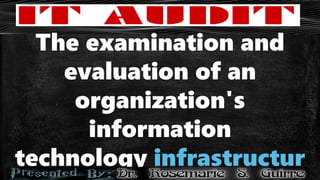

The examination and
evaluation of an
organization's
information
technology infrastructur
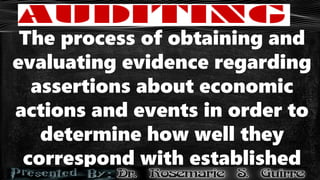
The process of obtaining and
evaluating evidence regarding
assertions about economic
actions and events in order to
determine how well they
correspond with established
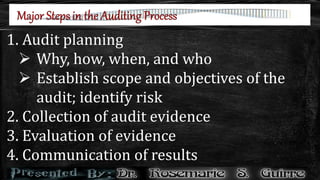
1. Audit planning
 Why, how, when, and who
 Establish scope and objectives of the
audit; identify risk
2. Collection of audit evidence
3. Evaluation of evidence
4. Communication of results
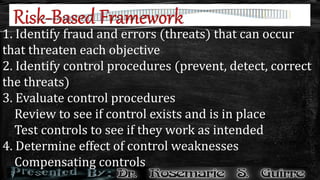
1. Identify fraud and errors (threats) that can occur
that threaten each objective
2. Identify control procedures (prevent, detect, correct
the threats)
3. Evaluate control procedures
Review to see if control exists and is in place
Test controls to see if they work as intended
4. Determine effect of control weaknesses
Compensating controls
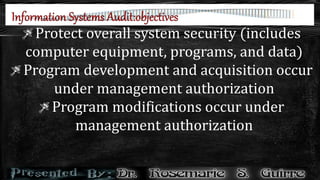
ZProtect overall system security (includes
computer equipment, programs, and data)
ZProgram development and acquisition occur
under management authorization
ZProgram modifications occur under
management authorization
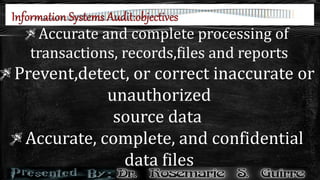
ZAccurate and complete processing of
transactions, records,files and reports
ZPrevent,detect, or correct inaccurate or
unauthorized
source data
ZAccurate, complete, and confidential
data files
•Integrated Test Facility
•Snapshot Technique
•System Control Audit Review File (SCARF)
•Audit Hooks
•Continuous and Intermittent Simulation
•Integrated Test Facility
▫Uses fictitious inputs
•Snapshot Technique
▫Master files before and after update are stored for
specially marked transactions
•System Control Audit Review File (SCARF)
▫Continuous monitoring and storing of
transactions that meet pre-specifications
•Audit Hooks
▫Notify auditors of questionable
transactions
•Continuous and Intermittent
Simulation
▫Similar to SCARF for DBMS
Automated Audit
Workpapers
Data Analysis
Risk Assessment
Scheduling
Timekeeping
Flowcharting
Report
Generation
Computer Audit Software
can perform audit tasks on a
copy of a company’s data.
Operational Audits
To evaluate effectiveness, efficiency, and
goal achievement. Although the basic
audit steps are the same, the specific
activities of evidence collection are
focused toward operations.
Auditing information System

Auditing information System

  • 3.
    The examination and evaluationof an organization's information technology infrastructur
  • 4.
    The process ofobtaining and evaluating evidence regarding assertions about economic actions and events in order to determine how well they correspond with established
  • 5.
    1. Audit planning Why, how, when, and who  Establish scope and objectives of the audit; identify risk 2. Collection of audit evidence 3. Evaluation of evidence 4. Communication of results
  • 6.
    1. Identify fraudand errors (threats) that can occur that threaten each objective 2. Identify control procedures (prevent, detect, correct the threats) 3. Evaluate control procedures Review to see if control exists and is in place Test controls to see if they work as intended 4. Determine effect of control weaknesses Compensating controls
  • 7.
    ZProtect overall systemsecurity (includes computer equipment, programs, and data) ZProgram development and acquisition occur under management authorization ZProgram modifications occur under management authorization
  • 8.
    ZAccurate and completeprocessing of transactions, records,files and reports ZPrevent,detect, or correct inaccurate or unauthorized source data ZAccurate, complete, and confidential data files
  • 9.
    •Integrated Test Facility •SnapshotTechnique •System Control Audit Review File (SCARF) •Audit Hooks •Continuous and Intermittent Simulation
  • 10.
    •Integrated Test Facility ▫Usesfictitious inputs •Snapshot Technique ▫Master files before and after update are stored for specially marked transactions •System Control Audit Review File (SCARF) ▫Continuous monitoring and storing of transactions that meet pre-specifications
  • 11.
    •Audit Hooks ▫Notify auditorsof questionable transactions •Continuous and Intermittent Simulation ▫Similar to SCARF for DBMS
  • 12.
    Automated Audit Workpapers Data Analysis RiskAssessment Scheduling Timekeeping Flowcharting Report Generation
  • 13.
    Computer Audit Software canperform audit tasks on a copy of a company’s data.
  • 14.
    Operational Audits To evaluateeffectiveness, efficiency, and goal achievement. Although the basic audit steps are the same, the specific activities of evidence collection are focused toward operations.

Editor's Notes

  • #4 Information technology audits determine whether IT controls protect corporate assets, ensure data integrity and are aligned with the business's overall goals. IT auditors examine not only physical security controls, but also overall business and financial controls that involve information technology systems.
  • #8 Using the risk-based framework for an information systems audit allows the auditor to review and evaluate internal controls that protect the system to meet each of the following objectives:
  • #9 Using the risk-based framework for an information systems audit allows the auditor to review and evaluate internal controls that protect the system to meet each of the following objectives:
  • #15 Review operating policies and documentation Confirm procedures with management and operating personnel Observe operating functions and activities Examine financial and operating plans and reports Test accuracy of operating information Test operational controls