Lecture-Auditing
Audit Definition & Objectives
 AUDIT is “An unbiased assessment and verification of a company's
corresponding records and supporting documents, externally or
internally”
 While QUALITY AUDIT means the process of systematic examination of
a quality system carried out by an internal or external quality auditor or
an audit team. It is an important part of organization's quality
management system.
It is a fact finding practice which is different from inspection which is
mainly a defect finding activity.
Purpose of Audit
The purpose of audit is to help determine:
 The adequacy and compliance level of a system or process/es &
 The effectiveness in achieving any defined target levels
And it is done by collecting objective evidences of implemented
system or process/es
Characteristics of an Audit
 Systematic
 Independent
 Documented process
 Obtaining audit evidences
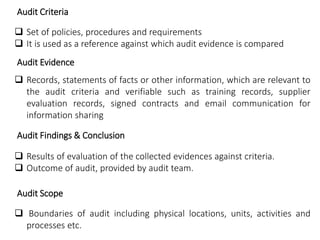
Audit Criteria
 Set of policies, procedures and requirements
 It is used as a reference against which audit evidence is compared
Audit Evidence
 Records, statements of facts or other information, which are relevant to
the audit criteria and verifiable such as training records, supplier
evaluation records, signed contracts and email communication for
information sharing
Audit Findings & Conclusion
 Results of evaluation of the collected evidences against criteria.
 Outcome of audit, provided by audit team.
 Boundaries of audit including physical locations, units, activities and
processes etc.
Audit Scope
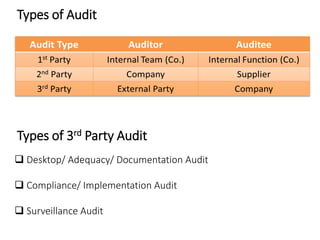
Types of Audit
Types of 3rd Party Audit
 Desktop/ Adequacy/ Documentation Audit
 Compliance/ Implementation Audit
 Surveillance Audit
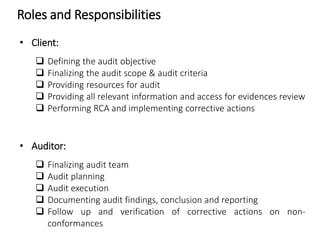
Roles and Responsibilities
• Client:
 Defining the audit objective
 Finalizing the audit scope & audit criteria
 Providing resources for audit
 Providing all relevant information and access for evidences review
 Performing RCA and implementing corrective actions
• Auditor:
 Finalizing audit team
 Audit planning
 Audit execution
 Documenting audit findings, conclusion and reporting
 Follow up and verification of corrective actions on non-
conformances
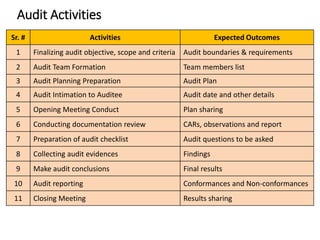
Audit Activities
Sr. # Activities Expected Outcomes
1 Finalizing audit objective, scope and criteria Audit boundaries & requirements
2 Audit Team Formation Team members list
3 Audit Planning Preparation Audit Plan
4 Audit Intimation to Auditee Audit date and other details
5 Opening Meeting Conduct Plan sharing
6 Conducting documentation review CARs, observations and report
7 Preparation of audit checklist Audit questions to be asked
8 Collecting audit evidences Findings
9 Make audit conclusions Final results
10 Audit reporting Conformances and Non-conformances
11 Closing Meeting Results sharing
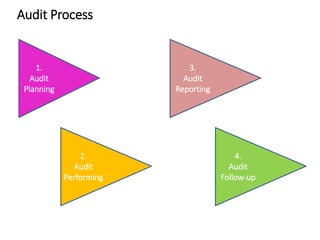
Audit Process
1.
Audit
Planning
2.
Audit
Performing
4.
Audit
Follow-up
3.
Audit
Reporting
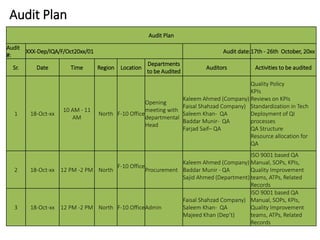
Audit Plan
Audit Plan
Audit
#:
XXX-Dep/IQA/F/Oct20xx/01 Audit date:17th - 26th October, 20xx
Sr. Date Time Region Location
Departments
to be Audited
Auditors Activities to be audited
1 18-Oct-xx
10 AM - 11
AM
North F-10 Office
Opening
meeting with
departmental
Head
Kaleem Ahmed (Company)
Faisal Shahzad Company)
Saleem Khan- QA
Baddar Munir- QA
Farjad Saif– QA
Quality Policy
KPIs
Reviews on KPIs
Standardization in Tech
Deployment of QI
processes
QA Structure
Resource allocation for
QA
2 18-Oct-xx 12 PM -2 PM North
F-10 Office
Procurement
Kaleem Ahmed (Company)
Baddar Munir - QA
Sajid Ahmed (Department)
ISO 9001 based QA
Manual, SOPs, KPIs,
Quality Improvement
teams, ATPs, Related
Records
3 18-Oct-xx 12 PM -2 PM North F-10 OfficeAdmin
Faisal Shahzad Company)
Saleem Khan- QA
Majeed Khan (Dep’t)
ISO 9001 based QA
Manual, SOPs, KPIs,
Quality Improvement
teams, ATPs, Related
Records
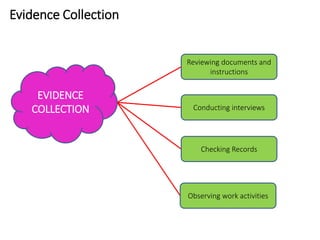
Evidence Collection
Reviewing documents and
instructions
Conducting interviews
Checking Records
Observing work activities
EVIDENCE
COLLECTION
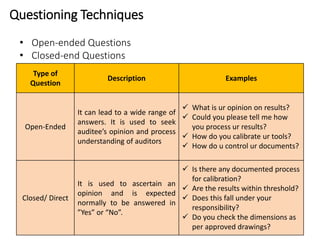
Questioning Techniques
• Open-ended Questions
• Closed-end Questions
Type of
Question
Description Examples
Open-Ended
It can lead to a wide range of
answers. It is used to seek
auditee’s opinion and process
understanding of auditors
 What is ur opinion on results?
 Could you please tell me how
you process ur results?
 How do you calibrate ur tools?
 How do u control ur documents?
Closed/ Direct
It is used to ascertain an
opinion and is expected
normally to be answered in
”Yes” or “No”.
 Is there any documented process
for calibration?
 Are the results within threshold?
 Does this fall under your
responsibility?
 Do you check the dimensions as
per approved drawings?
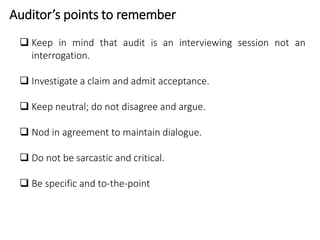
Auditor’s points to remember
 Keep in mind that audit is an interviewing session not an
interrogation.
 Investigate a claim and admit acceptance.
 Keep neutral; do not disagree and argue.
 Nod in agreement to maintain dialogue.
 Do not be sarcastic and critical.
 Be specific and to-the-point
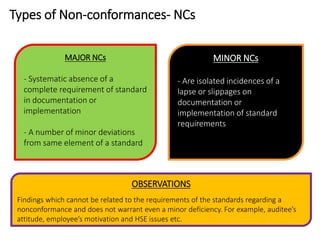
Types of Non-conformances- NCs
MAJOR NCs
- Systematic absence of a
complete requirement of standard
in documentation or
implementation
- A number of minor deviations
from same element of a standard
MINOR NCs
- Are isolated incidences of a
lapse or slippages on
documentation or
implementation of standard
requirements
OBSERVATIONS
Findings which cannot be related to the requirements of the standards regarding a
nonconformance and does not warrant even a minor deficiency. For example, auditee’s
attitude, employee’s motivation and HSE issues etc.
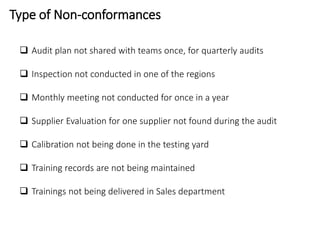
Type of Non-conformances
 Audit plan not shared with teams once, for quarterly audits
 Inspection not conducted in one of the regions
 Monthly meeting not conducted for once in a year
 Supplier Evaluation for one supplier not found during the audit
 Calibration not being done in the testing yard
 Training records are not being maintained
 Trainings not being delivered in Sales department
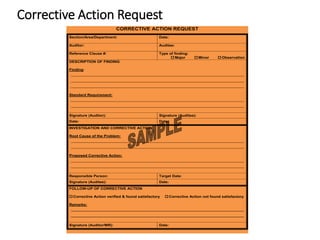
Corrective Action Request
CORRECTIVE ACTION REQUEST
Section/Area/Department: Date:
Auditor: Auditee:
Reference Clause #: Type of finding:
 Major  Minor  Observation
DESCRIPTION OF FINDING
Finding:
_______________________________________________________________________________
_______________________________________________________________________________
_______________________________________________________________________________
Standard Requirement:
_______________________________________________________________________________
_______________________________________________________________________________
Signature (Auditor): Signature (Auditee):
Date: Date:
INVESTIGATION AND CORRECTIVE ACTION
Root Cause of the Problem:
_______________________________________________________________________________
_______________________________________________________________________________
Proposed Corrective Action:
_______________________________________________________________________________
_______________________________________________________________________________
Responsible Person: Target Date:
Signature (Auditee): Date:
FOLLOW-UP OF CORRECTIVE ACTION
 Corrective Action verified & found satisfactory  Corrective Action not found satisfactory
Remarks:
_______________________________________________________________________________
_______________________________________________________________________________
Signature (Auditor/MR): Date:
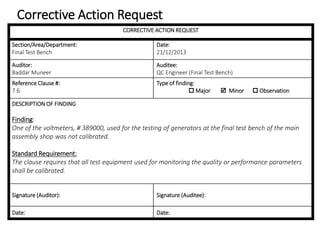
Corrective Action Request
CORRECTIVE ACTION REQUEST
Section/Area/Department:
Final Test Bench
Date:
21/12/2013
Auditor:
Baddar Muneer
Auditee:
QC Engineer (Final Test Bench)
Reference Clause #:
7.6
Type of finding:
 Major  Minor  Observation
DESCRIPTION OF FINDING
Finding:
One of the voltmeters, # 389000, used for the testing of generators at the final test bench of the main
assembly shop was not calibrated.
Standard Requirement:
The clause requires that all test equipment used for monitoring the quality or performance parameters
shall be calibrated.
Signature (Auditor): Signature (Auditee):
Date: Date:

Auditing.pdf

  • 1.
  • 3.
    Audit Definition &Objectives  AUDIT is “An unbiased assessment and verification of a company's corresponding records and supporting documents, externally or internally”  While QUALITY AUDIT means the process of systematic examination of a quality system carried out by an internal or external quality auditor or an audit team. It is an important part of organization's quality management system. It is a fact finding practice which is different from inspection which is mainly a defect finding activity.
  • 4.
    Purpose of Audit Thepurpose of audit is to help determine:  The adequacy and compliance level of a system or process/es &  The effectiveness in achieving any defined target levels And it is done by collecting objective evidences of implemented system or process/es Characteristics of an Audit  Systematic  Independent  Documented process  Obtaining audit evidences
  • 5.
    Audit Criteria  Setof policies, procedures and requirements  It is used as a reference against which audit evidence is compared Audit Evidence  Records, statements of facts or other information, which are relevant to the audit criteria and verifiable such as training records, supplier evaluation records, signed contracts and email communication for information sharing Audit Findings & Conclusion  Results of evaluation of the collected evidences against criteria.  Outcome of audit, provided by audit team.  Boundaries of audit including physical locations, units, activities and processes etc. Audit Scope
  • 6.
    Types of Audit Typesof 3rd Party Audit  Desktop/ Adequacy/ Documentation Audit  Compliance/ Implementation Audit  Surveillance Audit
  • 7.
    Roles and Responsibilities •Client:  Defining the audit objective  Finalizing the audit scope & audit criteria  Providing resources for audit  Providing all relevant information and access for evidences review  Performing RCA and implementing corrective actions • Auditor:  Finalizing audit team  Audit planning  Audit execution  Documenting audit findings, conclusion and reporting  Follow up and verification of corrective actions on non- conformances
  • 8.
    Audit Activities Sr. #Activities Expected Outcomes 1 Finalizing audit objective, scope and criteria Audit boundaries & requirements 2 Audit Team Formation Team members list 3 Audit Planning Preparation Audit Plan 4 Audit Intimation to Auditee Audit date and other details 5 Opening Meeting Conduct Plan sharing 6 Conducting documentation review CARs, observations and report 7 Preparation of audit checklist Audit questions to be asked 8 Collecting audit evidences Findings 9 Make audit conclusions Final results 10 Audit reporting Conformances and Non-conformances 11 Closing Meeting Results sharing
  • 9.
  • 10.
    Audit Plan Audit Plan Audit #: XXX-Dep/IQA/F/Oct20xx/01Audit date:17th - 26th October, 20xx Sr. Date Time Region Location Departments to be Audited Auditors Activities to be audited 1 18-Oct-xx 10 AM - 11 AM North F-10 Office Opening meeting with departmental Head Kaleem Ahmed (Company) Faisal Shahzad Company) Saleem Khan- QA Baddar Munir- QA Farjad Saif– QA Quality Policy KPIs Reviews on KPIs Standardization in Tech Deployment of QI processes QA Structure Resource allocation for QA 2 18-Oct-xx 12 PM -2 PM North F-10 Office Procurement Kaleem Ahmed (Company) Baddar Munir - QA Sajid Ahmed (Department) ISO 9001 based QA Manual, SOPs, KPIs, Quality Improvement teams, ATPs, Related Records 3 18-Oct-xx 12 PM -2 PM North F-10 OfficeAdmin Faisal Shahzad Company) Saleem Khan- QA Majeed Khan (Dep’t) ISO 9001 based QA Manual, SOPs, KPIs, Quality Improvement teams, ATPs, Related Records
  • 11.
    Evidence Collection Reviewing documentsand instructions Conducting interviews Checking Records Observing work activities EVIDENCE COLLECTION
  • 12.
    Questioning Techniques • Open-endedQuestions • Closed-end Questions Type of Question Description Examples Open-Ended It can lead to a wide range of answers. It is used to seek auditee’s opinion and process understanding of auditors  What is ur opinion on results?  Could you please tell me how you process ur results?  How do you calibrate ur tools?  How do u control ur documents? Closed/ Direct It is used to ascertain an opinion and is expected normally to be answered in ”Yes” or “No”.  Is there any documented process for calibration?  Are the results within threshold?  Does this fall under your responsibility?  Do you check the dimensions as per approved drawings?
  • 13.
    Auditor’s points toremember  Keep in mind that audit is an interviewing session not an interrogation.  Investigate a claim and admit acceptance.  Keep neutral; do not disagree and argue.  Nod in agreement to maintain dialogue.  Do not be sarcastic and critical.  Be specific and to-the-point
  • 14.
    Types of Non-conformances-NCs MAJOR NCs - Systematic absence of a complete requirement of standard in documentation or implementation - A number of minor deviations from same element of a standard MINOR NCs - Are isolated incidences of a lapse or slippages on documentation or implementation of standard requirements OBSERVATIONS Findings which cannot be related to the requirements of the standards regarding a nonconformance and does not warrant even a minor deficiency. For example, auditee’s attitude, employee’s motivation and HSE issues etc.
  • 15.
    Type of Non-conformances Audit plan not shared with teams once, for quarterly audits  Inspection not conducted in one of the regions  Monthly meeting not conducted for once in a year  Supplier Evaluation for one supplier not found during the audit  Calibration not being done in the testing yard  Training records are not being maintained  Trainings not being delivered in Sales department
  • 16.
    Corrective Action Request CORRECTIVEACTION REQUEST Section/Area/Department: Date: Auditor: Auditee: Reference Clause #: Type of finding:  Major  Minor  Observation DESCRIPTION OF FINDING Finding: _______________________________________________________________________________ _______________________________________________________________________________ _______________________________________________________________________________ Standard Requirement: _______________________________________________________________________________ _______________________________________________________________________________ Signature (Auditor): Signature (Auditee): Date: Date: INVESTIGATION AND CORRECTIVE ACTION Root Cause of the Problem: _______________________________________________________________________________ _______________________________________________________________________________ Proposed Corrective Action: _______________________________________________________________________________ _______________________________________________________________________________ Responsible Person: Target Date: Signature (Auditee): Date: FOLLOW-UP OF CORRECTIVE ACTION  Corrective Action verified & found satisfactory  Corrective Action not found satisfactory Remarks: _______________________________________________________________________________ _______________________________________________________________________________ Signature (Auditor/MR): Date:
  • 17.
    Corrective Action Request CORRECTIVEACTION REQUEST Section/Area/Department: Final Test Bench Date: 21/12/2013 Auditor: Baddar Muneer Auditee: QC Engineer (Final Test Bench) Reference Clause #: 7.6 Type of finding:  Major  Minor  Observation DESCRIPTION OF FINDING Finding: One of the voltmeters, # 389000, used for the testing of generators at the final test bench of the main assembly shop was not calibrated. Standard Requirement: The clause requires that all test equipment used for monitoring the quality or performance parameters shall be calibrated. Signature (Auditor): Signature (Auditee): Date: Date: