ASSIGNMENT
SUBJECT – FOREST EXTENSION AND COMMUNITY FORESTRY
TOPIC – AUDIO VISUAL AIDS
NAME – ROHAN PANWAR
COURSE – B.SC FORESTRY (HONS)
SEMESTER – 5TH
SUBMITTED TO – Ms. PRATIKSHA RAJ
AUDIO VISUAL AIDS
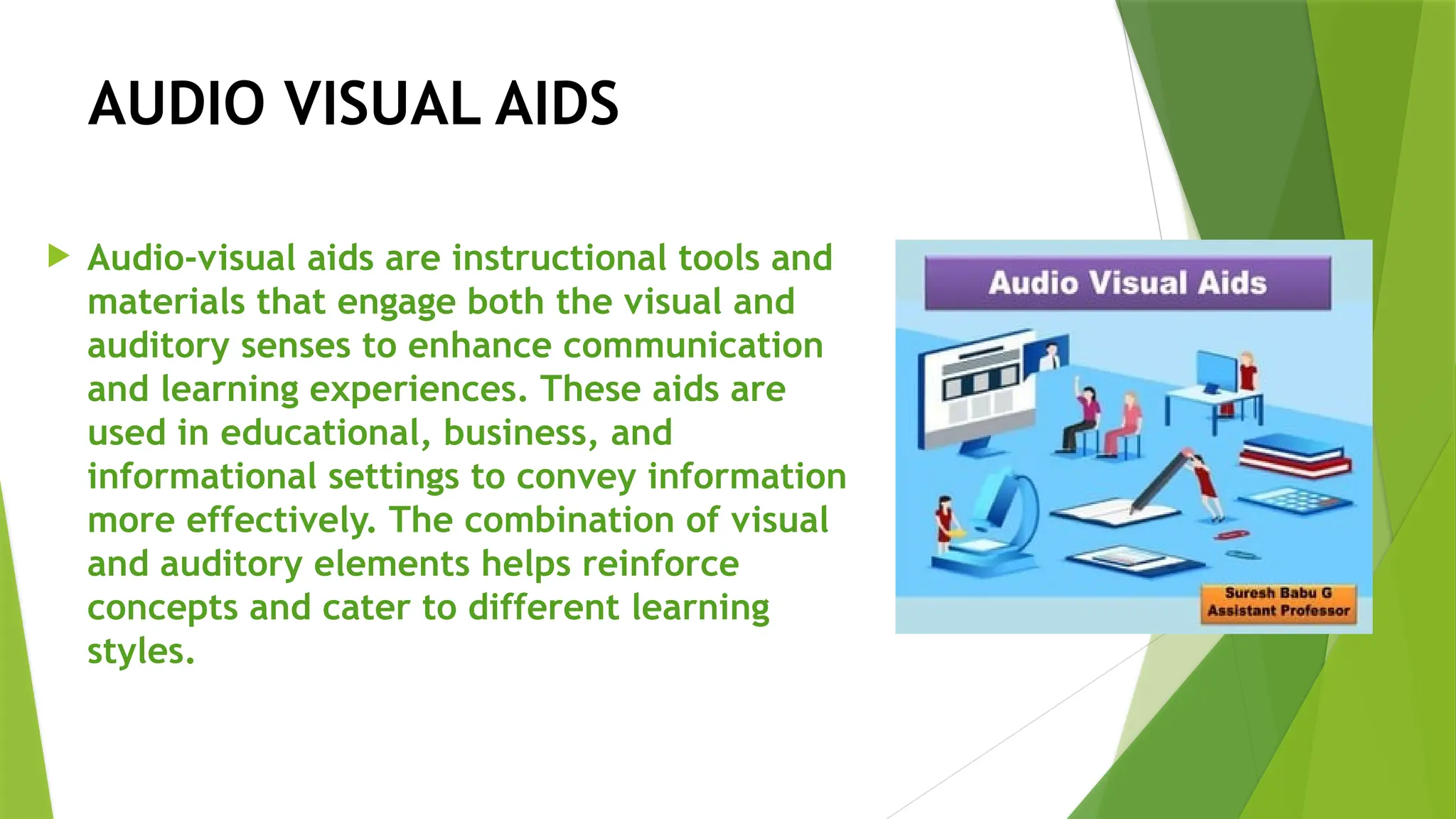
 Audio-visual aids are instructional tools and
materials that engage both the visual and
auditory senses to enhance communication
and learning experiences. These aids are
used in educational, business, and
informational settings to convey information
more effectively. The combination of visual
and auditory elements helps reinforce
concepts and cater to different learning
styles.
PURPOSE:
Antidote to the disease of verbal instructions
Best motivation
Clear images
Vicarious experience
Variety of stimulation
Opportunities to handle and manipulate
 Retention
CHARACTERISTICS OF A SMART AUDIO-
VISUAL AIDS:
Relevancy: Smart audio-visual aids are directly pertinent to the topic or
learning objectives, ensuring their alignment with the content being
presented.
Accuracy: Information presented through smart audio-visual aids is precise,
reliable, and free from errors to maintain educational integrity.
Interest: They are designed to captivate and sustain the audience’s interest,
fostering engagement and participation.
Understandability: Smart audio-visual aids use clear and comprehensible
visuals and language, promoting easy understanding of the presented
material.
 Motivation: These aids are structured to motivate learners, encouraging
active participation and a positive attitude toward the learning
experience.
CLASSIFICATION OF AUDIO-VISUAL
AIDS:
Audio visual aids classification is based on
the idea of sensory experience; relatives
derive learning, chiefly through direct
sensory contact. Keeping this seeable,
these are often classified into three main
groups:
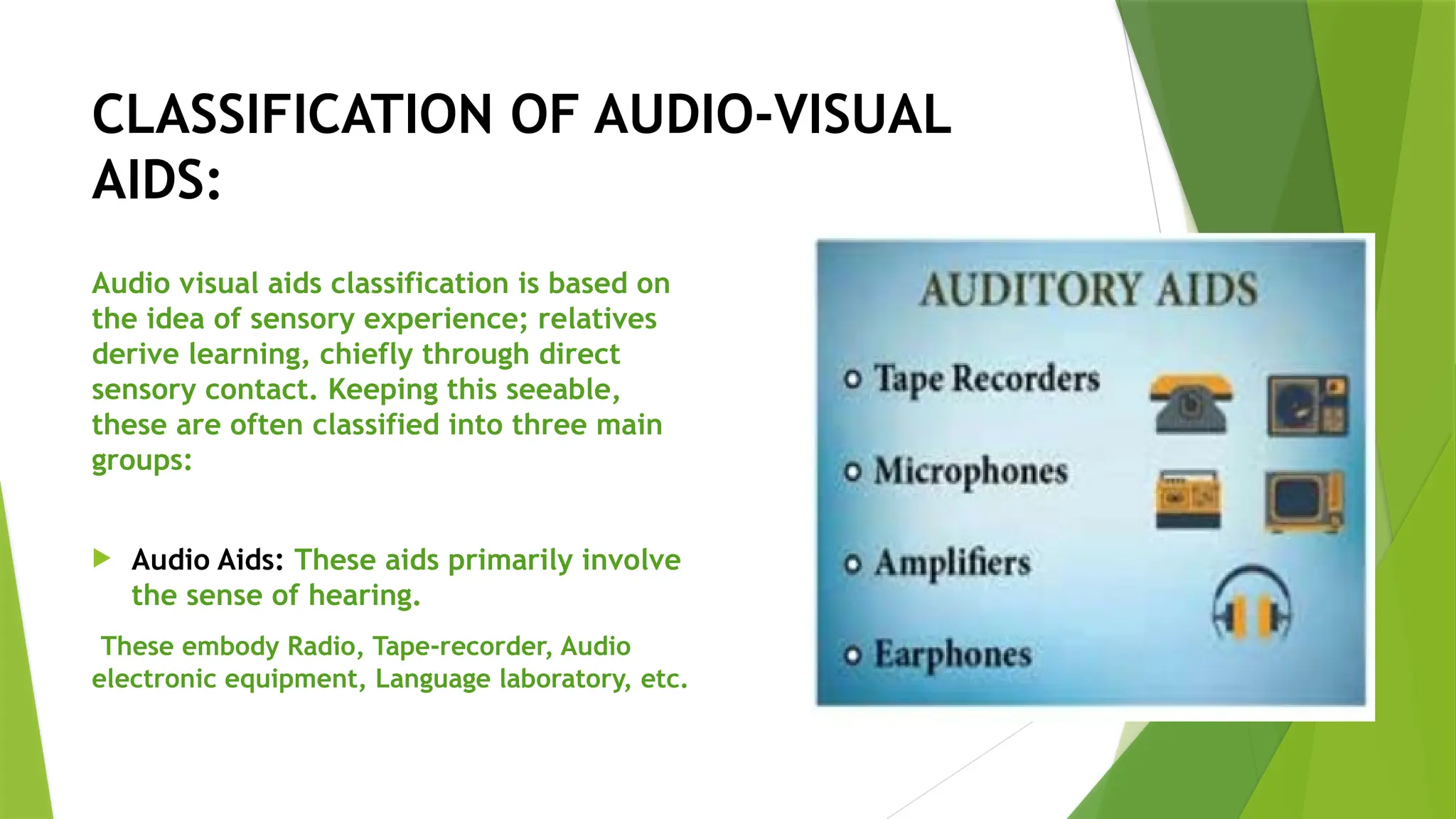
 Audio Aids: These aids primarily involve
the sense of hearing.
These embody Radio, Tape-recorder, Audio
electronic equipment, Language laboratory, etc.
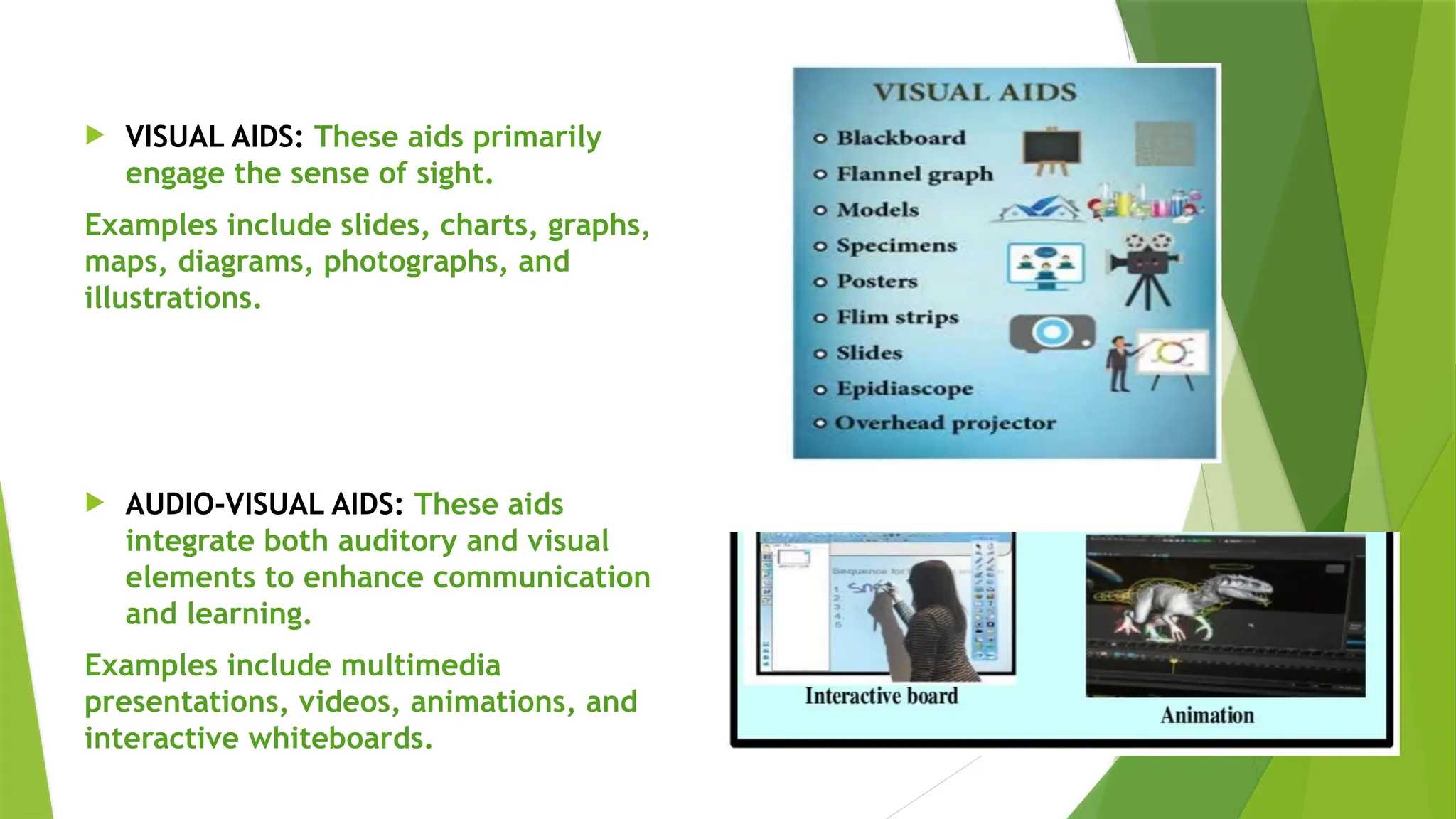
 VISUAL AIDS: These aids primarily
engage the sense of sight.
Examples include slides, charts, graphs,
maps, diagrams, photographs, and
illustrations.
 AUDIO-VISUAL AIDS: These aids
integrate both auditory and visual
elements to enhance communication
and learning.
Examples include multimedia
presentations, videos, animations, and
interactive whiteboards.
ADVANTAGES OF AUDIO-VISUAL AIDS:
Enhanced Understanding: Visual and auditory stimuli together
improve comprehension.
Increased Engagement: Captivating visuals and sounds boost audience
interest.
Memory Retention: The combination reinforces information, aiding
memory retention.
Cater to Learning Styles: Accommodates diverse learning preferences
and styles.
 Clarity of Concepts: Visual representations clarify complex ideas
more effectively.
DISADVANTAGES OF AUIDO-VISUAL
AIDS:
Technical Issues: Potential for equipment malfunctions or compatibility
issues.
Distractions: Visual or auditory elements may divert attention from key
content.
Costly Setup: Acquiring and maintaining audio-visual equipment can be
expensive.
Dependency: Overreliance on aids may hinder development of essential
listening or observation skills.
 Limited Interaction: Passive consumption of content may reduce
active learner participation.
CONCLUSION:
 In conclusion, audio-visual aids play a pivotal role in
enhancing communication and learning experiences.
Their ability to combine auditory and visual elements
makes complex concepts more accessible and engaging.
However, their effectiveness relies on careful selection,
proper integration, and consideration of the audience
and context. While audio-visual aids offer numerous
advantages, awareness of potential challenges such as
technical issues, distractions, and cost factors is crucial.
Ultimately, when thoughtfully employed, audio-visual
aids significantly contribute to effective information
delivery and knowledge retention in various educational
and communicative settings.
THANK YOU

Audio visual aids its classification and advantages

  • 1.
    ASSIGNMENT SUBJECT – FORESTEXTENSION AND COMMUNITY FORESTRY TOPIC – AUDIO VISUAL AIDS NAME – ROHAN PANWAR COURSE – B.SC FORESTRY (HONS) SEMESTER – 5TH SUBMITTED TO – Ms. PRATIKSHA RAJ
  • 2.
    AUDIO VISUAL AIDS Audio-visual aids are instructional tools and materials that engage both the visual and auditory senses to enhance communication and learning experiences. These aids are used in educational, business, and informational settings to convey information more effectively. The combination of visual and auditory elements helps reinforce concepts and cater to different learning styles.
  • 3.
    PURPOSE: Antidote to thedisease of verbal instructions Best motivation Clear images Vicarious experience Variety of stimulation Opportunities to handle and manipulate  Retention
  • 4.
    CHARACTERISTICS OF ASMART AUDIO- VISUAL AIDS: Relevancy: Smart audio-visual aids are directly pertinent to the topic or learning objectives, ensuring their alignment with the content being presented. Accuracy: Information presented through smart audio-visual aids is precise, reliable, and free from errors to maintain educational integrity. Interest: They are designed to captivate and sustain the audience’s interest, fostering engagement and participation. Understandability: Smart audio-visual aids use clear and comprehensible visuals and language, promoting easy understanding of the presented material.  Motivation: These aids are structured to motivate learners, encouraging active participation and a positive attitude toward the learning experience.
  • 5.
    CLASSIFICATION OF AUDIO-VISUAL AIDS: Audiovisual aids classification is based on the idea of sensory experience; relatives derive learning, chiefly through direct sensory contact. Keeping this seeable, these are often classified into three main groups:  Audio Aids: These aids primarily involve the sense of hearing. These embody Radio, Tape-recorder, Audio electronic equipment, Language laboratory, etc.
  • 6.
     VISUAL AIDS:These aids primarily engage the sense of sight. Examples include slides, charts, graphs, maps, diagrams, photographs, and illustrations.  AUDIO-VISUAL AIDS: These aids integrate both auditory and visual elements to enhance communication and learning. Examples include multimedia presentations, videos, animations, and interactive whiteboards.
  • 7.
    ADVANTAGES OF AUDIO-VISUALAIDS: Enhanced Understanding: Visual and auditory stimuli together improve comprehension. Increased Engagement: Captivating visuals and sounds boost audience interest. Memory Retention: The combination reinforces information, aiding memory retention. Cater to Learning Styles: Accommodates diverse learning preferences and styles.  Clarity of Concepts: Visual representations clarify complex ideas more effectively.
  • 8.
    DISADVANTAGES OF AUIDO-VISUAL AIDS: TechnicalIssues: Potential for equipment malfunctions or compatibility issues. Distractions: Visual or auditory elements may divert attention from key content. Costly Setup: Acquiring and maintaining audio-visual equipment can be expensive. Dependency: Overreliance on aids may hinder development of essential listening or observation skills.  Limited Interaction: Passive consumption of content may reduce active learner participation.
  • 9.
    CONCLUSION:  In conclusion,audio-visual aids play a pivotal role in enhancing communication and learning experiences. Their ability to combine auditory and visual elements makes complex concepts more accessible and engaging. However, their effectiveness relies on careful selection, proper integration, and consideration of the audience and context. While audio-visual aids offer numerous advantages, awareness of potential challenges such as technical issues, distractions, and cost factors is crucial. Ultimately, when thoughtfully employed, audio-visual aids significantly contribute to effective information delivery and knowledge retention in various educational and communicative settings.
  • 10.