AUDIOLOGICAL
ASSESSMENT
PRESENTED BY
DR RAHUL JAIN
SR-2 MCh Neurosurgery
Moderated by:
Dr V.C. Jha
HoD Neurosurgery
AIIMS Patna
• An Audiological evaluation is a series of diagnostic
procedures used to determine the type, degree,
and configuration of hearing loss.
• The goal of this evaluation is to develop a
treatment plan that is unique to the patient’s needs
in order to improve their communication skills.
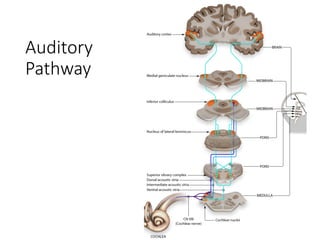
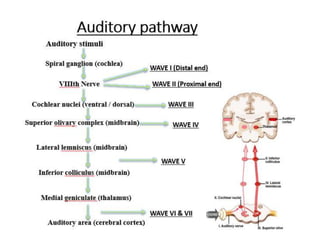
Auditory
Pathway
Bedside hearing assessment
useful for assessing
• 1. Type of hearing loss – conductive/ sensorineural/
mixed
• 2. Degree of hearing loss
• 3. Approximate site of pathology
Limitations
• 1. Not accurate
• 2. Subjective test
• 3. Requires patient’s cooperation
• 4. Cannot be performed in unconscious patients and
children <5 year olds.
I. VOICE TEST (FREE-FIELD SPEECH TEST)
• Can usually detect hearing loss >30 dB with a false
positive rate of 13%
• Test is done with patient facing forward and
examiner stationed opposite to the test ear or
behind the patient.
• Patient should not be able to see examiner’s lip
movements. Non-test ear should be masked to
prevent participation.
• Test is performed at 2 feet (one arm distance) and
then at 6 inches. And the voices used are loud
voice, conversational voice and whisper.
• If the patient can hear a whisper at 2 feet the
hearing is considered normal.
II. TUNING FORK TESTS
• Tuning forks used for hearing assessment: 256, 512 and
1024 Hz.
• 512 Hz tuning fork is the best as:
the frequency falls in the range of speech frequency
 sound lasts longer (1024 Hz has a faster decay)
produces less overtones* (256 Hz produces more
overtones)
*Overtones are frequencies above the fundamental
frequency
Tones < 256 Hz tend to enhance perception by the
production of vibrations
Activation of tuning fork:
• Struck at a point about one-third of the length of
the prong from the free end (to minimize
overtones)
• Struck against a firm surface like the elbow or the
thenar eminence of the palm and not a hard
surface like a table (to minimize overtones and
prevent internal fractures in the tuning fork)
• If the vibrations are felt in the stem of the tuning
fork, it indicates production of overtones.
1. RINNE’S TEST
• False positive rate 20%
• Strike the tuning fork against the elbow and place it
over the mastoid process of the patient and when
he stops hearing the sound place it in front of the
external auditory canal. If the patient can still hear
it indicates that the air conduction is better than
the bone conduction.
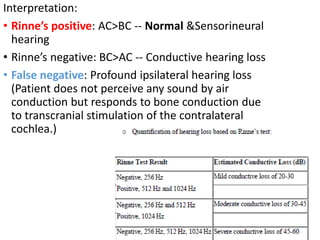
Interpretation:
• Rinne’s positive: AC>BC -- Normal &Sensorineural
hearing
• Rinne’s negative: BC>AC -- Conductive hearing loss
• False negative: Profound ipsilateral hearing loss
(Patient does not perceive any sound by air
conduction but responds to bone conduction due
to transcranial stimulation of the contralateral
cochlea.)
2. WEBER’S TEST
• Low sensitivity and specificity
Procedure
• Only 512 Hz tuning fork used. Activated tuning fork
is placed on the vertex/ root of nose/ upper central
incisors. The patient is asked which ear hears the
sound better.
Interpretation
• Normal: Central
• Conductive deafness: lateralized to the worse ear
• Sensorineural deafness: lateralized to the better ear
• Weber’s lateralizes at a difference in threshold of
only 5 dB between the two ears
Causes of lateralization in conductive deafness
1. Ambient noise theory:
In conductive hearing loss ambient sounds present in
the atmosphere are not heard and hence, the tuning
fork is heard better.
2. Theory of dispersion:
When sound from the vibrating tuning fork reaches
the middle ear it disperses in all directions – towards
the cochlea and towards the external auditory canal.
In conductive hearing loss, the sound does not get
dispersed to the exterior due to the middle ear
pathology.
3. SCHWABACH Test
• Once popular but no longer is in use.
• It compares pts. hearing sensitivity with that of an
examiner (assuming that he/she has a normal hearing).
• The fork is set into vibration, stem is placed alternately
against the mastoid process of the pt. and the examiner.
Here meatus is not closed.
• Vibratory energy of the tines of fork decreases
overtime, making the tone softer
• Pt. should indicate whether the tone is heard or not
each time
• When the pt. no longer hears the tone, examiner
immediately places the stem behind his or her own ear
and using a watch, notes the number of seconds the tone
is audible after the pt. stops hearing it
Inference
• Normal Schwabach: Both pt. & examiner stop
hearing the tone at approximately the same time.
Patient has normal BC
• Diminished Schwabach: Pt. stop hearing the sound
much sooner than the examiner. Patient BC is
impaired/SNHL
4. ABSOLUTE BONE CONDUCTION TEST
(Modification of Schwabach test)
Prerequisite: Examiner has normal hearing
Procedure
• Press the tragus and place the vibrating tuning fork on the
mastoid. Ask the patient to raise his hand when he stops hearing
the sound and then the tuning fork is transferred to the mastoid
of the doctor.
Interpretation
• Doctor can hear the sound -- bone conduction of patient is
reduced (SNHL)
• Doctor cannot hear sound -- bone conduction is normal
Pure Tone audiometry
• Pure tone sound : It is produced when an object
vibrates in a fixed frequency.
• AIMS OF PTA :
1. definite hearing loss
2. CHL/SNHL/MHL
3. degree of hearing loss
4. to compare pre-op n post-op results
5. medicolegal purpose
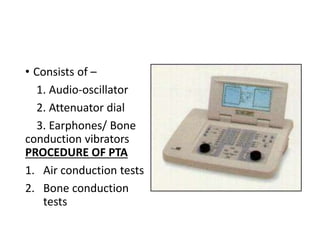
• Consists of –
1. Audio-oscillator
2. Attenuator dial
3. Earphones/ Bone
conduction vibrators
PROCEDURE OF PTA
1. Air conduction tests
2. Bone conduction
tests
Defining Threshold
• Hearing threshold is defined as
“the lowest sound pressure level at which
under specified conditions , a person gives a
predetermined percentage of correct responses on
repeated trials”
In clinical use : predetermined percentage is 50%
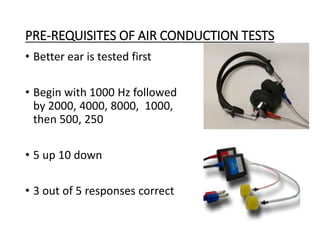
PRE-REQUISITES OF AIR CONDUCTION TESTS
• Better ear is tested first
• Begin with 1000 Hz followed
by 2000, 4000, 8000, 1000,
then 500, 250
• 5 up 10 down
• 3 out of 5 responses correct
BONE CONDUCTION TESTS
Cochlea can be stimulated by-
• Compressional/ Distortional Bone Conduction
• Inertial Bone conduction
• Osseotympanic Bone conduction
CONDITIONS FOR BONE CONDUCTION TESTS
• Calibration
• Reasonably noiseless test environment
• Placement of bone conduction vibrators
1. mastoid placement
2. frontal placement
MASTOID PLACEMENT
• Bone conduction vibrators placed
over mastoid bone
• Test ear : uncovered by
headphones
• Non- test ear : covered to deliver
the masking sound
FRONTAL PLACEMENT
• Vibrator over frontal bone & fixed
with an elastic headband.
• Frontal placement results superior
than mastoid placement due to less
variation of amount of tissue
between vibrator & skull base.
• But mastoid more sensitive area
MASKING
• Each ear has to be tested separately & individually
• Contralateral masking : presenting a noise to non-
test ear so that non-test ear is acoustically blocked
& doesn’t participate in hearing test.
• In air conduction tests masking should always be
done while testing with sounds of >45dB.
• In bone conduction tests masking should always be
done ideally.
HOW MUCH TO MASK
• Noise used for masking should –
- be loud enough to prevent the tone from test
ear reaching & stimulating non-test ear
- not so loud that it will pass over to test ear &
influence or mask sensitivity of test ear.
• Both overmasking & undermasking should be
avoided.
TYPES OF MASKING SOUNDS
• WHITE NOISE
• NARROW BAND NOISE
• COMPLEX NOISE
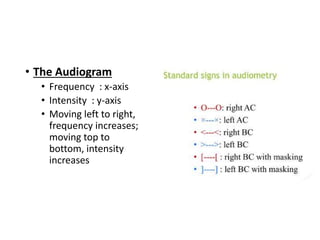
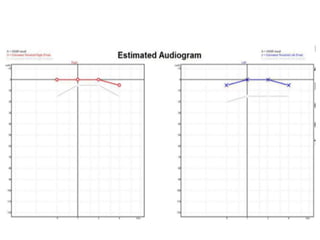
• The Audiogram
• Frequency : x-axis
• Intensity : y-axis
• Moving left to right,
frequency increases;
moving top to
bottom, intensity
increases
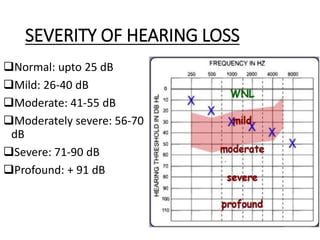
SEVERITY OF HEARING LOSS
Normal: upto 25 dB
Mild: 26-40 dB
Moderate: 41-55 dB
Moderately severe: 56-70
dB
Severe: 71-90 dB
Profound: + 91 dB
• PTA OF CONDUCTIVE DEAFNESS
AC
threshold>30dB.
BC threshold<20
dB.
A-B gap>25 dB.
• PTA OF SENSORINEURAL DEAFNESS
AC threshold>30
dB.
BC threshold>20
dB.
A-B gap<20 dB.
• PTA OF MIXED DEAFNESS
AC
threshold>45
dB.
BC
threshold>20
dB.
A-B gap>20 dB.
LIMITATIONS OF P.T.A.
• 1.AUDIOGRAMS ARE VERY OFTEN INACCURATE.
a)Improper technique- masking, placement.
b)Improper test condition-RNTE.
c)Improper test instrument- calibration.
d)Improper examiner.
• 2.A SUBJECTIVE & TIME-CONSUMING TEST.
• 3.IT DOES NOT ASSESS ALL FEATURES OF HEARING(
frequency discrimination, temporal resolution)
• 4.IT DOES NOT IDENTIFY THE NATURE OF THE
PATHOLOGY.
• 5.BONE CONDUCTION TEST DOES NOT ASSESS THE
TRUE SENSORINEURAL RESERVE.
• 6.MANY SOURCES OF VARIANCES IN THE TEST
RESULTS THAT ARE NOT RELATED TO HEARING.
IMPEDANCE AUDIOMETRY
• Objective differentiation between CHL & SNHL
Principle
• When sound energy travels from one medium to other,
there is loss of sound energy as it is reflected off from
the surface of second medium.
• Medium 1 : Air has low impedance
• Medium 2 : cochlear fluid has high impedance
• In our auditory system : Middle ear acts as the
impedance matching device such that most of the
sound energy coming from air is transmitted to
cochlear fluid.
• Measurement of change of impedance of the
middle ear at the plane of tympanic membrane as a
result of change in air pressure in the external
auditory meatus
• Y-axis : compliance
• X-axis : air pressure
1) Probe with 3 apertures
 Probe tone 220 or 260
Hz
 Microphone amplifier
assembly & requisite
measuring system
 Air pump manometer
• 2) Hermetically sealed
external auditory meatus
INSTRUMENTS
 Perfect sealing of
meatus
 EAC pressure is first
increased to +200 mm
H2O pressure
 Pressure is then
changed to 0 and then
to -600 mm H2O
pressure &
corresponding
compliances are then
measured at +150,
+100 ------0---- -150, -
200
• PARAMETERS TO BE ESTIMATED
Measurement of static compliance
Measurement of middle ear pressure
Type & shape of tympanogram
Static compliance-
• NORMAL : 0.35 to 1.4ml
Abnormally high > 2.5ml
Abnormally low < 0.28ml
• Least reliable parameter -Wide range of
normalcy value
• - overlap of
value btw normal and pathological ear
High compliance,
•Tympanic membrane is
thinned or scarred
•Ossicular chain
discontinuity
•Post stapedectomy
Low compliance,
•Otosclerosis
•Fixed malleus syndrome,
•Tympanosclerosis
•Secretory otitis media
•Tumors of middle ear
•Thickened tympanic
membrane
Pathologies with normal
compliance,
•Eustachian tube
dysfunction without
secretory otitis media
• Measurement of middle ear pressure
• It is the pressure of air inside middle ear cavity at
which ear function most effectively i.e. transmit the
highest amount of sound.
• Normal range +50 to -50mm of water
• ET dysfunction very common in children : 25 to -
100mmH20
Types and shapes of tympanogram
Fallacies of tympanometry
• When there are two pathologies present at the
same time impedance only represent laterally
situated pathology
• Static compliance is more fallacious than middle
ear pressure
• If 2 pathologies present, static compliance
represent the more lateral pathology
• Example- OTOSCLEROSIS +ET dysfunction
Middle ear pressure : Negative ; Compliance : Less
Mistaken for Otitis media
Brainstem evoked response
audiometry
• Objective, noninvasive,
electrophysiological test
• Structural & functional
integrity of auditory
pathway
• Represents synchronous
neural activity generated by
8th N. and neural centres
and tracts in brainstem that
are responsive to auditory
stimuli
Principles
• When sound reaches cochlea, it is converted in to
electrical impulse and passes from cochlea to
auditory cortex
• Passage of impulse though this pathway generates
electrical activity, which can be monitored by
placing surface electrodes on vertex or scalp
• Wave form can be studied with regards to latency,
amplitude and wave morphology
Method of recording BERA
• Elicited by a click stimulus 50-60 dB intensity above
average pure tone hearing level
• Recorded by-
1. active electrode (red) : vertex
2. reference electrode(white/black) :
mastoid/earlobe of ipsilateral ear
3. ground electrode(green) : over forehead just
above nasion
•Evoked response elements
1. Short latency response (SLR)-
10 millisec, records response generated in brain stem
2. Middle latency response (MLR)-
10-50 millisec
3. Late latency response(LLR)-
50-500 millisec
BERA :Interpretation
• Latency
• Absolute
• Interwave
• Interaural
• Amplitude
• Wave morphology
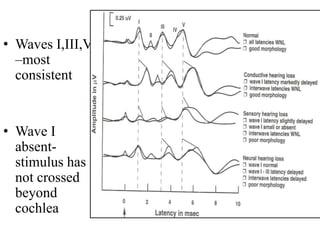
• Waves I,III,V
–most
consistent
• Wave I
absent-
stimulus has
not crossed
beyond
cochlea
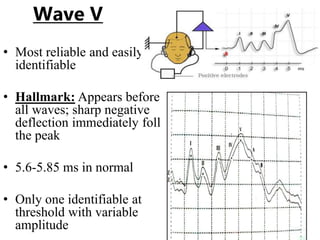
Wave V
• Most reliable and easily
identifiable
• Hallmark: Appears before
all waves; sharp negative
deflection immediately foll
the peak
• 5.6-5.85 ms in normal
• Only one identifiable at
threshold with variable
amplitude
Key Facts
• Latency: Onset of stimulus – Peak of
wave (Ms)
• Interwave latency: time interval
between 2 waves of same ear ( wave
I to V: 4 ms in adult, 5 ms In
newborns)
when lesion between 8th N and
brainstem
• Interaural latency: Time interval
between 2 ears of same wave (max
0.3 ms). If >0.4 ms – Retrocochlear
lesion
• Conductive HL: Graph shifts to
right but interwave latencies normal
USES
1. Detection & quantification of deafness in
difficult to test pt
2. Identification of site of lesion in retro-cochlear
pathology
3. Study of central auditory disorders
4. Study of maturity of central nervous system
Limitations
• Cost & needs special training
• Interpretation is subjective
• Lack of frequency specificity
• Time consuming
AUDITORY
STEADY
STATE
RESPONSE
(ASSR)
• Auditory evoked potential test that can be
used to objectively predict frequency specific
hearing threshold in all patients irrespective
of age, mental state and the degree of
hearing loss.
• Pure tone sound is modulated( in the
amplitude domain (by turning the sound off
and or alternately) and in the frequency
domain (like warbling the tone).
Modulation of the pure tone sound stimulus
Narrows down the spectral splatter
Very restricted narrow area of the basilar membrane is stimulated.
Rate of modulation
• 20Hz- response is elicited from the cortical areas of the central auditory
nervous system,
• 20 to 50Hz- response is elicited from the sub-cortical regions of the
central auditory nervous system (midbrain and thalamus, (i.e., the portion
of the auditory pathway the generates the MLR)
• >60Hz- response is elicited from brainstem
Carrier frequency (CF)
• Frequency of sound the hearing
threshold of which is being
ascertained, i.e., it is the test
frequency and is of 500Hz, 1000Hz,
2000Hz and 4000Hz.
Modulation frequency (MF)
• Number of times the carrier
frequency (CF) is being modulated
per second, i.e., 90 times (90Hz) or
100 times (100Hz).
Puretone sounds (CF) of 500Hz, 1000Hz, 2000Hz and 4000Hz are usually used for
ASSR recording.
The sound is modulated e.g., 90 times a second (90Hz modulation frequency) and
the evoked neural response is pre-amplified, filtered, sampled and analysed
Computer analyses the consistency of the response and determines whether the
sound has been heard or not.
Best results – when each frequency is tested separately at different modulations
Otoacoustic Emissions (OAEs)
• Otoacoustic emissions (OAE) are sounds generated
from the cochlea transmitted across the middle ear
to the external ear canal, where they can be
recorded.
• The production of an OAE is a marker for inner ear
health and a simple way to screen for hearing loss.
• The primary purpose of otoacoustic
emission (OAE) tests is to determine cochlear
status, specifically hair cell function.
Two types of OAE:
• Spontaneous OAE (SOAE), which occur
continuously without external stimuli
• Evoked OAE (EOAE), which requires an acoustic
stimulus prior to its measurement.
Cochlear amplifier theory – by David Kemp
as the traveling wave peaks at its frequency-specific
point in the basilar membrane, the outer hair cells
(OHC) produce a secondary disruption of the basilar
membrane, amplifying the signal to the brain. also
generates a byproduct lower amplitude wave that
travels back along the membrane, through the
middle ear, and emerges out the external ear canal
as an OAE.
• Spontaneous otoacoustic emissions (SOAE) are
sounds generated from the ear without an acoustic
stimulus and can be measured with microphones
placed in the external ear canal. Their frequencies
are between 500 Hz to 4,500 Hz.
• Evoked otoacoustic emissions (EOAE) can be
evoked utilizing three different acoustic stimuli:
transient evoked, stimulus-frequency, and
distortion product. Transient evoked and distortion
product otoacoustic emissions are the most
commonly used techniques for a newborn hearing
screening.
• Transient-evoked OAE (TEOAE) are evoked using a
click or tone-burst stimuli.
• A click stimulus has an abrupt onset, short
duration, and covers a broad frequency range up to
4 kHz to evoke responses from multiple nerve
fibers.
• tone burst stimuli delivered at a narrower
frequency range, especially at lower frequencies, to
obtain more frequency-specific responses.
• Stimulus-frequency OAE (SFOAE) is evoked by a
single pure tone stimulus. However, the response
emission occurs at the same frequency as the
stimulus and is hard to distinguish from residual
stimulus energy. Thus, there is limited clinical use
for this technique.
• Distortion-product OAE (DPOAE) is evoked using
two simultaneous pure tone stimuli (f1 and f2).
• Unlike TEOAE, which provides an overall view of
cochlear function across a broad range of
frequencies, DPOAE can be customized to assess
frequencies that match the patient’s
audiogram and are more sensitive for detecting
high-frequency hearing loss.
• Studies have shown a stimulus level of 55 to 65 dB
intensity, 10 dB difference between the two tones,
the frequency range between 2000 Hz and 8000 Hz,
and a frequency ratio (f2/f1) of 1.2 provides the
best accuracy in separating normal hearing patients
from those with hearing loss.
• When measuring the DPOAE, the largest response
emission should occur at the frequency calculated
from the formula: 2f1-f2. Thus, the advantage of
DPOAE is that the response emission occurs at a
frequency different from the two pure tone stimuli,
which makes its measurement easily
distinguishable
Uses
• OAE could be measured from patients with a
normally functioning cochlea but not from those
with hearing impairments with thresholds over 30
dB HL, illustrating the potential of using OAE as a
hearing test.
• OAE are also very sensitive in detecting mild
hearing impairment. Damage to the outer hair cells
from noise trauma or ototoxic medications can
appear on OAE before presenting on an audiogram.
limitations of OAE screening are the
• lack of specificity. There is a risk of false positives
due to contamination from other sounds, either
from the test environment or internal sounds such
as breathing and swallowing
• challenging to distinguish OAE from background
noise.
• Since OAE travel through the middle ear, they can
also be affected by any middle ear disease, such as
middle ear effusion.
• OAE may not be measurable in children with
adhesive otitis even though the OHCs are
healthy. Thus, OAE cannot distinguish between
conductive hearing loss and sensorineural loss.

Audilogical Assessment.pptx

  • 1.
    AUDIOLOGICAL ASSESSMENT PRESENTED BY DR RAHULJAIN SR-2 MCh Neurosurgery Moderated by: Dr V.C. Jha HoD Neurosurgery AIIMS Patna
  • 2.
    • An Audiologicalevaluation is a series of diagnostic procedures used to determine the type, degree, and configuration of hearing loss. • The goal of this evaluation is to develop a treatment plan that is unique to the patient’s needs in order to improve their communication skills.
  • 3.
  • 4.
    Bedside hearing assessment usefulfor assessing • 1. Type of hearing loss – conductive/ sensorineural/ mixed • 2. Degree of hearing loss • 3. Approximate site of pathology Limitations • 1. Not accurate • 2. Subjective test • 3. Requires patient’s cooperation • 4. Cannot be performed in unconscious patients and children <5 year olds.
  • 5.
    I. VOICE TEST(FREE-FIELD SPEECH TEST) • Can usually detect hearing loss >30 dB with a false positive rate of 13% • Test is done with patient facing forward and examiner stationed opposite to the test ear or behind the patient. • Patient should not be able to see examiner’s lip movements. Non-test ear should be masked to prevent participation.
  • 6.
    • Test isperformed at 2 feet (one arm distance) and then at 6 inches. And the voices used are loud voice, conversational voice and whisper. • If the patient can hear a whisper at 2 feet the hearing is considered normal.
  • 7.
    II. TUNING FORKTESTS • Tuning forks used for hearing assessment: 256, 512 and 1024 Hz. • 512 Hz tuning fork is the best as: the frequency falls in the range of speech frequency  sound lasts longer (1024 Hz has a faster decay) produces less overtones* (256 Hz produces more overtones) *Overtones are frequencies above the fundamental frequency Tones < 256 Hz tend to enhance perception by the production of vibrations
  • 8.
    Activation of tuningfork: • Struck at a point about one-third of the length of the prong from the free end (to minimize overtones) • Struck against a firm surface like the elbow or the thenar eminence of the palm and not a hard surface like a table (to minimize overtones and prevent internal fractures in the tuning fork) • If the vibrations are felt in the stem of the tuning fork, it indicates production of overtones.
  • 10.
    1. RINNE’S TEST •False positive rate 20% • Strike the tuning fork against the elbow and place it over the mastoid process of the patient and when he stops hearing the sound place it in front of the external auditory canal. If the patient can still hear it indicates that the air conduction is better than the bone conduction.
  • 11.
    Interpretation: • Rinne’s positive:AC>BC -- Normal &Sensorineural hearing • Rinne’s negative: BC>AC -- Conductive hearing loss • False negative: Profound ipsilateral hearing loss (Patient does not perceive any sound by air conduction but responds to bone conduction due to transcranial stimulation of the contralateral cochlea.)
  • 12.
    2. WEBER’S TEST •Low sensitivity and specificity Procedure • Only 512 Hz tuning fork used. Activated tuning fork is placed on the vertex/ root of nose/ upper central incisors. The patient is asked which ear hears the sound better. Interpretation • Normal: Central • Conductive deafness: lateralized to the worse ear • Sensorineural deafness: lateralized to the better ear • Weber’s lateralizes at a difference in threshold of only 5 dB between the two ears
  • 13.
    Causes of lateralizationin conductive deafness 1. Ambient noise theory: In conductive hearing loss ambient sounds present in the atmosphere are not heard and hence, the tuning fork is heard better. 2. Theory of dispersion: When sound from the vibrating tuning fork reaches the middle ear it disperses in all directions – towards the cochlea and towards the external auditory canal. In conductive hearing loss, the sound does not get dispersed to the exterior due to the middle ear pathology.
  • 14.
    3. SCHWABACH Test •Once popular but no longer is in use. • It compares pts. hearing sensitivity with that of an examiner (assuming that he/she has a normal hearing). • The fork is set into vibration, stem is placed alternately against the mastoid process of the pt. and the examiner. Here meatus is not closed. • Vibratory energy of the tines of fork decreases overtime, making the tone softer • Pt. should indicate whether the tone is heard or not each time • When the pt. no longer hears the tone, examiner immediately places the stem behind his or her own ear and using a watch, notes the number of seconds the tone is audible after the pt. stops hearing it
  • 15.
    Inference • Normal Schwabach:Both pt. & examiner stop hearing the tone at approximately the same time. Patient has normal BC • Diminished Schwabach: Pt. stop hearing the sound much sooner than the examiner. Patient BC is impaired/SNHL
  • 16.
    4. ABSOLUTE BONECONDUCTION TEST (Modification of Schwabach test) Prerequisite: Examiner has normal hearing Procedure • Press the tragus and place the vibrating tuning fork on the mastoid. Ask the patient to raise his hand when he stops hearing the sound and then the tuning fork is transferred to the mastoid of the doctor. Interpretation • Doctor can hear the sound -- bone conduction of patient is reduced (SNHL) • Doctor cannot hear sound -- bone conduction is normal
  • 17.
    Pure Tone audiometry •Pure tone sound : It is produced when an object vibrates in a fixed frequency. • AIMS OF PTA : 1. definite hearing loss 2. CHL/SNHL/MHL 3. degree of hearing loss 4. to compare pre-op n post-op results 5. medicolegal purpose
  • 18.
    • Consists of– 1. Audio-oscillator 2. Attenuator dial 3. Earphones/ Bone conduction vibrators PROCEDURE OF PTA 1. Air conduction tests 2. Bone conduction tests
  • 19.
    Defining Threshold • Hearingthreshold is defined as “the lowest sound pressure level at which under specified conditions , a person gives a predetermined percentage of correct responses on repeated trials” In clinical use : predetermined percentage is 50%
  • 20.
    PRE-REQUISITES OF AIRCONDUCTION TESTS • Better ear is tested first • Begin with 1000 Hz followed by 2000, 4000, 8000, 1000, then 500, 250 • 5 up 10 down • 3 out of 5 responses correct
  • 21.
    BONE CONDUCTION TESTS Cochleacan be stimulated by- • Compressional/ Distortional Bone Conduction • Inertial Bone conduction • Osseotympanic Bone conduction CONDITIONS FOR BONE CONDUCTION TESTS • Calibration • Reasonably noiseless test environment • Placement of bone conduction vibrators 1. mastoid placement 2. frontal placement
  • 22.
    MASTOID PLACEMENT • Boneconduction vibrators placed over mastoid bone • Test ear : uncovered by headphones • Non- test ear : covered to deliver the masking sound FRONTAL PLACEMENT • Vibrator over frontal bone & fixed with an elastic headband. • Frontal placement results superior than mastoid placement due to less variation of amount of tissue between vibrator & skull base. • But mastoid more sensitive area
  • 23.
    MASKING • Each earhas to be tested separately & individually • Contralateral masking : presenting a noise to non- test ear so that non-test ear is acoustically blocked & doesn’t participate in hearing test. • In air conduction tests masking should always be done while testing with sounds of >45dB. • In bone conduction tests masking should always be done ideally.
  • 24.
    HOW MUCH TOMASK • Noise used for masking should – - be loud enough to prevent the tone from test ear reaching & stimulating non-test ear - not so loud that it will pass over to test ear & influence or mask sensitivity of test ear. • Both overmasking & undermasking should be avoided.
  • 25.
    TYPES OF MASKINGSOUNDS • WHITE NOISE • NARROW BAND NOISE • COMPLEX NOISE
  • 26.
    • The Audiogram •Frequency : x-axis • Intensity : y-axis • Moving left to right, frequency increases; moving top to bottom, intensity increases
  • 27.
    SEVERITY OF HEARINGLOSS Normal: upto 25 dB Mild: 26-40 dB Moderate: 41-55 dB Moderately severe: 56-70 dB Severe: 71-90 dB Profound: + 91 dB
  • 28.
    • PTA OFCONDUCTIVE DEAFNESS AC threshold>30dB. BC threshold<20 dB. A-B gap>25 dB.
  • 29.
    • PTA OFSENSORINEURAL DEAFNESS AC threshold>30 dB. BC threshold>20 dB. A-B gap<20 dB.
  • 30.
    • PTA OFMIXED DEAFNESS AC threshold>45 dB. BC threshold>20 dB. A-B gap>20 dB.
  • 31.
    LIMITATIONS OF P.T.A. •1.AUDIOGRAMS ARE VERY OFTEN INACCURATE. a)Improper technique- masking, placement. b)Improper test condition-RNTE. c)Improper test instrument- calibration. d)Improper examiner. • 2.A SUBJECTIVE & TIME-CONSUMING TEST. • 3.IT DOES NOT ASSESS ALL FEATURES OF HEARING( frequency discrimination, temporal resolution)
  • 32.
    • 4.IT DOESNOT IDENTIFY THE NATURE OF THE PATHOLOGY. • 5.BONE CONDUCTION TEST DOES NOT ASSESS THE TRUE SENSORINEURAL RESERVE. • 6.MANY SOURCES OF VARIANCES IN THE TEST RESULTS THAT ARE NOT RELATED TO HEARING.
  • 33.
    IMPEDANCE AUDIOMETRY • Objectivedifferentiation between CHL & SNHL Principle • When sound energy travels from one medium to other, there is loss of sound energy as it is reflected off from the surface of second medium. • Medium 1 : Air has low impedance • Medium 2 : cochlear fluid has high impedance • In our auditory system : Middle ear acts as the impedance matching device such that most of the sound energy coming from air is transmitted to cochlear fluid.
  • 34.
    • Measurement ofchange of impedance of the middle ear at the plane of tympanic membrane as a result of change in air pressure in the external auditory meatus • Y-axis : compliance • X-axis : air pressure
  • 35.
    1) Probe with3 apertures  Probe tone 220 or 260 Hz  Microphone amplifier assembly & requisite measuring system  Air pump manometer • 2) Hermetically sealed external auditory meatus INSTRUMENTS
  • 36.
     Perfect sealingof meatus  EAC pressure is first increased to +200 mm H2O pressure  Pressure is then changed to 0 and then to -600 mm H2O pressure & corresponding compliances are then measured at +150, +100 ------0---- -150, - 200
  • 37.
    • PARAMETERS TOBE ESTIMATED Measurement of static compliance Measurement of middle ear pressure Type & shape of tympanogram
  • 38.
    Static compliance- • NORMAL: 0.35 to 1.4ml Abnormally high > 2.5ml Abnormally low < 0.28ml • Least reliable parameter -Wide range of normalcy value • - overlap of value btw normal and pathological ear High compliance, •Tympanic membrane is thinned or scarred •Ossicular chain discontinuity •Post stapedectomy Low compliance, •Otosclerosis •Fixed malleus syndrome, •Tympanosclerosis •Secretory otitis media •Tumors of middle ear •Thickened tympanic membrane Pathologies with normal compliance, •Eustachian tube dysfunction without secretory otitis media
  • 39.
    • Measurement ofmiddle ear pressure • It is the pressure of air inside middle ear cavity at which ear function most effectively i.e. transmit the highest amount of sound. • Normal range +50 to -50mm of water • ET dysfunction very common in children : 25 to - 100mmH20
  • 40.
    Types and shapesof tympanogram
  • 41.
    Fallacies of tympanometry •When there are two pathologies present at the same time impedance only represent laterally situated pathology • Static compliance is more fallacious than middle ear pressure • If 2 pathologies present, static compliance represent the more lateral pathology • Example- OTOSCLEROSIS +ET dysfunction Middle ear pressure : Negative ; Compliance : Less Mistaken for Otitis media
  • 42.
    Brainstem evoked response audiometry •Objective, noninvasive, electrophysiological test • Structural & functional integrity of auditory pathway • Represents synchronous neural activity generated by 8th N. and neural centres and tracts in brainstem that are responsive to auditory stimuli
  • 43.
    Principles • When soundreaches cochlea, it is converted in to electrical impulse and passes from cochlea to auditory cortex • Passage of impulse though this pathway generates electrical activity, which can be monitored by placing surface electrodes on vertex or scalp • Wave form can be studied with regards to latency, amplitude and wave morphology
  • 45.
    Method of recordingBERA • Elicited by a click stimulus 50-60 dB intensity above average pure tone hearing level • Recorded by- 1. active electrode (red) : vertex 2. reference electrode(white/black) : mastoid/earlobe of ipsilateral ear 3. ground electrode(green) : over forehead just above nasion
  • 46.
    •Evoked response elements 1.Short latency response (SLR)- 10 millisec, records response generated in brain stem 2. Middle latency response (MLR)- 10-50 millisec 3. Late latency response(LLR)- 50-500 millisec
  • 47.
    BERA :Interpretation • Latency •Absolute • Interwave • Interaural • Amplitude • Wave morphology
  • 48.
    • Waves I,III,V –most consistent •Wave I absent- stimulus has not crossed beyond cochlea
  • 49.
    Wave V • Mostreliable and easily identifiable • Hallmark: Appears before all waves; sharp negative deflection immediately foll the peak • 5.6-5.85 ms in normal • Only one identifiable at threshold with variable amplitude
  • 50.
    Key Facts • Latency:Onset of stimulus – Peak of wave (Ms) • Interwave latency: time interval between 2 waves of same ear ( wave I to V: 4 ms in adult, 5 ms In newborns) when lesion between 8th N and brainstem • Interaural latency: Time interval between 2 ears of same wave (max 0.3 ms). If >0.4 ms – Retrocochlear lesion • Conductive HL: Graph shifts to right but interwave latencies normal
  • 52.
    USES 1. Detection &quantification of deafness in difficult to test pt 2. Identification of site of lesion in retro-cochlear pathology 3. Study of central auditory disorders 4. Study of maturity of central nervous system
  • 53.
    Limitations • Cost &needs special training • Interpretation is subjective • Lack of frequency specificity • Time consuming
  • 54.
    AUDITORY STEADY STATE RESPONSE (ASSR) • Auditory evokedpotential test that can be used to objectively predict frequency specific hearing threshold in all patients irrespective of age, mental state and the degree of hearing loss. • Pure tone sound is modulated( in the amplitude domain (by turning the sound off and or alternately) and in the frequency domain (like warbling the tone).
  • 55.
    Modulation of thepure tone sound stimulus Narrows down the spectral splatter Very restricted narrow area of the basilar membrane is stimulated. Rate of modulation • 20Hz- response is elicited from the cortical areas of the central auditory nervous system, • 20 to 50Hz- response is elicited from the sub-cortical regions of the central auditory nervous system (midbrain and thalamus, (i.e., the portion of the auditory pathway the generates the MLR) • >60Hz- response is elicited from brainstem
  • 56.
    Carrier frequency (CF) •Frequency of sound the hearing threshold of which is being ascertained, i.e., it is the test frequency and is of 500Hz, 1000Hz, 2000Hz and 4000Hz. Modulation frequency (MF) • Number of times the carrier frequency (CF) is being modulated per second, i.e., 90 times (90Hz) or 100 times (100Hz).
  • 58.
    Puretone sounds (CF)of 500Hz, 1000Hz, 2000Hz and 4000Hz are usually used for ASSR recording. The sound is modulated e.g., 90 times a second (90Hz modulation frequency) and the evoked neural response is pre-amplified, filtered, sampled and analysed Computer analyses the consistency of the response and determines whether the sound has been heard or not. Best results – when each frequency is tested separately at different modulations
  • 60.
    Otoacoustic Emissions (OAEs) •Otoacoustic emissions (OAE) are sounds generated from the cochlea transmitted across the middle ear to the external ear canal, where they can be recorded. • The production of an OAE is a marker for inner ear health and a simple way to screen for hearing loss. • The primary purpose of otoacoustic emission (OAE) tests is to determine cochlear status, specifically hair cell function.
  • 61.
    Two types ofOAE: • Spontaneous OAE (SOAE), which occur continuously without external stimuli • Evoked OAE (EOAE), which requires an acoustic stimulus prior to its measurement. Cochlear amplifier theory – by David Kemp as the traveling wave peaks at its frequency-specific point in the basilar membrane, the outer hair cells (OHC) produce a secondary disruption of the basilar membrane, amplifying the signal to the brain. also generates a byproduct lower amplitude wave that travels back along the membrane, through the middle ear, and emerges out the external ear canal as an OAE.
  • 62.
    • Spontaneous otoacousticemissions (SOAE) are sounds generated from the ear without an acoustic stimulus and can be measured with microphones placed in the external ear canal. Their frequencies are between 500 Hz to 4,500 Hz. • Evoked otoacoustic emissions (EOAE) can be evoked utilizing three different acoustic stimuli: transient evoked, stimulus-frequency, and distortion product. Transient evoked and distortion product otoacoustic emissions are the most commonly used techniques for a newborn hearing screening.
  • 63.
    • Transient-evoked OAE(TEOAE) are evoked using a click or tone-burst stimuli. • A click stimulus has an abrupt onset, short duration, and covers a broad frequency range up to 4 kHz to evoke responses from multiple nerve fibers. • tone burst stimuli delivered at a narrower frequency range, especially at lower frequencies, to obtain more frequency-specific responses.
  • 64.
    • Stimulus-frequency OAE(SFOAE) is evoked by a single pure tone stimulus. However, the response emission occurs at the same frequency as the stimulus and is hard to distinguish from residual stimulus energy. Thus, there is limited clinical use for this technique. • Distortion-product OAE (DPOAE) is evoked using two simultaneous pure tone stimuli (f1 and f2). • Unlike TEOAE, which provides an overall view of cochlear function across a broad range of frequencies, DPOAE can be customized to assess frequencies that match the patient’s audiogram and are more sensitive for detecting high-frequency hearing loss.
  • 65.
    • Studies haveshown a stimulus level of 55 to 65 dB intensity, 10 dB difference between the two tones, the frequency range between 2000 Hz and 8000 Hz, and a frequency ratio (f2/f1) of 1.2 provides the best accuracy in separating normal hearing patients from those with hearing loss. • When measuring the DPOAE, the largest response emission should occur at the frequency calculated from the formula: 2f1-f2. Thus, the advantage of DPOAE is that the response emission occurs at a frequency different from the two pure tone stimuli, which makes its measurement easily distinguishable
  • 67.
    Uses • OAE couldbe measured from patients with a normally functioning cochlea but not from those with hearing impairments with thresholds over 30 dB HL, illustrating the potential of using OAE as a hearing test. • OAE are also very sensitive in detecting mild hearing impairment. Damage to the outer hair cells from noise trauma or ototoxic medications can appear on OAE before presenting on an audiogram.
  • 68.
    limitations of OAEscreening are the • lack of specificity. There is a risk of false positives due to contamination from other sounds, either from the test environment or internal sounds such as breathing and swallowing • challenging to distinguish OAE from background noise. • Since OAE travel through the middle ear, they can also be affected by any middle ear disease, such as middle ear effusion. • OAE may not be measurable in children with adhesive otitis even though the OHCs are healthy. Thus, OAE cannot distinguish between conductive hearing loss and sensorineural loss.