WHO CNS TUMORS 2021
CLASSIFICATION
Presented By – Dr. Rahul Jain
• The 2016 revised 4th edition significantly changed
the classification of a number of tumour families,
introducing a greater reliance on molecular
markers.
• The most notable changes involve diffuse gliomas,
in which IDH status (mutated vs. wildtype) and
1p19q co-deletion (for oligodendrogliomas) have
risen to prominence.
• 5th edition (2021) builds on the prior version by placing
greater emphasis on molecular markers both in terms of
classification and grading.
• Some tumours remain primarily assessed histologically
while others are entirely on the basis of molecular
parameters.
This will be reflected in a "layered report structure" wherein
histological features, grading and molecular information will
be combined to form an integrated diagnosis.
• integrated diagnosis
• histopathological classification
• CNS WHO grade
• molecular information
Terminology
Type and subtype
• type replaces "entity"
• subtype replaces "variant"
For example, meningiomas represent one "type"
with numerous "subtypes" e.g. chordoid, rhabdoid,
clear cell etc.
Grading within tumour types
• In prior editions tumours of the central nervous
system where graded (roughly) equivalently so
that, in principle, grade I tumours of any type were
generally indolent and could be cured if completely
resected, whereas grade IV tumours would result in
rapid demise.
• As a further step towards bringing the CNS
classification of tumours in line with those of other
systems, this approach has been mostly
abandoned, in favour of grading tumours purely
within each "type“.
• Due to the inertia of prior classifications and the
desire to avoid additional confusion, however, this
has only been adopted in a way that does not
overly clash with prior grading.
• For example, despite grading within tumour types,
no grade 1 diffuse astrocytoma, IDH-mutant exists
(only grade 2, 3 and 4 are available). Similarly,
glioblastoma, IDH-wildtype can only ever be a
grade 4 tumour.
Arabic numerals
• Previously the Roman numerals I, II, III and IV were
used for grading.
• replaced by the Arabic numerals 1, 2, 3 and 4 to
bring CNS tumour grades in line with other
systems.
• However, since the features used to grade CNS
tumours remain different from those used
systemically, it is recommended that the grade be
preceded by "CNS WHO", e.g. "meningioma CNS
WHO grade 1”.
Anaplastic modifier
• The term anaplastic, used extensively in the prior
classifications has been dropped in favour of
grading only.
• Thus what was previously known as an "anaplastic
astrocytoma" is now referred to as an
"astrocytoma, IDH-mutant, CNS WHO grade 3’’.
Molecular grading
• For the first time, molecular features have been
explicitly added to the grading schema, and may
supersede histological features.
• For example, an IDH-wildtype astrocytoma with
low-grade histologic features can be considered
grade 4 (glioblastoma) in the presence of EGFR
amplification, TERT promoter mutation or the
combined gain of chromosome 7 and loss of
chromosome 10 [+7/-10]
Structure
• Despite a move towards molecular markers for
some entities, the classification continues to be
organised according to the cell of origin (e.g.
ependymal tumours) or anatomical origin (e.g.
tumours of the sellar region).
• Essential and desirable diagnostic criteria
Each tumour type has been given certain essential
diagnostic criteria necessary for a specific diagnosis,
as well as additional non-essential but nonetheless
desirable criteria 8.
• Not elsewhere classified (NEC)
In addition to not otherwise specified (NOS), which
denotes tumours where complete molecular
classification is not available, not elsewhere classified
(NEC) has been added to denote tumours that have
been fully characterised but that do not fit within the
established classification system
Modifications in a Nutshell
1. Used various genetic/ somatic mutation/
chromosomal alterations/ enzyme modifications
etc.
2. Classification based on location is not preferred.
3. Only ependymomas are classified based on
location as supra/infra-tentorial.
4. Subtypes are used rather than variants.
5. Choroidal tumors are based on epithelial
classification.
6. NOS and NEC – no histological or molecular clue
can be given to them.
7. Novel diagnostic techniques added to expand and
improve classification
• DNA FISH
• DNA and RNA sequencing
• RNA expression profiling
Changes in tumors
1. Gliosarcoma and Glioblastoma giant cell varieties are
not included in the recent classification.
2. Diffuse astrocytomas are classified as only 3 types in
CNS WHO5 rather than 15 varieties in 4th edition of
2016
1. Astrocytoma –IDH mutant
2. Oligodendrogllioma, IDH-mutant and 1p/19q-codeleted.
3. Glioblastoma, IDH-wildtype
3. IDH-mutant was previously classified in only GBM,
rather now in 2021 extended to all varieties of
Glioma.
4. Presence of CDKN2A/B homogenous deletion
results in CNS WHO grade 4 even in the absence of
microvascular proliferation or necrosis.
So only histological classification is no more playing
pivotal role.
All glioma samples should be subjected for genetic
analysis irrespective of histology.
5. GBM should be considered in case of
• Presence of necrosis
• Presence of microvascular proliferation
• TERT promoter mutation
• EGFR gene amplification
• +7/-10 chromosome copy number change.
6. Myxopapillary Ependymoma is now classified as
Grade 2 rather than Grade 1.
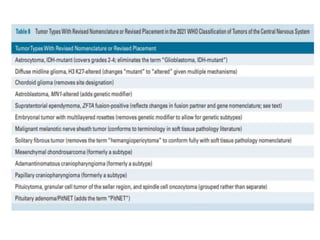
7. Papillary, Clear cell and tancytic are no more
considered as subtypes, rather included s variant of
histological pattern only.
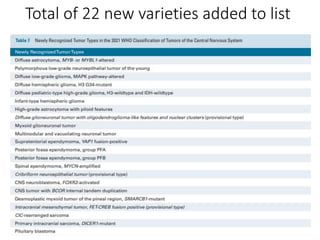
Total of 22 new varieties added to list
References
• WHO Classification of Tumours Editorial Board. World
Health Organization Classification of Tumours of the
Central Nervous System. 5th ed. Lyon: International
Agency for Research on Cancer; 2021.
• David N Louis, Arie Perry, Pieter Wesseling, Daniel J
Brat, Ian A Cree, Dominique Figarella-Branger, Cynthia
Hawkins, H K Ng, Stefan M Pfister, Guido Reifenberger,
Riccardo Soffietti, Andreas von Deimling, David W
Ellison, The 2021 WHO Classification of Tumors of the
Central Nervous System: a summary, Neuro-Oncology,
Volume 23, Issue 8, August 2021, Pages 1231–1251

CNS WHO 2021 tumor classification.pptx

  • 1.
    WHO CNS TUMORS2021 CLASSIFICATION Presented By – Dr. Rahul Jain
  • 2.
    • The 2016revised 4th edition significantly changed the classification of a number of tumour families, introducing a greater reliance on molecular markers. • The most notable changes involve diffuse gliomas, in which IDH status (mutated vs. wildtype) and 1p19q co-deletion (for oligodendrogliomas) have risen to prominence.
  • 3.
    • 5th edition(2021) builds on the prior version by placing greater emphasis on molecular markers both in terms of classification and grading. • Some tumours remain primarily assessed histologically while others are entirely on the basis of molecular parameters. This will be reflected in a "layered report structure" wherein histological features, grading and molecular information will be combined to form an integrated diagnosis. • integrated diagnosis • histopathological classification • CNS WHO grade • molecular information
  • 4.
    Terminology Type and subtype •type replaces "entity" • subtype replaces "variant" For example, meningiomas represent one "type" with numerous "subtypes" e.g. chordoid, rhabdoid, clear cell etc.
  • 5.
    Grading within tumourtypes • In prior editions tumours of the central nervous system where graded (roughly) equivalently so that, in principle, grade I tumours of any type were generally indolent and could be cured if completely resected, whereas grade IV tumours would result in rapid demise. • As a further step towards bringing the CNS classification of tumours in line with those of other systems, this approach has been mostly abandoned, in favour of grading tumours purely within each "type“.
  • 6.
    • Due tothe inertia of prior classifications and the desire to avoid additional confusion, however, this has only been adopted in a way that does not overly clash with prior grading. • For example, despite grading within tumour types, no grade 1 diffuse astrocytoma, IDH-mutant exists (only grade 2, 3 and 4 are available). Similarly, glioblastoma, IDH-wildtype can only ever be a grade 4 tumour.
  • 7.
    Arabic numerals • Previouslythe Roman numerals I, II, III and IV were used for grading. • replaced by the Arabic numerals 1, 2, 3 and 4 to bring CNS tumour grades in line with other systems. • However, since the features used to grade CNS tumours remain different from those used systemically, it is recommended that the grade be preceded by "CNS WHO", e.g. "meningioma CNS WHO grade 1”.
  • 8.
    Anaplastic modifier • Theterm anaplastic, used extensively in the prior classifications has been dropped in favour of grading only. • Thus what was previously known as an "anaplastic astrocytoma" is now referred to as an "astrocytoma, IDH-mutant, CNS WHO grade 3’’.
  • 9.
    Molecular grading • Forthe first time, molecular features have been explicitly added to the grading schema, and may supersede histological features. • For example, an IDH-wildtype astrocytoma with low-grade histologic features can be considered grade 4 (glioblastoma) in the presence of EGFR amplification, TERT promoter mutation or the combined gain of chromosome 7 and loss of chromosome 10 [+7/-10]
  • 10.
    Structure • Despite amove towards molecular markers for some entities, the classification continues to be organised according to the cell of origin (e.g. ependymal tumours) or anatomical origin (e.g. tumours of the sellar region).
  • 11.
    • Essential anddesirable diagnostic criteria Each tumour type has been given certain essential diagnostic criteria necessary for a specific diagnosis, as well as additional non-essential but nonetheless desirable criteria 8. • Not elsewhere classified (NEC) In addition to not otherwise specified (NOS), which denotes tumours where complete molecular classification is not available, not elsewhere classified (NEC) has been added to denote tumours that have been fully characterised but that do not fit within the established classification system
  • 12.
    Modifications in aNutshell 1. Used various genetic/ somatic mutation/ chromosomal alterations/ enzyme modifications etc. 2. Classification based on location is not preferred. 3. Only ependymomas are classified based on location as supra/infra-tentorial. 4. Subtypes are used rather than variants. 5. Choroidal tumors are based on epithelial classification.
  • 13.
    6. NOS andNEC – no histological or molecular clue can be given to them. 7. Novel diagnostic techniques added to expand and improve classification • DNA FISH • DNA and RNA sequencing • RNA expression profiling
  • 14.
    Changes in tumors 1.Gliosarcoma and Glioblastoma giant cell varieties are not included in the recent classification. 2. Diffuse astrocytomas are classified as only 3 types in CNS WHO5 rather than 15 varieties in 4th edition of 2016 1. Astrocytoma –IDH mutant 2. Oligodendrogllioma, IDH-mutant and 1p/19q-codeleted. 3. Glioblastoma, IDH-wildtype 3. IDH-mutant was previously classified in only GBM, rather now in 2021 extended to all varieties of Glioma.
  • 15.
    4. Presence ofCDKN2A/B homogenous deletion results in CNS WHO grade 4 even in the absence of microvascular proliferation or necrosis. So only histological classification is no more playing pivotal role. All glioma samples should be subjected for genetic analysis irrespective of histology.
  • 16.
    5. GBM shouldbe considered in case of • Presence of necrosis • Presence of microvascular proliferation • TERT promoter mutation • EGFR gene amplification • +7/-10 chromosome copy number change. 6. Myxopapillary Ependymoma is now classified as Grade 2 rather than Grade 1. 7. Papillary, Clear cell and tancytic are no more considered as subtypes, rather included s variant of histological pattern only.
  • 17.
    Total of 22new varieties added to list
  • 19.
    References • WHO Classificationof Tumours Editorial Board. World Health Organization Classification of Tumours of the Central Nervous System. 5th ed. Lyon: International Agency for Research on Cancer; 2021. • David N Louis, Arie Perry, Pieter Wesseling, Daniel J Brat, Ian A Cree, Dominique Figarella-Branger, Cynthia Hawkins, H K Ng, Stefan M Pfister, Guido Reifenberger, Riccardo Soffietti, Andreas von Deimling, David W Ellison, The 2021 WHO Classification of Tumors of the Central Nervous System: a summary, Neuro-Oncology, Volume 23, Issue 8, August 2021, Pages 1231–1251