TCP PRESENTO 2020, THIAGARAJAR COLLEGE OF PRECEPTORS, MADURAI.
 The process through
which certain stimuli
are selected from a
group of others is
generally refered as
attention.
 Attention, in
psychology, the
concentration
of awareness on some
phenomenon to the
exclusion of other
stimuli.
TCP PRESENTO 2020, THIAGARAJAR COLLEGE OF PRECEPTORS, MADURAI.
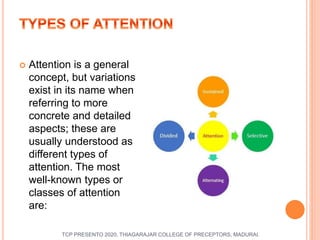
 Attention is a general
concept, but variations
exist in its name when
referring to more
concrete and detailed
aspects; these are
usually understood as
different types of
attention. The most
well-known types or
classes of attention
are:
TCP PRESENTO 2020, THIAGARAJAR COLLEGE OF PRECEPTORS, MADURAI.
 the ability to use attention resources for your own
mental processes and other interoceptive aspects.
External attention:
gained from external stimuli and stimuli coming from
the surroundings
Divided attention:
ability to focus attention on two or more tasks at the
same time. For example, driving and listening to
music at the same time.
TCP PRESENTO 2020, THIAGARAJAR COLLEGE OF PRECEPTORS, MADURAI.
 Sustained attention:
ability to maintain attention resources and respond
correctly.
TCP PRESENTO 2020, THIAGARAJAR COLLEGE OF PRECEPTORS, MADURAI.
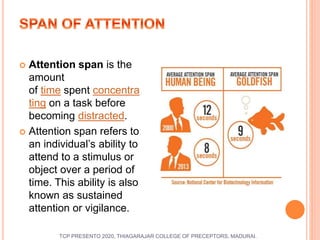
 Attention span is the
amount
of time spent concentra
ting on a task before
becoming distracted.
 Attention span refers to
an individual’s ability to
attend to a stimulus or
object over a period of
time. This ability is also
known as sustained
attention or vigilance.
TCP PRESENTO 2020, THIAGARAJAR COLLEGE OF PRECEPTORS, MADURAI.
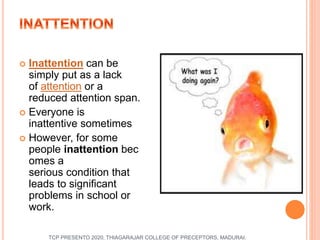
 Inattention can be
simply put as a lack
of attention or a
reduced attention span.
 Everyone is
inattentive sometimes
 However, for some
people inattention bec
omes a
serious condition that
leads to significant
problems in school or
work.
TCP PRESENTO 2020, THIAGARAJAR COLLEGE OF PRECEPTORS, MADURAI.
 Distraction is the diverting
of the attention of an
individual or group from the
chosen object of attention
onto the source of
distraction. Distraction is
caused by one of the
following: lack of ability to
pay attention; lack of
interest in the object of
attention; greater interest in
something other than the
object of attention; or the
great intensity, novelness or
attractiveness of the source
of distraction.
TCP PRESENTO 2020, THIAGARAJAR COLLEGE OF PRECEPTORS, MADURAI.
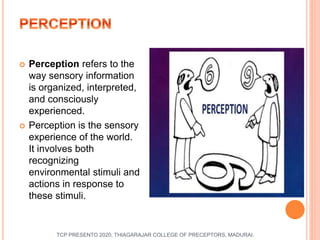
 Perception refers to the
way sensory information
is organized, interpreted,
and consciously
experienced.
 Perception is the sensory
experience of the world.
It involves both
recognizing
environmental stimuli and
actions in response to
these stimuli.
TCP PRESENTO 2020, THIAGARAJAR COLLEGE OF PRECEPTORS, MADURAI.
 According to Gestalt
psychology, the whole
is different from the
sum of its parts. Based
upon this belief, Gestalt
psychologists
developed a set of
principles to explain
perceptual
organization, or how
smaller objects are
grouped to form larger
ones.
TCP PRESENTO 2020, THIAGARAJAR COLLEGE OF PRECEPTORS, MADURAI.
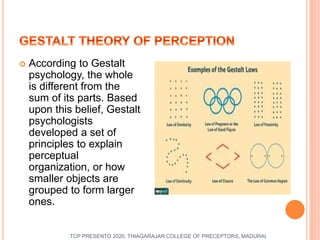
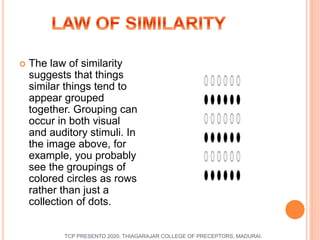
 The law of similarity
suggests that things
similar things tend to
appear grouped
together. Grouping can
occur in both visual
and auditory stimuli. In
the image above, for
example, you probably
see the groupings of
colored circles as rows
rather than just a
collection of dots.
TCP PRESENTO 2020, THIAGARAJAR COLLEGE OF PRECEPTORS, MADURAI.
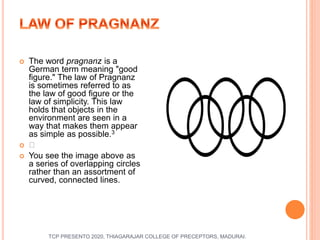
 The word pragnanz is a
German term meaning "good
figure." The law of Pragnanz
is sometimes referred to as
the law of good figure or the
law of simplicity. This law
holds that objects in the
environment are seen in a
way that makes them appear
as simple as possible.3
 
 You see the image above as
a series of overlapping circles
rather than an assortment of
curved, connected lines.
TCP PRESENTO 2020, THIAGARAJAR COLLEGE OF PRECEPTORS, MADURAI.
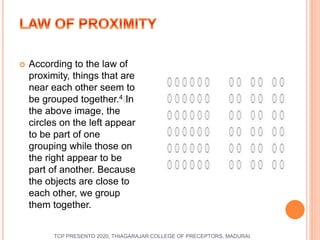
 According to the law of
proximity, things that are
near each other seem to
be grouped together.4In
the above image, the
circles on the left appear
to be part of one
grouping while those on
the right appear to be
part of another. Because
the objects are close to
each other, we group
them together.
TCP PRESENTO 2020, THIAGARAJAR COLLEGE OF PRECEPTORS, MADURAI.
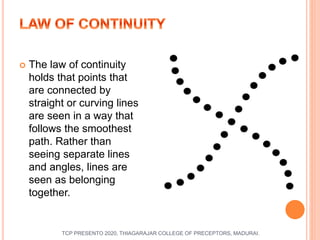
 The law of continuity
holds that points that
are connected by
straight or curving lines
are seen in a way that
follows the smoothest
path. Rather than
seeing separate lines
and angles, lines are
seen as belonging
together.
TCP PRESENTO 2020, THIAGARAJAR COLLEGE OF PRECEPTORS, MADURAI.
 According to the law of
closure, things are
grouped together if they
seem to complete some
entity.1
 Our brains often ignore
contradictory information
and fill in gaps in
information. In the image
above, you probably see
the shapes of a circle and
rectangle because your
brain fills in the missing
gaps in order to create a
meaningful image.
TCP PRESENTO 2020, THIAGARAJAR COLLEGE OF PRECEPTORS, MADURAI.

ATTENTION AND PERCEPTION

  • 1.
    TCP PRESENTO 2020,THIAGARAJAR COLLEGE OF PRECEPTORS, MADURAI.
  • 2.
     The processthrough which certain stimuli are selected from a group of others is generally refered as attention.  Attention, in psychology, the concentration of awareness on some phenomenon to the exclusion of other stimuli. TCP PRESENTO 2020, THIAGARAJAR COLLEGE OF PRECEPTORS, MADURAI.
  • 3.
     Attention isa general concept, but variations exist in its name when referring to more concrete and detailed aspects; these are usually understood as different types of attention. The most well-known types or classes of attention are: TCP PRESENTO 2020, THIAGARAJAR COLLEGE OF PRECEPTORS, MADURAI.
  • 4.
     the abilityto use attention resources for your own mental processes and other interoceptive aspects. External attention: gained from external stimuli and stimuli coming from the surroundings Divided attention: ability to focus attention on two or more tasks at the same time. For example, driving and listening to music at the same time. TCP PRESENTO 2020, THIAGARAJAR COLLEGE OF PRECEPTORS, MADURAI.
  • 5.
     Sustained attention: abilityto maintain attention resources and respond correctly. TCP PRESENTO 2020, THIAGARAJAR COLLEGE OF PRECEPTORS, MADURAI.
  • 6.
     Attention spanis the amount of time spent concentra ting on a task before becoming distracted.  Attention span refers to an individual’s ability to attend to a stimulus or object over a period of time. This ability is also known as sustained attention or vigilance. TCP PRESENTO 2020, THIAGARAJAR COLLEGE OF PRECEPTORS, MADURAI.
  • 7.
     Inattention canbe simply put as a lack of attention or a reduced attention span.  Everyone is inattentive sometimes  However, for some people inattention bec omes a serious condition that leads to significant problems in school or work. TCP PRESENTO 2020, THIAGARAJAR COLLEGE OF PRECEPTORS, MADURAI.
  • 8.
     Distraction isthe diverting of the attention of an individual or group from the chosen object of attention onto the source of distraction. Distraction is caused by one of the following: lack of ability to pay attention; lack of interest in the object of attention; greater interest in something other than the object of attention; or the great intensity, novelness or attractiveness of the source of distraction. TCP PRESENTO 2020, THIAGARAJAR COLLEGE OF PRECEPTORS, MADURAI.
  • 9.
     Perception refersto the way sensory information is organized, interpreted, and consciously experienced.  Perception is the sensory experience of the world. It involves both recognizing environmental stimuli and actions in response to these stimuli. TCP PRESENTO 2020, THIAGARAJAR COLLEGE OF PRECEPTORS, MADURAI.
  • 10.
     According toGestalt psychology, the whole is different from the sum of its parts. Based upon this belief, Gestalt psychologists developed a set of principles to explain perceptual organization, or how smaller objects are grouped to form larger ones. TCP PRESENTO 2020, THIAGARAJAR COLLEGE OF PRECEPTORS, MADURAI.
  • 11.
     The lawof similarity suggests that things similar things tend to appear grouped together. Grouping can occur in both visual and auditory stimuli. In the image above, for example, you probably see the groupings of colored circles as rows rather than just a collection of dots. TCP PRESENTO 2020, THIAGARAJAR COLLEGE OF PRECEPTORS, MADURAI.
  • 12.
     The wordpragnanz is a German term meaning "good figure." The law of Pragnanz is sometimes referred to as the law of good figure or the law of simplicity. This law holds that objects in the environment are seen in a way that makes them appear as simple as possible.3    You see the image above as a series of overlapping circles rather than an assortment of curved, connected lines. TCP PRESENTO 2020, THIAGARAJAR COLLEGE OF PRECEPTORS, MADURAI.
  • 13.
     According tothe law of proximity, things that are near each other seem to be grouped together.4In the above image, the circles on the left appear to be part of one grouping while those on the right appear to be part of another. Because the objects are close to each other, we group them together. TCP PRESENTO 2020, THIAGARAJAR COLLEGE OF PRECEPTORS, MADURAI.
  • 14.
     The lawof continuity holds that points that are connected by straight or curving lines are seen in a way that follows the smoothest path. Rather than seeing separate lines and angles, lines are seen as belonging together. TCP PRESENTO 2020, THIAGARAJAR COLLEGE OF PRECEPTORS, MADURAI.
  • 15.
     According tothe law of closure, things are grouped together if they seem to complete some entity.1  Our brains often ignore contradictory information and fill in gaps in information. In the image above, you probably see the shapes of a circle and rectangle because your brain fills in the missing gaps in order to create a meaningful image. TCP PRESENTO 2020, THIAGARAJAR COLLEGE OF PRECEPTORS, MADURAI.