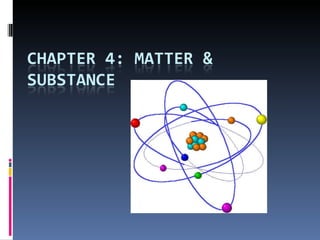
Atoms All matter consists of tiny units Consist of a nucleus in the centre surrounded by electron. Electron move around the nucleus following orbit
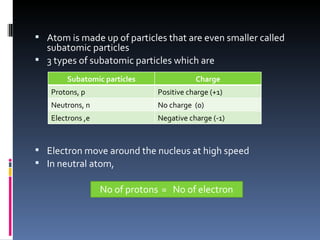
Atom is made up of particles that are even smaller called subatomic particles 3 types of subatomic particles which are Electron move around the nucleus at high speed In neutral atom, No of protons =  No of electron Subatomic particles Charge Protons, p Positive charge (+1) Neutrons, n No charge  (0) Electrons ,e Negative charge (-1)
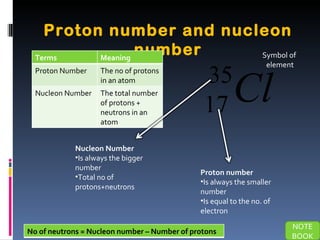
Proton number and nucleon number Symbol of  element Nucleon Number Is always the bigger number Total no of protons+neutrons Proton number Is always the smaller number Is equal to the no. of electron NOTE BOOK Terms Meaning Proton Number The no of protons in an atom Nucleon Number The total number of protons + neutrons in an atom No of neutrons = Nucleon number – Number of protons
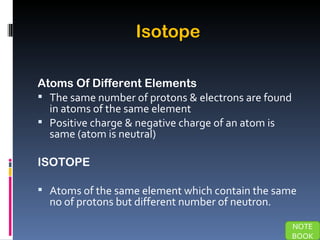
Isotope Atoms Of Different Elements The same number of protons & electrons are found in atoms of the same element Positive charge & negative charge of an atom is same (atom is neutral) ISOTOPE Atoms of the same element which contain the same no of protons but different number of neutron. NOTE BOOK
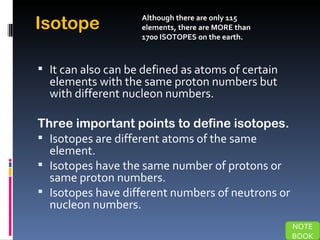
Isotope It can also can be defined as atoms of certain elements with the same proton numbers but with different nucleon numbers. Three important points to define isotopes. Isotopes are different atoms of the same element. Isotopes have the same number of protons or same proton numbers. Isotopes have different numbers of neutrons or nucleon numbers. Although there are only 115 elements, there are MORE than 1700 ISOTOPES on the earth. NOTE BOOK
Hydrogen Isotope Each isotope is named by INSERTING THE NUCLEON NUMBER AFTER the name of element  NOTE BOOK
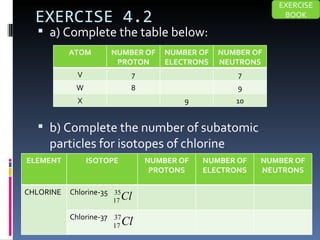
EXERCISE 4.2 a) Complete the table below: b) Complete the number of subatomic particles for isotopes of chlorine EXERCISE BOOK ATOM NUMBER OF PROTON NUMBER OF ELECTRONS NUMBER OF NEUTRONS V 7 7 W 8 9 X 9 10 ELEMENT ISOTOPE NUMBER OF PROTONS NUMBER OF ELECTRONS NUMBER OF NEUTRONS CHLORINE Chlorine-35 Chlorine-37
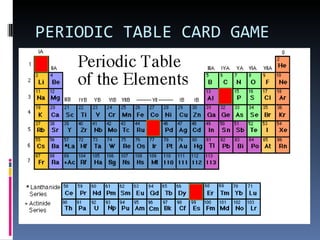
Periodic Table
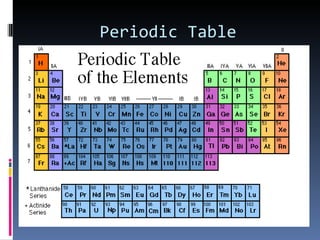
Periodic Table Elements are arranged in order of increasing proton number Proton number increases from left to right and from top to bottom GROUP: Vertical column Elements in same group have similar chemical properties PERIOD: Horizontal row Chemical and physical properties gradually changed when crossing periods NOTE BOOK
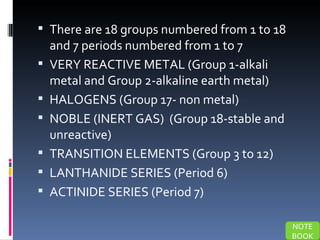
There are 18 groups numbered from 1 to 18 and 7 periods numbered from 1 to 7 VERY REACTIVE METAL (Group 1-alkali metal and Group 2-alkaline earth metal) HALOGENS (Group 17- non metal) NOBLE (INERT GAS)  (Group 18-stable and unreactive) TRANSITION ELEMENTS (Group 3 to 12) LANTHANIDE SERIES (Period 6) ACTINIDE SERIES (Period 7) NOTE BOOK
Locations of metals,  non- metals and semi-metals METAL (Elements in Group 1 , 2 ,13 and transition metals) NON-METAL (Elements in group 16 ,17 ,18) SEMI-METAL (Elements between metal and non metal. Possess certain properties of metal and non-metal) NOTE BOOK
PERIODIC TABLE CARD GAME
Importance of periodic table Helps us to study elements in orderly and systematic approach Help us to know properties of elements because elements with similar properties are in same group Help us to predict the properties and uses of an element  NOTE BOOK

Periodic table

  • 1.
  • 2.
    Atoms All matterconsists of tiny units Consist of a nucleus in the centre surrounded by electron. Electron move around the nucleus following orbit
  • 3.
    Atom is madeup of particles that are even smaller called subatomic particles 3 types of subatomic particles which are Electron move around the nucleus at high speed In neutral atom, No of protons = No of electron Subatomic particles Charge Protons, p Positive charge (+1) Neutrons, n No charge (0) Electrons ,e Negative charge (-1)
  • 4.
    Proton number andnucleon number Symbol of element Nucleon Number Is always the bigger number Total no of protons+neutrons Proton number Is always the smaller number Is equal to the no. of electron NOTE BOOK Terms Meaning Proton Number The no of protons in an atom Nucleon Number The total number of protons + neutrons in an atom No of neutrons = Nucleon number – Number of protons
  • 5.
    Isotope Atoms OfDifferent Elements The same number of protons & electrons are found in atoms of the same element Positive charge & negative charge of an atom is same (atom is neutral) ISOTOPE Atoms of the same element which contain the same no of protons but different number of neutron. NOTE BOOK
  • 6.
    Isotope It canalso can be defined as atoms of certain elements with the same proton numbers but with different nucleon numbers. Three important points to define isotopes. Isotopes are different atoms of the same element. Isotopes have the same number of protons or same proton numbers. Isotopes have different numbers of neutrons or nucleon numbers. Although there are only 115 elements, there are MORE than 1700 ISOTOPES on the earth. NOTE BOOK
  • 7.
    Hydrogen Isotope Eachisotope is named by INSERTING THE NUCLEON NUMBER AFTER the name of element NOTE BOOK
  • 8.
    EXERCISE 4.2 a)Complete the table below: b) Complete the number of subatomic particles for isotopes of chlorine EXERCISE BOOK ATOM NUMBER OF PROTON NUMBER OF ELECTRONS NUMBER OF NEUTRONS V 7 7 W 8 9 X 9 10 ELEMENT ISOTOPE NUMBER OF PROTONS NUMBER OF ELECTRONS NUMBER OF NEUTRONS CHLORINE Chlorine-35 Chlorine-37
  • 9.
  • 10.
    Periodic Table Elementsare arranged in order of increasing proton number Proton number increases from left to right and from top to bottom GROUP: Vertical column Elements in same group have similar chemical properties PERIOD: Horizontal row Chemical and physical properties gradually changed when crossing periods NOTE BOOK
  • 11.
    There are 18groups numbered from 1 to 18 and 7 periods numbered from 1 to 7 VERY REACTIVE METAL (Group 1-alkali metal and Group 2-alkaline earth metal) HALOGENS (Group 17- non metal) NOBLE (INERT GAS) (Group 18-stable and unreactive) TRANSITION ELEMENTS (Group 3 to 12) LANTHANIDE SERIES (Period 6) ACTINIDE SERIES (Period 7) NOTE BOOK
  • 12.
    Locations of metals, non- metals and semi-metals METAL (Elements in Group 1 , 2 ,13 and transition metals) NON-METAL (Elements in group 16 ,17 ,18) SEMI-METAL (Elements between metal and non metal. Possess certain properties of metal and non-metal) NOTE BOOK
  • 13.
  • 14.
    Importance of periodictable Helps us to study elements in orderly and systematic approach Help us to know properties of elements because elements with similar properties are in same group Help us to predict the properties and uses of an element NOTE BOOK