Periodic Table
Content:
● Introduction to Periodic table
● Periods
● Groups
● History of periodic Table
● Periodic trend in Properties
Introduction to periodic Table
he periodic table is a tabular arrangement of chemical elements, organized based on
their atomic number, electron configuration, and recurring chemical properties. It
provides a systematic representation of all known elements and serves as a valuable
tool in understanding the relationships and patterns between different elements.
Basic Information
Elements in the periodic table are arranged in rows called periods and columns called
groups. Each element is represented by its atomic symbol, which is usually a one- or
two-letter abbreviation derived from its name. The atomic number of an element
corresponds to the number of protons in its nucleus and determines its position in the
periodic table.
The periodic table allows scientists to categorize elements into various groups based
on similar properties. Elements in the same group tend to exhibit similar chemical
behavior, valence electron configurations, and can often form similar types of chemical
bonds. The table is structured in a way that highlights periodic trends, such as the
increase in atomic size or electronegativity as you move from left to right across a
period.
Periods
Periods: Periods in the periodic table are horizontal rows that represent the
arrangement of elements in increasing order of their atomic numbers. There are a total
of seven periods in the modern periodic table. Each period represents a new energy
level or shell in the electronic structure of the elements. For example, the first period
consists of only two elements, hydrogen (H) and helium (He), which have their electrons
in the first energy level. The second period contains elements with electrons in both the
first and second energy levels, and so on. As you move from left to right across a
period, the atomic number and the number of protons increase.
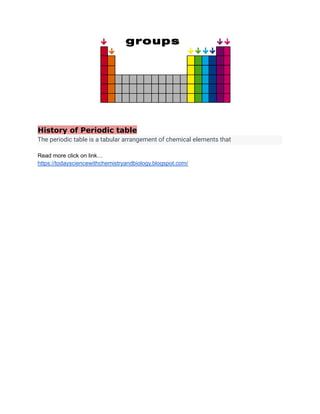
Groups:
Groups: Groups in the periodic table are vertical columns that group together elements
with similar properties. Elements within the same group share common characteristics,
such as similar electron configurations and chemical behavior. There are 18 groups in
the modern periodic table, numbered from 1 to 18. The groups are also referred to as
families. Some common group names include alkali metals (Group 1), alkaline earth
metals (Group 2), halogens (Group 17), and noble gases (Group 18). Elements in the
same group tend to have similar outer electron configurations, which influences their
reactivity and bonding patterns.
History of Periodic table
The periodic table is a tabular arrangement of chemical elements that
Read more click on link…
https://todaysciencewithchemistryandbiology.blogspot.com/

periodic table.pdf

  • 1.
    Periodic Table Content: ● Introductionto Periodic table ● Periods ● Groups ● History of periodic Table ● Periodic trend in Properties Introduction to periodic Table he periodic table is a tabular arrangement of chemical elements, organized based on their atomic number, electron configuration, and recurring chemical properties. It provides a systematic representation of all known elements and serves as a valuable tool in understanding the relationships and patterns between different elements. Basic Information Elements in the periodic table are arranged in rows called periods and columns called groups. Each element is represented by its atomic symbol, which is usually a one- or two-letter abbreviation derived from its name. The atomic number of an element corresponds to the number of protons in its nucleus and determines its position in the periodic table.
  • 2.
    The periodic tableallows scientists to categorize elements into various groups based on similar properties. Elements in the same group tend to exhibit similar chemical behavior, valence electron configurations, and can often form similar types of chemical bonds. The table is structured in a way that highlights periodic trends, such as the increase in atomic size or electronegativity as you move from left to right across a period. Periods Periods: Periods in the periodic table are horizontal rows that represent the arrangement of elements in increasing order of their atomic numbers. There are a total of seven periods in the modern periodic table. Each period represents a new energy level or shell in the electronic structure of the elements. For example, the first period consists of only two elements, hydrogen (H) and helium (He), which have their electrons in the first energy level. The second period contains elements with electrons in both the first and second energy levels, and so on. As you move from left to right across a period, the atomic number and the number of protons increase. Groups: Groups: Groups in the periodic table are vertical columns that group together elements with similar properties. Elements within the same group share common characteristics, such as similar electron configurations and chemical behavior. There are 18 groups in the modern periodic table, numbered from 1 to 18. The groups are also referred to as families. Some common group names include alkali metals (Group 1), alkaline earth metals (Group 2), halogens (Group 17), and noble gases (Group 18). Elements in the same group tend to have similar outer electron configurations, which influences their reactivity and bonding patterns.
  • 3.
    History of Periodictable The periodic table is a tabular arrangement of chemical elements that Read more click on link… https://todaysciencewithchemistryandbiology.blogspot.com/