Chapter 7 – Sound Waves
PHYS 243
Fall 2020-2021
Objectives: After completion of this
module, you should be able to:
• Define sound and solve problems
relating to its velocity in solids,
liquids, and gases.
• Use boundary conditions to apply
concepts relating to frequencies
in open and closed pipes.
Definition of Sound
Source of sound:
a tuning fork.
Sound is a longitudinal
mechanical wave that
travels through an
elastic medium.
Many things vibrate in
air, producing a sound
wave.
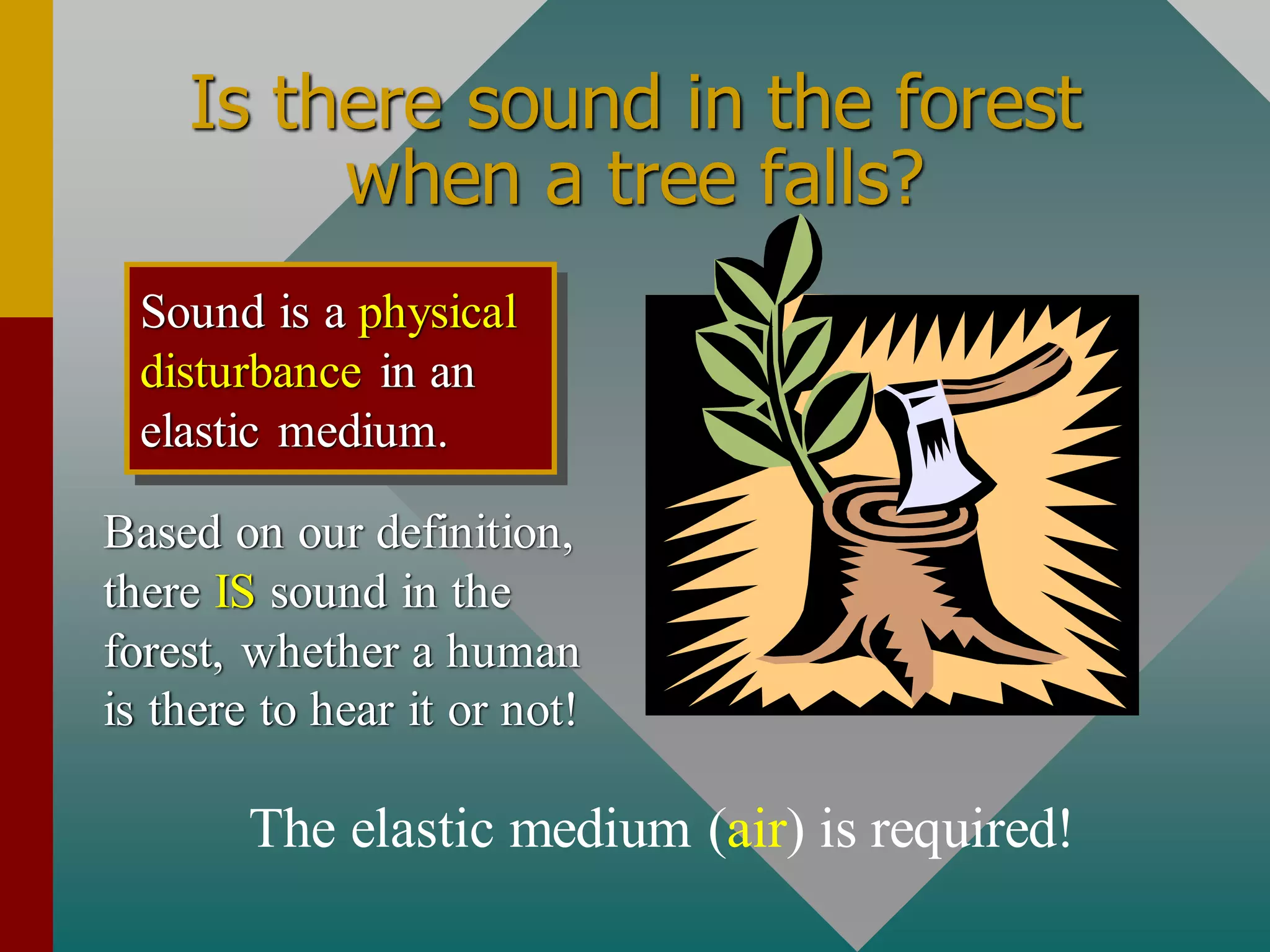
Is there sound in the forest
when a tree falls?
Based on our definition,
there IS sound in the
forest, whether a human
is there to hear it or not!
Sound is a physical
disturbance in an
elastic medium.
The elastic medium (air) is required!
Sound Requires a Medium
Evacuated Bell Jar
Batteries
Vacuum pump
The sound of a ringing bell diminishes as air leaves
the jar. No sound exists without air molecules.
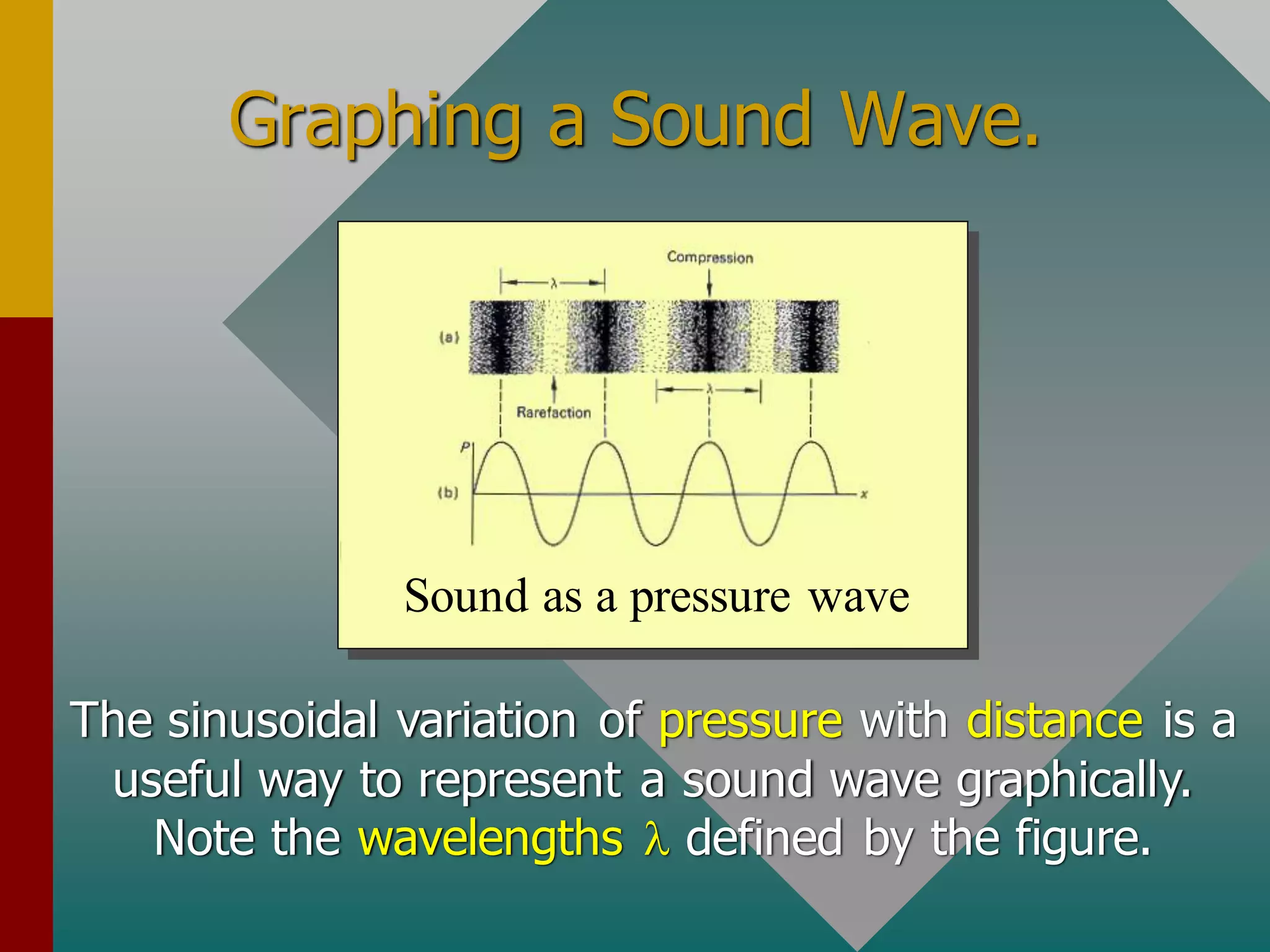
Graphing a Sound Wave.
Sound as a pressure wave
The sinusoidal variation of pressure with distance is a
useful way to represent a sound wave graphically.
Note the wavelengths l defined by the figure.
Factors That Determine the Speed of Sound.
Longitudinal mechanical waves (sound) have a
wave speed dependent on elasticity factors and
density factors. Consider the following examples:
A denser medium has greater
inertia resulting in lower wave
speeds.
A medium that is more elastic
springs back quicker and
results in faster speeds.
steel
water
Speeds for different media
Y
v

= Metal rod
Young’s modulus, Y
Metal density, 
4
3
B S
v

+
= Extended
Solid
Bulk modulus, B
Shear modulus, S
Density, 
B
v

=
Fluid
Bulk modulus, B
Fluid density, 
Example 1: Find the speed of
sound in a steel rod.
vs = ?
11
3
2.07 x 10 Pa
7800 kg/m
Y
v

= = v =5150 m/s
 = 7800 kg/m3
Y = 2.07 x 10¹¹ Pa
Speed of Sound in Air
For the speed of sound in air, we find that:
P RT
B P and
M


= =
 = 1.4 for air
R = 8.34 J/kg mol
M = 29 kg/mol
B P
v

 
= =
RT
v
M

=
Note: Sound velocity increases with temperature T.
Example 2: What is the speed of sound
in air when the temperature is 200C?
-3
(1.4)(8.314 J/mol K)(293 K)
29 x 10 kg/mol
RT
v
M

= =
Given:  = 1.4; R = 8.314 J/mol K; M = 29 g/mol
T = 200 + 2730 = 293 K M = 29 x 10-3 kg/mol
v = 343 m/s
Dependence on Temperature
RT
v
M

=
Note: v depends on
Absolute T:
Now v at 273 K is 331 m/s.
, R, M do not change, so
a simpler formula might be:
T
331 m/s
273K
v =
Alternatively, there is the approximation using 0C:
0
m/s
331 m/s 0.6
C
c
v t
 
= +  
 
Example 3: What is the
velocity of sound in air
on a day when the temp-
erature is equal to 270C?
Solution 1:
T
331 m/s
273K
v =
300 K
331 m/s
273K
v =
T = 270 + 2730 = 300 K;
v = 347 m/s
v = 347 m/s
Solution 2: v = 331 m/s + (0.6)(270C);
Musical Instruments
Sound waves in air
are produced by the
vibrations of a violin
string. Characteristic
frequencies are based
on the length, mass,
and tension of the
wire.
Vibrating Air Columns
Just as for a vibrating string, there are characteristic
wavelengths and frequencies for longitudinal sound
waves. Boundary conditions apply for pipes:
Open pipe
A A
The open end of a pipe must be
a displacement antinode A.
Closed pipe
A
N
The closed end of a pipe must
be a displacement node N.
Velocity and Wave Frequency.
The period T is the time to move a distance of one
wavelength. Therefore, the wave speed is:
1
but so
v T v f
T f
l
l
= = =
The frequency f is in s-1 or hertz (Hz).
The velocity of any wave is the product of the
frequency and the wavelength:
v f l
=
v
f
l
=
Possible Waves for Open Pipe
L 2
1
L
l =
Fundamental, n = 1
2
2
L
l =
1st Overtone, n = 2
2
3
L
l =
2nd Overtone, n = 3
2
4
L
l =
3rd Overtone, n = 4
All harmonics are
possible for open pipes:
2
1, 2, 3, 4 . . .
n
L
n
n
l = =
Characteristic Frequencies
for an Open Pipe.
L 1
2
v
f
L
=
Fundamental, n = 1
2
2
v
f
L
=
1st Overtone, n = 2
3
2
v
f
L
=
2nd Overtone, n = 3
4
2
v
f
L
=
3rd Overtone, n = 4
All harmonics are
possible for open pipes:
1, 2, 3, 4 . . .
2
n
nv
f n
L
= =
Possible Waves for Closed Pipe.
1
4
1
L
l =
Fundamental, n = 1
1
4
3
L
l =
1st Overtone, n = 3
1
4
5
L
l =
2nd Overtone, n = 5
1
4
7
L
l =
3rd Overtone, n = 7
Only the odd
harmonics are allowed:
4
1, 3, 5, 7 . . .
n
L
n
n
l = =
L
Possible Waves for Closed Pipe.
1
1
4
v
f
L
=
Fundamental, n = 1
3
3
4
v
f
L
=
1st Overtone, n = 3
5
5
4
v
f
L
=
2nd Overtone, n = 5
7
7
4
v
f
L
=
3rd Overtone, n = 7
Only the odd
harmonics are allowed:
L
1, 3, 5, 7 . . .
4
n
nv
f n
L
= =
Example 4. What length of closed pipe is needed
to resonate with a fundamental frequency of 256
Hz? What is the second overtone? Assume that
the velocity of sound is 340 M/s.
Closed pipe
A
N
L = ?
1, 3, 5, 7 . . .
4
n
nv
f n
L
= =
1
1
(1) 340 m/s
;
4 4 4(256 Hz)
v v
f L
L f
= = = L = 33.2 cm
The second overtone occurs when n = 5:
f5 = 5f1 = 5(256 Hz) 2nd Ovt. = 1280 Hz
Summary of Formulas For
Speed of Sound
Y
v

=
Solid rod
4
3
B S
v

+
=
Extended Solid
B
v

=
Liquid
RT
v
M

=
Sound for any gas:
0
m/s
331 m/s 0.6
C
c
v t
 
= +  
 
Approximation
Sound in Air:
Summary of Formulas (Cont.)
v
f
l
=
v f l
=
For any wave:
Characteristic frequencies for open and closed pipes:
1, 2, 3, 4 . . .
2
n
nv
f n
L
= = 1, 3, 5, 7 . . .
4
n
nv
f n
L
= =
OPEN PIPE CLOSED PIPE
CONCLUSION: Chapter 22
Sound Waves

SOUND WAVES.pdf

  • 1.
    Chapter 7 –Sound Waves PHYS 243 Fall 2020-2021
  • 2.
    Objectives: After completionof this module, you should be able to: • Define sound and solve problems relating to its velocity in solids, liquids, and gases. • Use boundary conditions to apply concepts relating to frequencies in open and closed pipes.
  • 3.
    Definition of Sound Sourceof sound: a tuning fork. Sound is a longitudinal mechanical wave that travels through an elastic medium. Many things vibrate in air, producing a sound wave.
  • 4.
    Is there soundin the forest when a tree falls? Based on our definition, there IS sound in the forest, whether a human is there to hear it or not! Sound is a physical disturbance in an elastic medium. The elastic medium (air) is required!
  • 5.
    Sound Requires aMedium Evacuated Bell Jar Batteries Vacuum pump The sound of a ringing bell diminishes as air leaves the jar. No sound exists without air molecules.
  • 6.
    Graphing a SoundWave. Sound as a pressure wave The sinusoidal variation of pressure with distance is a useful way to represent a sound wave graphically. Note the wavelengths l defined by the figure.
  • 7.
    Factors That Determinethe Speed of Sound. Longitudinal mechanical waves (sound) have a wave speed dependent on elasticity factors and density factors. Consider the following examples: A denser medium has greater inertia resulting in lower wave speeds. A medium that is more elastic springs back quicker and results in faster speeds. steel water
  • 8.
    Speeds for differentmedia Y v  = Metal rod Young’s modulus, Y Metal density,  4 3 B S v  + = Extended Solid Bulk modulus, B Shear modulus, S Density,  B v  = Fluid Bulk modulus, B Fluid density, 
  • 9.
    Example 1: Findthe speed of sound in a steel rod. vs = ? 11 3 2.07 x 10 Pa 7800 kg/m Y v  = = v =5150 m/s  = 7800 kg/m3 Y = 2.07 x 10¹¹ Pa
  • 10.
    Speed of Soundin Air For the speed of sound in air, we find that: P RT B P and M   = =  = 1.4 for air R = 8.34 J/kg mol M = 29 kg/mol B P v    = = RT v M  = Note: Sound velocity increases with temperature T.
  • 11.
    Example 2: Whatis the speed of sound in air when the temperature is 200C? -3 (1.4)(8.314 J/mol K)(293 K) 29 x 10 kg/mol RT v M  = = Given:  = 1.4; R = 8.314 J/mol K; M = 29 g/mol T = 200 + 2730 = 293 K M = 29 x 10-3 kg/mol v = 343 m/s
  • 12.
    Dependence on Temperature RT v M  = Note:v depends on Absolute T: Now v at 273 K is 331 m/s. , R, M do not change, so a simpler formula might be: T 331 m/s 273K v = Alternatively, there is the approximation using 0C: 0 m/s 331 m/s 0.6 C c v t   = +    
  • 13.
    Example 3: Whatis the velocity of sound in air on a day when the temp- erature is equal to 270C? Solution 1: T 331 m/s 273K v = 300 K 331 m/s 273K v = T = 270 + 2730 = 300 K; v = 347 m/s v = 347 m/s Solution 2: v = 331 m/s + (0.6)(270C);
  • 14.
    Musical Instruments Sound wavesin air are produced by the vibrations of a violin string. Characteristic frequencies are based on the length, mass, and tension of the wire.
  • 15.
    Vibrating Air Columns Justas for a vibrating string, there are characteristic wavelengths and frequencies for longitudinal sound waves. Boundary conditions apply for pipes: Open pipe A A The open end of a pipe must be a displacement antinode A. Closed pipe A N The closed end of a pipe must be a displacement node N.
  • 16.
    Velocity and WaveFrequency. The period T is the time to move a distance of one wavelength. Therefore, the wave speed is: 1 but so v T v f T f l l = = = The frequency f is in s-1 or hertz (Hz). The velocity of any wave is the product of the frequency and the wavelength: v f l = v f l =
  • 17.
    Possible Waves forOpen Pipe L 2 1 L l = Fundamental, n = 1 2 2 L l = 1st Overtone, n = 2 2 3 L l = 2nd Overtone, n = 3 2 4 L l = 3rd Overtone, n = 4 All harmonics are possible for open pipes: 2 1, 2, 3, 4 . . . n L n n l = =
  • 18.
    Characteristic Frequencies for anOpen Pipe. L 1 2 v f L = Fundamental, n = 1 2 2 v f L = 1st Overtone, n = 2 3 2 v f L = 2nd Overtone, n = 3 4 2 v f L = 3rd Overtone, n = 4 All harmonics are possible for open pipes: 1, 2, 3, 4 . . . 2 n nv f n L = =
  • 19.
    Possible Waves forClosed Pipe. 1 4 1 L l = Fundamental, n = 1 1 4 3 L l = 1st Overtone, n = 3 1 4 5 L l = 2nd Overtone, n = 5 1 4 7 L l = 3rd Overtone, n = 7 Only the odd harmonics are allowed: 4 1, 3, 5, 7 . . . n L n n l = = L
  • 20.
    Possible Waves forClosed Pipe. 1 1 4 v f L = Fundamental, n = 1 3 3 4 v f L = 1st Overtone, n = 3 5 5 4 v f L = 2nd Overtone, n = 5 7 7 4 v f L = 3rd Overtone, n = 7 Only the odd harmonics are allowed: L 1, 3, 5, 7 . . . 4 n nv f n L = =
  • 21.
    Example 4. Whatlength of closed pipe is needed to resonate with a fundamental frequency of 256 Hz? What is the second overtone? Assume that the velocity of sound is 340 M/s. Closed pipe A N L = ? 1, 3, 5, 7 . . . 4 n nv f n L = = 1 1 (1) 340 m/s ; 4 4 4(256 Hz) v v f L L f = = = L = 33.2 cm The second overtone occurs when n = 5: f5 = 5f1 = 5(256 Hz) 2nd Ovt. = 1280 Hz
  • 22.
    Summary of FormulasFor Speed of Sound Y v  = Solid rod 4 3 B S v  + = Extended Solid B v  = Liquid RT v M  = Sound for any gas: 0 m/s 331 m/s 0.6 C c v t   = +     Approximation Sound in Air:
  • 23.
    Summary of Formulas(Cont.) v f l = v f l = For any wave: Characteristic frequencies for open and closed pipes: 1, 2, 3, 4 . . . 2 n nv f n L = = 1, 3, 5, 7 . . . 4 n nv f n L = = OPEN PIPE CLOSED PIPE
  • 24.