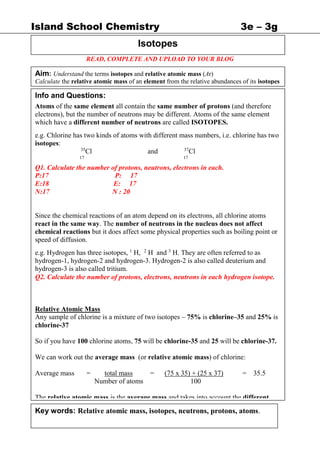
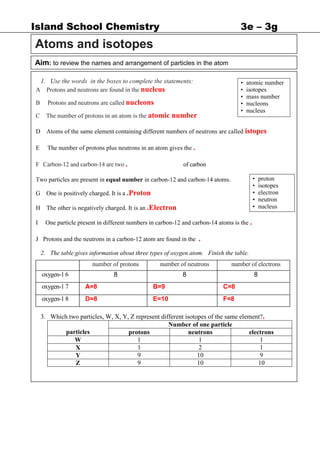
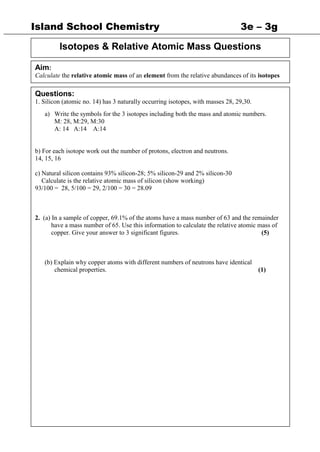
1. Isotopes are atoms of the same element that have different numbers of neutrons. This document discusses isotopes and how to calculate relative atomic mass.
2. It provides examples of different isotopes like chlorine-35, chlorine-37, and hydrogen isotopes. The number of protons and electrons are the same between isotopes but the number of neutrons can differ.
3. To calculate relative atomic mass, you must know the natural abundances of each isotope and take a weighted average of their masses based on these abundances. For chlorine, 75% is chlorine-35 and 25% is chlorine-37, giving a relative atomic mass of 35.5.