
Atomic Layer Deposition (ALD)

Student: Chinmayananda Gouda
Recommender: Prof. Wha-Tzong Whang

Dept. of Materials Science and Engineering, National Chiao Tung University

Jan.7, 2014
Outline
1

About ALD

2

Application (ACS , journal )

3

Approaches
Conclusion
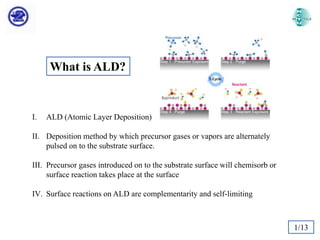
What is ALD?

I.

ALD (Atomic Layer Deposition)

II. Deposition method by which precursor gases or vapors are alternately
pulsed on to the substrate surface.
III. Precursor gases introduced on to the substrate surface will chemisorb or
surface reaction takes place at the surface
IV. Surface reactions on ALD are complementarity and self-limiting

1/13
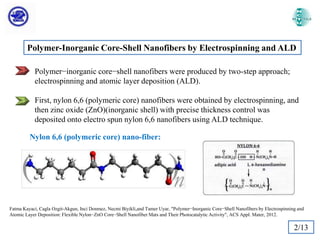
Polymer-Inorganic Core-Shell Nanofibers by Electrospinning and ALD
Polymer−inorganic core−shell nanofibers were produced by two-step approach;
electrospinning and atomic layer deposition (ALD).
First, nylon 6,6 (polymeric core) nanofibers were obtained by electrospinning, and
then zinc oxide (ZnO)(inorganic shell) with precise thickness control was
deposited onto electro spun nylon 6,6 nanofibers using ALD technique.

Nylon 6,6 (polymeric core) nano-fiber:

Fatma Kayaci, Cagla Ozgit-Akgun, Inci Donmez, Necmi Biyikli,and Tamer Uyar, "Polymer−Inorganic Core−Shell Nanofibers by Electrospinning and
Atomic Layer Deposition: Flexible Nylon−ZnO Core−Shell Nanofiber Mats and Their Photocatalytic Activity", ACS Appl. Mater, 2012.

2/13
Approaches

Core−shell nylon 6,6-ZnO nanofibers mat can be a very good candidate as a
filter material for water purification and organic waste treatment because of
their photo catalytic properties along with structural flexibility and stability.

The reason, the development of flexible nanofibrous membranes or textiles
having photocatalytic properties is still on demand for self-cleaning and water
purification and waste treatment.

3/13
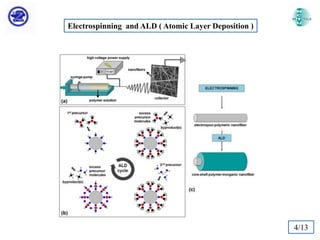
Electrospinning and ALD ( Atomic Layer Deposition )

4/13
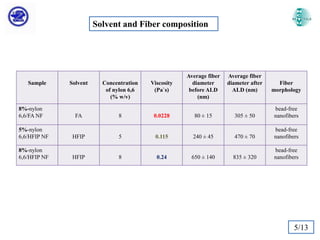
Solvent and Fiber composition

Sample

8%-nylon
6,6/FA NF
5%-nylon
6,6/HFIP NF

8%-nylon
6,6/HFIP NF

Solvent

FA

HFIP

HFIP

Concentration
of nylon 6,6
(% w/v)
8

5

8

Viscosity
(Pa`s)

0.0228

0.115

0.24

Average fiber
diameter
before ALD
(nm)
80 ± 15

240 ± 45

650 ± 140

Average fiber
diameter after
ALD (nm)

Fiber
morphology

305 ± 50

bead-free
nanofibers

470 ± 70

bead-free
nanofibers

835 ± 320

bead-free
nanofibers

5/13
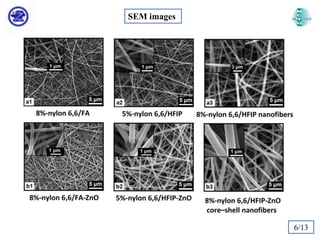
SEM images

6/13
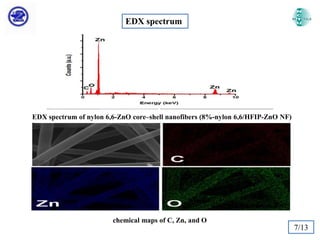
EDX spectrum

EDX spectrum of nylon 6,6-ZnO core–shell nanofibers (8%-nylon 6,6/HFIP-ZnO NF)

chemical maps of C, Zn, and O

7/13
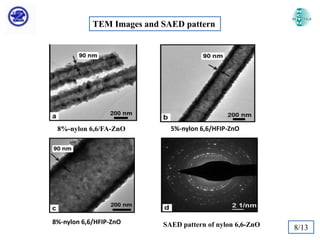
TEM Images and SAED pattern

8%-nylon 6,6/FA-ZnO

8%-nylon 6,6/HFIP-ZnO

5%-nylon 6,6/HFIP-ZnO

SAED pattern of nylon 6,6-ZnO

8/13
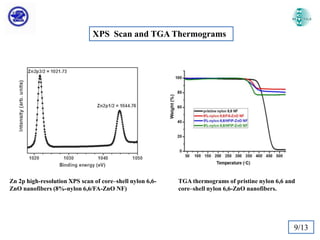
XPS Scan and TGA Thermograms

Zn 2p high-resolution XPS scan of core–shell nylon 6,6ZnO nanofibers (8%-nylon 6,6/FA-ZnO NF)

TGA thermograms of pristine nylon 6,6 and
core–shell nylon 6,6-ZnO nanofibers.

9/13
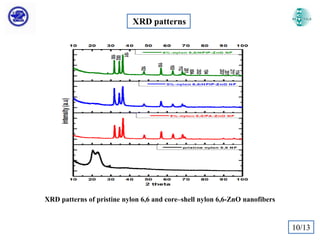
XRD patterns

XRD patterns of pristine nylon 6,6 and core–shell nylon 6,6-ZnO nanofibers

10/13
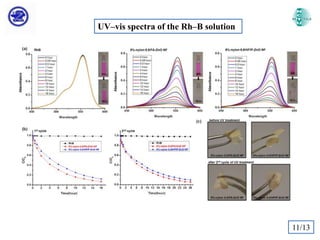
UV–vis spectra of the Rh–B solution

11/13
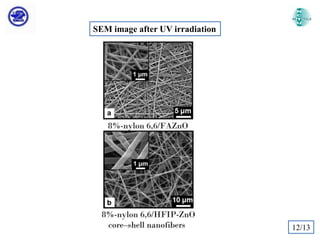
SEM image after UV irradiation

12/13
Conclusion
The core−shell nylon 6,6-ZnO nanofibers mats can be quite applicable as a
filtering/membrane material for treatment of organic pollutants for water purification
due to their efficient photocatalytic properties, structural flexibility and stability

ALD is a relatively low-temperature process providing ultimate
conformality, therefore, three dimensional, polymeric nanofiber templates can easily be
coated by ALD of inorganic materials for producing flexible nanofiber mats.

13/13
I welcome your questions,
suggestion, comments!

Atomic Layer Depostion , 7th Jan 2014

  • 1.
    Atomic Layer Deposition(ALD) Student: Chinmayananda Gouda Recommender: Prof. Wha-Tzong Whang Dept. of Materials Science and Engineering, National Chiao Tung University Jan.7, 2014
  • 2.
    Outline 1 About ALD 2 Application (ACS, journal ) 3 Approaches Conclusion
  • 3.
    What is ALD? I. ALD(Atomic Layer Deposition) II. Deposition method by which precursor gases or vapors are alternately pulsed on to the substrate surface. III. Precursor gases introduced on to the substrate surface will chemisorb or surface reaction takes place at the surface IV. Surface reactions on ALD are complementarity and self-limiting 1/13
  • 4.
    Polymer-Inorganic Core-Shell Nanofibersby Electrospinning and ALD Polymer−inorganic core−shell nanofibers were produced by two-step approach; electrospinning and atomic layer deposition (ALD). First, nylon 6,6 (polymeric core) nanofibers were obtained by electrospinning, and then zinc oxide (ZnO)(inorganic shell) with precise thickness control was deposited onto electro spun nylon 6,6 nanofibers using ALD technique. Nylon 6,6 (polymeric core) nano-fiber: Fatma Kayaci, Cagla Ozgit-Akgun, Inci Donmez, Necmi Biyikli,and Tamer Uyar, "Polymer−Inorganic Core−Shell Nanofibers by Electrospinning and Atomic Layer Deposition: Flexible Nylon−ZnO Core−Shell Nanofiber Mats and Their Photocatalytic Activity", ACS Appl. Mater, 2012. 2/13
  • 5.
    Approaches Core−shell nylon 6,6-ZnOnanofibers mat can be a very good candidate as a filter material for water purification and organic waste treatment because of their photo catalytic properties along with structural flexibility and stability. The reason, the development of flexible nanofibrous membranes or textiles having photocatalytic properties is still on demand for self-cleaning and water purification and waste treatment. 3/13
  • 6.
    Electrospinning and ALD( Atomic Layer Deposition ) 4/13
  • 7.
    Solvent and Fibercomposition Sample 8%-nylon 6,6/FA NF 5%-nylon 6,6/HFIP NF 8%-nylon 6,6/HFIP NF Solvent FA HFIP HFIP Concentration of nylon 6,6 (% w/v) 8 5 8 Viscosity (Pa`s) 0.0228 0.115 0.24 Average fiber diameter before ALD (nm) 80 ± 15 240 ± 45 650 ± 140 Average fiber diameter after ALD (nm) Fiber morphology 305 ± 50 bead-free nanofibers 470 ± 70 bead-free nanofibers 835 ± 320 bead-free nanofibers 5/13
  • 8.
  • 9.
    EDX spectrum EDX spectrumof nylon 6,6-ZnO core–shell nanofibers (8%-nylon 6,6/HFIP-ZnO NF) chemical maps of C, Zn, and O 7/13
  • 10.
    TEM Images andSAED pattern 8%-nylon 6,6/FA-ZnO 8%-nylon 6,6/HFIP-ZnO 5%-nylon 6,6/HFIP-ZnO SAED pattern of nylon 6,6-ZnO 8/13
  • 11.
    XPS Scan andTGA Thermograms Zn 2p high-resolution XPS scan of core–shell nylon 6,6ZnO nanofibers (8%-nylon 6,6/FA-ZnO NF) TGA thermograms of pristine nylon 6,6 and core–shell nylon 6,6-ZnO nanofibers. 9/13
  • 12.
    XRD patterns XRD patternsof pristine nylon 6,6 and core–shell nylon 6,6-ZnO nanofibers 10/13
  • 13.
    UV–vis spectra ofthe Rh–B solution 11/13
  • 14.
    SEM image afterUV irradiation 12/13
  • 15.
    Conclusion The core−shell nylon6,6-ZnO nanofibers mats can be quite applicable as a filtering/membrane material for treatment of organic pollutants for water purification due to their efficient photocatalytic properties, structural flexibility and stability ALD is a relatively low-temperature process providing ultimate conformality, therefore, three dimensional, polymeric nanofiber templates can easily be coated by ALD of inorganic materials for producing flexible nanofiber mats. 13/13
  • 16.
    I welcome yourquestions, suggestion, comments!